
Types of Professional Communication: Master Channels 2026
You know this moment if you're already operating at a high level. You've done the analysis, found the risk, shaped the recommendation, and entered the meeting ready to contribute. Then someone with a weaker idea says it in a cleaner way, in the right format, at the right moment, and their point gets traction while yours stalls.
That isn't only a content problem. It's a communication strategy problem.
Senior professionals rarely struggle because they lack intelligence or effort. More often, they lose influence because they treat communication as one generic skill instead of a set of choices. The format you choose, the channel you use, the amount of detail you include, the way you hold the room, and the follow-up you send all shape how your authority is perceived.
That matters even more if you're working across cultures, leading hybrid teams, or speaking in a second language. At that level, people don't only evaluate what you know. They evaluate whether you sound like someone who can lead.
Beyond Words The Strategy of Communication
A strong idea can fail for simple reasons. It arrives as a dense email when the issue needed a live discussion. It's presented verbally when the stakeholders needed a written record. It's technically correct but visually confusing. Or it's delivered in a tone that sounds tentative when the situation requires clear direction.
That's why the types of professional communication aren't academic labels. They're strategic tools. Professional communication spans verbal, non-verbal, written, visual, and digital channels, and the right choice depends on message complexity, urgency, audience size, documentation needs, and cultural context, as outlined in this overview of professional communication channel types.
Communication choice shapes authority
At senior level, people notice whether your communication matches the moment.
A board update usually needs concise spoken framing, disciplined body language, and a visual that supports the decision. A project handoff may need written precision. A sensitive disagreement often goes badly when handled in chat and much better in a brief call. The same person can sound authoritative in one setting and uncertain in another, because the channel was wrong.
Use the channel that makes the decision easier, not the channel that feels safest to you.
Many ambitious professionals get stuck by over-relying on the communication mode they control best. Analysts often hide in documents. Strong presenters sometimes avoid writing. Technical leaders may explain too much when executives only need the decision, risk, and next step.
Modern communication is mixed by default
Professional communication now moves across platforms, not through one dominant format. If you work with distributed teams, clients, or leadership groups, you're already switching between meetings, slides, instant messages, email, comments, and social platforms. Even public-facing communication follows this pattern. For practical examples of how channel choice changes message design, review Narrareach's social media examples.
If you want a broader foundation before refining executive delivery, this guide to business communication fundamentals helps clarify the distinction between general workplace communication and strategic influence.
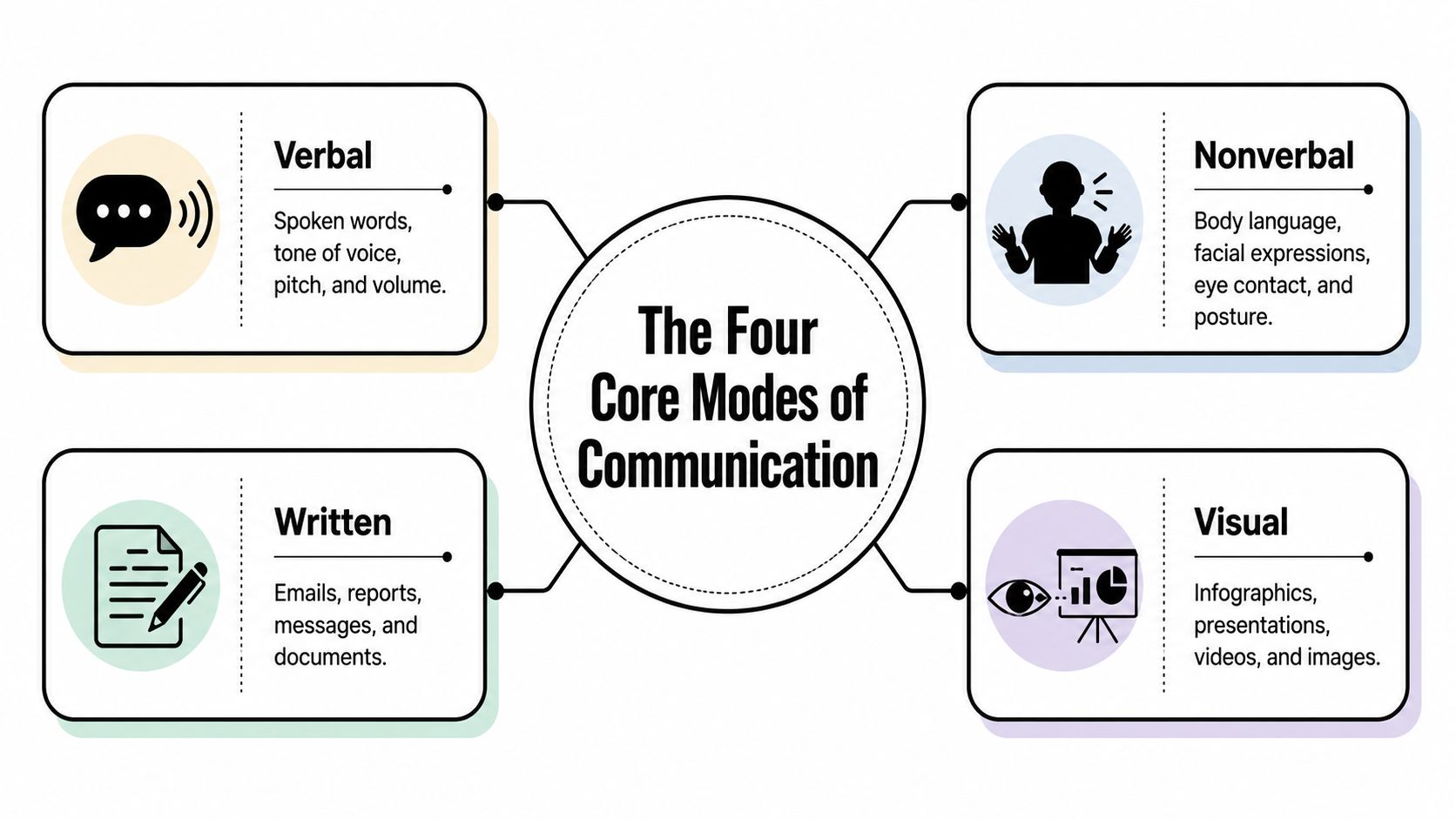
The Four Core Modes of Communication
Think of the core modes as a compass. Each direction helps you do something different, and confusion starts when you expect one mode to do another mode's job.
Verbal communication
Verbal communication is spoken language. In professional settings, that includes team updates, client calls, interviews, negotiations, presentations, and executive discussions. Verbal skill is often perceived as speaking more, though it typically involves speaking with better structure.
When you give a verbal update, your listener has no rewind button. If your point appears halfway through your explanation, you force people to work too hard. Senior communication works better when you lead with the headline, then support it.
A useful pattern is simple:
- Start with the point: “We have a delivery risk.”
- Add the reason: “The dependency moved later than planned.”
- State the ask or next step: “We need a decision on scope today.”
That structure sounds more senior because it respects time and reduces cognitive load.
Nonverbal communication
Nonverbal communication includes posture, eye contact, facial expression, pace, stillness, gesture, and the way you occupy space. In high-stakes rooms, nonverbal signals often shape credibility before anyone evaluates your logic.
A common executive mistake is uncontained movement. Fast nodding, rushed hand gestures, looking down at notes, or smiling when delivering difficult news can soften your authority. The opposite problem is overcorrection. If you become rigid, you can look rehearsed or defensive.
Practical rule: Aim for steady, not dramatic. Calm posture and intentional pauses signal command better than constant motion.
Written communication
Written communication carries decisions, expectations, records, and accountability. Email, project briefs, memos, proposals, summaries, and stakeholder updates all sit here. Good writing isn't the same as long writing. In fact, senior readers usually reward compression.
Here's where professionals lose impact:
| Situation | Weak written choice | Strong written choice |
|---|---|---|
| Status update | Background-heavy explanation | Clear status, blocker, next action |
| Executive request | Long context before the ask | Decision request in the first lines |
| Team brief | Vague ownership | Named owners and deadlines |
| Follow-up email | Repeating the whole meeting | Decisions, actions, and unresolved issues |
Written communication should reduce ambiguity, not display effort.
Visual communication
Visual communication includes slides, charts, dashboards, diagrams, whiteboards, and short video explanations. It becomes essential when the message involves trends, options, trade-offs, or process.
The mistake isn't using visuals. It's using decorative visuals that compete with the message. Executives don't need crowded slides with every data point pasted onto one screen. They need visual framing that makes the implication obvious.
A good visual answers one question fast. What changed? What matters? What decision follows?
Navigating the Organizational Flow
The same message changes when it moves up, down, or across the organization. Direction alters tone, detail, and political risk.
Upward communication
Upward communication is what you send to your manager, leadership team, or executive stakeholders. The goal isn't self-expression. The goal is decision support.
That means you can't just report activity. You need to frame relevance. Executives usually want the issue, the impact, the recommendation, and any decision needed from them. If you bury the recommendation under operational detail, your message sounds junior even if the analysis is strong.
A practical resource for sharpening concise updates is WhisperAI's project update guide. It aligns well with how senior audiences process status communication.
Downward communication
Downward communication happens when you lead others. In this scenario, many technically strong managers fail. They assume clarity because the instruction makes sense in their own head.
Your team needs more than direction. They need priorities, context, and confidence. If your message is too abstract, people hesitate. If it's too controlling, they stop thinking. Strong downward communication sets the standard while leaving room for execution.
For managers who want to tighten this skill, this resource on communication for managers is useful because it focuses on practical workplace application rather than theory.
Lateral communication
Lateral communication sits between peers, cross-functional partners, and adjacent teams. This mode depends less on hierarchy and more on cooperation.
Peer communication breaks down when people defend turf, over-explain to prove expertise, or avoid direct disagreement. The strongest lateral communicators do three things well:
- They clarify shared goals: They start with what both sides need.
- They make requests easy to answer: They ask for a decision, input, or action, not a vague discussion.
- They protect relationships while staying direct: They challenge ideas without making the exchange personal.
If you want faster alignment across teams, reduce ambiguity first. Friction often comes from unclear ownership, not difficult personalities.
Choosing the Right Channel in a Digital World
You send a detailed email to settle a cross-functional issue. Two hours later, the actual decision gets made in a chat thread you were not part of. Your message was clear. Your channel choice was wrong.
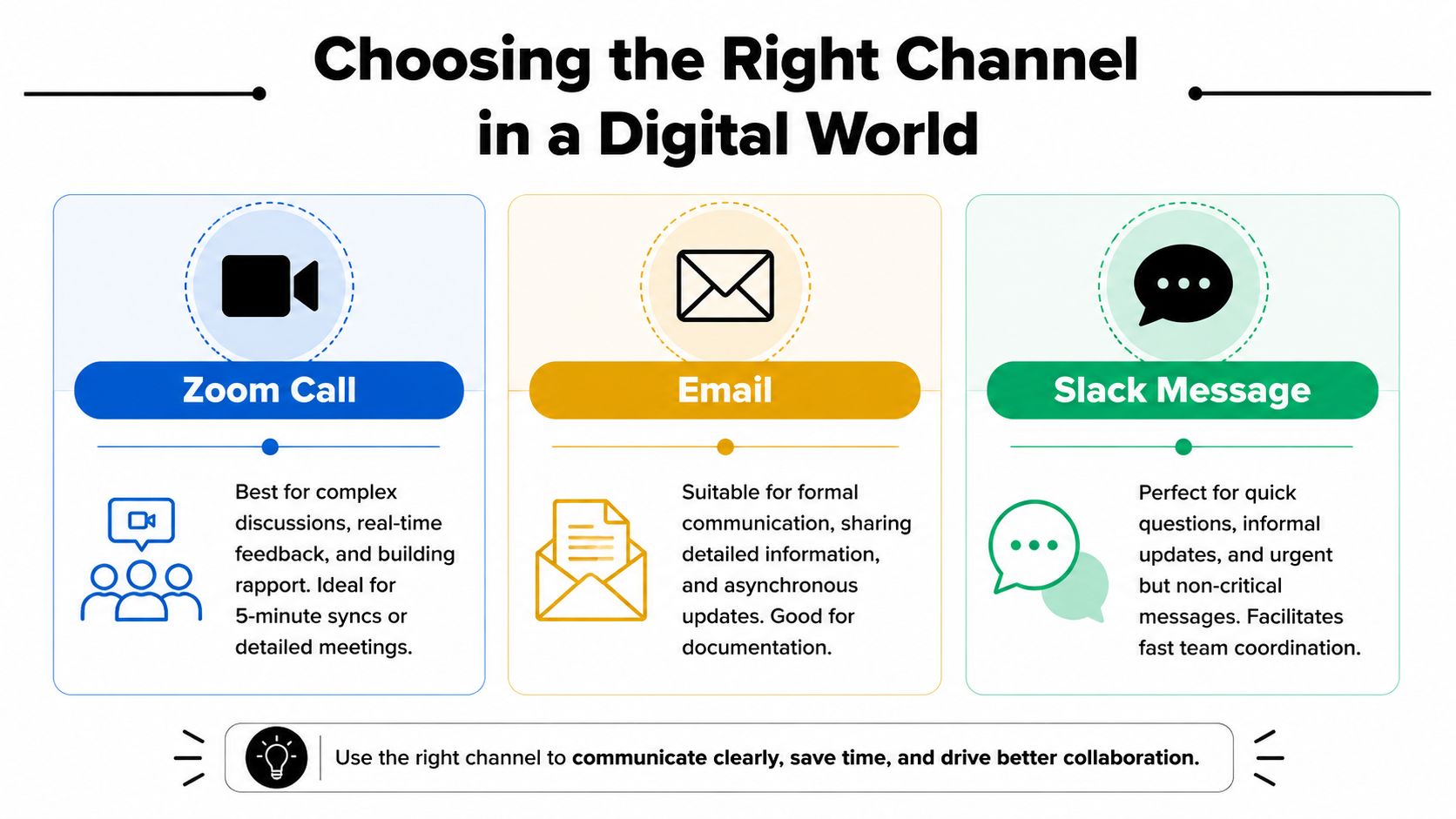
Senior professionals are judged on more than what they say. They are judged on where they say it, how fast they respond, and whether their choice of channel fits the decision in front of them. In hybrid work, channel selection is part of executive presence. The wrong medium can make you look slow, indirect, or disconnected from how the organization operates.
Analysts at Zoom found that workplace communication now spreads across several channels, with leaders reporting instant messaging as the tool they use most often at 50%, employees preferring it at 64%, and email still close behind at 63% in Zoom's workplace communication statistics. That mix matters. Authority is not about forcing every conversation into your preferred format. It is about choosing the format that gets clarity, speed, and alignment with the least friction.
A practical decision framework
Before you send anything, make three decisions.
Is it time-sensitive?
Use a live channel when delay creates risk. Call, video, or direct message for immediate response. An urgent issue handled by email often looks organized on the surface and ineffective in practice.
Is it complex?
Use conversation before documentation when the issue involves disagreement, nuance, or several moving parts. Ten chat messages rarely resolve a strategic conflict. A 15-minute discussion often does. Then capture the outcome in writing.
Does it need a record?
Put the final decision in a written channel if ownership, accountability, budget, or deadlines are involved. Verbal alignment feels efficient in the moment. It creates confusion later if nobody documented what was agreed.
Channel trade-offs in practice
Each channel sends a signal.
- Instant messaging works for quick coordination, short updates, and simple questions that need a fast answer.
- Email works for decisions, stakeholder communication, formal follow-up, and messages that need structure and reference later.
- Meetings work for ambiguity, negotiation, coaching, sensitive feedback, and issues where tone and reaction matter as much as content.
The trade-off is straightforward. Chat is fast but easy to misread. Email is durable but often too slow for live problem-solving. Meetings create alignment but can waste time when the goal could have been handled in writing.
Strong leaders do not ask which channel is best in general. They ask which channel gives this message the best chance of being understood, acted on, and remembered.
Email still carries weight, especially with senior stakeholders. It also exposes weak judgment quickly. Long, overloaded messages make the reader work too hard. If your written updates tend to sprawl, review this guide to business email etiquette. If you want models you can adapt for follow-ups, requests, and decision emails, these professional email samples for workplace communication are useful starting points.
Common Communication Pitfalls for International Leaders
International professionals often bring strong discipline, technical depth, and thoughtful preparation. Those strengths are real. But at senior level, the habits that helped you look careful earlier in your career can start to work against you.

Over-relying on writing
Many non-native English professionals lean on written communication because it gives more time to think, revise, and control grammar. That makes sense. But when you hide in writing, others may read caution as low confidence.
This gets worse when the writing becomes too dense. Technical communication, used for manuals and reports, emphasizes audience analysis and revision to reduce ambiguity, but that principle can be misapplied when ordinary workplace writing needs brevity and directness, as explained by APMG's overview of technical communication.
In other words, precision is valuable. Exhaustive explanation is not always.
Confusing politeness with indirectness
Some professionals soften everything to avoid sounding rude. They replace a clear recommendation with layers of context. They turn disagreement into vague suggestion. They avoid naming risks directly.
That can create a serious executive presence problem. Senior leaders need to know what you think. If your view only appears after seven minutes of framing, people may assume you don't have one.
A better goal is respectful directness. If this is a recurring challenge, learning the difference between direct and indirect communication styles can help you stay culturally aware without becoming vague.
Missing nonverbal expectations
Cross-cultural communication isn't only verbal. Eye contact, pause length, interruption norms, facial expressiveness, and physical stillness all vary across cultures. A style that reads as respectful in one context may read as uncertain in another.
You do not need to imitate someone else's personality. You do need to understand how your signals are being interpreted in the room you're actually in.
Treating every interaction like an exam
This is common among high performers. You prepare so thoroughly that your communication becomes heavy. Every answer sounds formal. Every update carries too much background. Every discussion becomes proof that you've done the work.
That style can be impressive at specialist level. It often feels tiring at executive level. Senior communication needs selective depth. Give enough to support the decision, then stop.
How to Communicate with Executive Authority
You are in a leadership meeting. The discussion is drifting, two functions are protecting their turf, and the decision window is closing. At that level, authority is not just about what you say. It is about choosing the form that lets your judgment carry weight quickly.

Senior leaders rarely rely on one mode alone. They speak to set direction, use silence and eye contact to hold the room, put one clean visual on screen to focus attention, and follow with a written summary that removes ambiguity. Each choice affects how others read your authority. Used well, these modes reinforce each other. Used poorly, they make strong thinking look uncertain.
That is the gap in many articles about communication types. They list channels as if the choice were neutral. It is not neutral. For international professionals in senior environments, channel choice is part of executive presence. A weak email instead of a direct call, or a cluttered slide instead of a clear recommendation, can lower confidence in your judgment faster than a minor language mistake.
What executive communication sounds like
Executive communication is concise, directional, and decision-oriented. It gives people your point early, then enough reasoning to act on it. If you want a clearer definition of executive communication in practice, start there.
Here is the difference in plain terms:
| Situation | Less effective | More executive |
|---|---|---|
| Recommendation | “I wanted to share some thoughts on a few possible options” | “I recommend option two for speed and lower implementation risk” |
| Risk update | “There are a few concerns we may want to consider” | “We have one material risk that affects timeline and budget” |
| Cross-functional conflict | “Both teams have valid perspectives” | “The teams disagree on ownership. We need one decision maker” |
The trade-off is real. Shorter communication can feel exposed, especially if you were trained to prove rigor through context. But at executive level, delayed clarity often reads as weak ownership. Give the conclusion first. Support it with the few facts that matter most.
Authority is built after the meeting
A strong performance in the room is only half the job. Authority also shows up in what happens next.
Follow-up should make action easier, not reopen the discussion. Name the decision. Confirm the owner. State the deadline. Identify the unresolved issue, if one remains. Clean follow-through signals control. Vague follow-through creates rework and invites others to redefine what was agreed.
For professionals who want structured support, Intonetic offers The Gravitas Method, a 12-week one-on-one executive presence coaching program for international professionals working on vocal authority, strategic framing, body language, and high-stakes communication.
A short example of executive delivery in action can help make this concrete:
The standard to aim for
You do not need a different personality. You need sharper choices under pressure.
- Match message to medium: Use the channel that fits the decision. Sensitive disagreement often needs a live conversation, not a long email thread.
- Lead with the conclusion: Senior audiences want your judgment before your process.
- Make delivery match intent: If your recommendation is firm, your voice, pace, and posture need to support it.
- Use visuals to direct attention: One clear slide can strengthen your authority. Five crowded slides usually weaken it.
This is what executive authority looks like in practice. You choose the communication mode strategically, not habitually.
Your Next Step Toward Influential Communication
Mastering the types of professional communication isn't about memorizing labels. It's about making sharper choices. You choose the mode, the direction, the level of formality, the amount of detail, and the channel that best serves the outcome.
That's learnable. It's also visible. Once you start paying attention, you'll notice your own defaults immediately. Maybe you over-explain in writing. Maybe you speak well but frame weakly. Maybe your nonverbal presence softens strong ideas. Maybe you're using the wrong channel at the wrong level of the organization.
The fastest way to improve is to identify your specific pattern, not to consume more generic advice.
If you want a clear starting point, take the free Executive Communication Assessment from Intonetic. It's a practical way to evaluate how you currently come across in senior-level settings, where your authority may be leaking, and which communication shifts will have the biggest impact first.