
What is Executive Communication: Essential Leadership Guide
You explain a sharp idea in a meeting. Your analysis is sound. Your recommendation is practical. People nod, thank you, and then move on.
Later, someone else restates a simpler version of the same point and the room treats it like the obvious path forward.
If you're an international professional, this can feel very confusing. You know your subject better than many others in the room. You work hard, prepare carefully, and often carry more complexity than your native-English-speaking peers. Yet your message doesn't always land with the weight it deserves.
That gap usually isn't about intelligence, expertise, or work ethic. It's about executive communication.
At senior levels, people don't evaluate only what you know. They also evaluate how clearly you frame decisions, how steadily you speak under pressure, how well you adapt your message to different stakeholders, and whether your communication makes others feel confident following you.
The Difference Between Speaking and Being Heard
A lot of strong professionals confuse communication with transmission. They think, "I said it clearly, so the job is done."
Senior leadership doesn't work that way. A message counts only when the audience understands it, trusts it, and knows what to do with it.
Executive communication is the set of skills leaders use to convey strategy, priorities, and decisions with clarity, credibility, and influence. That matters because communication quality shapes how people understand the organization itself. In one 2025 internal communications study, 79% of employees said the quality of communication they receive from leaders affects how well they understand organizational goals. The same study found a major perception gap. 80% of leaders believed their internal communications were clear and engaging, but only 50% of employees agreed. It also notes that, as a 2026 projection, poor communication has been estimated to cost organizations between $9,284 and more than $30,000 per employee per year, with U.S. businesses collectively losing well over $2 trillion annually due to ineffective communication, according to these workplace communication statistics.
Why good ideas still lose traction
In practice, people don't reward raw information. They reward information that arrives in a form they can use.
That means your idea can fail for reasons that have nothing to do with its quality:
- Your framing starts too low-level. You begin with process details when the room wants the decision.
- Your delivery sounds tentative. Even a good recommendation weakens when your pace is rushed or your ending drops away.
- Your language is accurate but heavy. Complex wording can make you sound less senior, not more.
- Your pronunciation draws attention away from meaning. If that's happening, targeted work on English pronunciation for public speaking can reduce friction so listeners stay with your point.
Speaking proves you have information. Being heard proves you can lead with it.
What changes at the executive level
At earlier career stages, being right often carries you. At senior levels, being right is the starting point.
People in leadership roles are expected to create alignment, reduce ambiguity, and move groups toward action. That's why executive communication isn't a soft extra. It's part of the job itself.
When your message lands, people don't just understand your words. They understand your priorities, your judgment, and your readiness for bigger responsibility.
Defining Executive Communication
The simplest answer to what is executive communication is this: it's communication designed to survive scale.
Regular professional communication helps you share information. Executive communication helps you turn strategy into decisions, alignment, and coordinated action across different audiences.
A useful analogy is software. Standard communication is like one application doing one task. Executive communication is more like the operating system. It has to support multiple users, handle noise, maintain consistency, and keep the whole system functioning when conditions change.
It is a system, not a speech style
Executive communication is not just "clear speaking." It is a systems-level alignment process where leaders translate strategy into messages that survive organizational scale. The same corporate message gets interpreted differently by board members, employees, regions, and functions, which is why audience segmentation matters so much. Effective leaders adapt context without changing core intent. When they don't, people reinterpret the message locally, and that creates drift, inconsistent execution, and speculation during change, as outlined in this overview of executive communication strategy.
That same source makes an important practical point. Strong executive communication relies on repeated core messages, deliberate channel selection, and feedback loops that change future messaging. Without those loops, communication becomes performance instead of leadership.
Standard vs executive communication
| Dimension | Standard Professional Communication | Executive Communication |
|---|---|---|
| Primary goal | Share information accurately | Create alignment and drive action |
| Audience focus | One team or one counterpart | Multiple stakeholder groups with different priorities |
| Level of context | Task, update, or explanation | Strategic meaning, trade-offs, and implications |
| Message design | What happened or what is needed | What matters, why it matters, and what happens next |
| Channel choice | Based on convenience | Based on risk, sensitivity, and audience need |
| Success marker | People received the message | People interpreted it correctly and acted consistently |
| Feedback use | Limited or informal | Built in and used to refine future communication |
Working rule: If you deliver the same message the same way to every audience, you're not communicating like an executive. You're broadcasting.
What this means in real meetings
In a board conversation, you may need to emphasize risk, decision points, and consequences.
In a team meeting, the same strategy has to become operational clarity. People need to know what changes, what stays stable, and where to focus.
In a cross-functional setting, your job is different again. You need to reduce ambiguity between groups that use different language, different metrics, and different assumptions. That is why executive communication is less about eloquence and more about precision under real organizational conditions.
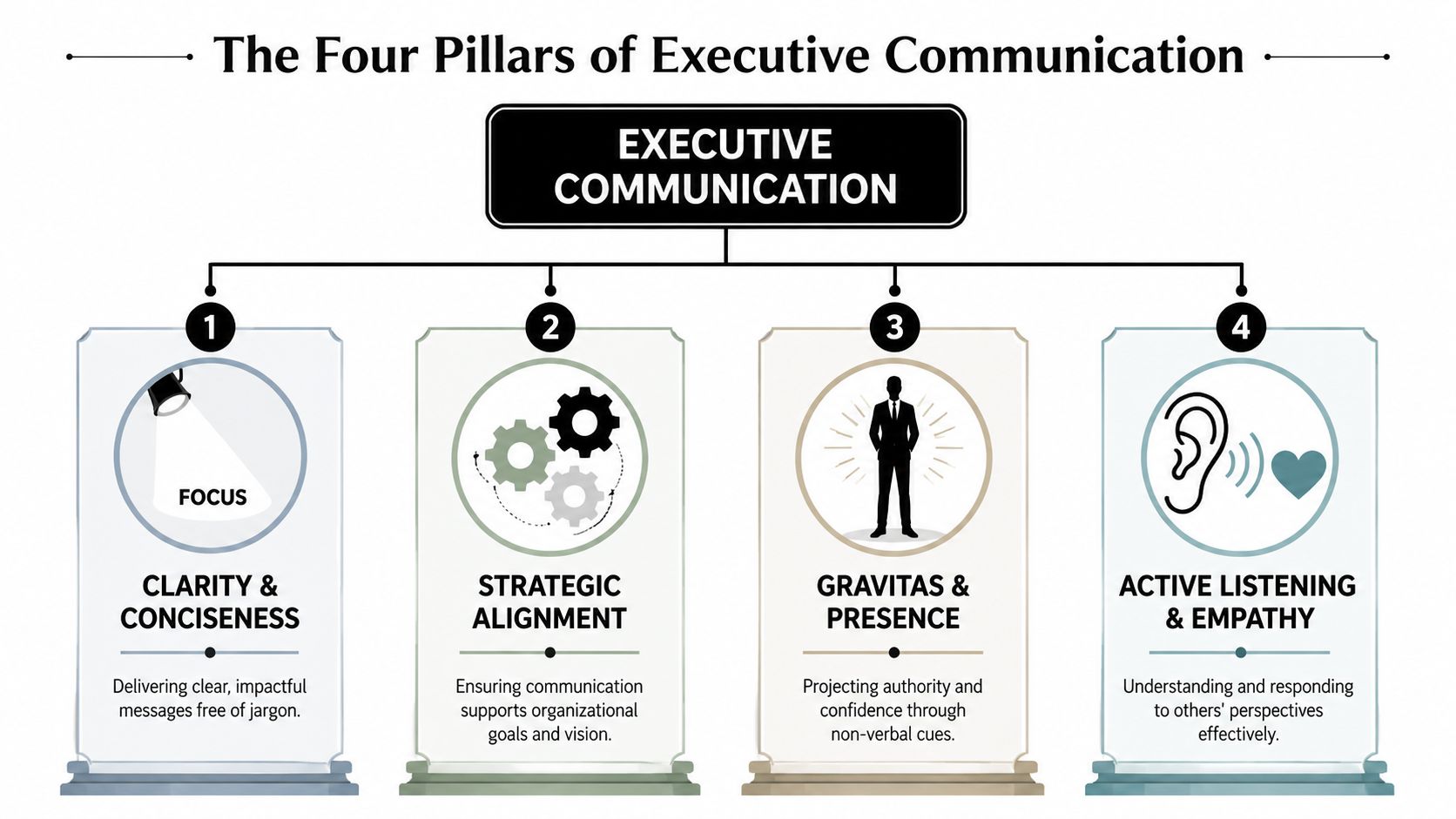
The Four Pillars of Executive Communication
Most professionals try to improve executive communication by working on one thing at a time. Usually that means slides, vocabulary, or confidence. That approach is too narrow.
Senior-level communication works when four elements support each other.
Strategic framing
A senior message starts with meaning, not background. Before you speak, you should know your headline, your recommendation, and the business relevance.
If your audience has to work hard to find the point, they won't experience you as executive. They'll experience you as informative but difficult to follow.
Strong framing usually answers four questions quickly:
- What is happening
- Why it matters
- What decision or direction you recommend
- What the audience should do next
Vocal authority
At this point, many international professionals lose influence they have already earned.
You may have a strong idea, but if your voice rushes, trails off, collapses at sentence endings, or uses pauses to search rather than emphasize, listeners often focus on delivery friction instead of strategic value. That's one reason precise work on speech mechanics matters. If you want to sharpen articulation without sounding stiff, this guide on how to enunciate better is a useful starting point.
A pause can signal control or uncertainty. Senior communicators know the difference.
Executive body language
Body language doesn't need to be theatrical. It needs to be clean.
That means stable posture, contained movement, eye focus that includes the room, and gestures that support the message instead of leaking nervous energy. The goal isn't charisma. The goal is congruence. Your physical presence should match the level of certainty and responsibility in your words.
High-stakes performance
Senior communication is tested most when conditions are least comfortable. That includes tense questions, incomplete information, disagreement, and time pressure.
Leading frameworks consistently identify clarity, conciseness, credibility, authenticity, and adaptability as core performance specifications of effective executive communication. Practical benchmarks include using simple language, visual aids for complex information, and choosing the right channel for the situation, from face-to-face discussions for high-stakes conversations to presentations for structured alignment, as described in these examples of effective executive communication.
How the pillars work together
- Strategic framing makes your message relevant.
- Vocal authority makes it credible.
- Executive body language makes it believable.
- High-stakes performance makes it dependable when pressure rises.
If one pillar is weak, the others have to compensate. That rarely works for long.
Why Executive Communication Drives Leadership Influence
Promotions into senior roles aren't based only on output. They're based on trust. People ask themselves whether you can represent the function, align competing stakeholders, and lead through ambiguity without creating extra confusion.
That is why executive communication changes careers.
Influence is an operational advantage
As organizations became more complex, remote, and cross-functional, executive communication grew more important. Modern surveys show how much time leaders now spend repairing coordination problems. Over one-third of leaders spend an hour or more each day resolving collaboration issues, and inefficient productivity can cost as much as $16,491 per manager annually. Communication also shapes retention. 61% of employees who are unlikely to stay cite poor internal communication as a key reason for wanting to leave. Earlier surveys found that 91% of employees said their leaders lack critical communication skills, and 86% of employees and executives cited ineffective collaboration and communication as the main cause of workplace failures, according to these workplace communication findings.
Those numbers matter, but the day-to-day reality matters just as much. Senior leaders spend a large share of their time clarifying, persuading, reframing, calming, and redirecting. Communication isn't adjacent to leadership. It is leadership in motion.
What this means for international professionals
If English isn't your first language, people may judge your leadership readiness through delivery signals that native speakers barely notice. Pace. sentence stress. pause placement. word endings. response speed under challenge.
That doesn't mean you need to sound native. It means you need to sound decisive, clear, and easy to follow.
A practical way to build visibility is to communicate more deliberately in public professional channels. Short leadership videos on LinkedIn can help you practice concise framing and visible executive presence. If you're using that format, this LinkedIn video upload guide by Klap is a useful operational reference. And if pronunciation is part of the issue, focused work on English pronunciation for work and career growth can remove obstacles that shouldn't be deciding your advancement.
The professionals who rise fastest aren't always the smartest in the room. They're often the clearest under pressure.
The Two Hidden Gaps Undermining Your Authority
Most executive communication advice is incomplete for international professionals. It tells you to be clear, concise, authentic, and strategic. All of that is correct. It still misses two problems that subtly block authority.

The non-native speaker paradox
Existing executive communication literature overwhelmingly emphasizes clarity, conciseness, and credibility, yet it offers very little practical guidance on how accent, pronunciation, pacing, or language-processing delays affect perceived executive authority for international professionals. It often treats executive communication as culturally neutral, even though non-native speakers are usually managing two jobs at once. They must master both the strategic content of leadership communication and the delivery mechanics that many native speakers develop unconsciously. Research on the foreign accent effect shows that listeners attribute lower competence and credibility to non-native speakers even when the content is identical, as discussed in this piece on why executive communication matters.
This is why generic advice often feels frustrating. You already know you should be strategic. The primary challenge is getting that strategy to sound authoritative in real time.
If you've felt that your competence is discounted because of delivery cues rather than substance, it helps to understand accent bias in the workplace. Naming the pattern makes it easier to address it directly.
Communication under cognitive load
The second gap shows up when there is no script.
You might present well when prepared, then lose precision in executive Q&A, tense stakeholder conversations, or sudden challenge from a senior leader. Your thinking is still strong, but stress compresses your language. You hedge. You over-explain. You answer the first question you heard instead of the underlying one being asked.
A lot of internal communication advice focuses on planning, channels, and message consistency. That matters. For broader organizational context, these internal communication best practices for 2026 offer useful guidance on communication design. But they don't solve the moment when you're on the spot and need to sound composed while processing information live.
One way to see how these issues show up in practice is to study delivery, not just messaging.
What actually closes these gaps
You don't fix these problems by collecting more generic tips. You fix them through targeted practice tied to your real work: live presentations, board updates, stakeholder pushback, performance conversations, and difficult questions.
One option designed for this is The Gravitas Method, a 12-week one-on-one executive presence coaching program for international professionals who want to communicate with more authority and influence at senior levels. Coached by Nikola, it covers vocal authority, strategic framing, executive body language, and high-stakes communication. The program is priced at $8,200 paid in full or $9,000 across three installments.
The key point isn't the program itself. It's the development model. Senior communication improves fastest when you work on the exact interaction between message, delivery, and pressure.
A Practical Diagnostic for Your Communication Style
You don't need a perfect self-assessment. You need an honest one.
Most professionals evaluate themselves by effort. They think about how much they prepared, how complex the subject was, or whether they felt nervous. Executive communication should be evaluated by impact.

Ask yourself these questions
Use this diagnostic after your next presentation, leadership meeting, or high-stakes conversation.
- Did I lead with the point or did I make people wait for it?
- Did my audience leave with a clear decision or just more information?
- Did my pace sound controlled or did it speed up when I felt pressure?
- Did I use pauses to create emphasis or only when I was searching for words?
- Did my body look composed when challenged, or did tension show in my hands, shoulders, or face?
- Did I adapt my explanation to the audience or give everyone the same version?
- When interrupted, did I stay structured or lose the thread of my message?
- Did people respond to my recommendation or only comment on the details?
Score the friction, not just the content
A useful diagnostic isn't "Was my idea good?" A better one is "Where did friction appear?"
Look for patterns such as:
| Signal | Likely issue |
|---|---|
| People ask what your recommendation is at the end | Weak strategic framing |
| You sound less confident in Q&A than in prepared remarks | Pressure affects vocal control and structure |
| Colleagues say you're smart but hard to follow | Too much detail, not enough hierarchy |
| Your point lands better in writing than live meetings | Delivery mechanics are reducing impact |
If people consistently need to reinterpret you, your communication has a friction problem, not an intelligence problem.
What to do with the result
Pick one recent high-stakes interaction and review it against the list above. Don't try to fix everything at once.
Choose the pattern that costs you the most influence. For one person, that's rushed delivery. For another, it's weak recommendations. For another, it's visible tension when challenged. Precision matters more than motivation here.
Take the First Step to Executive Influence
Executive communication is learnable. It isn't reserved for charismatic extroverts, native speakers, or people who were "born to lead."
It is a professional skill. You build it by learning how to frame ideas at the right altitude, deliver them with authority, and stay composed when the conversation becomes less predictable.
For international professionals, that work is especially important because subtle delivery issues often hide real leadership capability. Fixing those issues doesn't change who you are. It lets other people see your judgment more clearly.
If you're exploring support options, even a general coaching platform can help you understand how structured coaching relationships work. But if your specific goal is senior-level influence in English, the strongest first move is a focused diagnostic of how your communication lands.
Book the free Executive Communication Assessment. It gives you a clearer view of where your authority is already strong, where friction is undermining it, and what to work on first.
If you're ready to communicate like your role is already bigger than your title, start with Intonetic. The free Executive Communication Assessment is the simplest way to identify the delivery, framing, and presence gaps that are holding back your influence.