
Direct vs Indirect Communication: A Leader’s Guide
You speak in a senior meeting, and the room goes slightly still.
You meant to be clear. Instead, your comment sounds blunt. Or you meant to be diplomatic, and your point disappears under too much softening. After the meeting, nobody says you handled it badly. That’s what makes this hard. The signals are subtle. A shorter reply from your boss. A stakeholder who becomes polite but distant. A proposal that stalls because your “yes” and their “yes” didn’t mean the same thing.
For ambitious international professionals, direct vs indirect communication isn’t a soft-skills side topic. It affects credibility, authority, and whether people read you as senior.
The Unspoken Rules of Senior Leadership
A common executive mistake isn’t saying the wrong thing. It’s using the wrong level of explicitness for the room.
You see it in quarterly reviews, board updates, and cross-border negotiations. A leader says, “This approach won’t work,” expecting efficiency. One group hears decisiveness. Another hears disrespect. In the same week, another leader says, “There may be a few concerns we should revisit,” expecting the room to infer urgency. Some do. Others think the issue is minor and keep moving.

That tension gets sharper as you move up. Senior leadership runs on unwritten rules. You’re expected to be clear, but not crude. Diplomatic, but not vague. Decisive, but not socially clumsy.
One reason this matters so much is scale. Roughly 65 to 70% of the world’s population lives in cultures that favor indirect, high-context communication, which means about two out of every three external stakeholders or peers may operate in those markets, according to Talaera’s overview of direct and indirect communication. If you lead across regions, directness is never just a personal preference. It’s a strategic choice.
Why senior people get judged more harshly
At junior levels, colleagues often excuse awkward phrasing if the work is strong. At senior levels, people read communication as a proxy for judgment.
They ask themselves:
- Can this person handle tension? If you sound too sharp, they worry about trust.
- Can this person influence different audiences? If you’re too indirect, they worry about clarity.
- Can this person represent the business externally? If your style creates friction, they question readiness.
That’s why many professionals eventually seek structured feedback on how they land in high-stakes settings, whether through self-review, peer input, or a formal executive communication assessment.
Senior communication is rarely judged only by what you meant. It’s judged by what other people inferred.
Decoding Communication What Direct and Indirect Really Mean
Most articles define direct communication as “saying what you mean” and indirect communication as “hinting.” That’s too simplistic to be useful.
The distinction is low-context vs high-context communication. In low-context environments, the message sits mostly in the words. In high-context environments, the message sits partly in the words and partly in tone, hierarchy, relationship history, timing, and what is left unsaid.
Early in any leadership relationship, I listen for one question: where does this group expect meaning to live?
Direct communication
Direct communicators usually value speed, transparency, and explicit ownership. They tend to say:
- What the issue is
- Who owns it
- What must happen next
- When a decision is needed
That style can sound like: “We’re off timeline. I need the revised forecast by Thursday.”
In many corporate environments, about 52% of professionals self-identify as communicating directly, while nearly 40% align with softer or more indirect styles, which creates a real mismatch in daily interaction, as summarized in Niagara Institute’s workplace communication statistics.
Indirect communication
Indirect communicators usually value harmony, face-saving, and relational stability. They often signal disagreement or refusal through phrasing, timing, or tone rather than blunt wording.
That style can sound like: “This may be difficult to finalize by Thursday,” which may mean, “Thursday is unrealistic.”
Here’s the practical issue. If you only listen to literal wording, you’ll miss the message. If you only rely on implication, you’ll miss deadlines.
| Style | What it prioritizes | What it sounds like | Common risk |
|---|---|---|---|
| Direct | Clarity, speed, explicit accountability | “I disagree with this plan.” | Can sound harsh or politically unaware |
| Indirect | Harmony, face-saving, relational continuity | “We may want to revisit part of this plan.” | Can sound vague or noncommittal |
| Calibrated | Clear message with audience sensitivity | “I see two risks here. Let’s adjust before we commit.” | Takes more skill and preparation |
Why professionals misread each other
A direct communicator often assumes ambiguity means uncertainty. An indirect communicator often assumes bluntness means hostility. Both interpretations can be wrong.
Listening matters more than many leaders realize. If you want a practical framework for noticing what people mean beneath the wording, these effective communication practices are useful because they focus on interpretation, not just response.
Your voice also affects how either style lands. A flat or tense delivery can make directness sound severe and indirectness sound unsure. That’s why the difference between intonation and inflection in speech matters in executive settings. The same sentence can land as confident, cautious, or confrontational depending on how you shape it.
The High-Stakes Trade-Offs in Executive Communication
No serious leader gets to choose one style forever.
You choose based on the cost of confusion, the importance of buy-in, the emotional temperature of the room, and the political stakes. Directness and indirectness are not moral categories. They are tools with consequences.
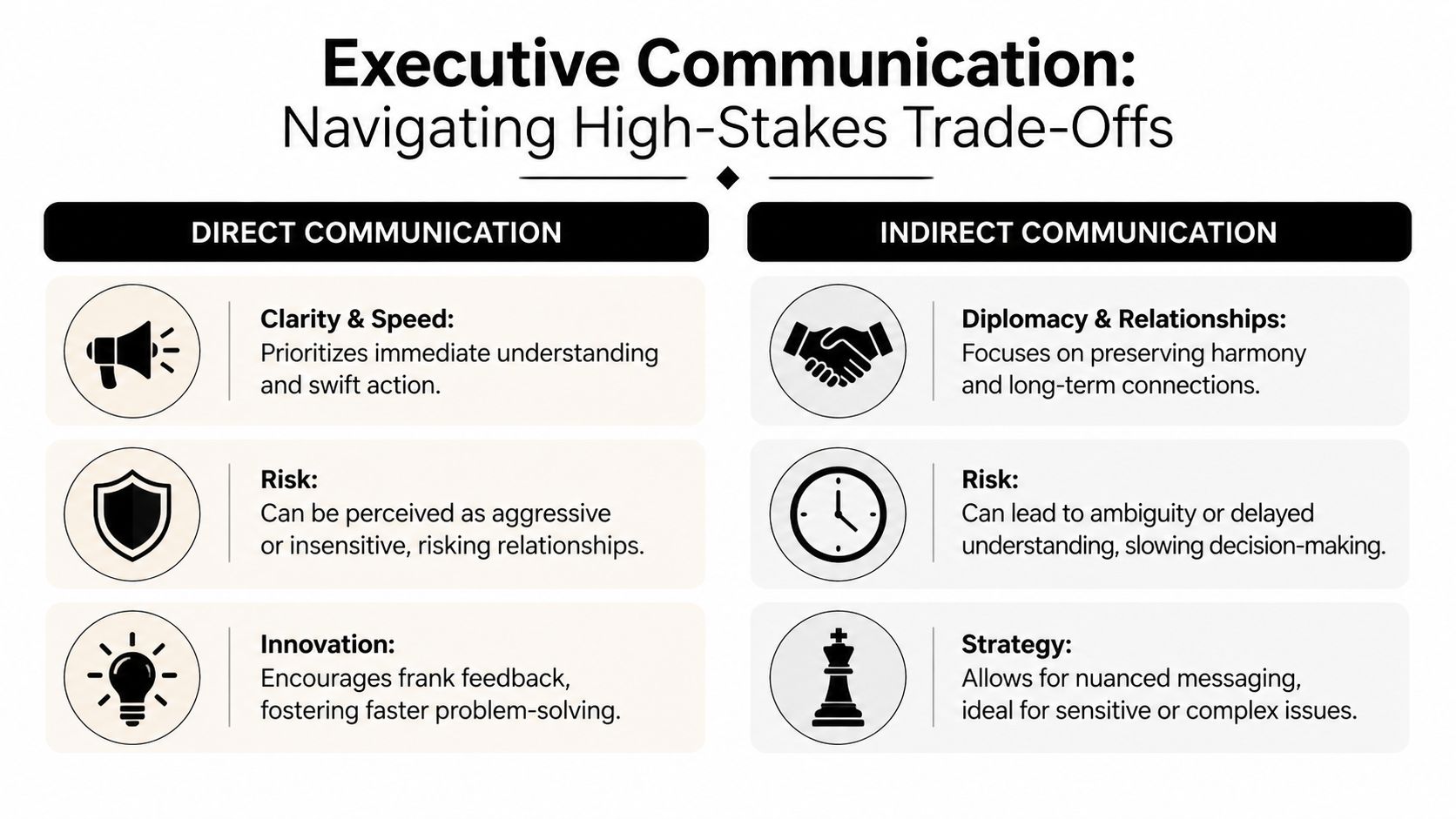
Research summarized by Study.com’s lesson on direct and indirect communication notes that direct communication accelerates problem resolution because the message is explicit and leaves little room for guessing. The same source also notes that indirect communication prioritizes stakeholder relationships and can be more useful in emotional situations or when tensions are high, though it can slow decision-making.
Speed versus buy-in
If a production system is failing, directness helps. You need ownership, sequence, and deadlines. “Stop the rollout. Engineering owns root cause. Update me in one hour.” Nobody benefits from polite fog in that moment.
But speed creates its own risk. If the issue depends on cross-functional cooperation, direct orders can get compliance without commitment. People do the task, then disengage.
Core trade-off: Direct communication moves faster. Indirect communication often protects the willingness to keep working together.
Clarity versus face-saving
Direct feedback reduces ambiguity. The recipient knows what’s wrong and what must change. That’s useful when quality standards, legal risk, or technical precision matter.
Indirect feedback protects dignity. In cultures or teams where public contradiction is costly, that matters. If you expose a senior stakeholder too openly, you may win the point and lose the relationship.
A few examples show how this plays out:
-
Board update
- Direct: “This target is unrealistic.”
- Indirect: “We may want to revisit the assumptions behind this target.”
-
Vendor negotiation
- Direct: “Your pricing doesn’t work for us.”
- Indirect: “It may be difficult for us to proceed under the current structure.”
-
Team correction
- Direct: “This analysis is incomplete.”
- Indirect: “I think this needs one more pass before we circulate it.”
Efficiency versus relationship depth
Direct communicators often mistake relational work for inefficiency. Indirect communicators often mistake explicitness for poor manners. Both errors create expensive problems.
A direct style can shorten meetings, reduce back-and-forth, and make expectations obvious. In remote settings, that advantage gets even stronger because fewer nonverbal cues are available.
An indirect style can preserve trust, especially when someone is under pressure, embarrassed, or senior enough that public correction creates political fallout.
A message can be clear and still cost you influence if the listener feels exposed.
This is why high-stakes communication training often focuses less on “be more direct” and more on matching style to business consequence. In difficult meetings, many leaders need support not with vocabulary, but with pressure handling, framing, and delivery under scrutiny. That’s the core value of coaching built for confident communication in high-stakes situations.
A Leader's Guide to Choosing the Right Style
International professionals often get poor advice here. “Be more direct” is incomplete. “Read the room” is too vague.
You need better decision rules.

The accent penalty
One of the hardest realities in executive communication is that the same directness is not judged equally. As noted in Diversity Resources on global communication styles in the workplace, international professionals can face a credibility gap where direct speech is interpreted as aggressive or lacking nuance, especially when accent, pacing, or vocal delivery affect how the message is received.
This matters in tech, finance, and consulting because these fields often reward concise communication. A native speaker can say, “I disagree. The model is wrong,” and get read as confident. A non-native speaker may say the same words and get read as rigid.
That doesn’t mean you should become vague. It means you must package directness more strategically.
Use these adjustments:
-
Lead with orientation
“I want to be clear on the risk I see.” -
Then state the point cleanly
“This forecast assumes stability that we don’t have.” -
Then add collaborative intent
“Let’s stress-test the downside before we commit.”
That sequence keeps the message explicit while reducing the chance that listeners hear attack instead of leadership.
When directness becomes a liability
At senior levels, excessive directness can signal poor judgment. Not because the content is wrong, but because the delivery ignores status, timing, or emotional context.
A CFO challenging assumptions in a budgeting session can be direct. A VP publicly cornering a peer in front of their team often loses more than they gain.
This pattern resembles what strong teachers already know. They adapt style to the learner, the moment, and the outcome. That’s one reason this guide for educators on teaching styles is unexpectedly relevant to leaders. Good communicators don’t repeat one mode. They calibrate for uptake.
A useful decision filter is this:
| Situation | Better default | Why |
|---|---|---|
| Crisis, compliance, technical specification | Direct | Ambiguity creates operational risk |
| Sensitive feedback to a peer or senior stakeholder | Indirect at first, then clarify | Protects rapport while opening the issue |
| Negotiation with long-term partner | Calibrated | You need clarity without shrinking trust |
| Team conflict with emotion in the room | Indirect entry, direct close | Start with regulation, end with decisions |
A quick leadership drill can help you hear the difference in real time:
The right question to ask before you speak
Don’t ask, “Should I be direct or indirect?”
Ask:
- What is the cost of ambiguity here?
- What is the cost of relational damage here?
- How will my delivery change the interpretation of the same words?
That third question is where many talented international leaders underperform. They choose the right content and the wrong delivery pattern.
If your words are direct but your tone is tense, clipped, or rushed, listeners may hear threat instead of clarity.
Building Your Communication Toolkit Scripts and Exercises
Understanding the styles isn’t enough. You need language you can use when the room is moving fast.
The goal isn’t to sound softer or harder. The goal is to sound intentional.
Scripts for common leadership moments
| Situation | Typical indirect script | Typical direct script | Strategically calibrated script |
|---|---|---|---|
| Disagreeing with a proposal | “Maybe we should think about this a bit more.” | “I don’t agree with this.” | “I see the logic, but I have two concerns that could affect execution.” |
| Delegating a task | “If you have time, could you possibly look at this?” | “Do this by Friday.” | “I need you to take this on and send me a draft by Friday. Let me know today if that timeline creates a conflict.” |
| Pushing back on a deadline | “I’ll try.” | “That deadline won’t work.” | “I can do this well, or I can do it by that date. If the date is fixed, we need to reduce scope.” |
| Giving corrective feedback | “There were a few small issues.” | “This wasn’t good enough.” | “The direction is right, but the analysis needs more evidence before we share it.” |
| Admitting a mistake | “There may have been some confusion.” | “I made a mistake.” | “I missed this in the earlier review. Here’s the correction and what I’m doing to prevent a repeat.” |
Practical rule: Calibrated language names the issue, protects dignity, and makes the next step unmistakable.
Exercise one, sharpen vague language
Take three phrases you use often: “maybe,” “I’ll try,” and “we should discuss.”
Rewrite them into decision language.
- Instead of “maybe” write what condition must be met.
- Instead of “I’ll try” write whether you can commit.
- Instead of “we should discuss” write who decides and by when.
This exercise is useful if you come from an indirect background and want to reduce accidental ambiguity.
Exercise two, soften hard edges without losing clarity
Take a sentence you would normally say in a blunt form. Example: “This is wrong.”
Now rebuild it in three parts:
- Context
“I want to flag a risk in the current approach.” - Clear message
“The assumption behind this figure isn’t supported.” - Forward motion
“Let’s revise it before the stakeholder review.”
This is the fastest way to make direct speech sound senior rather than sharp.
Exercise three, rehearse pressure scenarios out loud
Silent editing doesn’t build executive presence. Spoken practice does.
Pick one live situation this week. Record yourself delivering the message in three versions: more direct, more indirect, and calibrated. Listen for where your tone tightens, where your pace speeds up, and where your ending drops into uncertainty.
If you want a structured way to rehearse this, role-playing and simulation exercises for spoken English improvement can be adapted well for executive communication because they force you to respond under time pressure, not just write polished sentences afterward.
How to Project Authority While Respecting Norms
At senior levels, words are only part of the signal. Two people can use the same sentence and create opposite impressions.
That’s why direct vs indirect communication is really a question of delivery management. Directness without composure feels aggressive. Indirectness without presence feels weak. Authority comes from the combination of message, voice, timing, and body language.
What makes directness sound credible
Direct language lands best when your delivery is steady.
Use:
- A lower, calmer pace so clarity doesn’t sound like irritation
- Deliberate pauses before key points so you don’t rush into defensiveness
- Stillness in posture and hands so your message carries weight instead of strain
If you say, “I don’t support this approach,” while leaning forward, speaking fast, and clipping the final word, listeners may react to pressure more than content.
What makes indirectness sound senior
Indirect communication still needs structure. Otherwise it dissolves into hedging.
Use:
- Clear signposting such as “My concern is…” or “One risk I see…”
- Firm sentence endings instead of lifting your intonation as if asking permission
- Visible ownership of your position, even when phrased diplomatically
As noted by Indeed’s discussion of direct versus indirect communication, excessive directness without relational grounding can undermine executive presence and trigger defensive reactions in situations that require psychological safety.
The most influential leaders don’t choose between clarity and diplomacy. They make both visible at the same time.
Presence is the multiplier
At this point, many international professionals finally see the underlying problem. They don’t need more vocabulary. They need a communication system.
The Gravitas Method is a 12-week one-on-one executive presence coaching program for international professionals who want to communicate with more authority and influence at senior levels. The program is priced at $8,200 paid in full or $9,000 across three installments. Coached by Nikola, it covers vocal authority, strategic framing, executive body language, and high-stakes communication.
That kind of work matters because executive communication isn’t just about being understood. It’s about being trusted with larger decisions, more visible stakeholders, and more room-defining moments.
Take the First Step to Masterful Communication
You don’t need a personality transplant to handle direct vs indirect communication well. You need awareness, practice, and a better calibration system.
If you want to improve how your communication is perceived, start by identifying your defaults under pressure. Notice where you become too sharp, too vague, too fast, or too apologetic. Leaders who build that awareness improve faster than leaders who just “try to be more confident.” If you also want outside ideas on how presentation and delivery are evolving, this blog for AI video generators can spark useful thinking about how people consume spoken communication and presence online.
A strong next step is to take an accent reduction assessment alongside broader communication feedback, especially if vocal delivery affects how your message lands.
If you’re ready to understand how you come across in senior-level conversations, start with Intonetic’s free Executive Communication Assessment. It’s the clearest first step if you want to communicate with more authority, influence, and executive presence.