
Communication for Managers: Authority & Influence Guide
You're in a meeting with senior stakeholders. You know the recommendation is right. You've done the analysis, anticipated objections, and prepared the slide. Then someone with less expertise says nearly the same thing, but says it with more certainty, cleaner structure, and steadier presence. The room moves with them.
That's one of the most frustrating parts of communication for managers. The problem often isn't knowledge. It's translation. You know what you mean, but the message lands as hesitant, overexplained, too technical, or less senior than you intended.
For many managers, especially international professionals working in English, that gap gets expensive. It affects buy-in, visibility, promotion readiness, and trust under pressure. Strong management communication isn't just about being understood. It's about being understood quickly, remembered accurately, and followed.
Why Effective Manager Communication Is a Power Skill
Most managers still treat communication like a support skill. It isn't. It's the operating system of the role.
Research summarized by Project Management Academy notes that managers can spend 50% to 80% of their workday communicating, with some spending as much as 90% of an average day doing it, which is why clarity and conciseness directly affect leadership effectiveness (manager communication workload research). If most of your day is spent in meetings, updates, decisions, feedback, and alignment conversations, communication isn't adjacent to performance. It is performance.
What strong communication changes
A manager with weak communication creates friction even when their intentions are good. Team members leave meetings with different interpretations. Stakeholders hear too much detail and miss the decision. A tense tone turns a healthy challenge into perceived defensiveness.
A manager with strong communication does something different. They reduce ambiguity, shorten decision cycles, and make action easier for other people.
That's why communication for managers should be treated as a business discipline, not a personality trait.
Practical rule: If people regularly ask follow-up questions about ownership, timing, or priority, the issue usually isn't intelligence. It's message design.
Where managers lose authority
The most common breakdowns are predictable:
- Too much context: You explain the journey instead of the conclusion.
- Unclear stakes: People hear the update but not why it matters.
- Soft endings: You finish with uncertainty when the situation requires direction.
- No verification: You assume agreement means understanding.
Managers who lead well usually develop clear routines for these moments. They decide the point before the meeting starts. They adapt their level of detail to the audience. They state what they want people to do next.
If you want a broader leadership lens on strategies to inspire teams, that resource is useful because it connects communication style to motivation and trust, not just message mechanics. For international leaders, another practical layer is how speech patterns affect credibility in the room. This piece on the real-world impact of having a foreign accent is relevant because expertise can be judged through delivery long before your full argument is heard.
The shift that matters
Stop asking, “How can I say more?”
Ask, “How can I make the decision easier for other people?”
That shift changes everything. It moves you from talking to leading.
Prepare Your Message with Strategic Framing
Authority starts before you speak. Senior managers rarely improvise structure. They may sound natural, but their message has a frame.
When managers ramble, it's usually because they haven't chosen the shape of the message. A useful frame does three things. It tells people what bucket to place your message in, what matters most, and what they should do with it.
Use SBI for feedback
The Situation, Behavior, Impact model works because it keeps feedback concrete and reduces emotional fog.
A weak version sounds like this: “You need to be more proactive in meetings.”
That lands badly because it's vague and easy to argue with.
A stronger version sounds like this:
- Situation: “In yesterday's client review…”
- Behavior: “…when the scope change came up, you stayed silent until the end.”
- Impact: “That made it harder for the team to address the risk early, and the client interpreted the pause as uncertainty.”
This kind of framing helps the other person respond to specifics. It also makes you sound composed and fair.
Use problem, solution, benefit for persuasion
When you need buy-in, don't start with your idea. Start with the problem the audience already cares about.
A manager pitching a process change might say:
| Weak framing | Strong framing |
|---|---|
| “I'd like to introduce a new reporting workflow.” | “Right now, updates are scattered across tools, which slows decision-making. I recommend one weekly reporting workflow with a single owner. That gives leadership a faster view of risk and frees the team from repeated status requests.” |
This structure works especially well with executives because it respects their limited attention. It moves from issue to answer to business value without wandering.
If pronunciation or verbal clarity makes it harder to deliver a structured message cleanly, targeted practice helps. This guide on how to improve your English pronunciation for work and career is useful for managers who already know what they want to say but need cleaner delivery.
Use what, so what, now what for updates
Status updates fail when they become data dumps. The room doesn't need every detail. It needs orientation.
The What, So What, Now What sequence is effective because it forces relevance.
- What: “The vendor pushed delivery by one week.”
- So what: “That affects the integration timeline and puts the pilot at risk.”
- Now what: “I need approval today to re-sequence internal testing and notify the client.”
If your update doesn't end with a decision, owner, or next step, it's probably incomplete.
This is one of the most practical communication for managers habits to build. Use it in project reviews, board prep, cross-functional meetings, and escalation calls. It shortens your message without making you sound abrupt.
A fast prep routine before any important conversation
Before a high-visibility meeting, write down four things:
- The point: What's the one sentence they must remember?
- The stake: Why does this matter now?
- The ask: What do you need from them?
- The likely objection: Where will they push back?
That takes a few minutes. It saves you from ten minutes of unfocused talking.
Master Delivery with Vocal Authority and Executive Presence
A well-structured message can still lose force if the delivery undercuts it.
Many managers know the content but don't sound senior when the moment becomes high stakes. That's especially true in global organizations, where authority is often judged through accent, pacing, vocal control, and body language. As CMA Consult notes, many managers are perceived as lacking authority because of accent, pacing, or body language, which shifts the underlying question from communicating more to communicating with more authority, especially for non-native English leaders in high-stakes settings (authority gap in executive communication).

Vocal authority
You don't need a dramatic voice. You need a stable one.
Managers lose authority vocally in a few common ways:
- Rising intonation: Statements sound like questions.
- End-of-sentence drop-off: The key point becomes hard to hear.
- Rushing: You sound less certain because you sound eager to get through it.
- Overfilling space: “Just,” “kind of,” “maybe,” and similar fillers dilute conviction.
Try this short drill. Record yourself saying a recommendation in one sentence. Then listen for the final five words. If those words weaken, rise, or disappear, your authority weakens with them.
A better pattern is simple. Breathe before the sentence. Land the key noun or verb clearly. Finish without trailing away.
Strategic pacing
Fast speech often comes from pressure, not confidence. Senior presence usually sounds measured because the speaker isn't competing with the room.
Use pauses intentionally in three places:
- Before the main point: It signals importance.
- After a hard number or decision: It gives people time to register the consequence.
- After a challenge from someone senior: It prevents reactive answers.
Here's a useful test. In your next meeting, answer one difficult question half a beat slower than feels natural. You'll probably sound more composed than you feel.
A deeper walkthrough on these mechanics is here:
Executive body language
Body language doesn't need to be theatrical. It needs to be economical.
The goal is to remove signals that suggest uncertainty or apology. Managers often undercut themselves by shrinking physically, overnodding, fidgeting, or looking away when making a strong point.
Use this comparison:
| Less authoritative | More authoritative |
|---|---|
| Looking down while answering | Looking at one person, then widening your gaze |
| Constant hand movement | Deliberate gestures that support one point at a time |
| Leaning back when challenged | Staying grounded and slightly forward |
| Nervous smile during disagreement | Neutral face with calm tone |
Your body should confirm your message, not soften it.
If you want structured support in those areas, executive presence coaching can help isolate whether the issue is voice, framing, nonverbal habits, or performance under pressure.
Lead High-Stakes Conversations with Composure
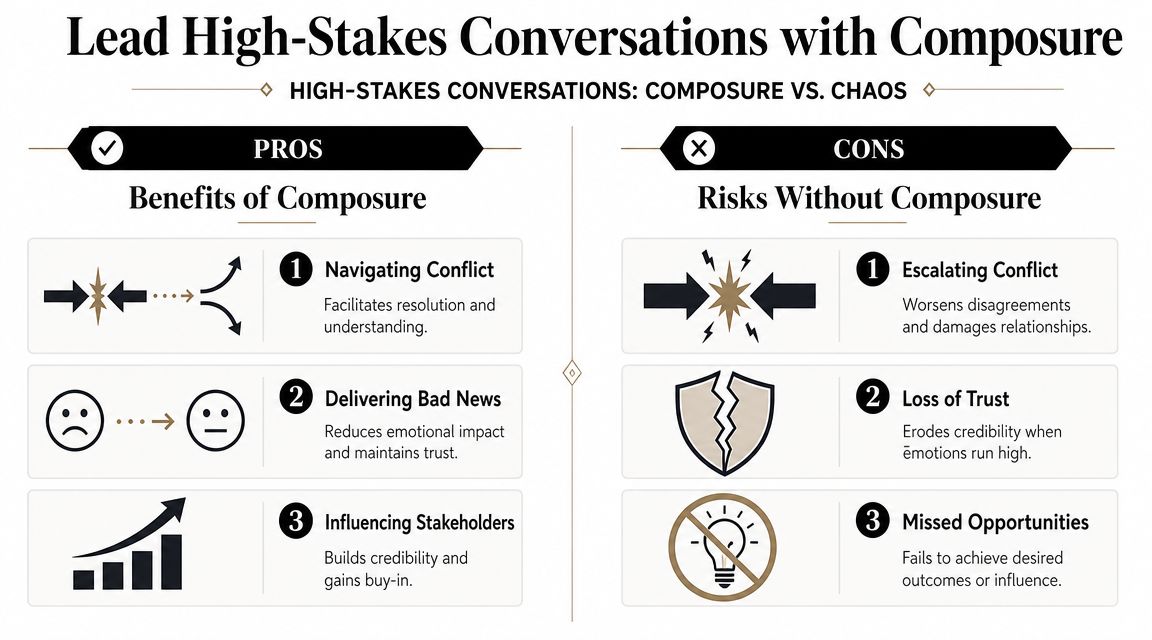
A manager's reputation often changes in a handful of difficult moments. Not in routine updates. In the meeting where you challenge a risky decision, deliver unwelcome feedback, or answer a hostile question without losing your footing.
Composure matters because pressure distorts language. People overexplain, defend too early, or talk faster than they think. The fix isn't to become colder. It's to stay structured while the stakes rise.
When you need to disagree upward
Suppose a senior leader wants to accelerate a launch and you believe the team is exposed. Many managers either go passive or become oppositional. Neither works.
A better response sounds like this:
“I understand the push for speed. My concern is that launching on that date increases delivery risk in two areas. If the priority is timing, we can do it, but we'll need to narrow scope and align on what we're willing to defer.”
That response does three things well. It acknowledges the business pressure, states the risk directly, and offers a path instead of resistance.
When you need to deliver tough feedback
Performance conversations fall apart when the manager tries to soften every sentence. The employee leaves unclear, and the issue continues.
A steadier version might sound like this:
- Name the pattern: “I want to talk about a recurring issue in stakeholder updates.”
- Describe the consequence: “When deadlines shift and the message goes out late, trust drops.”
- Set the expectation: “I need you to communicate changes earlier, even if the full answer isn't available yet.”
- Invite response: “What's getting in the way right now?”
That last line matters. It keeps accountability in place without turning the conversation into a lecture.
When the room gets tense
In Q&A, many managers answer the emotional tone instead of the actual question. That's where defensiveness shows up.
Use these replacements:
- Instead of: “That's not what happened.”
Say: “Let me clarify what changed and why.” - Instead of: “We already considered that.”
Say: “We did look at that option. The trade-off was speed versus control.” - Instead of: “I disagree.”
Say: “I see it differently based on the risk profile we're managing.”
For managers who need personalized work on these moments, one option is The Gravitas Method, a 12-week one-on-one executive presence coaching program for international professionals who want to communicate with more authority and influence at senior levels. It's priced at $8,200 paid in full or $9,000 across three installments. Coached by Nikola, it covers vocal authority, strategic framing, executive body language, and high-stakes communication.
If anxiety around accent or judgment causes you to speed up or self-censor in those moments, this guide on how to overcome accent anxiety and speak fearlessly addresses a very common barrier.
Ensure Alignment with Effective Two-Way Communication
Many managers think they communicated because they spoke clearly once. That's not communication. That's transmission.
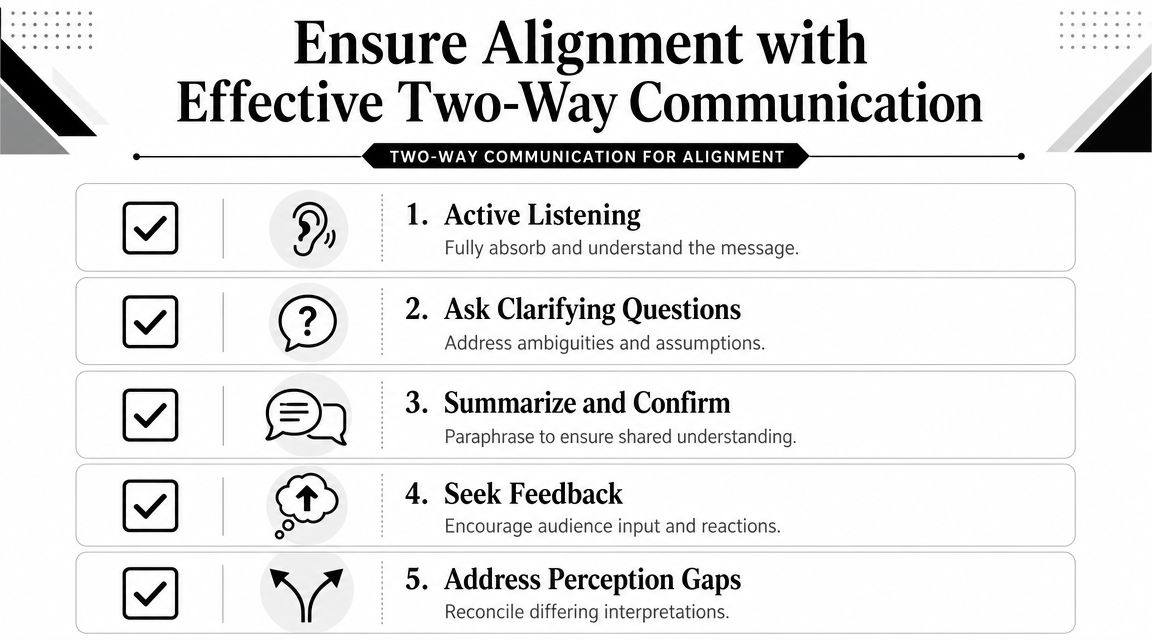
A more useful standard is alignment. Did the other person interpret the message the way you intended? Did they leave with the same priorities, same decision, and same next step?
That gap is wider than most leaders think. A 2025 Axios HQ study found that 80% of leaders believe their internal communications are clear, but only 50% of employees agree, which is why managers need to verify understanding rather than trust their own delivery alone (employee-reported communication clarity gap).
Replace false checks with real checks
Many managers end meetings with “Does that make sense?” The problem is that this question invites politeness, not clarity. People often say yes because they don't want to slow the meeting down or expose uncertainty.
Ask questions that require interpretation, not agreement.
- Better than “Any questions?”
“What's your understanding of the decision?” - Better than “We're aligned, right?”
“What are the next two actions from your side?” - Better than “Can you handle it?”
“Where do you see risk or ambiguity?”
These questions surface confusion early. They also signal that you value precision more than appearances.
Build a team habit of confirming meaning
The strongest managers normalize recap language. They don't treat it as a test. They treat it as operating hygiene.
Try this routine after project meetings:
| Moment | Manager move | Why it helps |
|---|---|---|
| End of discussion | Summarize the decision in one sentence | It closes interpretation gaps |
| Before close | Ask one person to restate their action | It reveals whether ownership is clear |
| After the meeting | Send a short written recap | It creates a shared reference point |
For teams that rely heavily on meetings, written follow-through matters. If you want a practical reference on documenting discussions cleanly, WhisperAI's meeting best practices offer useful guidance for turning conversation into usable records.
Psychological safety without vagueness
Two-way communication doesn't mean endless openness. It means people can say, “I'm not clear,” or “I see a risk,” without feeling punished for it.
That starts with manager behavior. If someone challenges your direction and you immediately shut it down, people learn to stay quiet. If you thank them, evaluate the point, and decide visibly, people learn that candor is productive.
Ask for disagreement before implementation, not after failure.
On video calls, clarity can break down even faster because tone, overlap, and audio quality interfere with meaning. This is why speaking English more clearly on video calls and presentations becomes a practical management skill, not just a presentation skill.
Your Action Plan for Influential Communication
If you want to improve communication for managers in a way that changes outcomes, focus on three capabilities.
First, frame the message before you speak. Decide the point, the stake, and the ask. Most communication problems start with unclear thinking, not poor vocabulary.
Second, upgrade delivery so your authority matches your expertise. A strong message delivered with rushed pace, uncertain tone, or apologetic body language won't get full credit in senior settings.
Third, verify alignment instead of assuming it. The standard isn't whether you said it. The standard is whether the other person understood it accurately and can act on it.
A simple 30-day approach
Don't try to fix everything at once. Pick one behavior and practice it deliberately for a month.
- Week one: End every update with a clear next step.
- Week two: Remove hedging language from recommendations.
- Week three: Ask one alignment question in every meeting.
- Week four: Record one presentation or meeting answer and review your pace, tone, and ending.
This kind of focused repetition works better than collecting tips you never apply.
Where to extend your influence
Manager communication doesn't stop in meetings. It shows up in written updates, stakeholder emails, and public professional visibility too. If you're also trying to sharpen how you show up externally, this guide on how to post on LinkedIn effectively is a useful complement because it forces the same core discipline: clarity, relevance, and audience awareness.
The bigger point is simple. Influence is trainable. Authority is observable. Presence is not magic.
You don't need to become someone else. You need your communication to reflect the level you already operate at.
If you want a clearer picture of what's helping your executive communication and what's undermining it, start with the free Executive Communication Assessment from Intonetic. It's the best entry point if you're serious about improving how you frame ideas, sound under pressure, and show up with more authority in senior conversations.