
What Is Business Communication: A Leader’s Guide
You present a strong analysis in a meeting. The logic is sound, the data is solid, and you know the recommendation is right. Then someone else says a shorter, cleaner version two minutes later, and the room moves with them.
That experience is common for high-performing international professionals. The problem usually isn't intelligence or effort. It's that being understandable isn't the same as sounding senior.
For what is business communication, the usual definition describes exchanging information at work. That definition is correct, but it's incomplete. In senior environments, communication decides whose ideas get funded, whose judgment gets trusted, and who gets seen as ready for bigger scope.
The Hidden Cost of Good Enough Communication
A lot of professionals operate with communication that is technically fine. Their English is functional. Their slides are acceptable. Their emails make sense. But “fine” often fails in rooms where leaders are expected to be concise, calm, and persuasive under pressure.
For international professionals, the gap feels sharper. You may know the subject better than everyone else in the room and still lose influence because your point arrives too late, sounds too detailed, or lands without enough authority. Accent can become part of that experience, especially when listeners confuse unfamiliar delivery with lower confidence or lower seniority. This is one reason many professionals start paying closer attention to how spoken delivery affects perception at work, particularly when they're navigating how accent affects career progression in practice.
The business cost is not abstract. One workplace survey found that 88% of the workweek is spent communicating, including about 19 hours per week on writing tasks, and that poor communication can cost between $10,000 and $55,000 per employee per year according to these workplace communication statistics.
That changes the conversation. Communication isn't a finishing touch. It's part of the operating system of the company.
What good enough looks like
Good enough communication usually has a few predictable traits:
- It starts too wide. The speaker gives background before the point.
- It sounds effortful. The audience hears strain, not command.
- It leaves interpretation work to others. People get facts, but not a clear conclusion.
- It protects accuracy at the expense of impact. Everything is included, so nothing stands out.
Good communication helps people understand you. Senior communication helps people decide, align, and act.
That's the true threshold. At senior levels, you're not judged only on whether your words are correct. You're judged on whether your communication reduces friction for everyone else.
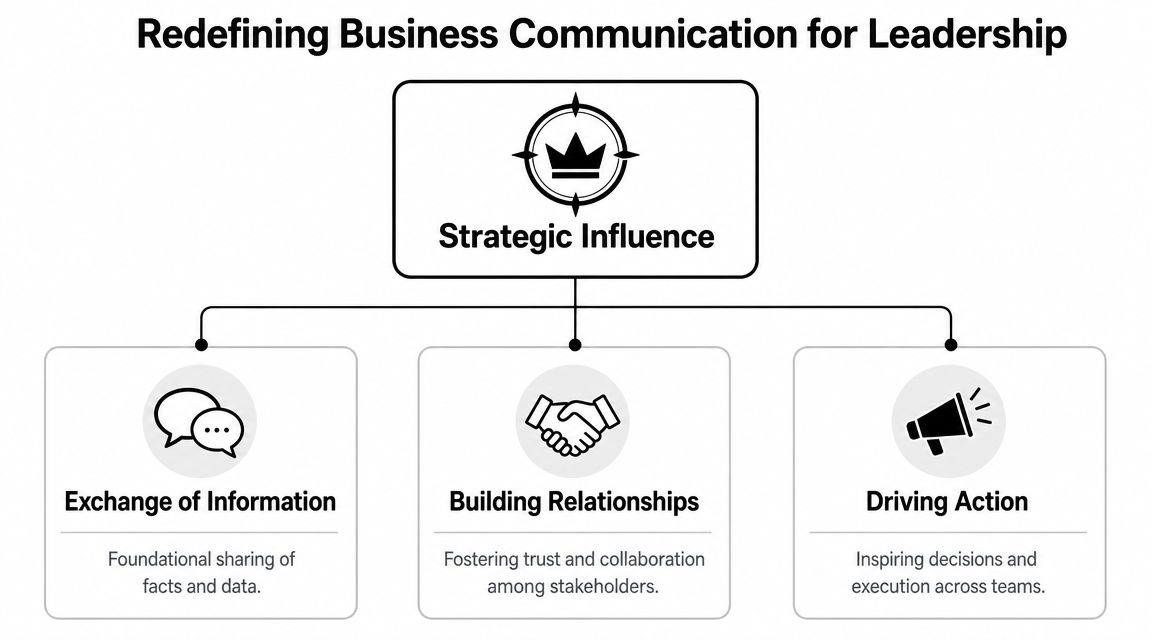
Redefining Business Communication for Leadership
The standard definition of business communication is too passive. It suggests that work is mainly about exchanging information, as if your job were to transfer facts from one person to another.
Leadership communication works differently. Its real purpose is to create movement. It helps a boss make a decision, a team align around priorities, a peer resolve ambiguity, or an external stakeholder trust your message.
It's not one skill
A better way to understand business communication is by direction of flow. In advanced practice, communication moves upward, downward, laterally, and externally. Guidance on advanced business communications notes that matching the flow and the channel to the decision task is critical to avoid coordination failures and information asymmetries inside organizations, as outlined in this overview of upward, downward, lateral, and external communication flows.
That framework matters because the same words don't work equally well in every direction.
| Direction | What you're trying to do | What often goes wrong |
|---|---|---|
| Upward | Shape decisions, escalate risks, earn trust | Too much detail, weak recommendation |
| Downward | Create clarity, consistency, accountability | Mixed signals, vague expectations |
| Lateral | Coordinate with peers, solve cross-functional issues | Territorial language, unclear ownership |
| External | Build confidence with clients, investors, media, partners | Overexplaining, defensive tone, inconsistent message |
Senior people adjust the message to the flow
If you're speaking upward, your manager rarely needs your full process. They need the headline, the implication, and the recommendation. If you're speaking downward, your team needs less ambiguity and more structure. If you're working laterally, peers need efficiency and respect, not a status performance. If you're speaking externally, the message has to be polished enough to protect credibility.
That's why executives who handle press or public-facing scrutiny often train specifically for high-stakes scenarios. The demands of media interview preparation for executives are a useful example because they force a discipline many leaders need in ordinary business settings too. Answer the question, stay on message, and make your point without sounding scripted.
What makes communication sound senior
Senior communication usually has three visible features:
- It is selective. It doesn't say everything. It says what matters most now.
- It is directional. It moves the audience toward a conclusion or action.
- It is controlled. The speaker doesn't rush, sprawl, or apologize for the message.
A city's traffic system is a helpful analogy. Roads, signals, and lanes aren't there just to let vehicles exist. They're there to direct flow so people and goods reach the right destination with less friction. Business communication does the same thing inside an organization.
If you remember one idea, make it this: business communication is not just exchange. It is strategic influence expressed through language, timing, and channel choice.
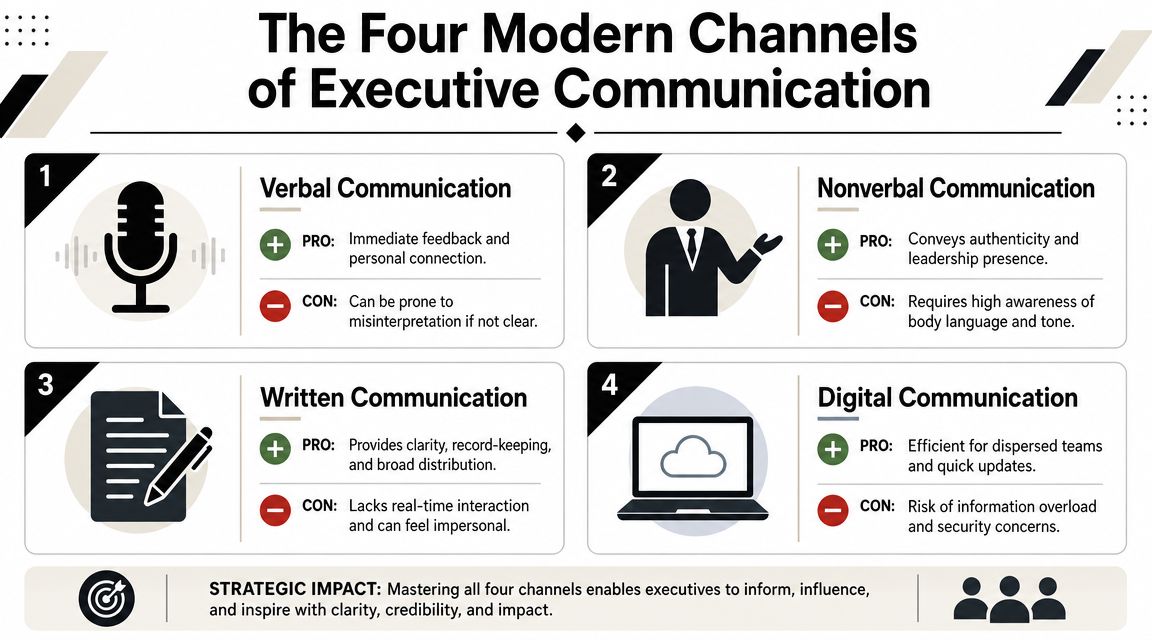
The Four Modern Channels of Executive Communication
Leaders don't communicate through one medium. They move across spoken conversation, body language, written messaging, and digital platforms all day. That's why generic advice often breaks down. A person may sound credible in a meeting and weak in email, or sharp in writing and flat on video.
In a modern workplace, organizations use nearly 9 different channels on average to communicate with employees. Email is still dominant, with 65% of companies primarily using it to communicate with clients and 73% of internal communication leaders ranking it as their most effective channel, according to this roundup of business communication channel statistics.
Verbal communication
This is often the first channel that comes to mind. In executive settings, verbal communication isn't just vocabulary. It's pacing, emphasis, sentence control, and your ability to land a point without circling around it.
A senior verbal style often sounds like this:
- Headline first. “My recommendation is X.”
- Reason second. “Because the current plan creates delay in approval.”
- Next step third. “We need a decision by Friday.”
If you tend to ramble when stakes rise, reduce the number of ideas per answer. One point said cleanly beats three points delivered with hesitation.
Nonverbal communication
People assess authority before you finish your second sentence. Posture, facial tension, eye focus, stillness, and how you enter a room all shape perceived credibility.
This applies on video too. Many international professionals underestimate how much authority drops when they speak too quickly, look down at notes, or show tension in the jaw and shoulders. Practical work on speaking more clearly on video calls and presentations often improves not just intelligibility but perceived composure.
Practical rule: If your body looks rushed, your message sounds less trustworthy.
A polished wardrobe also supports authority because appearance signals context awareness before you speak. For professionals refining their executive image, a thoughtful guide to female business attire is useful because visual presentation and spoken authority work together.
Written communication
Most careers are now shaped in writing more than people admit. Email, project updates, memos, strategy documents, Slack summaries, and board notes all create a record of how you think.
Strong executive writing does four things well:
- Leads with the point
- Cuts background that doesn't change the decision
- States implications clearly
- Ends with a clean ask or decision path
Weak writing often sounds careful but creates extra work for the reader. It buries the message under context.
Later in the day, many people now draft with AI. That can help with speed, but it creates a new problem. Messages become grammatically polished yet strategically bland. If you use AI, treat it as a drafting tool, not your judgment.
This short breakdown is worth watching if you want a simple reset on communication basics before applying them at a more senior level:
Digital communication
Digital communication includes Slack, Teams, internal platforms, asynchronous updates, and your professional presence across channels. Here, many professionals create accidental noise.
Use digital tools with intent:
- Use chat for speed. Quick clarifications, lightweight coordination.
- Use email for decisions and records. Anything that needs traceability.
- Use meetings for tension or ambiguity. If emotion or politics are involved, text alone is risky.
- Use external platforms carefully. Your public presence should support your credibility, not fragment it.
Professionals building a coherent public voice can borrow useful ideas from own.page's creator strategy for online presence. The lesson isn't that every executive needs to become a creator. It's that scattered communication weakens authority, while consistent positioning strengthens it.
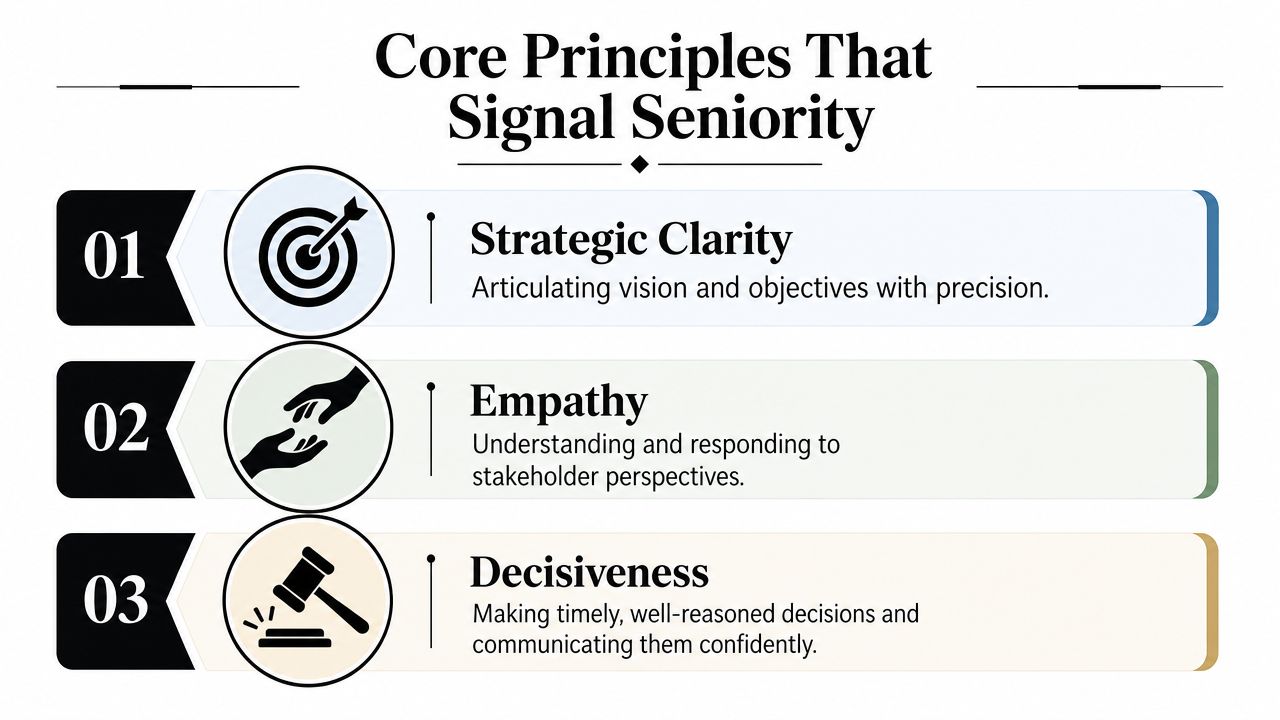
Core Principles That Signal Seniority
Senior communication is judged fast. In a meeting, people decide within the first minute whether you sound like someone who reports problems or someone who can lead through them.
Strategic framing
Senior professionals do not walk an audience through their thinking in discovery order. They lead with what matters to the business.
That usually means starting with one of four things: the decision, the risk, the trade-off, or the recommendation. After that, they add only the context needed to support action.
The same analysis should sound different depending on who is listening. A CFO wants financial exposure. A product lead wants trade-offs and downstream impact. A country manager may care more about timing, local risk, and operational load. International professionals often lose authority here because they focus so hard on accurate English that they forget to frame for the audience. Accuracy matters. Relevance matters more.
Clarity over complexity
Clear communication signals command. Complexity often signals unfinished thinking.
In technical and executive contexts, your job is to translate analysis into meaning. The useful standard from technical communication skills and translating data into meaning is simple: explain what the information means for the decision, not just what the information says.
If your audience still has to figure out the implication, your message is not finished.
This is a hard trade-off for strong subject matter experts. Cutting detail can feel risky, especially in a second language, where nuance takes more effort. But senior people are trusted because they reduce cognitive load for others. They make it easier to act.
Audience-centered delivery
Authority is never only about wording. It is also about calibration.
A board update needs compression and control. A team briefing needs direction. A tense stakeholder conversation needs firmness without sounding defensive. For international professionals, there is another layer. Accent, pacing, word choice, and politeness norms can all affect how confidence is perceived, even when the content is strong.
That is why executive presence work often goes beyond grammar or presentation tips. It focuses on how you sound under pressure, how you hold your message, and how you adapt without diluting authority. Professionals who want structured support with those skills often look at executive presence coaching for international professionals.
Presentation also shapes credibility before you speak. In some client-facing and leadership settings, visible choices such as dress still influence first impressions. A practical guide to female business attire is useful for professionals who want their appearance to support, rather than distract from, their message.
The principles matter more than tactics
Templates help. Stock phrases help. Preparation frameworks help.
But seniority comes through when the underlying judgment is strong. The principle drives the sentence, not the other way around.
Use this quick test:
| Principle | What it sounds like in practice |
|---|---|
| Strategic framing | “The issue is not the delay itself. The delay pushes launch into a higher-risk window.” |
| Clarity over complexity | “Several factors are involved, but one driver matters most.” |
| Audience-centered delivery | “For this group, I would focus on business impact, not the full technical path.” |
Common Communication Failures to Avoid
Most communication problems in ambitious professionals aren't random. They're recognizable habits. The good news is that senior alternatives are also learnable.

The information dump
The junior habit is to prove competence by showing everything. The senior move is to lead with the headline and pull in detail only when needed.
If you hear yourself saying, “To give a bit of background,” stop and ask whether that background changes the decision. If it doesn't, cut it.
The vague ask
A surprising amount of workplace communication ends without a clear request. People explain the issue, share context, and then leave everyone guessing about what should happen next.
Compare these two endings:
- “Let me know your thoughts.”
- “I recommend option B. If you agree, I'll finalize the plan today.”
Only one of them sounds ready for senior responsibility.
Misreading the room
You can deliver a factually correct message and still fail because the room wasn't ready for the way you delivered it. Maybe the audience is defensive. Maybe leadership is anxious. Maybe a peer group needs collaboration, not certainty.
International professionals often get unfairly judged. If your delivery already requires extra listener effort, a mismatch in tone makes the message even harder to accept. Work on accent reduction for executives can help here when the goal is not sounding different for its own sake, but sounding easier to follow in high-stakes settings.
The room rarely rewards the most complete speaker. It usually rewards the clearest one.
A simple replacement model
Use this shift when pressure rises:
| Junior habit | Senior alternative |
|---|---|
| Start with context | Start with conclusion |
| Share observations | State implication |
| End with discussion | End with recommendation |
| Defend expertise | Demonstrate judgment |
When people say someone has “executive presence,” they often mean this pattern. The person reduces noise, reads the moment, and makes it easier for others to move.
Take the First Step Toward Authoritative Communication
A capable professional gives an update in clear English, answers every question, and still leaves the room without influence. A more senior speaker says less, frames the decision, and makes the next move obvious. That is the standard business communication has to meet when promotion, visibility, and trust are on the line.
For international professionals, the gap often has little to do with expertise. The pressure comes from handling language, pace, pronunciation, cultural expectations, and executive scrutiny at the same time. The good news is practical. Authority is not a personality trait. It is a set of communication habits you can practice until they become reliable under pressure.
Quick-start guide
| Principle | Immediate Action |
|---|---|
| Lead with the point | Start your next update with your recommendation in one sentence |
| Reduce listener effort | Cut background unless it changes the decision |
| Sound more decisive | Replace “just sharing” language with a clear position |
| Match the channel | Move complex or tense issues out of chat and into conversation |
| Improve spoken clarity | Practice high-stakes phrases aloud before the meeting |
| Build credibility over time | Review your pronunciation habits for workplace communication using this guide on improving English pronunciation for work and career |
I give clients one instruction early: aim to be easy to trust. In practice, that means clearer structure, steadier delivery, tighter framing, and stronger judgment about what your audience needs from you right now.
Small shifts change how people read your seniority. A cleaner opening in a meeting. A firmer recommendation in email. Fewer extra words before the main point. Those are the signals colleagues and leaders use to decide whether you are ready for broader responsibility.
You do not need to sound like someone else. You need a communication system that holds up in high-stakes conversations.
If you want a practical starting point, take the free Executive Communication Assessment from Intonetic. It helps international professionals identify the habits that weaken authority in meetings, presentations, and tough conversations, so your next step is based on diagnosis rather than guesswork.