
Master Strategic Communication Skills: Lead with Impact
You're probably in one of these situations right now. You know your material cold, but in senior meetings your point lands flat, someone else reframes the same idea five minutes later, and suddenly that version gets traction. Or you're an international professional leading serious work in tech, finance, or consulting, yet your communication still gets judged as “not executive enough” even when your thinking is stronger than the room's.
That gap isn't usually about intelligence. It's about how authority, message, and delivery come together under pressure. Senior professionals don't get rewarded only for being right. They get rewarded for helping other people understand, trust, and act on what they're saying.
That's where strategic communication skills matter. Not as presentation polish. As a system for turning expertise into perceived seniority.
Why Strategic Communication Is Your Career Multiplier
A lot of capable professionals think communication becomes important after they reach leadership. It's the opposite. Communication is often what allows leadership to trust that you're ready for larger scope.
When your ideas don't gain traction, the cost isn't just personal frustration. Projects slow down. Stakeholders leave meetings unclear on priorities. Teams execute against different assumptions. If you want a useful baseline on the broader role communication plays in organizations, this overview of business communication in modern companies is a good place to start.
Poor communication carries a measurable business penalty. A 2026 projection on workplace communication costs estimates losses between $9,284 and over $30,000 per employee annually, adding up to $1.2 trillion for U.S. businesses each year. The same source notes that organizations with effective communication strategies see 4.5 times higher employee retention rates.
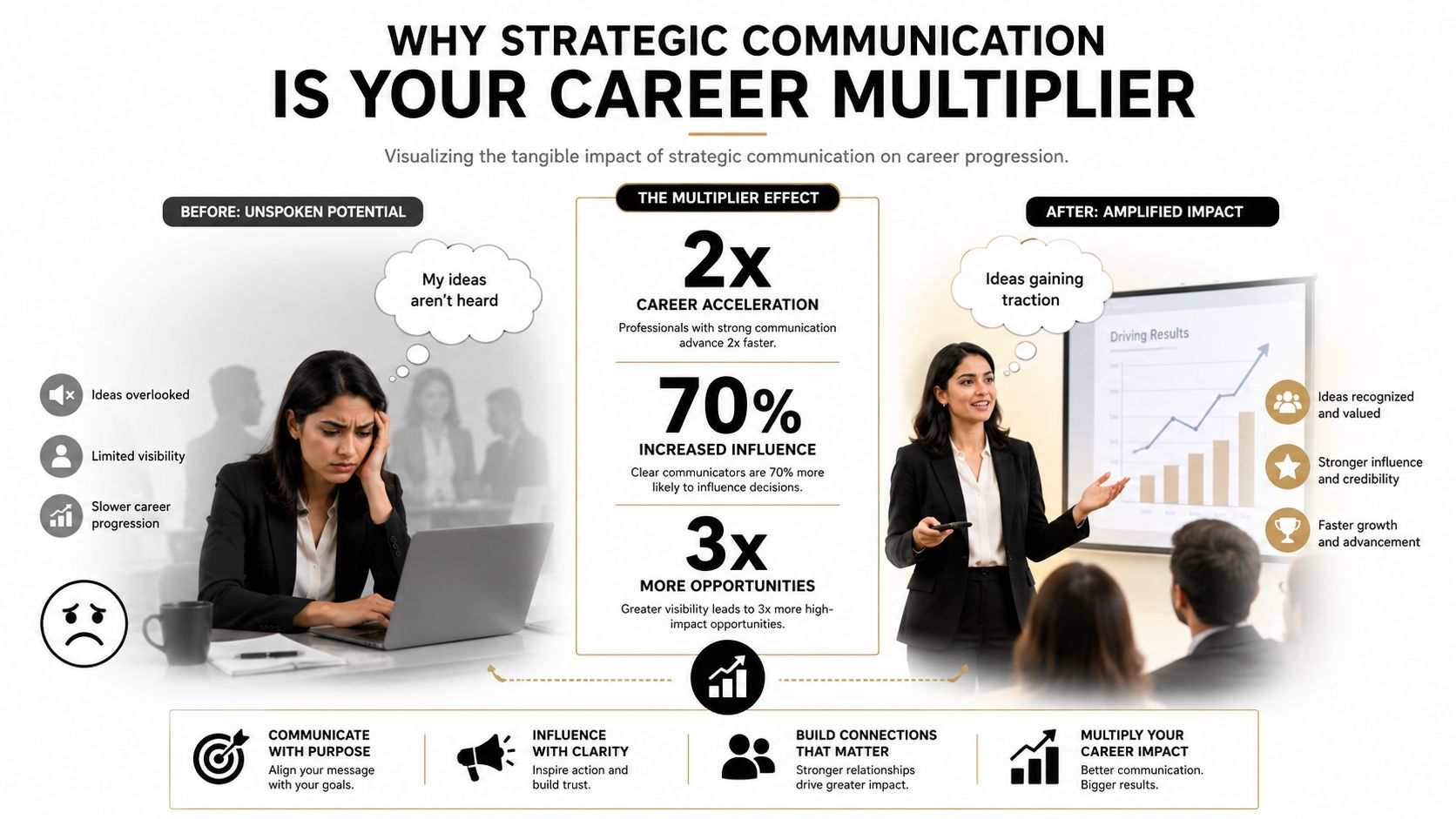
That's why I don't treat communication as a soft skill. I treat it as an operating skill. It protects revenue, reduces friction, and helps leaders align people around action.
Information sharing isn't the same as influence
Many professionals communicate accurately but not strategically. They provide updates, context, and detail. What they don't always do is shape interpretation.
Senior communication answers three questions fast:
- What matters most: The audience shouldn't have to dig for the point.
- Why it matters now: Relevance decides whether people listen.
- What should happen next: If there's no action, the communication is incomplete.
Practical rule: If your audience leaves with information but no clear decision path, you informed them. You didn't lead them.
This distinction matters most in high-stakes settings. A product leader explaining roadmap trade-offs to executives isn't just reporting. A finance director defending a recommendation in a tense review isn't just presenting numbers. A consultant challenging a client assumption isn't just speaking clearly. Each person is trying to move judgment, attention, and action.
Career growth follows perceived seniority
People often assume strong work should speak for itself. In senior environments, it rarely does. Someone still has to frame the significance of the work, connect it to business priorities, and deliver it with enough authority that others trust the recommendation.
That's why strategic communication skills become a career multiplier. They help technical expertise get recognized as leadership capability, not just functional competence.
The Three Pillars of Executive Communication
Most professionals try to improve communication by collecting tips. Speak slower. Be concise. Make eye contact. Prepare more. Those help, but they don't give you a diagnostic model.
A better framework is to think in three pillars: Authority, Message, and Delivery. This aligns closely with how executive presence is evaluated. According to Sylvia Hewlett's Center for Talent Innovation study of 4,000 professionals, senior leaders assess executive presence through gravitas at 67%, communication at 28%, and appearance at 5%.
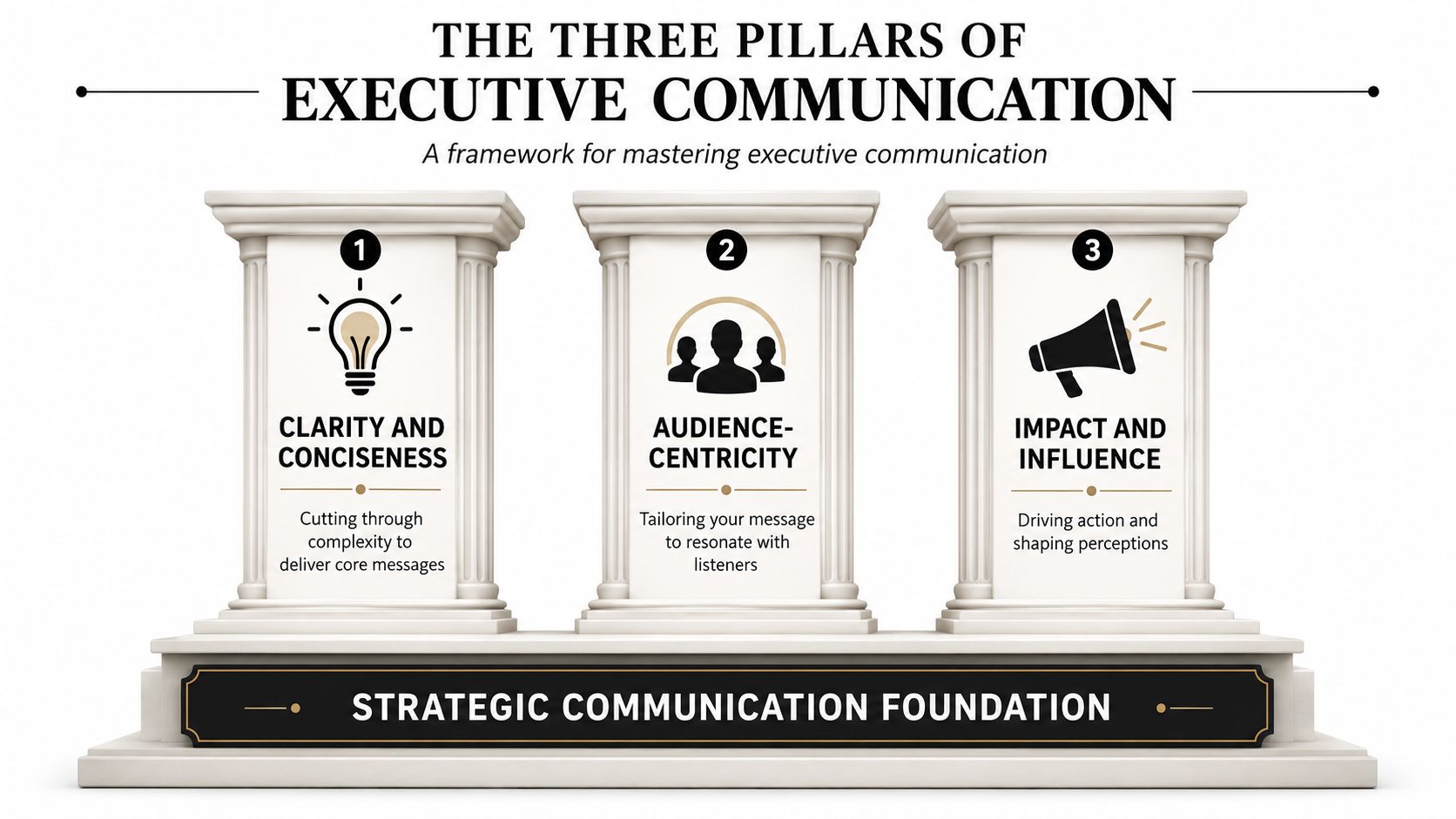
The labels vary across sources, but the practical lesson is clear. People don't judge seniority mainly by style. They judge whether you sound grounded, think clearly, and carry yourself like someone who can handle consequence. This deeper look at executive presence at senior levels helps if that concept still feels abstract.
Authority
Authority is the internal signal you send before anyone evaluates your slide deck. It shows up in how you enter a discussion, whether you sound rushed, whether you over-explain, and whether you defend every point too early.
Authority doesn't mean dominance. It means steadiness.
Common signs of weak authority include:
- Overloading context: You keep proving you've done the work instead of stating the recommendation.
- Verbal hedging: “This may be a silly point” or “I'm not sure, but…” weakens strong thinking.
- Reactive posture: You answer the emotion in the room instead of the issue being discussed.
A useful benchmark appears in this short video:
Message
Message is where many high-performers lose credibility. They know too much. Their explanation reflects the structure of their analysis, not the structure of audience attention.
A senior message is usually shorter than the speaker expects. It gets to the recommendation early, translates technical detail into business implication, and makes the next move obvious.
Strong communicators don't say more. They reduce the work the audience has to do.
If you're technical, this is often the biggest shift. Your job isn't to transfer everything you know. It's to transfer the minimum the audience needs to decide well.
Delivery
Delivery is the visible and audible expression of the first two pillars. It includes pacing, pauses, voice placement, facial tension, posture, eye line, and how you manage pressure when interrupted.
Appearance matters, but far less than many professionals fear. What usually changes perception faster is cleaner delivery. A calm pause. A lower, more settled pace. A direct answer instead of a defensive one.
Together, these three pillars create a practical self-audit:
| Pillar | Question to ask yourself | Typical failure mode |
|---|---|---|
| Authority | Do I sound like I trust my own judgment? | Hesitation, hedging, over-explaining |
| Message | Is my point obvious within seconds? | Detail before direction |
| Delivery | Does my presence support the message? | Rush, strain, visual distraction |
Mastering Strategic Framing and Structure Under Pressure
Pressure exposes weak structure. You can often get away with rambling in low-stakes settings because people are patient. In executive settings, they aren't. If the point isn't clear fast, attention drops and your credibility goes with it.
That's why strong strategic communication skills start before you speak. First, assess the audience. Then, structure the message.
Read the room before you build the message
Audience analysis sounds basic until you do it properly. The useful questions aren't “Who are they?” but “What do they care about, what will they resist, and what do they need in order to move?”
Before a high-stakes conversation, get specific:
- Knowledge level: Are you speaking to specialists, cross-functional peers, or senior leaders outside your domain?
- Resistance points: What are they likely to challenge first. Cost, risk, timing, optics, or execution?
- Expectations: Are they expecting a recommendation, a progress update, a decision, or reassurance?
- Pressure context: Are they overloaded, skeptical, politically exposed, or short on time?
This is also where channel choice matters. Some conversations need live discussion because alignment depends on immediate clarification. Others work better asynchronously when the material is complex and stakeholders need time to process. This practical breakdown of synchronous vs asynchronous communication methods is useful when you're deciding whether to handle a message in a meeting, in Slack, by email, or in a pre-read.
Use What So What Now What
A reliable structure under pressure is the What? So what? Now what? framework. A teaching source on this method explains that expert communicators use it to define the core information, clarify its relevance, and specify the next action. The same source notes that omitting the “now what” weakens retention and action in practice, which is why the framework is so effective in executive communication.
Here's how it works in real terms:
-
What
State the fact, observation, decision, or recommendation.
Example: “Customer onboarding friction is delaying activation for enterprise accounts.” -
So what
Translate meaning for this audience.
Example: “That delay affects revenue timing, implementation capacity, and renewal confidence.” -
Now what
Make the next step explicit.
Example: “I recommend we approve the revised onboarding sequence this week and pilot it with the next enterprise cohort.”
If you stop at analysis, senior people often hear uncertainty. If you finish with a clear next move, they hear leadership.
This matters even more when you talk to senior leadership in compressed, high-judgment situations. They don't need every branch of your reasoning at the start. They need your conclusion, the business relevance, and the decision path.
What doesn't work under pressure
A few habits consistently damage otherwise strong communicators:
- Chronological storytelling: You explain how you discovered the issue instead of stating the issue.
- Pre-defending every objection: You answer unasked questions before making a recommendation.
- Ending vaguely: “So, yes, those are my thoughts” leaves the burden on the audience.
In pressure moments, structure is composure made visible. If you know where you're taking the audience, you sound calmer because you are calmer.
Developing Vocal Authority and Executive Body Language
You can have a strong message and still sound junior if your delivery leaks strain. That happens all the time with highly competent professionals, especially when English isn't their first language. They know the content, but pace increases, breathing shortens, the voice rises, and gestures become either too small or too busy.
Delivery changes faster than people think when you train the right elements.
Build authority through the voice first
Leading executive coaching programs teach five concrete techniques for gravitas: voice control and pacing, strategic pauses, conflict resolution, time-blocking strategies, and emotional intelligence training, as outlined in IMD's executive presence guidance. In practice, the first two usually create the fastest visible shift.
Try these drills:
- Lower your pace on the first sentence: Don't rush the opening line. Your opening pace often sets the room's perception of your confidence.
- Pause after the main point: State the recommendation, then stop. Let people process it.
- Finish downward, not upward: If every sentence lifts at the end, you may sound unsure even when the content is solid.
- Mark emphasis intentionally: Stress the business noun or verb. Not every word deserves equal weight.
If you work remotely, clean audio matters more than many leaders realize. People often judge confidence through sound quality before they judge the content itself. If your environment is noisy, tools that reduce background noise with AI can help remove distractions so your pacing, tone, and pauses come through clearly.
For professionals who want a deeper voice and pacing practice routine, this guide on using your voice with more authority is a practical resource.
Executive body language without theatrics
Body language gets oversimplified. Executive presence isn't about copying expansive gestures or trying to look powerful. It's about reducing visible uncertainty.
Use these cues:
- Posture: Sit or stand tall enough to breathe freely. Collapsing your chest shortens breath and weakens projection.
- Stillness: Don't eliminate gesture. Eliminate restless gesture.
- Eye line: In person, land your point and hold eye contact briefly. On video, look into the camera when delivering the key sentence.
- Entry and reset: Before speaking, plant your feet or settle your seat position. Tiny resets create visible control.
A calm body helps produce a calm voice. A calm voice makes your thinking sound more credible.
The Gravitas Method is a 12-week one-on-one executive presence coaching program for international professionals who want to communicate with more authority and influence at senior levels. The program is priced at $8,200 paid in full or $9,000 across three installments. Coached by Nikola, it covers vocal authority, strategic framing, executive body language, and high-stakes communication.
Where senior professionals usually go wrong
Three patterns show up repeatedly:
- They confuse speed with fluency. Fast speech often signals anxiety, not mastery.
- They overcorrect body language. Forced gestures feel less authoritative than natural stillness.
- They treat delivery as separate from thinking. In reality, good delivery depends on clear internal structure.
You don't need a dramatic speaking style. You need a delivery style that supports trust.
Applying Your Skills in High-Stakes Scenarios
Communication advice becomes useful when it survives real pressure. In senior roles, the challenge usually isn't “How do I present better?” It's “How do I stay credible when stakes, politics, and time pressure all increase at once?”
A helpful way to practice is to borrow techniques from adjacent fields where message compression matters. For example, the discipline behind radio ad creation from SparkPod is relevant because it forces you to lead with a clear message, shape attention quickly, and make the next action unmistakable. High-stakes executive communication works the same way.
Strategic Communication in Action
| Role | High-Stakes Scenario | Strategic Communication Approach |
|---|---|---|
| Tech lead | Presenting a technical roadmap to non-technical executives | Lead with the business decision, not architecture detail. Use “What, So what, Now what” to connect technical sequencing to revenue, risk, or customer impact. Deliver the recommendation slowly, then support it with only the detail needed for trust. |
| Product manager | Challenging an unrealistic launch date in a cross-functional meeting | Start with alignment, then name the constraint directly. “We all want the same launch outcome. The current date creates quality and adoption risk.” Keep posture steady, avoid apologizing, and offer two viable alternatives instead of one objection. |
| Finance director | Defending a budget recommendation under scrutiny | State the recommendation first. Then explain the business trade-off in plain language. If challenged, don't refill the room with data immediately. Pause, answer the actual concern, and return to the decision path. |
| Consultant | Managing a demanding client negotiation | Distinguish between the client's stated request and the underlying business need. Use strategic pauses when the room becomes tense. Slow down rather than matching urgency. Frame recommendations around impact, implementation realism, and consequences of delay. |
| Data scientist | Explaining model limitations to commercial stakeholders | Translate uncertainty into decision language. Replace technical caveats with practical meaning. “This forecast is directionally useful for planning, but not precise enough for commitment.” Use clean visuals and don't narrate every line of analysis. |
| Senior manager | Disagreeing with a senior leader in a board-level discussion | Don't open with contradiction. Start with the shared objective, then introduce the risk. Keep your tone even and your body still. Offer a revised interpretation and a next step, not just a criticism. |
What this looks like in the room
In tech, the shift is usually from explanation to recommendation. Engineers and technical leads often assume detail creates confidence. For senior audiences, selective detail creates confidence.
In finance, the shift is from defensiveness to judgment. When budget pressure rises, strong communicators don't sound attached to the numbers. They sound responsible for the decision.
In consulting, the shift is from polish to control. Clients don't just evaluate what you know. They evaluate whether you can hold tension, absorb challenge, and still guide the conversation.
If you struggle most when interrupted or put on the spot, focused practice on how to think on your feet in live conversations is often more useful than more presentation rehearsal.
Measuring Your Growth and Taking the Next Step
Most professionals judge communication progress by feel. That's not enough. You need signals that tell you whether your strategic communication skills are changing how people receive you.
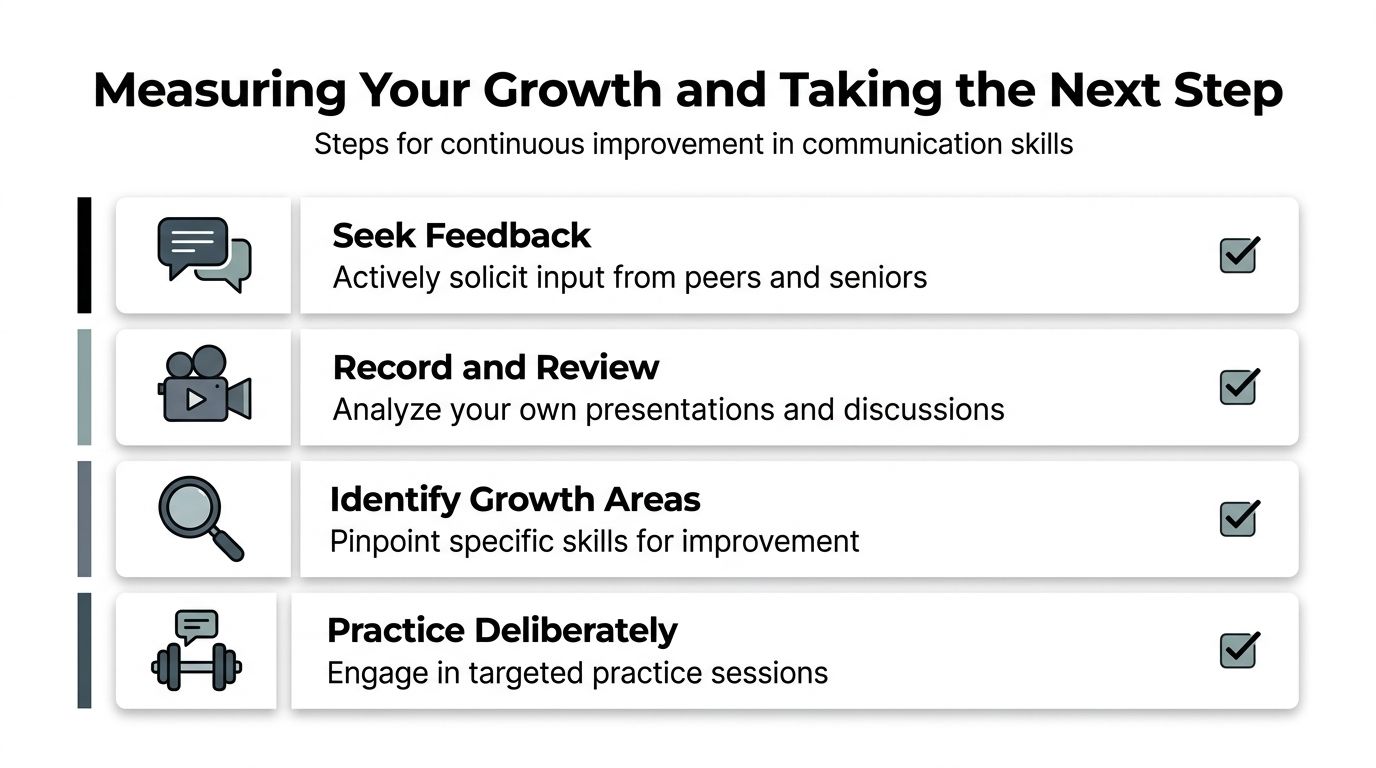
A strong measurement approach combines observation, feedback, and outcome. According to Selerix's guidance on communication strategy metrics, useful measures include message retention through follow-up conversations, idea adoption rates in meetings, and channel effectiveness. The same source warns that relying only on open rates or views is a frequent failure.
Track the signals that matter
Use a simple review after important meetings:
- Message retention: Can others restate your point accurately later?
- Idea adoption: Did the room move toward your recommendation?
- Invitation level: Are you being brought into more sensitive discussions?
- Channel fit: Did you choose the right format for the message?
Those questions tell you more than whether your slides looked polished.
Build a feedback loop
Ask for specific feedback, not vague impressions. “Did I seem clear?” won't help much. Better questions are:
- What was my main point as you heard it?
- Where did I sound least confident?
- At what moment did the message become most persuasive?
The fastest improvement usually comes when you measure how your communication changed other people's understanding, not how comfortable you felt while speaking.
Record yourself in low-risk settings. Review one variable at a time. Pace. Pauses. Sentence length. Openings. Endings. Trying to improve everything at once usually creates noise.
The professionals who improve fastest don't chase charisma. They train repeatable behaviors across the three pillars: authority, message, and delivery. That's how technical expertise starts sounding like executive readiness.
If you want a clearer view of where your communication is helping or limiting your perceived seniority, start with Intonetic's free Executive Communication Assessment. It's the best first step if you want an expert read on your authority, strategic framing, vocal delivery, and presence in high-stakes situations. From there, you can decide what to strengthen next and whether deeper support from Intonetic makes sense for your goals.