
How to Talk to Senior Leadership: Master Your Message
You probably know the feeling. You finally get time with a senior leader, you start explaining the background, and within seconds the conversation slips away from you. They interrupt with a question you weren't ready for. They jump straight to risk, budget, or timing while you're still laying out context. You leave thinking, “My idea was good. Why didn't it land?”
For many high-performing international professionals, that moment gets misread as a language problem. Sometimes language is part of it. More often, the underlying issue is strategic communication. Senior leaders aren't listening for effort or completeness. They're listening for signal. They want to know what decision is needed, what matters now, what could go wrong, and what you recommend.
That changes how you should think about how to talk to senior leadership. It isn't a presentation skill. It's an influence skill. It starts before the meeting, shows up in how you frame the message under pressure, and continues after the room goes quiet.
Why Most Conversations with Leadership Fail
A common failure pattern looks like this. A director or senior manager comes into the meeting ready, but ready in the wrong way. They have details, timelines, dependencies, and all the work that went into the project. What they don't have is an executive entry point.
So they begin chronologically. “We started looking at this last quarter…” Then they explain the background, the team's process, and the debate. By the time they reach the recommendation, the leader has already formed an impression: this person may be capable, but they're making me work too hard to find the point.

For non-native English speakers, this gets sharper. If you're already managing accent bias, processing speed, or the pressure to sound polished, it's easy to over-explain in order to sound careful. That instinct is understandable. It also weakens your authority. If that challenge feels familiar, this breakdown of accent bias in the workplace is worth reading because it helps separate communication mechanics from unfair perception.
Leaders are judging efficiency, not just fluency
Senior leadership usually isn't asking, “Was that a good presentation?” They're asking quieter questions.
- Can this person think at the right altitude
- Can they reduce noise
- Can they flag risk early
- Can I trust them with incomplete information and a moving situation
That's why weak communication creates more than awkward meetings. It creates business drag. Poor communication can cost companies between $10,000 and $55,000 per employee per year in lost productivity, and 86% of employees cite ineffective communication as a factor in workplace failures, according to workplace communication statistics compiled by High5.
Practical rule: If your update makes a senior leader work hard to identify the decision, your message is already losing power.
The problem is learnable
This is the part many talented professionals need to hear. Struggling in executive conversations doesn't mean you lack leadership potential. It usually means nobody taught you the operating system of senior-level communication.
Executive conversations reward compression, prioritization, and judgment. They punish rambling, excessive setup, and defensive detail. The shift is not from “speaking better English” to “sounding smarter.” The shift is from reporting work to directing attention.
Once you see that, the path gets clearer. You stop trying to cover every detail. You start trying to become useful at the level leadership values.
Decode Your Audience Before You Speak
Often, content is prepared before context. That's backwards.
If you want to know how to talk to senior leadership well, start by studying the leader, not your slides. A CFO, a business unit president, and a technical founder can hear the same sentence and react completely differently. One wants exposure and downside. One wants speed and trade-offs. One wants operational credibility. Your job is to know which room you're walking into before you open your mouth.
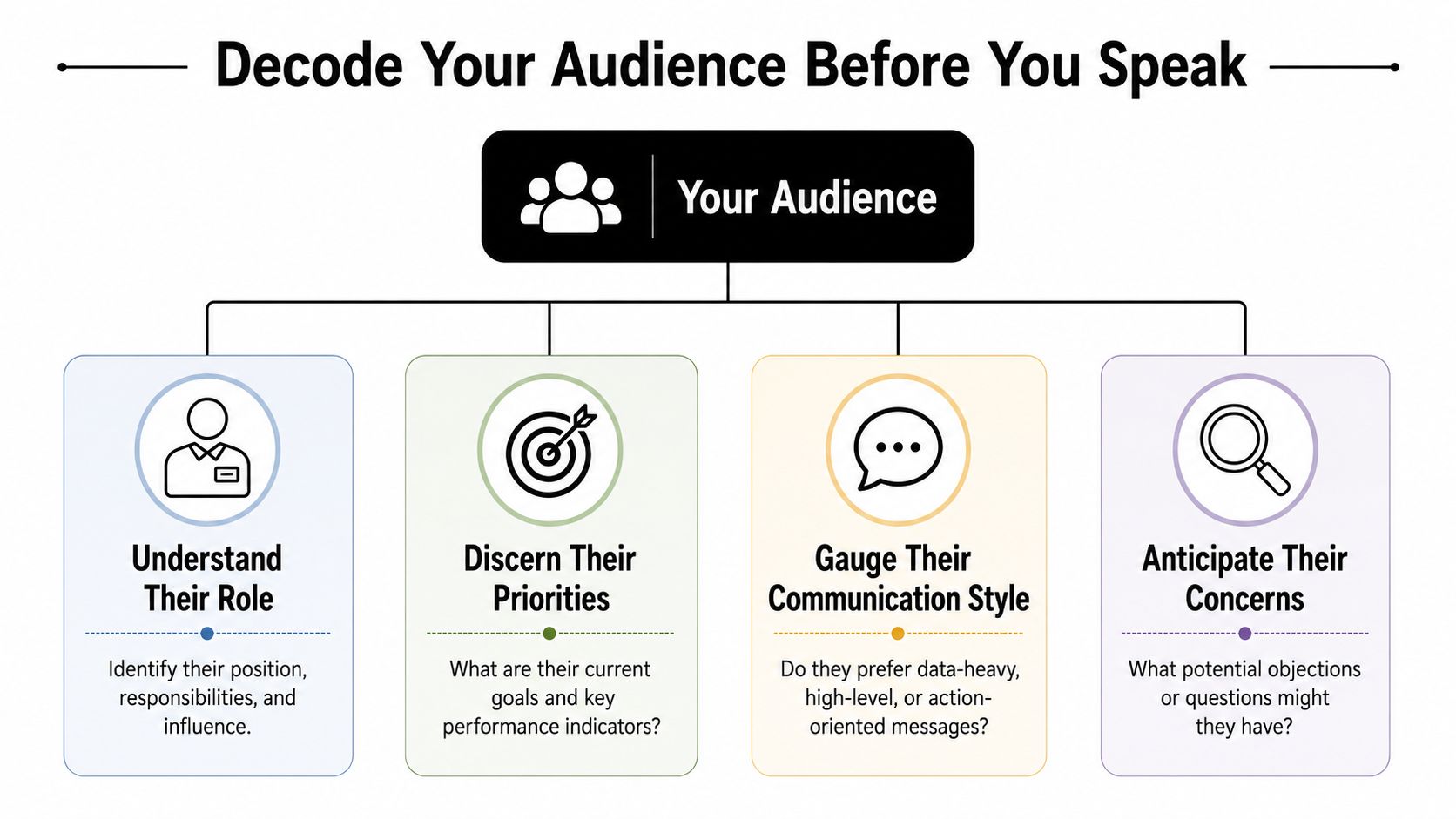
Harvard's guidance on managing up advises professionals to “speak in headlines” and frame updates around the leader's values and priorities because senior leaders are handling many competing demands and need concise information for fast decisions. You can read that guidance directly in Harvard's piece on communicating with senior leadership.
Build a leadership brief before the meeting
Create a one-page mental profile of the person you're speaking to. Not their biography. Their decision pattern.
Here's what to gather:
- Current priorities. What are they emphasizing in all-hands meetings, board updates, or quarterly reviews?
- Decision lens. Do they default to growth, cost, risk, customer impact, or execution discipline?
- Communication preference. Do they want a memo first, a one-slide summary, a verbal recommendation, or a spreadsheet appendix?
- Pressure context. What's happening around them right now that could shape their attention or patience?
Useful sources are often simple. Review recent internal communications. Ask colleagues who've presented to them. If you have access, ask the executive assistant how the leader prefers to receive pre-reads. That question alone can save you from bringing the wrong format into the room.
Senior leaders rarely reject a message because the idea is weak. They often reject it because the framing doesn't match the decision they need to make.
Four questions that sharpen your approach
Before any high-stakes conversation, answer these four questions in writing:
- What does this leader care about most right now
- What decision, approval, or alignment do I need
- What would make them skeptical
- What would make them trust me faster
Many international professionals gain ground quickly through the understanding that you don't need perfect phrasing if your framing is right. A leader will forgive a search for words. They won't forgive a message that ignores the business lens they operate from.
If you want a structured way to assess the gap between your current style and executive expectations, Intonetic offers a free Executive Communication Assessment that helps professionals identify where authority drops in real conversations.
Frame Your Message for Maximum Impact
The most useful shift in executive communication is simple. Lead with the recommendation. Not the history. Not the process. Not the amount of work your team did to get there.
Senior leaders need orientation fast. They want to know what you're asking for, what's at stake, and why your judgment is sound. Context still matters, but it comes after the decision frame.
Use a recommendation-first structure
A strong executive message usually fits this sequence:
-
Recommendation
“My recommendation is to delay the rollout by two weeks.” -
Business reason
“That protects the customer experience and reduces operational risk.” -
Supporting evidence
Include only the evidence needed to justify the judgment. -
Decision required
“I need your approval today so the teams can re-sequence work.”
That structure works in meetings, emails, pre-reads, and hallway conversations. It also helps non-native speakers because it reduces the amount of language you need to carry before reaching the point that matters.
What weak framing sounds like
Weak framing often sounds responsible, but it creates drag.
“We've been working across several teams to understand the implications, and there are a few areas we're still evaluating before we make a final recommendation.”
That sentence sounds thoughtful. It also tells a senior leader almost nothing. There's no point of view, no business consequence, and no decision path.
Strong framing sounds different:
“We should pause launch until the integration risk is resolved. The trade-off is a short delay now versus a larger customer issue later. I'm asking for approval to shift the timeline.”
That is easier to evaluate. It signals judgment.
Executive phrase alternatives
| Instead of Saying This… | Try Saying This… |
|---|---|
| We've been looking into a few options. | My recommendation is option B because it gives us the cleanest execution path. |
| I just wanted to give you an update. | The key update is this. We're on track, with one risk that needs attention. |
| There are a lot of details, but… | The headline is simple. We need a decision on timing. |
| I think this could maybe help. | This will improve coordination, but it requires clear ownership first. |
| We ran into some issues. | We've identified two risks early, and here's how we plan to handle them. |
| I'm not sure if this is the right approach. | I see two viable paths. My recommendation is the first one, and here's why. |
If this kind of compression is difficult, it helps to study adjacent writing skills too. A practical example is learning how to write an executive summary, because the same discipline applies in live conversation. Distill first. Expand only when asked.
Sound direct without sounding abrupt
Some international professionals worry that recommendation-first communication will sound rude. In practice, it sounds senior, as long as your tone is steady and your logic is clear.
You can soften without weakening:
-
Direct and respectful
“My recommendation is to keep the scope narrow for this phase.” -
Confident and collaborative
“Based on the trade-offs, I'd recommend option A. I'm happy to walk through the rationale.” -
Transparent under uncertainty
“We don't have perfect certainty yet, but the current evidence supports moving now.”
One structured option for professionals who want targeted coaching in these moments is The Gravitas Method, a 12-week one-on-one executive presence coaching program for international professionals who want to communicate with more authority and influence at senior levels. The program is priced at $8,200 paid in full or $9,000 across three installments. Coached by Nikola, it covers vocal authority, strategic framing, executive body language, and high-stakes communication.
Master the Room with Vocal and Nonverbal Cues
Even a strong message can collapse if the delivery signals uncertainty. Consequently, many capable professionals lose senior-room impact. The words are solid, but the voice rushes, the body contracts, the eye contact breaks too quickly, or the ending falls away as if asking for permission.

Executive presence is not about acting dominant. It's about making your delivery match the value of your thinking.
Use your voice to create authority
Three vocal habits matter immediately in senior conversations.
- Pace with intention. Nervous speakers often accelerate on important points. Slow down where the decision sits.
- Finish sentences cleanly. Don't let your voice drift upward at the end unless you are asking a question.
- Pause before key points. A short pause signals control and gives weight to what follows.
A lot of this is trainable through repetition. If you need a practical refresher on fundamentals, these effective verbal interaction strategies are a useful complement to higher-level executive work.
Let your body support the message
Your body should reduce friction, not create it.
Try these adjustments in meetings and video calls:
- Sit or stand still at the start. Don't begin speaking while fidgeting with notes, the camera, or your laptop.
- Keep gestures visible and deliberate. Hidden hands read as guarded. Chaotic hands read as anxious.
- Hold eye contact through the end of your main point. Many speakers look away at the exact moment they should project conviction.
- Take up appropriate space. Not performative space. Stable space.
If your body says “I'm unsure,” your words have to work twice as hard.
For international professionals, clarity beats speed
A common pattern among non-native English speakers is speaking too quickly to get through the sentence before losing it. That speed usually reduces clarity and lowers perceived authority.
When an accent creates a misunderstanding, don't apologize excessively or collapse. Reset the sentence calmly.
Try:
- “Let me say that more clearly.”
- “The key point is this.”
- “I'll repeat the recommendation.”
That response shows command. If articulation under pressure is one of your weak points, focused drills on how to enunciate better can help you become easier to follow without trying to erase your natural accent.
Here's a useful visual reminder on delivery mechanics:
Virtual rooms require extra precision
On video, small weaknesses get amplified. Lag interrupts rhythm. People multitask. Eye contact gets distorted. That means your delivery has to be cleaner than it would be in person.
In virtual executive meetings:
- Open with your point faster
- Use shorter sentences
- Pause after major statements
- Check for alignment without over-talking
“Would it help if I summarize the recommendation in one sentence?” is a strong reset line when a virtual room starts to drift.
Prepare for Questions and Handle Objections
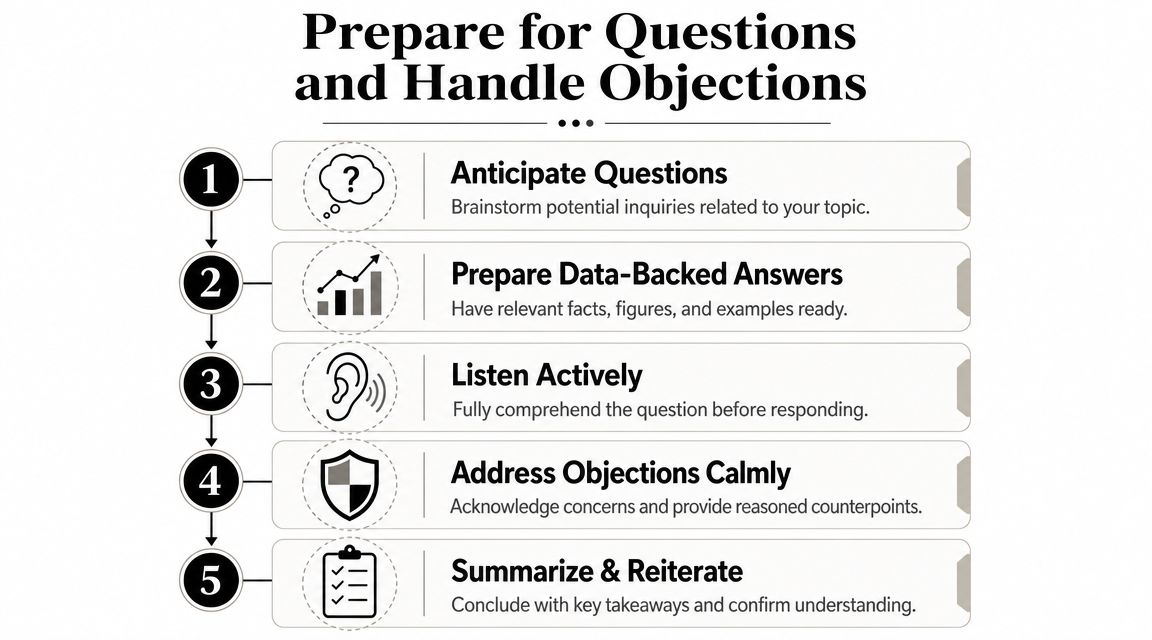
The element that causes apprehension is often the part that matters most. Questions tell you the room is engaging with your thinking. Silence can mean agreement, but it can also mean leaders don't trust the material enough to engage actively.
The mistake is treating Q&A as a test of memory. It's not. It's a test of judgment under pressure.
Rehearse for resistance, not for performance
A common approach involves rehearsing the polished version of a message. That helps with flow, but not with scrutiny. Better preparation involves pressure-testing the idea.
Use a simple three-part workflow:
- Run a pre-mortem. Assume the proposal failed. Ask what leadership would say went wrong.
- Ask a colleague to challenge it. Not politely. Aggressively enough to expose weak logic.
- Prepare your short answers. Not full speeches. Tight responses to likely objections.
Objections frequently arise from angles you didn't foreground: timing, optics, ownership, sequencing, dependency risk, or whether the team can execute what you're proposing.
Strong leaders don't trust answers that sound memorized. They trust answers that sound considered.
Use AI as a prep tool, not as a substitute for judgment
In a 2024 discussion, leaders from Google and Amazon said executives want less noise, not more information, and advised professionals to use AI to augment communication skills while relying on human judgment for strategy, tone, and credibility. That discussion is worth reviewing directly in this Google and Amazon leadership conversation.
That guidance maps well to preparation. AI can help you draft a briefing note, identify missing assumptions, or generate possible questions. It can also summarize background material so you spend more time on reasoning.
What it can't do for you is decide which objection matters politically, where trust is fragile, or when a technically correct answer will still fail in the room. Those are leadership calls.
A practical workflow looks like this:
- Draft your recommendation and rationale yourself.
- Use AI to generate possible executive questions.
- Edit the list based on your actual stakeholders.
- Rehearse live, out loud, with a human colleague.
- Tighten your answers after hearing where you ramble.
If your rehearsal happens on Microsoft Teams, tools for automating Microsoft Teams call recording can make review easier, especially when you want to catch filler language, defensive tone, or weak transitions in your own responses.
Handle hard questions without losing your center
You don't need instant brilliance. You need structure.
When a leader challenges you:
-
Acknowledge the question
“That's the right concern.” -
Answer the core issue first
Don't circle around the edges. -
Bridge back to the decision
“Given that risk, my recommendation stays the same, with one condition.” -
Say what you don't know cleanly
“I don't want to overstate certainty here. We're still verifying that piece.”
Bridging is especially useful when the question is broad, hostile, or off-topic. Good bridge phrases include:
- “The central issue is…”
- “What matters for the decision is…”
- “There are two parts to that…”
- “The short answer is yes, and the implication is…”
Practice pressure in a realistic way
Many international professionals practice English, but not executive pressure. Those are different. You need to rehearse interruption, challenge, and ambiguity.
Role-play works well here because it forces retrieval under stress rather than recall in comfort. If you want a practical framework, this guide on role-playing and simulation exercises to improve English accent and communication under pressure is especially useful for high-stakes professional settings.
The goal isn't to eliminate all uncertainty. It's to become the person who can stay clear when the room gets sharper.
Secure Your Win with Strategic Follow-Up
A leadership conversation isn't finished when the meeting ends. It isn't even finished when the leader says yes. It's finished when the decision is documented, the next steps are clear, and everyone leaves with the same understanding.
Many strong meetings gradually unravel. No summary goes out. Owners aren't named. Different people walk away with different assumptions. Then the project slows down and nobody can tell whether the original conversation produced alignment.
Send the follow-up while the conversation is still fresh
A good follow-up message does three things. It confirms what was decided, captures what still needs resolution, and shows that you own the next move.
A simple structure works well:
-
Opening line
Thank them briefly and restate the purpose of the meeting. -
Decision or key takeaway
One sentence. Clear and unambiguous. -
Action items
List each item with the owner and expected timing. -
Outstanding risks or open questions
Keep these short and visible. -
Next checkpoint
State when you'll update them again.
A workable follow-up template
You don't need a polished memo every time. Often a concise email is stronger.
Thanks for the discussion today. The key decision was to proceed with the narrower rollout path, with added review on the integration dependency.
Next steps:
- I will update the plan and circulate the revised timeline.
- Finance will review budget implications.
- Product and engineering will confirm readiness on the remaining dependency.
The main open issue is sequencing across teams. I'll return with a confirmed recommendation after cross-functional review.
That kind of note signals reliability. It also protects you. If priorities shift later, you have a clean record of what was discussed and what was agreed.
Follow-up builds long-term influence
Senior leadership remembers patterns. They remember who creates clarity after complex discussions. They remember who flags issues early, follows through, and keeps decisions moving.
That reputation compounds. Not through charisma alone, but through disciplined communication across the full cycle. Before the meeting, you gather intelligence. In the meeting, you frame the decision. Under pressure, you answer with judgment. After the meeting, you lock in alignment.
That is how to talk to senior leadership in a way that changes how you're perceived.
If you want a practical next step, start with Intonetic's free Executive Communication Assessment. It gives you a clearer view of how your current communication style lands in high-stakes settings and where to focus first if you want to speak with more authority, precision, and influence at senior levels.