
What Is Executive Presence: Actionable Tips for Leaders
You know the feeling. You prepare thoroughly, bring a sharp recommendation to a senior meeting, explain it clearly, and still the room moves on. Then a colleague reframes the same idea with a steadier voice, tighter structure, and more visible confidence. Suddenly people nod, ask follow-up questions, and treat the idea as strategic.
That gap is usually not about intelligence. It's rarely about effort either. More often, it's about executive presence.
For international professionals, this gap can feel especially frustrating. You may already be operating at a high level, but your delivery, pacing, framing, or accent can change how senior leaders interpret your authority. The good news is that executive presence isn't a mysterious trait some people are born with. It's a set of behaviors you can observe, practice, and strengthen.
What Is Executive Presence Really
What is executive presence? It's the combination of visible and audible signals that make other people trust your judgment, follow your lead, and believe you can handle pressure.
That means executive presence is not the same as charisma. It's not being loud. It's not performing confidence. And it's definitely not copying someone else's personality.
Executive presence shows up in moments like these:
- In meetings: You make a point once, clearly, and people understand the decision you want.
- Under pressure: A challenge comes your way, and you respond without rushing, shrinking, or over-explaining.
- In high-stakes communication: Your voice, structure, and body language support your message instead of weakening it.
A lot of professionals assume presence is innate because they only see the finished product. They see the composed VP, the sharp founder, the trusted department head. They don't see the rehearsal, correction, self-awareness, and repeated practice behind that impression.
Executive presence is best understood as a professional signal. It tells people, often very quickly, whether you sound ready for more responsibility.
For non-native English speakers, that signal gets filtered through extra layers. People may confuse language processing time with uncertainty. They may misread careful word choice as hesitation. They may react to accent before they evaluate substance. That doesn't mean the problem is your competence. It means delivery matters more than many people admit. This breakdown of how your accent really affects your career and what you can actually do about it speaks to that reality directly.
What executive presence is not
It helps to rule out bad advice early.
| Myth | What actually works |
|---|---|
| “Just be more confident” | Build behaviors that communicate steadiness and clarity |
| “You need a stronger personality” | You need stronger delivery under pressure |
| “Presence is mostly appearance” | Appearance matters, but judgment, composure, and communication matter more |
| “Accent is the problem” | Accent alone isn't the issue. Authority, pacing, framing, and vocal control matter more |
If you can learn to think clearly under pressure, speak in a more deliberate rhythm, and structure your message so senior people can act on it, you can build executive presence.
Why Executive Presence Is a Career Multiplier

At senior levels, technical skill stops being enough on its own. People still need expertise from you, of course. But they also need to believe you can represent the business, influence stakeholders, handle ambiguity, and make sound decisions under pressure.
That's where executive presence becomes a multiplier rather than a nice extra.
According to a Coqual executive presence study summarized by Garfinkle Executive Coaching, executive presence accounts for 26% of what it takes for a leader to secure their next promotion. That number matters because it captures something many high performers discover late. Promotions at senior levels don't go only to the person who works hardest or knows the most. They often go to the person others can already picture in the bigger seat.
Why strong performers still get overlooked
Three patterns come up repeatedly in practice:
- They sound detailed but not directional. Senior leaders want analysis, but they also want a recommendation.
- They lose composure when challenged. Even subtle defensiveness changes how authority is perceived.
- They communicate effort instead of judgment. Hard work earns respect. Senior presence earns trust.
A director who says, “We analyzed several possible approaches and there are many trade-offs,” may be accurate. A stronger executive version sounds more like, “We assessed the options. I recommend path two because it reduces operational risk and gives us room to scale.” Same intelligence. Different leadership signal.
Practical rule: Senior people listen for clarity under pressure. If your message gets longer as the stakes rise, your presence usually gets weaker.
Executive presence also matters because people make fast assessments. They decide whether to trust your recommendation before they have full information. They infer seniority from your pacing, your ability to summarize, your response to interruption, and the way you hold a room when tension rises.
A short explanation can help sharpen the distinction:
What it changes in real career terms
When executive presence improves, several things usually shift qualitatively:
- Your ideas get less “translation delay.” People grasp your point faster.
- You face less unnecessary pushback. Not because everyone agrees, but because your recommendation sounds considered.
- You become easier to sponsor. Leaders back people they trust to represent them well.
This is why executive presence matters so much in hybrid organizations too. In a boardroom, on Zoom, or in a cross-functional review, people are constantly asking one silent question: would I trust this person with a bigger decision?
If the answer is yes, your career moves differently.
The Three Pillars of Executive Presence
Most professionals improve faster once executive presence stops feeling vague. The clearest way to work on it is to break it into three pillars: gravitas, communication, and demeanor.
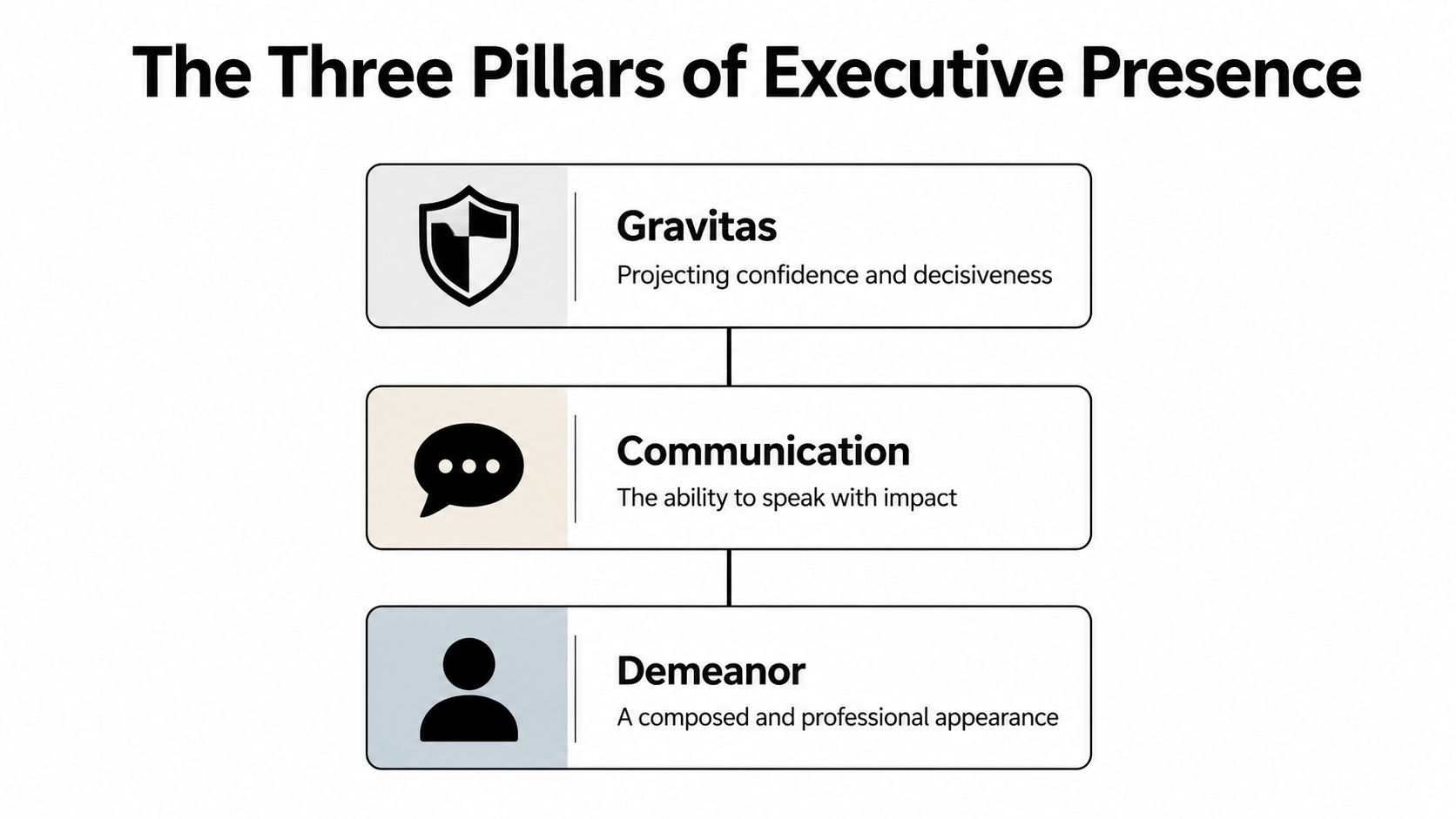
A Center for Talent Innovation finding summarized by Esade reported that 67% of senior executives identify gravitas, defined as confidence, poise under pressure, and decisiveness, as the core characteristic of executive presence. That tells you where to put your effort first.
Gravitas
Gravitas is the weight behind your words. It's the feeling that you can handle complexity without becoming visibly scattered.
What gravitas looks like in practice:
You get a tough question in a meeting. You pause, think, answer directly, and don't rush to defend yourself.
Someone without gravitas often over-explains, retreats into detail, or starts qualifying every sentence. Someone with gravitas may still say “I need to verify that,” but they say it calmly, with ownership.
Useful signs of gravitas include:
- Steady reactions: You don't look rattled by disagreement.
- Decisive language: You state a recommendation instead of circling it.
- Calm boundaries: You can say no, push back, or redirect without sounding tense.
For many international professionals, gravitas is less about “becoming bolder” and more about removing signals of uncertainty that don't reflect actual capability.
Communication
Communication is where many high-achieving professionals either gain or lose authority. Strong ideas don't create executive presence on their own. The audience has to receive them in a form that feels clear, concise, and senior.
A practical benchmark is this: can you explain the issue, your recommendation, and the business impact in a short, clean sequence?
Try this structure:
- State the issue
- Name the recommendation
- Explain the business impact
That simple frame helps you stop narrating your thought process in real time. It also helps if English isn't your first language, because structure reduces the pressure to improvise.
If you want to sharpen the language side of this, some of the Mandarin Mosaic language learning strategies are useful because they focus on practical communication habits rather than abstract fluency goals. For workplace authority, that distinction matters.
Clear communication at senior levels is rarely about saying more. It's about making your point easier to trust.
Pronunciation also plays a role here, not because you need to erase your identity, but because unclear sounds, uneven stress, and rushed rhythm can hide your authority. This guide on how to improve your English pronunciation for work and career addresses that directly.
Demeanor
Demeanor is the visible part of presence. It includes appearance, posture, facial control, eye contact, and how composed you seem on camera.
Many people over-focus on polish in this area. Yes, grooming and professional presentation matter. But demeanor works best when it supports the other two pillars.
A few examples make the distinction clear:
- A polished leader who fidgets, rushes, and avoids direct answers won't feel senior for long.
- A leader who sits upright, holds eye contact, and speaks with calm precision often does.
- On video, demeanor includes whether your face looks tense, whether you interrupt your own pauses, and whether your camera presence feels settled.
How the pillars work together
These three pillars reinforce each other.
| Pillar | What people notice | What weakens it |
|---|---|---|
| Gravitas | Calm authority under pressure | Defensiveness, over-qualification |
| Communication | Clear, concise, persuasive thinking | Rambling, weak structure, filler |
| Demeanor | Composed professional impression | Visible tension, distracting habits |
If one pillar is weak, the others have to work harder. A brilliant message delivered with tension and hesitation won't land as strongly. Good posture with poor structure won't create much influence either.
Executive presence becomes more reliable when all three start working together.
How to Assess Your Own Executive Presence
Presence is often judged by feeling. That's not enough. You need to assess behavior.
A useful starting point comes from a Hallett Leadership summary on executive presence, which notes that leaders scoring high in emotional steadiness, defined as maintaining composure via steady vocal tone (variance <10% in pitch modulation under stress) and strategic pause ratios, achieve 25% faster team decision-making. You don't need laboratory tools to use that insight. You do need to observe how you sound when pressure rises.

A practical self-audit
Use the checklist below after a presentation, stakeholder meeting, or difficult conversation.
For gravitas
- Pressure response: When challenged, did your voice tighten or stay steady?
- Decision posture: Did you make a clear recommendation, or did you leave the room to choose for you?
- Emotional control: Did you appear composed even when you disagreed?
For communication
- Structure: Could you explain your point in a short sequence without wandering?
- Pacing: Did you rush important ideas?
- Conciseness: Did you answer the actual question, or did you add extra context to feel safer?
For demeanor
- Posture: Did you look physically grounded?
- Facial control: Did your expression support your message, or show uncertainty?
- Camera presence: On Zoom, did you look engaged and settled?
What to listen for in your own recordings
Recording yourself is uncomfortable. It's also one of the fastest ways to improve.
Listen for:
- Pitch jump under stress: Your voice gets higher when challenged
- Filler clusters: “Um,” “maybe,” “sort of,” “I think”
- Collapse at the end of sentences: Your voice fades when you need conviction
- Lost pauses: You answer too fast to sound thoughtful
One useful precursor to this kind of assessment is reflecting on your work impact first. That process helps you separate actual value from the habits that may be obscuring it in conversation.
If your communication feels weaker in high-stakes moments than in casual conversation, assess under pressure, not in ideal conditions.
If you want an external baseline rather than guessing, a structured accent reduction assessment can help identify where pronunciation, pacing, and vocal delivery may be affecting authority.
Developing Presence as an International Professional
You explain the strategy clearly in your head. Then the meeting starts, the discussion speeds up, and your delivery loses force. You add more context than you want, speak faster than usual, or soften a point that would have sounded decisive in your first language. That gap matters, especially in global tech and finance, where senior leaders are judged as much on signal and clarity as on technical judgment.
Generic advice misses the problem. International professionals are often told to "be more confident" when the real challenge is speaking under pressure in a second language, handling accent bias, and adjusting to communication norms that were never made explicit.
A Center for Talent Innovation finding referenced by Ivey Executive Education points to a promotion gap around authoritative speech in multinational firms. I see that gap in practice. Strong operators get trusted with execution, but their visibility stalls because their communication does not sound as settled as their thinking.

Build vocal authority without erasing your identity
Senior presence does not require a native accent. It requires speech that is easy to follow, well paced, and confident under scrutiny.
Focus on the parts of delivery that affect authority fastest:
- Slow the pace enough to think while speaking: Speed often reads as tension, not intelligence.
- Stress the key words: Clear sentence stress helps listeners track your logic.
- Finish statements cleanly: Strong endings make recommendations sound deliberate.
- Protect your volume: If your voice drops at the end of important points, your authority drops with it.
The trade-off is real. If you spend all your attention monitoring pronunciation, you lose focus on message quality. If you ignore delivery entirely, your message may never land with the weight it deserves. The better approach is to improve intelligibility and composure first. For practical ways to do that, start with how to speak English with confidence even with an accent.
Use processing time well
Many non-native speakers rush to respond because silence feels dangerous. In senior settings, the opposite is often true. A short pause usually signals judgment.
Use a simple response pattern in high-stakes conversations:
- Pause
- State the recommendation
- Give one reason
- Stop
Example:
“My recommendation is to delay the rollout by one quarter. The main reason is implementation risk across two regions.”
This structure works because it reduces language load while increasing authority. You do not need to perform fluency. You need to make your thinking easy to trust.
Adjust to the communication code at senior levels
In many English-speaking executive environments, stakeholders expect the conclusion early. If your cultural training taught you to build context first, your message can sound less decisive than it is.
That does not mean your original style is wrong. It means the audience is using a different code for competence.
A practical adjustment looks like this:
| If your default is… | Try this instead |
|---|---|
| Background first | Recommendation first |
| Detailed explanation | One headline reason, then details if asked |
| Speaking quickly to prove fluency | Slower pace to show control |
| Filling pauses to avoid awkwardness | Brief silence before a key point |
This is one of the biggest shifts I coach. International professionals often assume they need better English, when what they need is a better match between their message and the expectations of senior listeners.
What tends to work
Presence improves faster when you stop chasing perfection and start choosing signals deliberately.
Clearer phrasing beats more complex phrasing.
A steady pace beats speed.
A direct recommendation beats a long preamble.
Composure beats verbal effort.
Executive presence for international professionals comes from making your expertise visible in the room, on camera, and under pressure. Your goal is not to sound like someone else. Your goal is to sound credible, clear, and senior in the version of English you use every day.
Your Next Steps to Building Unshakable Presence
You finish a senior meeting with the right analysis, but someone else gets remembered as the leader in the room. That gap usually comes down to signals you can train.
Executive presence develops through repeated, visible choices. How you open a recommendation. How you hold a pause when challenged. How you sound when the stakes rise. For international professionals in tech and finance, this matters even more because strong expertise can be underestimated when delivery does not match senior-level expectations.
Start narrower than you think.
Trying to fix everything at once usually creates more self-monitoring, which makes you sound less natural. Pick the one behavior that weakens your authority most often, then work on it until the change holds under pressure.
A useful way to choose your focus:
- If your message runs long: Practice a recommendation-first structure with a clear opening line.
- If your delivery feels strained: Slow your pace and let key points breathe.
- If you look less senior on camera than in person: Adjust posture, framing, and eye line before the call starts.
- If accent anxiety pulls your attention away from your message: Work on clarity, emphasis, and sentence control instead of chasing perfect pronunciation.
I tell clients this often. Presence strengthens when your ideas, voice, and behavior send one consistent signal.
That is also the trade-off. A polished vocabulary means little if your recommendation arrives late. Perfect grammar does not help if tension shows up in your pace. Senior stakeholders respond to clarity, judgment, and control first.
If you want a structured starting point, use this executive presence coaching and communication assessment. It helps pinpoint whether your biggest constraint is strategic framing, vocal authority, body language, or pressure handling, so your practice time goes to the right place.
If you are serious about improving, set a 30-day focus. Choose one meeting type, one behavior, and one feedback source. That is how presence becomes reliable, not occasional.