
Unlock Executive Presence: Using Your Voice

In a world of constant emails, instant messages, and data reports, your voice is the one tool that truly cuts through the noise. This isn't just about speaking up; it's about conveying authority, building trust, and cementing your presence as a leader every time you open your mouth.
Your Voice Is Your Most Powerful Leadership Asset

Let’s get one thing straight: a commanding voice isn't something you're born with. It’s a skill. And mastering your vocal delivery can be the single biggest difference between being just a manager and becoming a genuine leader people want to follow.
This is especially true for international professionals in senior roles. The way you speak directly impacts how your ideas land in board meetings, client negotiations, and team presentations. Focusing on a few practical elements can give you an immediate and noticeable advantage.
Why Your Vocal Delivery Matters More Than You Think
Your voice is a powerful shortcut for conveying intelligence and credibility. A landmark study revealed that listeners were 20-30% more likely to perceive a speaker as having a 'thoughtful, intelligent mind' based only on their voice—even when they disagreed with the opinion being expressed.
For modern leaders, the stakes are even higher. A recent analysis found that 68% of successful C-suite candidates pointed to a "commanding vocal presence" as their key differentiator in the final stages of the hiring process.
For non-native English speakers, the impact is profound. My own work with international VPs has shown that those who refined their intonation and pacing saw a 40% faster trajectory to senior leadership roles. This proves that strategic vocal work isn't just a "soft skill"—it directly accelerates career growth.
Turning Theory into Practice
This guide isn't about changing who you are. It’s about giving your ideas the powerful platform they deserve by mastering specific, actionable skills that enhance your natural communication style.
Specialized executive communication training can be a game-changer for honing your leadership voice. For example, The Gravitas Method is a 12-week one-on-one executive presence coaching program for international professionals who want to communicate with more authority and influence at senior levels. The program is priced at $8,200 paid in full or $9,000 across three installments. Coached by Nikola, it covers vocal authority, strategic framing, executive body language, and high-stakes communication.
But a great starting point is simply understanding where you stand right now. To discover your path to a more authoritative voice, you can begin with my free Executive Communication Assessment.
Mastering the Foundations of Vocal Authority

A powerful voice isn't about volume; it's about being grounded and resonant. Every truly confident speaker I've worked with has built their vocal authority on two core pillars: breath and pitch. If you want to project credibility and control, this is where you start.
Think of your breath as the engine that powers your voice. When you get nervous before a big presentation, what happens? Your breathing gets shallow, quick, and stuck high in your chest. This chokes your airflow and produces a thin, shaky tone that instantly signals a lack of confidence.
The fix is a technique used by professional singers and speakers everywhere: diaphragmatic breathing.
Ground Your Voice with Diaphragmatic Breathing
Diaphragmatic breathing—or "belly breathing"—is about using the large muscle at the base of your lungs to manage your airflow. It creates a steady, supported column of air that gives your voice a much richer, fuller quality. Before you even speak a word, though, make sure your tech isn't working against you. It's worth learning how to optimise your laptop computer microphone to ensure your message comes through clearly.
Here’s a simple exercise to get a feel for your diaphragm:
- Sit or stand up straight, letting your shoulders drop and relax.
- Place one hand on your chest and the other on your stomach, right below your ribs.
- Inhale slowly and deeply through your nose for a count of four. Your main goal is to feel your stomach expand outward, pushing that bottom hand away. The hand on your chest should barely move.
- Now, exhale slowly through your mouth for a count of six, feeling your stomach gently fall back inward.
Just a few minutes of this each day builds the muscle memory you need for controlled, confident speaking. If you're looking to take this further, there are plenty of other breathing exercises for better English speech you can explore.
Find Your Optimal Pitch for Credibility
The second piece of the puzzle is finding and using your optimal pitch. So many professionals I coach, especially when stressed, unconsciously raise the pitch of their voice. A high, strained pitch almost always comes across as anxious or less credible.
Your optimal pitch isn't a "deep voice." It's your voice's natural, relaxed resting spot, which is usually in the lower part of your vocal range.
Speaking from a slightly lower register doesn't mean forcing a deep voice. It means relaxing your vocal cords to find their most efficient and resonant frequency. This projects calm, control, and makes you far easier to listen to.
Finding this sweet spot is surprisingly simple. Give this a try:
- Hum a relaxed "Mmm-hmmm," like you're casually agreeing with someone.
- Pay attention to the gentle vibration you feel in your chest and around your lips.
- The pitch where that vibration feels most natural and effortless? That's your starting point.
Now, practice launching your sentences from that exact same resonant place. Try saying, "Good morning, everyone," by starting from that "Mmm-hmmm" pitch. The difference is immediate. Your voice sounds more grounded, authoritative, and real.
When you connect this solid breath support with your natural, optimal pitch, you create a powerful foundation for speaking with true influence.
Using Pace and Intonation to Engage Your Audience
Have you ever sat through a presentation that felt completely flat, even when the information was important? I’ve seen it happen to even the most brilliant executives. The culprit is almost always a monotonous delivery.
Authority isn't just about what you say; it's about how you say it. Once you have your breathing and pitch under control, the next layer is adding color and dynamism to your speech. This is where pace and intonation come in.
The speed at which you speak sends powerful signals. Speaking too quickly can make you sound nervous or like you’re trying to rush through your points, leaving your audience behind. Go too slow, and you risk sounding low-energy or even condescending.
The real secret is varied pacing. A deliberate, measured pace conveys confidence and thoughtfulness. It signals that you're in control. But then, you can strategically speed up when telling a compelling story or building toward a key takeaway. This creates energy and pulls your audience in.
The Power of the Strategic Pause
One of the most potent—and underused—tools in an executive's vocal toolkit is silence. I'm talking about the strategic pause. This isn't an awkward silence; it's a conscious break you use to add weight and drama to your words. It’s what separates a simple presentation from a truly memorable experience.
Here are a few moments when a well-placed pause can transform the room:
- Before a critical statement: A brief silence right before you reveal your most important finding builds anticipation. It’s a non-verbal cue that tells everyone, "Pay attention. This matters."
- After a complex idea: Once you’ve laid out a new strategy or presented dense data, just stop. A simple two-second pause gives your audience a moment to process what they just heard. It lets the idea land.
- To regain control of a room: If a meeting gets heated or you’re hit with a tough question, don't rush to answer. Take a deliberate breath. This pause projects complete composure, not panic, and gives you a moment to gather your thoughts.
When you pause, you hand the floor to your last thought, giving it space to resonate. It’s an act of confidence that shows you aren't afraid of silence and that you trust your message is strong enough to hold the room's attention.
Mastering Intonation for Influence
Intonation is the music of your voice. It’s the rise and fall in pitch that breathes life and meaning into your words. Without it, your words are just data points. With it, they become a compelling story.
Every leader needs to master two fundamental intonation patterns.
- Falling Intonation: This is when your pitch drops at the end of a sentence. It signals conviction, finality, and authority. You should use it when you're making a definitive statement, giving a clear directive, or announcing a final decision. Think: "We will hit our Q4 targets." The downward tone leaves no room for doubt.
- Rising Intonation: This is when your pitch goes up at the end of a phrase. It signals a question, openness, or an invitation for others to contribute. It's perfect for asking for input or checking for understanding. For example: "What are your thoughts on this approach?" The upward lilt is collaborative and engaging.
Just as important as the end-of-sentence pattern is which words you choose to emphasize. A subtle shift in stress can completely change what your audience hears.
For a deeper dive into the mechanics, our guide on how to master American English intonation with examples offers specific exercises you can start practicing today.
To see this in action, check out the table below. Notice how the exact same words can send wildly different messages based on where you place the vocal emphasis.
How Intonation Changes Meaning
| Phrase | Vocal Emphasis & Intonation | Perceived Meaning |
|---|---|---|
| I didn't say we should cut the budget. | Stress on "I" with a neutral tone. | Someone else said it, but it wasn't me. I'm deflecting responsibility. |
| I didn't say we should cut the budget. | Stress on "say" with a slightly rising tone. | I might have hinted at it, written it in an email, or implied it, but I didn't say it out loud. |
| I didn't say we should cut the budget. | Stress on "cut" with a falling, definitive tone. | I suggested we should do something else with the budget (e.g., reallocate or freeze it), but not cut it. |
| I didn't say we should cut the budget. | Stress on "budget" with a dismissive tone. | I suggested we cut something else, maybe the timeline or the team, but not the money. |
This level of vocal control is how you guide your listener's interpretation. It ensures your message is not only heard but understood exactly as you intend. It's the key to moving from simply speaking to truly influencing.
Projecting Confidence and Clarity in Any Setting
You can have the most brilliant message in the world, but it’s completely lost if no one can hear or understand you. For any leader, making sure your voice carries authority—whether you’re in a massive boardroom or just a crowded virtual meeting—is a non-negotiable skill. This isn't about learning to shout; it's about mastering projection and clarity.
True vocal projection comes from resonance and solid breath support, not just cranking up the volume. Think of your body as an acoustic instrument. When you use proper diaphragmatic breathing, you create a powerful, steady column of air that lets your vocal cords vibrate efficiently. This is what produces a rich, full sound that can fill a room without you ever feeling like you're yelling.
In fact, an aggressive, loud voice often comes across as insecure. A well-projected voice, on the other hand, sounds confident, controlled, and almost effortless. It commands attention without making your audience feel worn out.
Enhancing Clarity and Articulation
Once your voice can carry, you need to make sure every single word lands with precision. Mumbling or slurring your words, especially when you’re dealing with complex business jargon, forces your audience to work way too hard just to follow along. Clear articulation is a sign of respect for their time and attention.
If you want to improve your clarity, you have to get back to the mechanics of your speech:
- Over-articulate when you practice. Find a short text and read it aloud, but really exaggerate the movements of your lips, tongue, and jaw for each sound. It feels silly, but it builds the muscle memory you need for crisp pronunciation.
- Target your problem sounds. Record yourself saying a few business terms you use every day, like "synergistic," "monetization," or "strategic initiatives." Listen back and pinpoint any sounds that are a bit mushy or unclear, then practice just those sounds by themselves.
- Slow it down. When you feel rushed or nervous, your articulation is always the first thing to go. By deliberately slowing your pace, you give your brain the space it needs to form each word correctly.
Protecting Your Most Valuable Asset
Your voice is a finite resource, and honestly, vocal misuse is a huge professional hazard. The demands of constant communication—meetings, presentations, negotiations—can lead to serious strain, especially for high-performers. One recent study highlighted that 56% of professionals struggle with the breath support needed for a strong voice, and 36% endure vocal fatigue on a regular basis.
The stakes get even higher for those climbing to the C-suite. Another report showed that 62% of VP promotions were tied to what was described as 'perceived executive presence,' and your voice accounts for a massive 45% of that perception. You can learn more about the impact of vocal health from this research.
Maintaining your voice is just as crucial as maintaining any other professional tool. A few simple habits can prevent long-term damage and ensure your voice is reliable, especially during those demanding weeks.
Here are some essential vocal health practices to build into your routine:
- Hydration: Your vocal cords vibrate hundreds of times per second, and they need to be well-lubricated to do that. Don't just chug water right before a big talk; aim for consistent intake throughout the entire day.
- Vocal Warm-ups: You wouldn't run a marathon without stretching, so don't give a presentation with a cold voice. Before you speak, spend a few minutes doing gentle humming, lip trills (like a horse), and soft sighs. This prepares your vocal cords and prevents strain.
- Vocal Rest: After a long day packed with meetings, give your voice a real break. That means embracing silence and avoiding whispering—which is surprisingly stressful on the vocal cords.
Applying Your Vocal Toolkit in High-Stakes Situations
Knowing how to use your voice is one thing. Actually doing it when the pressure is on? That’s a completely different ballgame. This is where all the practice pays off. We’re going to move from theory to real-world application, breaking down the exact vocal strategies you need for three of the most common—and critical—scenarios executives face: delivering a high-impact presentation, chairing a contentious meeting, and navigating a tough negotiation.
Think of it like this: your projection, clarity, and vocal health are all deeply connected. Mastering one strengthens the others, building a foundation of unshakable vocal confidence.
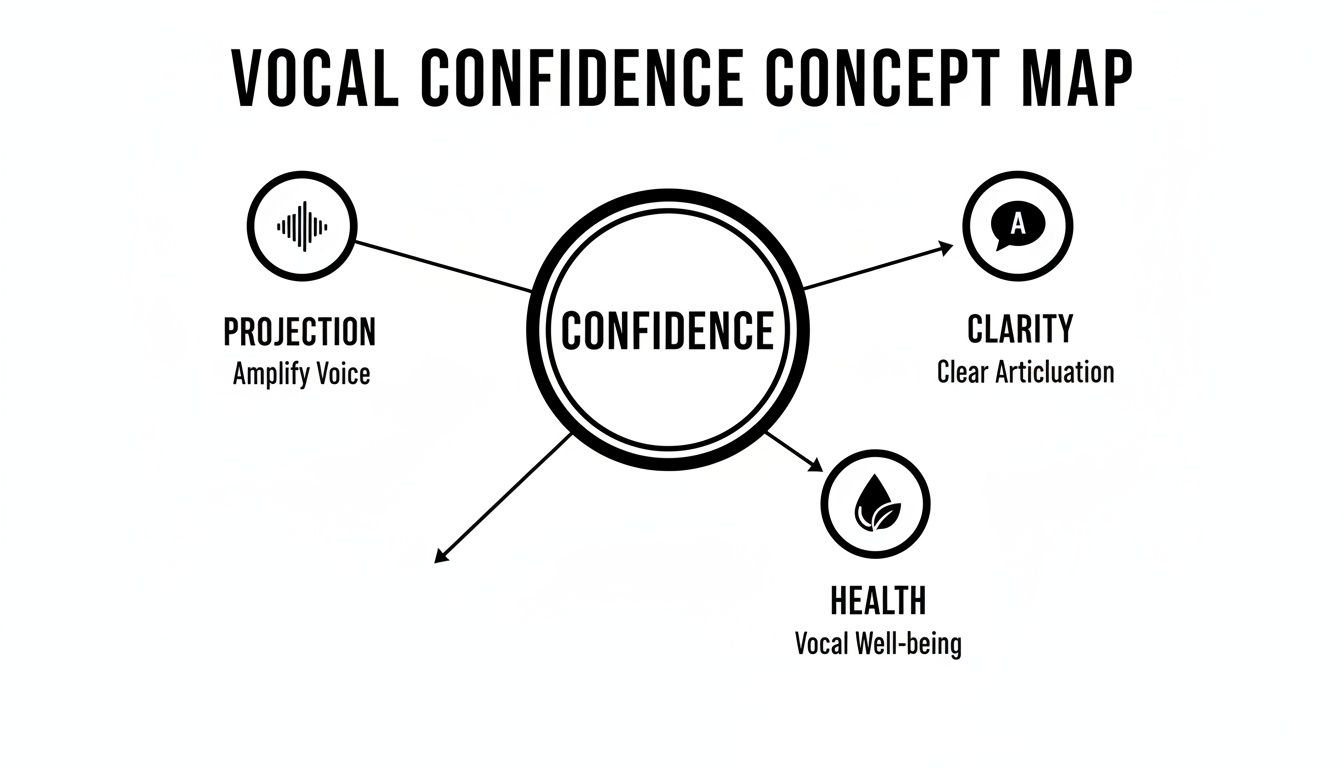
Confidence isn’t just a single skill. As you can see, it’s the result of weaving together multiple vocal disciplines until they support each other seamlessly.
The Make-or-Break Presentation
When you're delivering a high-stakes presentation, your primary goal is to project unwavering conviction. Your vocal delivery needs to be just as compelling as your data.
Right before you step up, ground yourself with two slow, deep diaphragmatic breaths. This calms the nerves and prepares your support.
Start your opening statement with a deliberate, slightly slower pace and a definitive falling intonation. Instead of rushing into your first words, land them with purpose. Say, "Today, we have a significant opportunity before us." and let your pitch fall at the end. That simple downward inflection signals absolute certainty.
As you move through your key points, make silence your ally. After you reveal a crucial statistic or a major takeaway, pause for a full two seconds. It might feel long, but for the audience, that silence amplifies the weight of your words and commands their complete attention.
Chairing a Contentious Meeting
When you're leading a difficult meeting, your voice is your primary tool for de-escalation and control. The goal is to maintain a calm, authoritative presence that steers the conversation productively, even when emotions are running high.
Speak from your optimal pitch—that lower, more resonant part of your vocal range. This naturally projects stability and makes you sound unflappable.
If you sense the conversation getting heated, consciously lower your volume and slow your pace. This is a subtle but powerful move. It forces others to quiet down just to hear you, which has the effect of physically calming the room's energy.
What if you're interrupted? Don't raise your voice to talk over them. Instead, hold your ground, take a breath, and use a calm but firm phrase. Something like, "John, I'll come to you in one moment, but it's important we finish this point." The steady tone combined with assertive language lets you regain control without escalating the conflict. For more strategies on this, you might find our guide on achieving confident communication in high-stakes situations helpful.
Navigating a Tough Negotiation
In a negotiation, your voice becomes a strategic asset for building leverage and managing pressure. What separates good negotiators from great ones is often their vocal polish. A recent study of 1,000 managers found that those with 'podcast-level vocal polish'—marked by clear pauses and varied pacing—received 28% more internal promotions. In simulations, this vocal control also led to 40% higher stakeholder buy-in.
When the other party makes a demanding request, your most powerful response is often a thoughtful pause. Instead of reacting immediately, take a deliberate breath. This communicates that you are carefully considering their position, not reacting emotionally. It also subtly shifts the pressure back to them to fill the silence.
Adopt a slower, more measured pace and keep your pitch in its lower, grounded range. This combination screams confidence. It tells the other side that you are in no rush to close a deal that isn't in your favor.
Ultimately, this calm, deliberate delivery signals that you are negotiating from a position of strength, not desperation.
Making It Stick: Daily Practice and Seeking Expert Guidance
Mastering your voice isn’t a one-and-done project; it’s a lot like maintaining a high-performance vehicle. You can’t just tune it up once and expect it to run perfectly forever. To command a room with your voice consistently, you have to turn these techniques into automatic habits.
The good news is, this doesn't require hours of grueling practice. The real key is consistency, not intensity. A few focused minutes each day is all it takes to keep your vocal instrument sharp and ready for any challenge.
Your 5-Minute Daily Vocal Warm-Up
Think of this as your morning coffee for your voice. It's a small investment that pays huge dividends throughout the day. Just integrate this simple routine into your morning.
- Ground Your Breath (1 minute): Stand up straight but keep your shoulders relaxed. Place one hand on your stomach. Now, breathe in through your nose for a count of four, feeling your belly expand. Exhale slowly through your mouth for a six-count. Repeat this 5-6 times to wake up your diaphragm.
- Activate Resonance (1 minute): Start with a gentle, easy hum—an "Mmm-hmmm" sound. You should feel a light vibration on your lips and in your chest. Gently glide that hum up and down your pitch range, like a soft siren. This warms up the vocal cords without straining them.
- Practice Articulation (2 minutes): Start with lip trills for about 30 seconds (think of a horse blowing air through its lips). Then, pick a couple of classic tongue twisters like "Red leather, yellow leather" or "Unique New York." Recite them slowly, exaggerating your mouth movements to get your articulators nimble.
- Set Your Pitch (1 minute): Find that optimal, resonant pitch again with another "Mmm-hmmm." From that spot, speak a few simple phrases. "Good morning." "Let's begin." Get used to starting from this place of vocal power.
Tracking Progress and Knowing When to Call a Coach
Self-awareness is your best tool for improvement. I always tell my clients to get in the habit of recording themselves once a week. It doesn't have to be a big production—just read an email aloud or practice the opening to a presentation.
When you listen back, ignore the content. Focus entirely on the delivery. Are your pauses deliberate? Is your pitch holding steady, or is it creeping up when you're stressed?
Self-practice can get you incredibly far. But many ambitious professionals eventually hit a plateau where they can't quite pinpoint what's holding them back. That's a clear signal it's time for an expert eye.
You might need personalized coaching if you’re running into these common issues:
- Your voice feels persistently tired or hoarse after a long day of calls.
- You’ve gotten feedback that you’re sometimes difficult to understand, or that your accent is getting in the way of your message.
- You feel like your delivery just doesn't project the authority that matches your title or experience.
- You struggle to hold the room's attention or feel like you're losing control in high-stakes meetings.
For international leaders, these challenges can be especially frustrating. A structured coaching program is often the fastest way to break through. If you're not sure what your next move should be, learning how to choose the right accent coach can give you a clear framework for making a decision. Personalized feedback helps you zero in on the exact habits that are limiting you, speeding up your progress far more than self-practice alone ever could.
At Intonetic, we specialize in closing the gap between your deep expertise and your executive presence. If you're tired of second-guessing how you sound and ready to communicate with undeniable authority, the first step is to get a clear, objective picture of where you stand today.
Book your complimentary Executive Communication Assessment to get a personalized, data-driven roadmap for your vocal development.