Master How to Think on Your Feet in 2026
You know the moment. A senior leader turns to you without warning and asks for your view. The question is simple on the surface, but the room makes it heavy. You know the subject. You've worked on it. Yet your mind starts searching for the perfect sentence while everyone waits.
That's usually the point where people give themselves bad advice. “Be more confident.” “Relax.” “Just speak naturally.” None of that helps when your brain is trying to sort ideas, manage nerves, and protect your credibility at the same time.
Thinking on your feet isn't a personality trait. It's a professional skill. Strong executives rarely improvise from nothing. They rely on trained habits: steadying their state, choosing a structure fast, buying themselves a second to think, and delivering an answer that sounds clear even when it was built in real time.
For non-native English professionals, the challenge is tougher. You're not only thinking. You may also be translating, monitoring pronunciation, and deciding how direct to sound in a room shaped by different cultural expectations. That extra load is real. It can make capable people sound less decisive than they are.
The Moment a Simple Question Feels Like a Test
“That's interesting. What's your take on the Q3 implications?”
The room goes quiet. Someone stops typing. Another person looks up from the slide deck. You feel the familiar split second of blankness that can stretch into something much longer if you panic.

Many smart professionals lose ground. Not because they lack insight, but because pressure scrambles access to what they already know. In senior meetings, people don't just evaluate the content of your answer. They also read your pace, your ability to organize a thought quickly, and whether you sound calm while doing it.
That's why interview prep and executive communication overlap more than one might initially realize. If you're also preparing for career interviews, the same pressure patterns show up there too. You're asked to respond before you feel ready, and the quality of your structure matters as much as the quality of your experience.
What senior audiences are actually testing
Leaders often assume they're checking your judgment. They are. But they're also checking three other things:
- Clarity under time pressure. Can you give a point before you start explaining?
- Prioritization. Do you know what matters most, or do you unload everything you know?
- Composure. Can you stay steady when the question feels slightly adversarial?
For international professionals, one more factor gets layered on top. Accent anxiety can turn a manageable pause into a self-conscious spiral. If that sounds familiar, this guide on how to overcome accent anxiety and speak fearlessly addresses the mental side of that pressure directly.
The blank mind moment usually isn't a knowledge problem. It's a retrieval problem under scrutiny.
People who seem naturally quick on their feet usually have one hidden advantage. They've practiced speaking from structure so often that they no longer build answers from scratch. That's trainable.
Master Your State Before You Master Your Words
Most bad off-the-cuff answers start before the first word. They start when your body reads a question as a threat.
Your breathing gets shallow. Your jaw tightens. Your speaking rate jumps. Then your answer becomes either too fast, too vague, or too long. If you don't regulate your state first, no framework will save you.
Use posture to help your brain work
A 2017 Psychological Science finding on standing and selective attention reported that participants responded 12 milliseconds faster on average to complex cognitive tasks while standing rather than sitting. That edge is small, but in rapid executive Q&A, small edges matter.
You can use that insight practically:
- Before a high-stakes call. Stand for your final review instead of slumping in your chair.
- During a virtual meeting. If your setup allows it, answer difficult questions standing.
- Before speaking in person. Plant both feet and lengthen your spine instead of folding inward over notes.
This isn't magic body language. It's a way to reduce the collapsed physical state that often comes with mental hesitation.
Treat silence as a tool
Many professionals sabotage themselves because they fear even a short pause. They think silence signals weakness. In senior settings, rushed speech usually looks weaker than a measured pause.
A useful replacement pattern is this:
- Hear the full question.
- Pause briefly.
- Give a framing sentence.
- Deliver the answer in a structure.
That framing sentence can be simple: “There are two implications.” Or: “My short answer is yes, with one caution.” It buys time and gives your audience confidence that you're in control.
Practical rule: Don't fill the first second with sound. Fill it with control.
Breathe low, then speak lower
When stress rises, people often inhale high into the chest and start speaking from a strained, higher pitch. That makes them sound less grounded than they are. A better pattern is one slow lower breath, then a deliberate first sentence delivered slightly slower than your instinct tells you.
If you need a reset routine, these breathing exercises for better English speech are useful because they connect breath to delivery, not just relaxation.
A quick pre-answer reset looks like this:
| Pressure cue | Unhelpful reaction | Better response |
|---|---|---|
| Hard question from a senior leader | Start talking immediately | Pause, inhale, give a headline |
| Mind goes blank | Add filler words | Name the structure you'll use |
| Voice sounds thin | Speed up | Drop pace and finish the first sentence fully |
What composure actually sounds like
Composure isn't sounding casual. It's sounding organized.
If you answer with a calm opening line, a visible structure, and a clean stop, people usually judge you as more senior than someone with better ideas delivered in a scattered way. The audience can only assess what they can follow.
Frameworks for Structuring Your Thoughts Instantly
When a question lands fast, structure beats brilliance. You don't need the perfect answer. You need an answer with a clear shape.
Professional communication programs built around message plans use this principle for a reason. According to Oak Innovation's overview of Think on Your Feet methods, case studies reported an 85% improvement in perceived trustworthiness when people used structured plans such as PREP or Problem-Cause-Solution, compared with 40% for unstructured responses.
PREP for opinion and recommendation
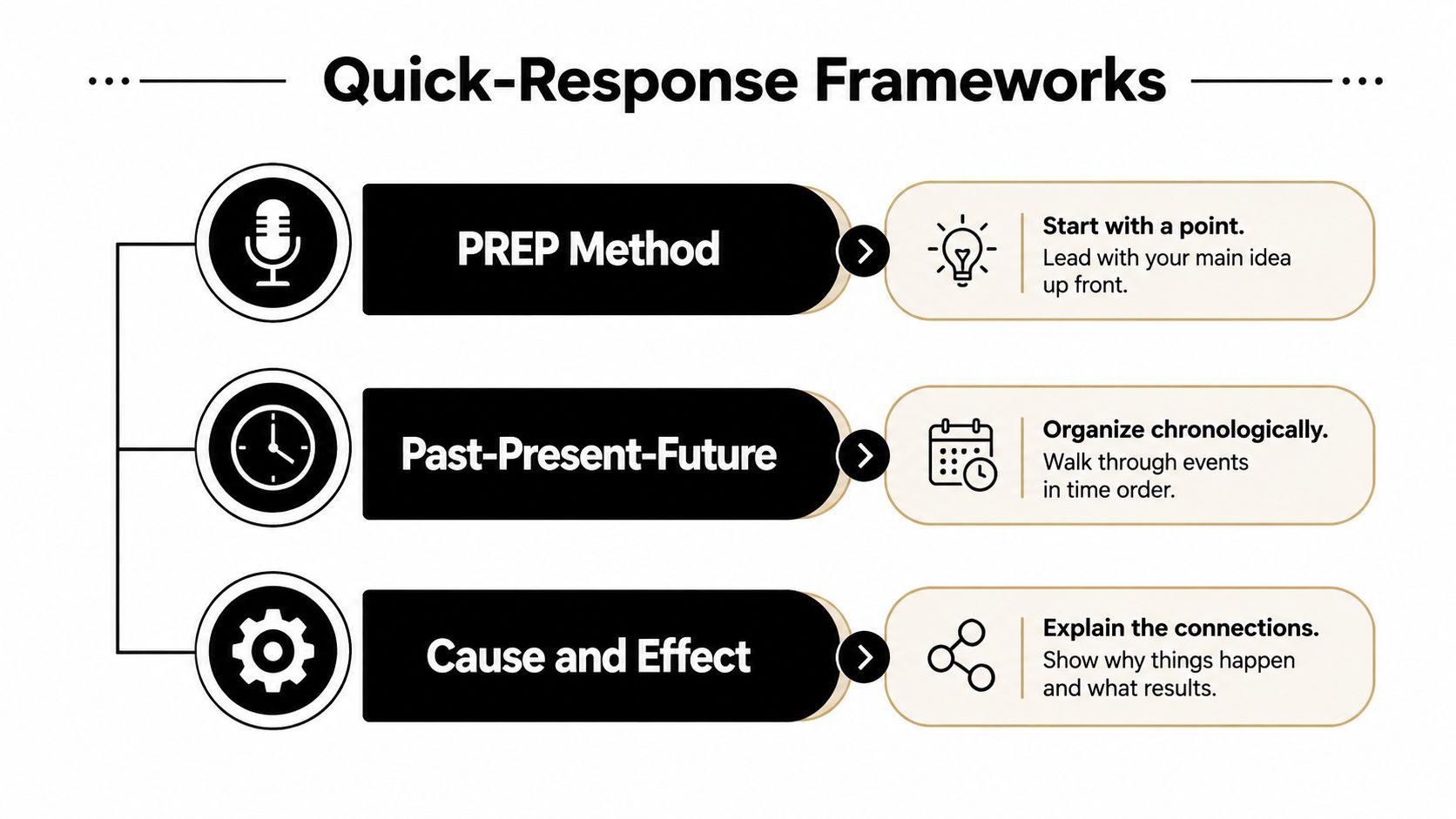
PREP stands for Point, Reason, Example, Point. It's the best default when someone asks what you think.
Use it for questions like:
- “What's your view on delaying the launch?”
- “Do you agree with this approach?”
- “How should we handle the client pushback?”
A weak answer often sounds like this:
“I mean, there are a few things to consider. On one hand the team needs more time, but also the market timing matters, and I think there are some risks with doing it too quickly, although I'd want to look at dependencies.”
That answer isn't wrong. It just doesn't help anyone decide.
A stronger answer sounds like this:
“My view is that we should delay the launch by a short period. The main reason is dependency risk across teams. Last-minute coordination issues usually create more damage than a controlled adjustment now. So my recommendation is a brief delay with a clear ownership plan.”
The first sentence gives the point. The last sentence lands it again.
STAR for examples from your experience
STAR stands for Situation, Task, Action, Result. It's useful when you need to prove judgment through a past example.
This framework works well for:
- board or stakeholder questions about how you handled a challenge
- promotion interviews
- performance reviews
- client conversations where credibility depends on experience
Rambling version:
“At my previous company there was a lot going on with one project and some confusion across teams. I worked with product and engineering and tried to align everyone. It was difficult because priorities kept changing.”
Structured version:
“The situation was a cross-functional project that had stalled because product and engineering were working from different priorities. My task was to realign the teams and get a decision path in place. I set up a short decision forum, clarified ownership, and reduced open issues to the few that actually blocked progress. The result was a faster decision cycle and a calmer stakeholder conversation.”
Notice what changed. The second answer gives sequence, ownership, and action. It sounds credible because it's easy to follow.
Problem-Cause-Solution for difficult discussions
This one is especially useful when the room feels tense. If a senior leader asks why something isn't working, don't start defending. Diagnose.
Use this shape:
- Problem. What's happening now?
- Cause. Why is it happening?
- Solution. What should happen next?
Example question: “Why are we missing deadlines?”
Unstructured answer:
“There are a lot of moving parts. We've had some resourcing issues, and I think some expectations weren't fully aligned, and there were changes from the client side too.”
Structured answer:
“The problem is that delivery dates are slipping. The main cause is unclear decision ownership when scope changes. My recommendation is to assign one decision owner for scope trade-offs and review changes in a tighter weekly forum.”
That answer is concise without sounding simplistic.
A simpler option when your mind is overloaded
Sometimes PREP feels too formal and STAR feels too detailed. In those moments, use Past, Present, Future.
- Past. What led here?
- Present. What matters now?
- Future. What happens next?
This can work surprisingly well in executive updates because it creates a natural timeline. It's also easier for many non-native speakers to retrieve quickly.
If you coach or manage people with different communication needs, you may also find these communication tools for ADHD and autism useful. Script supports can reduce overload while still preserving authenticity.
For spoken practice, structured simulation matters more than passive reading. These role-playing and simulation exercises to improve English accent are helpful because they force you to retrieve language under mild pressure.
Don't memorize full answers. Memorize answer shapes.
Language Templates for Non-Native English Speakers
Generic advice on thinking on your feet often assumes one thing that isn't true for many international professionals. It assumes your words arrive as fast as your thoughts.
For many non-native speakers, they don't. A 2023 Harvard Business Review analysis referenced here found that non-native speakers are 40% more likely to underperform in unscripted boardroom discussions, largely because of the cognitive load of bilingual processing. That matters because senior meetings reward visible fluency, not just sound judgment.

Replace filler with professional bridge phrases
Individuals commonly use “um,” “so,” or “I mean” when they need time. In senior settings, better holding phrases create thinking space while preserving authority.
Try these instead:
- To answer that directly: “To answer that directly, my view is…”
- The key issue is: “The key issue is execution risk.”
- I'd break that into two parts: useful when the question is broad.
- My short answer is: good when the room needs clarity fast.
- What matters most here is: helps you prioritize.
These phrases work because they do two jobs at once. They buy a second to think, and they signal organization.
Ask for clarification without sounding unsure
Many non-native speakers avoid clarification because they worry it will make them look unprepared. In reality, precise clarification often makes you sound more senior.
Use lines like:
- To answer precisely, do you mean the commercial impact or the operational impact?
- When you say timeline, are you referring to this quarter or the full rollout?
- I want to make sure I'm addressing the right part of the question. Is your main concern cost, speed, or delivery risk?
That language sounds analytical, not hesitant.
A clarifying question is often stronger than a rushed answer to the wrong question.
Keep your sentence architecture simple under pressure
When stress rises, long elegant sentences usually collapse first. Shorter executive phrasing travels better.
Compare these:
| Under pressure | Better executive version |
|---|---|
| “I think there are several dimensions we should maybe consider before making a final call.” | “There are two issues to consider before we decide.” |
| “What I'm trying to say is that the project is facing some difficulty because of alignment.” | “The project is delayed because ownership is unclear.” |
| “If I were to give my perspective, I would say that…” | “My view is that…” |
Shorter doesn't mean less intelligent. It means easier to process.
Control pace before you chase accent perfection
Many international professionals try to sound more credible by speaking faster. That usually backfires. Fast speech increases pronunciation errors, weakens intonation, and makes listeners work harder.
A better target is deliberate pace plus clean stress on key words. If you need daily phrase-level practice, these common daily phrases for English pronunciation practice are useful because they help you stabilize frequent speech patterns you can reuse in meetings.
Try this quick method in live conversation:
- Slow down your first sentence.
- Stress one important word per thought group.
- End the sentence fully instead of fading out.
- Pause before your next point rather than linking everything with “and.”
Keep a small personal phrase bank
You don't need dozens of templates. You need a few that feel natural in your mouth.
A strong starter set might include:
- “My view is…”
- “There are two parts to this.”
- “The main risk is…”
- “To be precise…”
- “What I'd recommend is…”
Practice those until they become automatic. Under pressure, familiarity beats variety.
Build Your Reflex with Micro-Exercises
You won't become quick on your feet by reading frameworks once. You need short repetitions that teach your brain to organize ideas before panic takes over.

The best drills are brief enough to survive a busy workweek. They should feel slightly uncomfortable, not overwhelming.
Five drills that build response speed
- The 60-second summary. Read one email, article, or project update. Then explain it out loud in one minute. Start with the main point, not the background.
- PREP the news. Take one headline and give your opinion using Point, Reason, Example, Point.
- Question replay. After a meeting, write down one question you wish you had answered better. Record a cleaner version.
- Clarify then answer. Practice responding to vague prompts by asking one sharp clarifying question before giving your view.
- Standing response reps. Deliver key answers while standing upright instead of curled over a desk.
Use body language carefully, not theatrically
Expansive posture advice gets oversimplified. A University at Buffalo summary of posture and risk-taking research reported that a feet-on-desk expansive pose increased risk-taking by 22% in American participants, while East Asian participants showed no such effect. That difference matters for international professionals.
What should you do with that?
Don't imitate exaggerated “power poses” because you heard they project authority. In some rooms they can look forced, culturally tone-deaf, or oddly aggressive. Instead, practice a version of physical openness that fits your environment:
- Open chest, grounded feet works almost everywhere.
- Relaxed shoulders and still hands read better than dramatic gestures.
- Slightly more space can help in Western contexts.
- More contained authority is often wiser in cultures that value restraint.
The goal isn't to look powerful. The goal is to stay physically available to your thinking.
Add pressure on purpose
Once a drill feels easy, add one constraint. Use a timer. Stand up. Answer while looking into your camera. Ask a colleague to interrupt with a follow-up question.
People begin building real transfer. If you want another outside resource focused on response speed in collaborative settings, this guide on improve agency brainstorming speed offers useful prompts that can be adapted for team communication.
Here's a simple video prompt you can practice with after a few written reps:
A one-week practice pattern
You don't need a huge routine. You need consistency.
| Day | Drill | Time |
|---|---|---|
| Monday | 60-second summary after your first email block | Brief |
| Tuesday | PREP response to one business headline | Brief |
| Wednesday | Record one answer to a tough stakeholder question | Brief |
| Thursday | Clarify then answer with a colleague or friend | Brief |
| Friday | Standing response reps before your last meeting | Brief |
| Weekend | Review your recordings and rewrite weak openings | Brief |
If you do this consistently, your answers start sounding prepared even when they aren't scripted.
Making the Skill Stick When the Pressure Is Real
You answer well in practice, then go blank when a CFO asks, “What's your recommendation?” in front of twelve people on a video call. That gap is common, especially for non-native English professionals. Under pressure, your brain is not only solving the business problem. It is also searching for precise language, monitoring tone, and trying not to make a visible mistake.
That is why one strong workshop rarely changes day-to-day performance. Skills fade when they are not tied to real meetings, real phrasing, and a repeatable review process. I see this often with senior clients. They know their subject well, but pressure narrows access to structure and language at the exact moment they need both.
The three breakdowns to watch
In corporate settings, the pattern usually shows up in one of three ways:
- You freeze at the start. The problem is often not knowledge. It is startup friction. Prepare two opening lines you can use in almost any meeting: “There are two parts to this,” or “My short answer is yes, with one risk.”
- You keep adding context. This happens when you are translating ideas into English in real time and do not trust that your first point was clear enough. End with a decision sentence: “My recommendation is to proceed this quarter.”
- Your tone slips under challenge. A sharp question can push even experienced leaders into sounding apologetic, defensive, or overly detailed. Return to the issue itself: “The concern is valid. Here is how I would handle it.”
These are fixable problems.
Build review into the week
Improvement comes faster when practice is attached to live stakes. After a meeting, take two minutes and capture the moment while it is still fresh. Do not grade your whole performance. Isolate one answer.
Use these four questions:
- Where did my answer lose shape?
- Which sentence bought me time, or should have?
- Did I answer the business question first?
- What exact wording would I use next time?
For non-native speakers, the fourth question matters most. General feedback like “be more concise” is too vague to use under pressure. Replace it with a line you can say in English.
Use pressure-specific rehearsal
A lot of professionals practice in conditions that are too clean. Real pressure includes interruptions, status differences, and the extra cognitive load of speaking polished English fast enough to sound decisive.
Practice closer to the actual environment. Rehearse your answer standing up. Record it in one take. Ask a colleague to interrupt after your first sentence. Redo the same answer with a stricter time limit. That is how the skill starts holding up in senior rooms.
If you want outside support, choose a process that works on live responses, not just general confidence. Executive presence coaching for international professionals is most useful when it focuses on your actual meeting language, your response patterns, and the moments where authority drops under stress.
What lasts is simple. Repetition, review, and phrases you can trust when the room gets quiet.