
Real Time Problem Solving: A Leader’s Guide to Fast
You're in the meeting, the deck is clean, the numbers are aligned, and then a director asks a question you didn't prep for. The room gets quiet, your team looks at you, and everyone is waiting to see whether you'll reach for the nearest safe answer or think clearly enough to steer the conversation.
That moment is real time problem solving in its purest form. It isn't just about being quick. It's about diagnosing the right issue, structuring a usable response, and sounding composed enough that people trust your judgment while you're still forming it.
Why Real Time Problem Solving Defines Senior Leadership
A senior leader is often judged less by the polished presentation and more by the answer that arrives when the presentation breaks. A board question, an investor challenge, or a production issue during a live demo can expose whether you're managing the moment or being managed by it. That's why real time problem solving has become a visible marker of executive readiness, not just a convenient soft skill, and why it matters in high-stakes settings where minutes of delay affect customer experience, revenue, and risk exposure [how real time data systems changed problem solving].
What senior rooms actually reward
A prepared answer helps, but prepared language alone doesn't carry authority. What leaders notice is whether you can separate the question from the pressure around the question, then speak in a way that makes the next decision easier for the room. That mix of analysis and delivery is why real time problem solving sits close to executive presence.
You can see the career difference in how people respond to uncertainty. Industry data says 75% of employees consider problem solving a critical job skill, 78% of employers call it essential, and 85% of decision-makers say it directly affects profitability [statistical principles for problem solving]. Those numbers matter because they reflect how often leaders are expected to convert ambiguity into action, not just explanation.
A leader doesn't win by sounding fastest. A leader wins by sounding organized when the room is unsettled.
The practical shift is simple. Mid-level performers often answer the question they expected. Senior leaders answer the question that was asked, then frame what happens next. That's the difference between being technically right and being trusted in real time.
For a useful companion on credibility in those moments, this guide on how to build credibility as a leader fits naturally with the communication side of the skill. The analytical side matters, but credibility is what buys you the room long enough to use it.
Rapid Diagnosis Under Pressure
The fastest mistake in a live problem is jumping to a solution before the problem is defined. In a production outage during a stakeholder demo, that usually sounds like someone blaming the system, then a team blaming each other, then everyone spending ten minutes fixing the visible symptom while the actual failure stays untouched. Good leaders slow that sequence down just enough to get the diagnosis right.
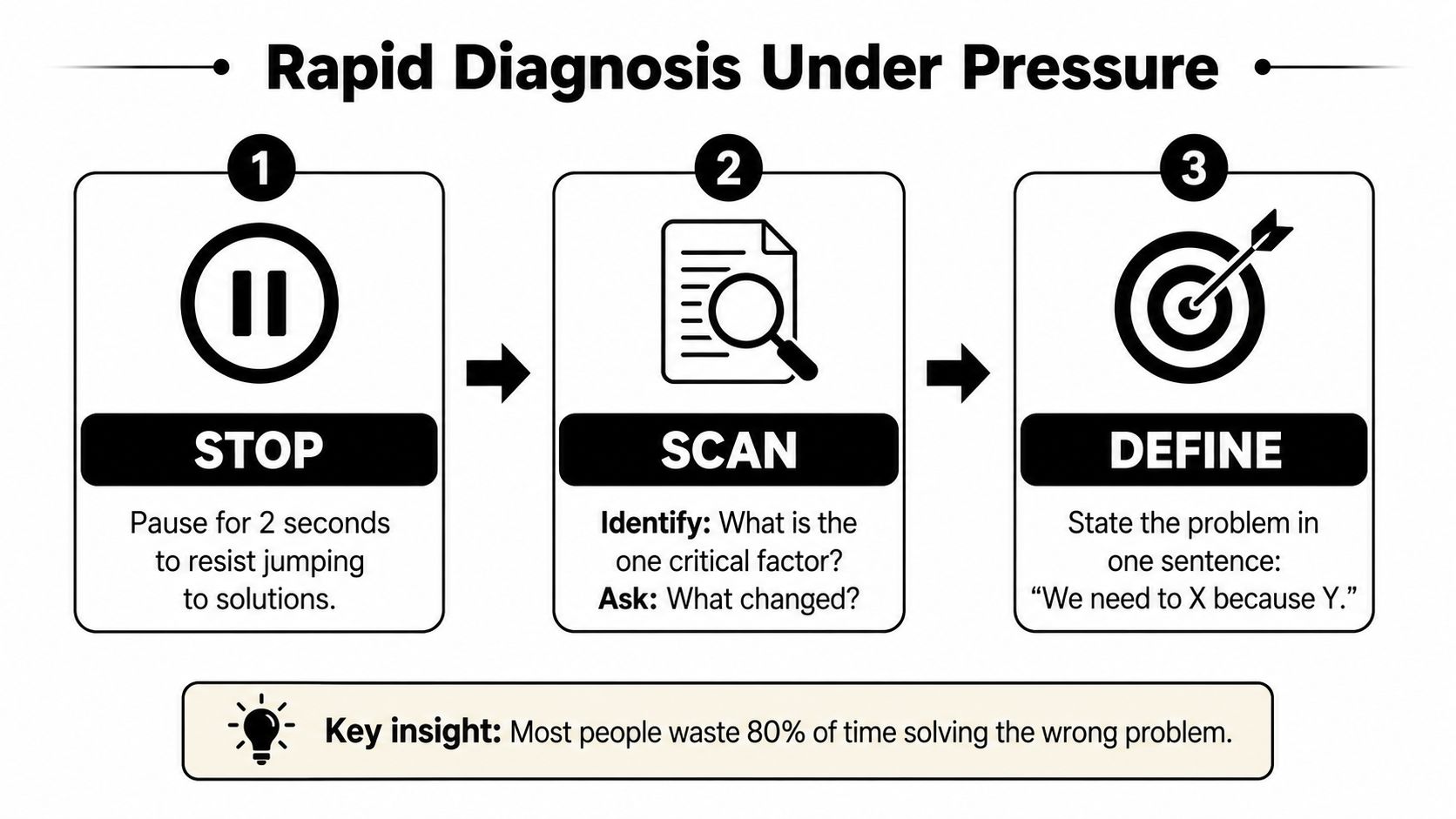
Stop, scan, define
Start with a hard pause. Not a dramatic pause, just a controlled break long enough to stop the reflex to guess. Then scan for the one thing that changed, because live problems usually move from normal to broken because one variable shifted.
A useful sequence is:
- Stop the motion. Buy two seconds and resist the first fix.
- Scan for the change. Ask what changed, where it changed, and who first noticed it.
- Define the problem in one sentence. State the failure mode, not the drama around it.
That last step is where many leaders slip. A clear problem statement narrows the room's attention, and a practical guide to proven problem definition steps helps reinforce that discipline without making the conversation feel academic. PMI also notes that effective problem statements should specify the problem's nature, location, timing, and magnitude, and that confirmation should be treated as a separate step rather than assumed from intuition [PMI problem-solving appraisal].
Practical rule: if you can't state the issue in one sentence, you're probably still describing symptoms.
The language matters. Instead of saying, “The demo is broken,” say, “The API response is timing out on the client side after the latest deployment.” That version doesn't just sound sharper. It makes the next question obvious.
For a compact reference that sits well beside this habit, thinking on your feet is really about staying disciplined while the room pushes for speed. The best leaders don't fill silence with noise, they use silence to avoid expensive guesses.
Structuring Your Response in the Moment
Once the issue is defined, the next job is to give the room a response they can follow without needing a whiteboard. That's especially important in a stakeholder Q&A, where an investor asks why the quarter missed target and half the table is watching whether you'll become defensive, evasive, or vague. The answer doesn't need to be long, but it does need to have shape.
A frame, then the facts, then the path forward
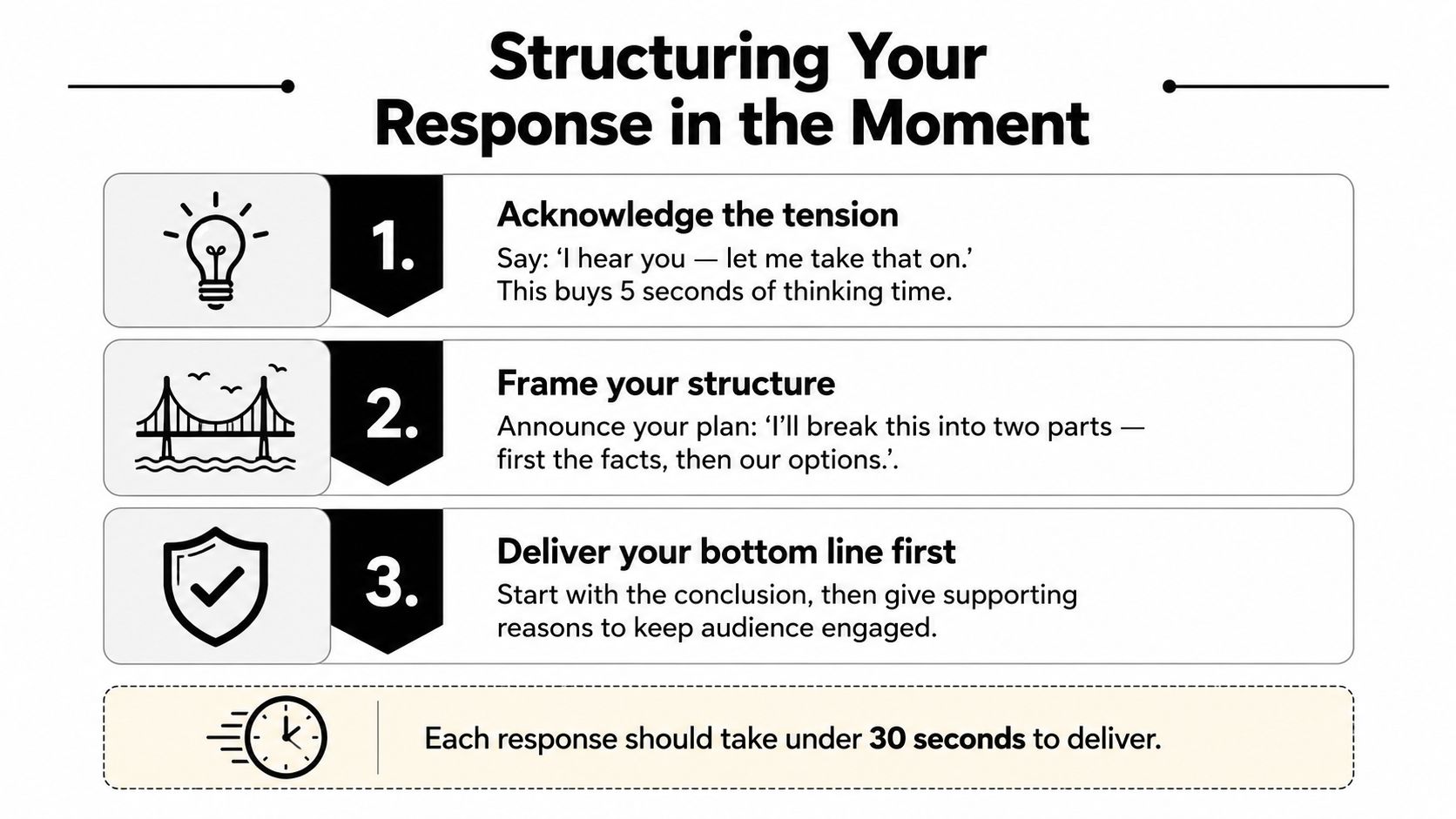
Open by acknowledging the tension without surrendering authority. A line like, “I hear the concern, and I'll answer it directly,” buys a few seconds while signaling that you're not ducking the question. Then frame the structure out loud so listeners know where the answer is headed.
A strong live response usually follows three moves:
- Acknowledge the tension. Show that you understand why the question matters.
- Frame the structure. Tell the room how you'll organize the answer.
- Deliver the bottom line first. Lead with the conclusion, then support it.
That structure works because people under pressure need orientation before detail. In practice, a response can sound like this, “The miss came from slower enterprise conversion in the last six weeks. I'll break that into two parts, what changed and what we're doing next.” Now the room knows the answer won't wander.
If you want a broader meeting-level parallel, facilitation moves for meetings are helpful because they show how structure reduces reactivity when several voices want the floor. The same principle applies in a boardroom, even when only one person is speaking.
Keep the response short enough to protect attention. A useful internal reference on professional short-form communication reinforces a habit senior leaders need constantly, saying the most important thing first and not burying the point inside a long preamble.
The room trusts a leader who can compress a messy issue into a clean path of thought.
Follow-up questions are where discipline matters again. Don't restart the whole answer. Pull one thread at a time, answer it, and return to the core line. That keeps you from sounding circular, which is one of the fastest ways to lose authority when people are already alert to risk.
Vocal and Body Language Tactics for Composure
People don't only hear whether you know what you're doing, they hear whether you're rushing to prove it. Breathless delivery, tight shoulders, and darting eye contact make a solid answer feel improvised and unstable. A composed body and voice don't fake competence, they give your thinking enough room to land.
Use pace as a signal
The most useful vocal move under pressure is controlled deceleration. Speak a little slower than your impulse tells you to, especially on the first sentence after the question lands. A short pause before the answer, a steady downward pitch at the end of key phrases, and deliberate breathing between clauses all help you sound settled rather than cornered.
A before-and-after contrast makes this obvious. Before, you say, “Uh, yes, so what happened was, I think the team saw a lag, and we're checking it.” After, you say, “The lag came from the latest deployment. We've isolated the issue, and we're verifying the fix now.” Same information, very different effect.
Reset the body before you speak
Posture changes fast. Put both feet down, drop the shoulders, and let the hands settle where they're visible and still. If you stand or sit slightly taller before answering, people read that as control, even if your mind is still working through the next sentence.
A few micro-skills help immediately:
- Pause before the first word. Silence is usually less costly than filler.
- Anchor the pitch. Start from a lower, steadier tone.
- Keep your hands quiet. Small gestures are fine, frantic motion isn't.
- Hold eye contact at sentence ends. Don't scan the room while finishing a point.
- Avoid speed spikes. One rushed sentence can undo five calm ones.
The image of composure matters because audiences often decide whether to trust the answer before they finish evaluating the facts. That's especially true in leadership settings where the stakes are reputational as well as operational.
For leaders who want a deeper body-language reference, body language for leaders is a natural complement to this work. The point isn't performance for its own sake. It's removing the physical signals that make otherwise strong judgment look uncertain.
Your voice should sound like it has room to think. If it sounds chased, the room starts chasing the issue instead of trusting the answer.

Rehearsal Drills to Build the Skill
Live composure usually comes from rehearsed reflexes. If you only practice real time problem solving in the moment, you're asking your nervous system to invent a calm response while people are watching, which is a bad trade. Better to make the skill familiar before the stakes arrive.
Build the muscle in small reps
Use short drills that isolate one pressure point at a time. A timed response exercise trains your diagnosis speed. A voice recording helps you hear where you rush or flatten your tone. A mirror drill exposes posture habits that you don't notice while speaking.
A simple routine can fit into a busy day:
- Two-minute response drill. Pick a random work question and answer it aloud with a clear beginning, middle, and end.
- One-minute recording. Listen for filler words, rising endings, and unfinished conclusions.
- Mirror reset. Practice entering an answer from a still, grounded stance.
- Interrupted rehearsal. Ask a colleague to cut in mid-response so you can recover the thread.
- One-sentence compression. State a complex issue in one sentence without losing the core point.
Those drills work because they attack different failure modes. One improves speed, one improves structure, one improves delivery, and one improves resilience when someone interrupts. Used together, they make the skill feel less like improvisation and more like a trained habit.
If you want a related speaking resource, impromptu speaking skills maps closely to the same pressure environment. It's the kind of practice that helps a leader keep the thread when the room moves faster than the slide deck.
The most useful benchmark is whether your response becomes easier to organize, not whether it becomes perfect. That's the sign the practice is working. You'll notice fewer false starts, cleaner transitions, and less physical tension before you answer.
Real Time Problem Solving in Three High Stakes Scenarios
The same core method holds across rooms, but the emphasis shifts depending on the audience. In a board meeting, you're protecting credibility. In an investor Q&A, you're protecting clarity and confidence. In a technical failure, you're protecting decision speed and operational calm.
Board meeting challenge
A director questions a strategic recommendation with data you hadn't foregrounded. The first move is diagnostic, not defensive. You restate the concern accurately, define whether the disagreement is about the assumption, the timing, or the scope, and then answer with a frame that separates facts from implications.
A clean response sounds like this, “Your data point changes the timing assumption, not the strategy itself. I'll walk through the assumption that moved, then the adjustment we'd make.” The tone stays even, the posture stays open, and the answer gives the board a decision path instead of a debate spiral.
Investor question on a missed milestone
An investor asks why the quarter slipped. Here, the temptation is to over-explain or over-apologize. Neither helps. The better move is to lead with the cause, state the current status, and name the next checkpoint.
The key is to avoid sounding like you're building a defense case. Investors usually want judgment and control, not theater. If you can identify the cause without rambling, then connect it to the next action in one pass, you reduce friction and preserve trust.
Production failure during a demo
This is the purest test of live diagnosis. The demo breaks, people can see the failure, and time pressure is immediate. You stop the motion, name the issue precisely, assign the next step, and protect the room from speculative noise.
In this setting, your voice matters as much as your troubleshooting. Calm language keeps the team from fragmenting. Clear ownership keeps the room from drifting into blame. The best response is short enough that engineers can act and stakeholders can still follow the story.
Across all three, the pattern is the same. Diagnose what changed, define the problem precisely, structure the response, and deliver it with physical calm. What changes is the degree of detail, the audience's tolerance for uncertainty, and the risk attached to the answer.
Building Real Time Problem Solving Into Your Leadership Identity
Most leaders can learn the framework. The harder step is making it feel natural when the room gets hot. That's where real time problem solving stops being a technique and starts becoming part of how you lead, how you speak, and how people experience your presence under pressure.
The Gravitas Method is a 12-week one-on-one executive presence coaching program for international professionals who want to communicate with more authority and influence at senior levels. It's priced at $8,200 paid in full or $9,000 across three installments, coached by Nikola, and it covers vocal authority, strategic framing, executive body language, and high-stakes communication. For leaders who want a structured way to close the gap between knowing the tools and using them cleanly in the room, the free Executive Communication Assessment is the entry point.
If you're ready to turn fast thinking into calm, senior-level communication, explore Intonetic and start with the free Executive Communication Assessment. It's a practical first step if you want sharper real time problem solving, stronger executive presence, and a way to handle boardrooms, stakeholder questions, and high-pressure conversations without losing your thread.