Master Impromptu Speaking Skills: A Practical Guide
A senior leader asks for your view. You know the subject. You've done the work. But in the two seconds before you speak, your brain splits in half. One part is trying to answer the question. The other is translating, editing, and checking whether your English sounds senior enough.
That's the part most advice misses.
For international professionals, impromptu speaking isn't just about thinking fast. It's about thinking fast while managing vocabulary, rhythm, tone, and the fear that one awkward sentence will make people underestimate your expertise. That doesn't mean you lack executive presence. It means you're carrying more cognitive load than the native speaker beside you.
Strong impromptu speaking skills are trainable. They improve when you reduce mental friction, use simple structures, and practice delivery under realistic pressure. The goal isn't to sound rehearsed. The goal is to sound clear, composed, and worth listening to when the room turns to you unexpectedly.
Why This Skill Matters More Than You Think
A project update is moving fast. A senior stakeholder turns to you and asks, “What do you recommend?” You have the answer. What slows you down is the extra processing. You are choosing the idea, translating it into clear English, checking tone, and deciding how direct you can sound without coming across too blunt.
People in the room do not see that hidden work. They hear the pause.
That is why impromptu speaking shapes reputation more than many professionals expect. In prepared presentations, your expertise has time to shine. In unscripted moments, colleagues often judge judgment, confidence, and readiness for bigger scope within seconds. Fair or unfair, those moments influence who gets trusted with client-facing conversations, cross-functional leadership, and higher-visibility work.
Why standard advice often falls short
A lot of speaking advice was written for people thinking and answering in the same language. That matters. For international professionals, a simple framework can still break down under pressure because the primary challenge is not only structure. It is structure plus translation load plus self-monitoring.
I see this often with highly capable clients. They know their topic, they know the meeting context, and they have studied standard tools such as PREP. Then a live question arrives, and the framework feels too heavy to run at full speed. They are not failing to think clearly. They are carrying more tasks at once.
That is also why generic tips such as “slow down” can feel incomplete. Slowing down helps only if you also know what to do with the extra second. International professionals need frameworks that are lighter, phrasing that is easier to retrieve under pressure, and delivery habits that protect authority even when the wording is not perfect.
If you want broader workplace-focused effective communication strategies, that resource complements this challenge well because it focuses on professional confidence, not stage performance.
What senior teams actually notice
Senior teams rarely score your response like an English exam. They look for signals. Did you answer the question directly? Did your first sentence give the room a direction? Did you sound settled enough that people could follow your thinking?
Clarity earns more respect than complexity here.
That is why learning to think on your feet in professional settings matters. Strong impromptu speaking helps people hear your judgment without getting distracted by hesitation, over-explaining, or sentence repair. For non-native speakers, the goal is not to remove every trace of effort. The goal is to make your expertise easier to recognize in real time.
Impromptu speaking is a professional visibility skill. In high-pressure moments, it often determines whether people remember your accent or your point.
First Prepare Your Mindset Not Your Speech
Many attempt to fix impromptu speaking by searching for better wording. The primary bottleneck is usually psychological. They're trying to sound impressive before they've learned how to stay settled.
That approach backfires. The more you chase a perfect answer, the harder it becomes to produce a clear one.
A direct industry survey on professional development priorities for 2025 found that 94% of participants identified impromptu speaking as the top presentation skill requiring upskilling (2025 survey on impromptu speaking demand). The demand is high because many professionals can present prepared material well, but lose authority when preparation disappears.
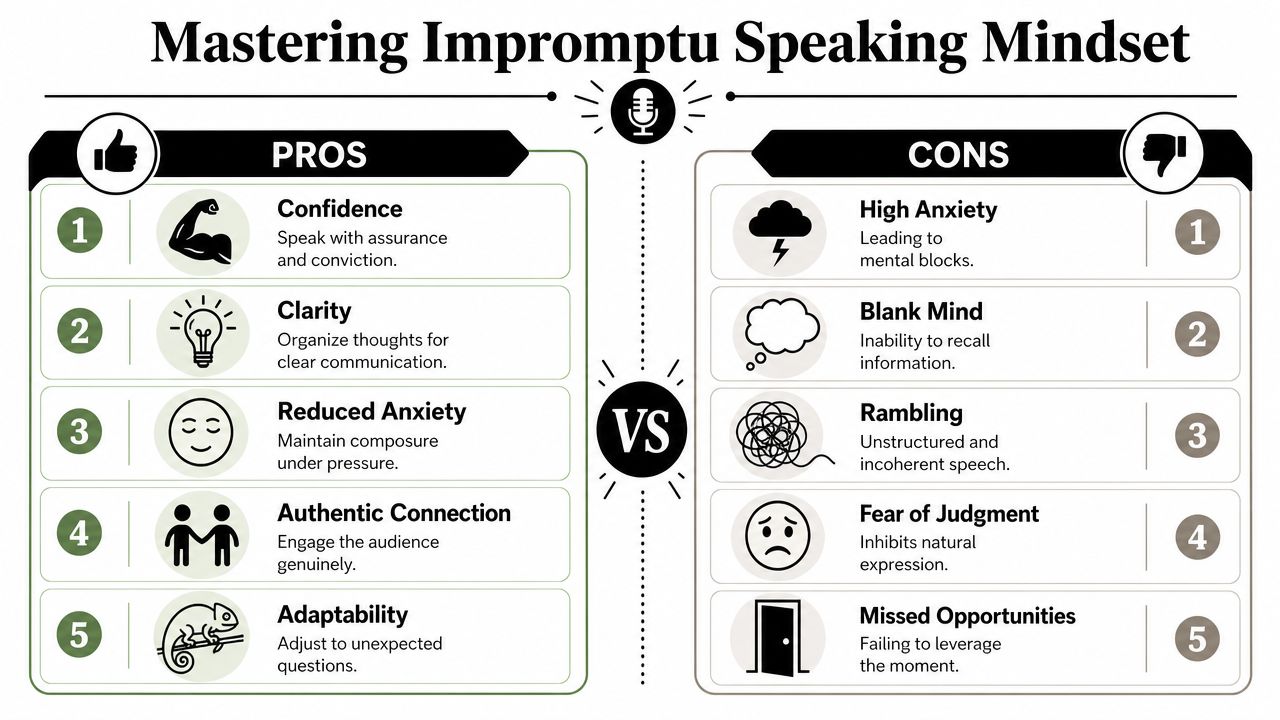
Replace perfection with contribution
In a meeting, your job isn't to deliver a TED-style answer. Your job is to contribute something useful, clearly and calmly. That shift matters because perfectionism creates delay. Delay creates panic. Panic creates blankness.
A more effective internal script is simple:
- I need a point, not a performance. One clear sentence beats three polished but unfocused ones.
- I can sound thoughtful without sounding complex. Senior people usually prefer directness.
- A short pause is not failure. It signals control when you use it deliberately.
The improv principle “Dare to be dull” is helpful here. It lowers the pressure to be brilliant. In practice, that means giving a plain, structured response instead of waiting for a clever one. Plain works. Forced brilliance usually collapses under time pressure.
Calm the body first
If your body is in alarm mode, your brain won't organize language well. This is especially true when you're speaking in a second language.
Try this before a meeting or before you answer:
- Exhale longer than you inhale. That helps reduce physical urgency.
- Plant your feet. A stable lower body reduces the urge to rush verbally.
- Relax your jaw and tongue. Tension there often shows up as clipped, breathless speech.
- Give yourself permission to start simple. Your first sentence only needs to open the answer.
If nerves regularly spike before speaking, practical ways to calm speech anxiety can help you build a repeatable reset rather than depending on confidence to magically appear.
Anxiety tells you the stakes are high. It doesn't tell you that you're incapable.
What doesn't work
Some mindset advice sounds encouraging but is useless in real meetings. These are common traps:
| Habit | Why it fails |
|---|---|
| Mentally scripting full answers | The conversation changes before you can use the script |
| Trying to eliminate all nerves | You waste energy fighting a normal response |
| Waiting until your English feels perfect | You delay practice on the very skill you need |
| Speaking fast to prove fluency | Speed often makes authority drop, not rise |
Confidence in impromptu speaking skills isn't something you wait to feel. It's something you build by lowering the cost of speaking imperfectly and staying composed long enough to finish your thought.
Frameworks That Structure Your Thoughts Instantly
When the room turns to you, structure matters more than style. You don't have time to invent a response from scratch. You need a shape your brain can grab quickly.
That's why frameworks work. They reduce decision-making in the moment. Instead of asking, “How do I say this well?” you ask, “What box am I in now?”
A practical training approach discussed in a public speaking forum recommends a daily 20 to 30 minute routine of answering random prompts for 60 to 180 seconds using structures like PREP, with participants reporting significant improvement after just one week of consistent practice (daily impromptu speaking drill with PREP).
Start with PREP
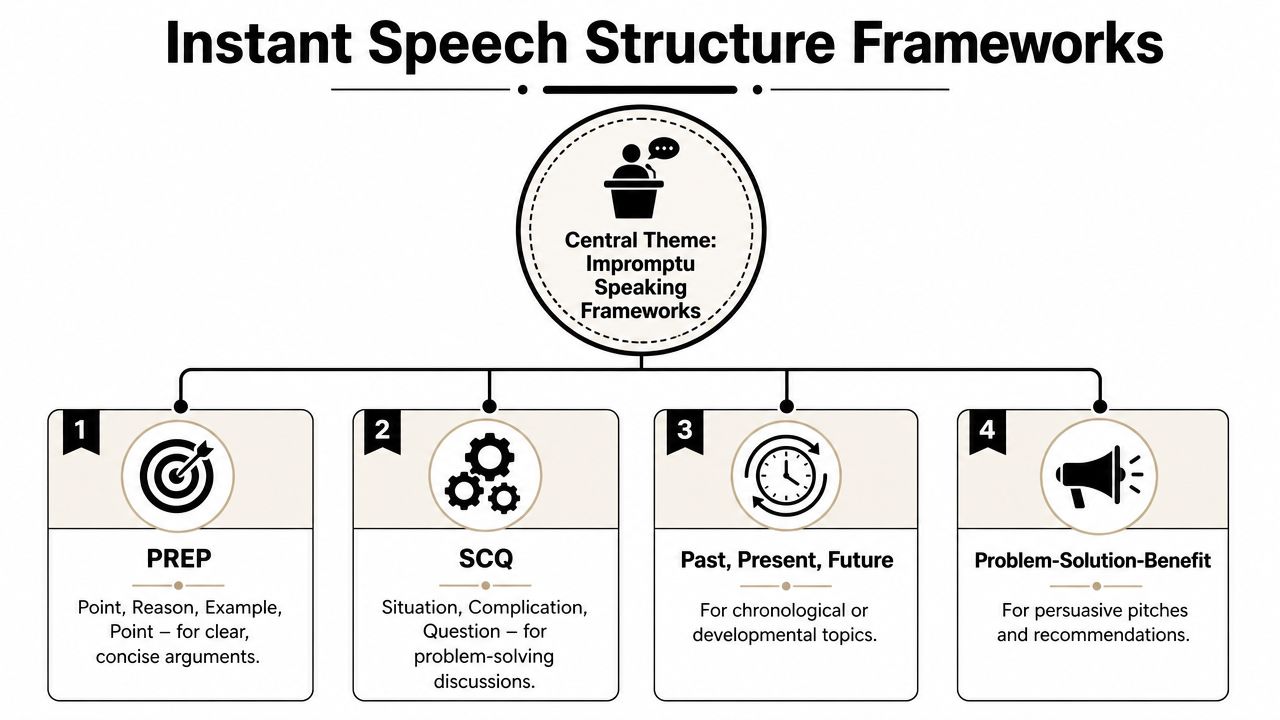
PREP stands for Point, Reason, Example, Point. It works well in meetings because it's short, flexible, and hard to get lost in.
Use it like this:
-
Point
Start with your answer.
“My view is that we should delay the launch.” -
Reason
Explain why.
“The main issue is that the current rollout plan creates avoidable risk for support and onboarding.” -
Example
Make it concrete.
“For example, the pilot feedback already shows confusion around setup, and if we scale now, that confusion will multiply.” -
Point
Close the loop.
“So my recommendation is to fix onboarding first, then launch with more confidence.”
For non-native speakers, PREP works best when you memorize the function of each part, not exact wording. Exact wording increases pressure. Function creates flexibility.
Sentence starters that reduce cognitive load
You don't need original transitions every time. Reusable language saves bandwidth.
Try these:
| PREP step | Useful starters |
|---|---|
| Point | “My view is…”, “The key issue is…”, “I'd recommend…” |
| Reason | “The reason is…”, “What's driving that is…”, “That matters because…” |
| Example | “For example…”, “We've seen this in…”, “A simple example is…” |
| Point again | “So the takeaway is…”, “That's why I'd…”, “Net, I think…” |
These phrases sound natural in business settings. What's more, they buy your brain time.
Here's a useful deeper read on communication as persuasion in business contexts if you want to connect structure with executive influence rather than just fluency.
Adapt PREP for second-language thinking
Traditional PREP advice often assumes you can access vocabulary instantly. If English isn't your first language, make two adjustments.
First, shorten each part. Your Point can be one sentence. Your Reason can be one sentence. Your Example can be one sentence. That's enough for many executive interactions.
Second, allow simple language. Authority doesn't depend on complex wording. It depends on clear logic.
Useful filter: If a phrase is hard to retrieve under pressure, it's too expensive to use.
Use alternative frameworks for specific moments
PREP is the default. But some moments call for a different frame.
SCQ for problem discussions
Situation, Complication, Question is useful when you need to diagnose an issue.
Example:
- Situation: “The project is on track in terms of scope.”
- Complication: “The challenge is that stakeholder alignment is weakening.”
- Question: “So the immediate question is whether we want speed or broader buy-in.”
Past Present Future for updates
This is strong when an executive asks for a quick summary.
Example:
- Past: “We completed discovery and tested the assumptions.”
- Present: “We're now validating the implementation path.”
- Future: “Next, we need a decision on ownership before we scale.”
A short video can help you see how structured spontaneous speaking sounds in practice:
Problem Solution Benefit for recommendations
This is useful when you need to persuade.
- Problem: “The current handoff is too fragmented.”
- Solution: “We should assign one clear decision owner.”
- Benefit: “That will reduce confusion and speed execution.”
The Gravitas Method is a 12-week one-on-one executive presence coaching program for international professionals who want to communicate with more authority and influence at senior levels. The program is priced at $8,200 paid in full or $9,000 across three installments. Coached by Nikola, it covers vocal authority, strategic framing, executive body language, and high-stakes communication.
Projecting Authority with Voice and Body Language
A strong answer can still sound weak if the delivery looks uncertain. Senior audiences don't just evaluate content. They read tempo, stillness, eye contact, and whether you seem comfortable carrying attention.
That's why authority is partly physical.
According to a Center for Talent Innovation study of 4,000 professionals, gravitas accounts for 67% of how senior leaders evaluate executive presence, compared with 28% for communication and 5% for appearance. The same summary emphasizes that non-verbal signals such as strategic pauses help project decisiveness (gravitas and executive presence breakdown).

Use pauses instead of fillers
Many international professionals try to prove fluency by eliminating silence. The result is often more “um,” “so,” or rushed repetition. A pause is stronger.
A strategic pause does three things at once:
- It gives you thinking time
- It signals composure
- It makes your next sentence sound more deliberate
If you're asked a difficult question, stop. Breathe once. Then begin. That tiny gap often increases perceived authority more than speaking immediately.
Silence feels longer to you than it does to your audience.
Adjust the body so the voice follows
Body language isn't decoration. It affects sound. If your chest collapses, your voice usually thins out. If your hands move frantically, your speech often speeds up.
Focus on a few visible behaviors:
-
Open posture
Keep your chest lifted and shoulders released. This supports steadier breath. -
Purposeful gestures
Let your hands underline meaning, not discharge nerves. Fewer gestures, used intentionally, usually look more senior. -
Anchored eye contact
Finish a sentence while looking at one person instead of darting across the room. -
Stillness at the start
Before you answer, let your body settle. The first second of physical control changes the tone of the rest.
If you want to strengthen presence when people are already listening to you, this guide on how to engage the audience in professional settings is worth studying alongside your speaking practice.
A quick authority check
Before speaking, ask yourself:
- Am I starting too fast?
- Am I using a filler where a pause would be stronger?
- Is my posture helping or hurting my voice?
- Does my face look tense, apologetic, or steady?
You don't need dramatic charisma. You need alignment between your message and your delivery.
Your 4-Week Impromptu Practice Plan
You get a question in a meeting. You understand it. You know the business context. But your brain is doing three jobs at once: choosing the idea, finding the English, and trying to sound composed while everyone watches.
That is why impromptu practice has to be realistic.
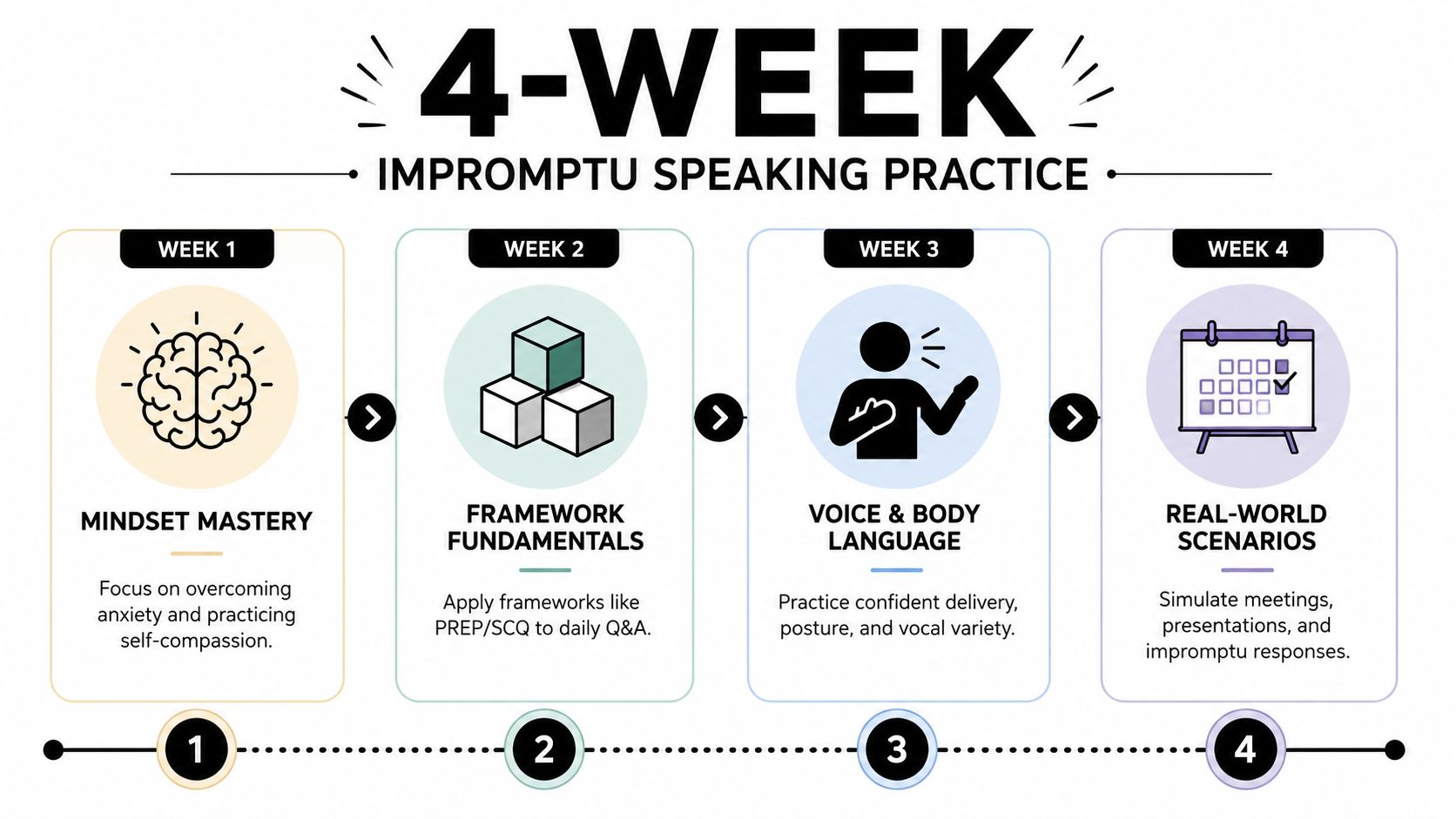
Short daily drills work better than occasional long sessions because they train retrieval under pressure. As noted earlier, research on career outcomes also points to the outsized value of soft skills in advancement. Spontaneous speaking is one of the places where that value becomes visible fast.
The goal of this four-week plan is simple: reduce cognitive overload so your expertise comes through sooner.
Week 1 builds response tolerance
Start with continuity, not polish.
Set aside 20 minutes a day. Answer random work-related prompts out loud. Keep each response brief. If you lose a word, keep going with simpler language instead of stopping to repair the sentence.
Use prompts like:
- “What makes a team effective?”
- “What's one risk in our industry?”
- “What should managers do better?”
Rules for Week 1:
- No restarting from the beginning
- No apologizing for your English
- No hunting for perfect vocabulary
- No translating full sentences in your head before speaking
That last rule matters. Many international professionals are not short on ideas. They get stuck because they try to finalize the wording before they begin. Week 1 breaks that habit and teaches you to stay in motion.
Week 2 adds structure that lowers mental load
Now add PREP: Point, Reason, Example, Point.
Use the same style of random prompts, but answer in 60 to 90 seconds. Keep the structure visible on a sticky note. For non-native speakers, that cue is not a crutch. It frees working memory. Once the order is fixed, you can spend more attention on word choice and clarity.
A useful daily sequence looks like this:
| Daily drill | What to do |
|---|---|
| Prompt 1 | Answer with PREP in under a minute |
| Prompt 2 | Give the same answer again, but more clearly |
| Prompt 3 | Replace any complex phrasing with simpler English |
| Prompt 4 | Record only your first two sentences and review them |
That third drill is especially important. In executive settings, simple language usually sounds more confident than complicated language delivered with strain.
If you want more repetition with workplace vocabulary, business English speaking practice for professionals helps build the language patterns that appear in impromptu answers.
Week 3 focuses on delivery under limited attention
Keep the answers short. Shift your attention to how the message lands.
Use these constraints:
- Pause for one beat before speaking
- Slow down your first sentence
- Finish the last word cleanly
- Use one intentional gesture on your main point only
Record yourself and review with one question in mind: do you sound clear and settled enough for people to trust the answer?
Do not judge yourself on whether you sound native. That standard is distracting and often counterproductive. In real meetings, listeners respond first to steadiness, structure, and vocal control.
If you want another way to sharpen pacing and spoken clarity, these professional podcast audio tips are useful because podcast interviews expose many of the same habits that weaken authority under pressure.
Week 4 simulates real workplace pressure
Now make the practice less comfortable and more realistic.
Use questions that are vague, skeptical, or politically sensitive:
- “Why are we behind?”
- “What would you do differently?”
- “I'm not convinced this is the right priority. What's your response?”
- “Can you explain that more clearly?”
Your job this week is not to produce a perfect answer instantly. Your job is to orient the conversation. That is a senior skill.
Try responses like:
- “I can't speak to every technical detail yet, but the key business issue is…”
- “The decision here comes down to two trade-offs…”
- “From a leadership perspective, the priority is…”
- “The clearest way to answer that is to separate the short-term issue from the long-term one…”
Adapted PREP becomes useful for international professionals. Keep the structure, but shorten it when the pressure is high. Sometimes one clear point and one reason is enough. A shorter answer often gives you time to think while still sounding decisive.
A practical weekly rhythm:
- Monday and Tuesday for random prompts
- Wednesday for recorded review
- Thursday for difficult Q&A simulation
- Friday for live practice with a colleague or coach
After four weeks, expect earlier starts, simpler wording, and less panic in the first ten seconds. That shift is significant. It means your expertise is becoming easier to hear.
Take Your Impromptu Skills to the Next Level
Most professionals don't need more advice. They need better training conditions. They need practice that reflects the pressure of real meetings, the reality of second-language thinking, and the executive standard of sounding concise without sounding abrupt.
That's the shift that makes impromptu speaking skills usable at work.
If you keep practicing with simple structures, strategic pauses, and realistic questions, you'll stop treating surprise as a threat. You'll start treating it as a leadership moment. That's when your expertise becomes easier for others to hear.
It also helps to sharpen the mechanics around spoken delivery beyond meetings alone. If you want another angle on vocal clarity, pacing, and presence, these professional podcast audio tips are useful because podcast interviews expose many of the same habits that weaken authority under pressure.
The next level usually comes from targeted feedback. Not generic encouragement. Not more theory. Specific feedback on where your authority drops, where your structure breaks, and how your delivery changes when the stakes rise.
If you want that level of clarity, start with a complimentary Executive Communication Assessment from Intonetic. It's the best entry point if you want to identify the specific gaps affecting your authority in meetings, presentations, and high-stakes conversations, then build a focused plan to improve how you speak under pressure.