
Business English Speaking Practice: A 12-Week Plan
You're probably already doing the hard part well. Your analysis is sound. You know your domain. You've earned your seat in the meeting.
Then the discussion turns to you, and the message lands flatter than it should. You speak a little too fast. You soften the opening. You add extra explanation before the main point. Someone with weaker ideas but stronger delivery gets the nod.
That's the problem most business english speaking practice misses. It trains language. Senior leaders are judged on language and presence.
Beyond Fluency The Untapped Power of Executive Presence
A lot of international professionals think the target is “perfect English.” It usually isn't. In high-stakes meetings, people don't reward perfection. They respond to clarity, steadiness, timing, and the sense that you can hold a room without forcing it.

That's why fluent professionals still get overlooked. They know the vocabulary, but their delivery signals uncertainty. They rush the key point. Their voice lifts at the end of a statement. They fill silence too quickly. None of that means they lack expertise. It means the expertise isn't being packaged in a way senior stakeholders instantly trust.
A 2024 LinkedIn survey of 5,000+ international professionals found that 68% of non-native English speakers in tech and finance report lacking vocal confidence as the top barrier to promotion, yet only 12% of Business English resources cover gravitas training (GlobalExam overview of spoken business English improvement). That gap matters because boardrooms don't evaluate you like a language teacher. They evaluate whether you sound ready.
What senior-level listeners actually hear
When executives listen, they're often scanning for three things:
- Vocal authority. Does your voice sound grounded, or does it sound hesitant?
- Strategic pausing. Can you let a point land without rushing to protect it?
- Confident delivery. Do your words, pace, face, and posture match the importance of the message?
If you want a useful companion resource on presentation delivery, this guide on how to engage audiences during delivery is worth reading because it sharpens the audience side of the equation, not just the language side.
Fluency gets you into the conversation. Presence shapes what happens after you speak.
Business english speaking practice becomes much more effective when you stop asking, “How do I sound more native?” and start asking, “How do I sound more credible under pressure?”
A better target than perfect English
The stronger target is executive presence in English. That means you can:
- state your point early,
- hold eye contact or camera contact,
- speak with enough vocal weight to sound settled,
- respond without scrambling when challenged.
If you want a structured diagnostic before building those habits, the Executive Communication Assessment is a practical starting point because it identifies where delivery, not just language knowledge, is limiting your influence.
Weeks 1-4 Building Your Vocal Foundation
Most professionals want to jump straight into presentations and negotiations. That's too early. If your breath, articulation, resonance, and pacing are unstable, pressure will expose it immediately.
A better first month is mechanical. You build habits that hold up when the room gets tense.
A proven method for this stage is Task-Based Language Teaching, which can deliver a 25-35% improvement in speaking fluency and confidence, and a needs analysis matters because 34% of professionals report their biggest gaps are in listening and speaking business materials (SAGE article on TBLT implementation).
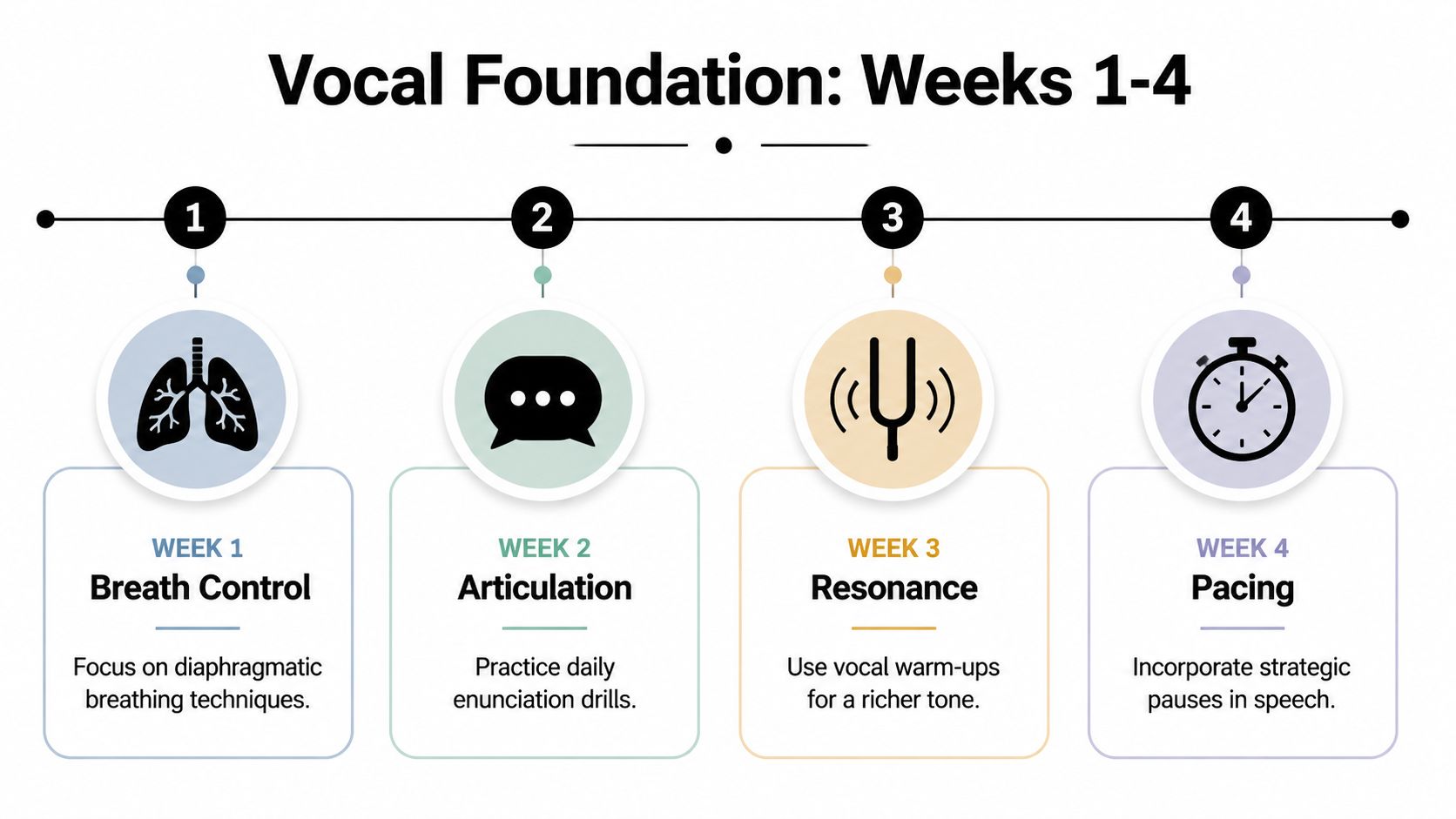
Week 1 and 2 settle the voice before you polish it
Start with breath control. Not because it sounds academic, but because shallow breathing creates rushed speech and thin vocal tone.
Use this daily sequence:
- Breathing reset. Inhale low into the ribcage, pause briefly, then speak one sentence on the exhale. Use real business lines such as “My recommendation is to delay the launch until legal approves the revised terms.”
- Sentence projection. Read five short statements out loud, aiming for calm volume rather than loud volume.
- End-stop practice. Finish each sentence fully. Don't let your voice drift upward unless you're asking an actual question.
In week two, move to articulation. You don't need exaggerated pronunciation. You need clean consonants and controlled openings, especially in meetings where audio quality is imperfect.
A short warm-up before calls helps. These vocal warm-ups and tongue twisters for clearer speech are useful because they prepare the mouth and jaw quickly without turning practice into a long ritual.
Week 3 and 4 make you sound more senior
By week three, work on resonance. The point isn't to force a lower voice. Forced depth sounds artificial. Instead, aim for a more settled tone by speaking from a relaxed body, reducing throat tension, and slowing the first sentence.
Try this comparison:
| Habit | What it signals | Better alternative |
|---|---|---|
| Fast first sentence | Nervousness | Slower opening with a deliberate pause |
| Upward inflection on statements | Uncertainty | Downward finish on key recommendations |
| Speaking without breath support | Strain | Short pause, inhale, then continue |
| Over-articulating every word | Self-consciousness | Clear key words, natural flow elsewhere |
Week four is pacing. Many capable professionals finally start sounding authoritative during this stage. Record a one-minute answer to a common question such as “What's the commercial risk here?” Then review it for three things:
- Did you rush the first ten seconds?
- Did you leave space after the key point?
- Did filler words appear when you searched for the next idea?
Practical rule: authority often sounds slower than comfort, but never slower than intention.
Keep the practice load light but daily. Ten focused minutes beats one long, unfocused session at the weekend.
Weeks 5-8 Mastering Strategic Communication
Once the voice is steadier, business english speaking practice needs to move from sound to structure. At this stage, professionals start sounding less like they're translating and more like they're leading.

This shift matters because a 2023 LinkedIn Workforce Report found that 67% of tech leads and product managers from non-native English speaking regions cited speaking with executive gravitas as their top barrier to C-suite promotions (British Council business English resource summary).
Use tighter answer frameworks
At this stage, don't practice random speaking. Practice controlled response patterns.
One reliable framework is PREP:
- Point. State your conclusion first.
- Reason. Give the logic.
- Example. Add one concrete illustration.
- Point. Close by restating the recommendation.
If a stakeholder asks, “Why are you pushing back on this timeline?”, a weak answer circles around context. A stronger answer starts with, “I'm pushing back because the current timeline increases execution risk.”
That opening alone changes the perceived level of control.
Train for meeting moments, not language exercises
Work with mini-scenarios that reflect real pressure:
- Polite interruption. “Can I pause there for a second? I want to clarify the dependency before we move on.”
- Disagreement without friction. “I see the upside. My concern is that we're underestimating the delivery risk.”
- Executive summary. “Let me summarize the decision, the risk, and the next step.”
This is also the right phase to refine melody and emphasis. Strong intonation helps listeners understand which words matter, especially in virtual meetings. These examples of American English intonation in professional speech are useful if your delivery sounds flat, rushed, or overly tentative.
Good strategy in English isn't more words. It's better sequencing.
Review recordings for message control
By now, your recording review should change. In the first month, you were listening for mechanics. Here, listen for leadership signals.
Ask:
- Was the main point clear in the first sentence?
- Did each example support the point, or distract from it?
- Did your pauses come before or after the most important idea?
- On video, did your face and posture look composed while you spoke?
A short self-audit after every important call is enough. Write down one moment where you lost control of the message and one moment where you led the conversation well. Progress speeds up when the review is specific.
Weeks 9-12 Commanding High-Stakes Scenarios
The last phase is where practice starts to resemble the moments that change careers. Not casual chat. Not controlled drills. Full-performance communication.

You can simulate presentations, negotiations, investor updates, and difficult stakeholder conversations here. The pressure should feel real enough that your old habits try to come back. That's useful. It shows you what still collapses under stress.
Project-Based Learning fits this phase well. It has shown results such as 20-30% sales growth for language-trained teams, and the process works through industry-specific projects like a VC pitch combined with weekly video audits to benchmark progress (Preply article on the ROI of business language training).
Scenario one executive presentations
Don't just rehearse slides. Rehearse the leadership moves inside the presentation.
Use this template:
- Opening decision line. State the headline before the background.
- Three-part logic. Give no more than three supporting points.
- Risk sentence. Name the concern before someone else does.
- Close with action. End on the decision you want.
Bad rehearsal sounds like memorization. Good rehearsal sounds like controlled variation. Repeat the same presentation several times, but vary the wording while keeping the structure stable.
Scenario two negotiations and pushback
Negotiation practice in English often fails because people only prepare vocabulary. You need prepared frames.
Use lines such as:
- To slow the pace. “Before we agree on terms, I want to isolate the two biggest risks.”
- To reframe pressure. “Speed matters, but so does implementation quality.”
- To hold your position. “We can move on timing or scope. We can't move on both.”
After each simulation, review not just what you said but what happened to your composure when challenged.
A useful rehearsal format is to watch your own delivery the way an external stakeholder would. This short video can help you think about presence, clarity, and public delivery under pressure:
For professionals preparing for these moments, pronunciation practice for public speaking under pressure can help reduce the friction that appears when nerves speed up your mouth faster than your thoughts.
Scenario three difficult conversations
This is the final test because it combines diplomacy, clarity, and authority.
Use a simple three-part script:
| Part | What to do | Example |
|---|---|---|
| Observation | State the issue cleanly | “We've missed the last two review deadlines.” |
| Impact | Explain why it matters | “That delay is now affecting the client timeline.” |
| Expectation | Set the next move | “I need a recovery plan by tomorrow morning.” |
Calm delivery is not softness. In difficult conversations, calm delivery is control.
Integrating Practice Into Your Busy Workweek
The biggest problem with business english speaking practice isn't motivation. It's friction. People think practice requires a free hour, a quiet room, and ideal energy. It doesn't.
What works is a repeatable system that fits inside a normal week. That matters even more now because Gartner reported 74% of enterprises adopted AI coaching by Q1 2026, and 62% of non-native leaders cited virtual gravitas as an unmet requirement for promotion (discussion of real-life business English expressions and AI-coaching trend). The shift is clear: professionals need feedback that fits remote work, not classroom conditions.
A realistic weekly rhythm
Use a split model. Micro-practice during the week. One deeper session on Friday or Sunday.
| Phase | Weeks | Primary Focus | Key Outcome |
|---|---|---|---|
| Foundation | 1-4 | Breath, articulation, resonance, pacing | More stable, authoritative vocal delivery |
| Strategy | 5-8 | Structuring answers, managing meetings, active listening | Clearer, more executive communication |
| Performance | 9-12 | Presentations, negotiations, difficult conversations | Stronger control in high-stakes scenarios |
Here’s a workable schedule:
- Monday. Record one minute on a current work topic. Review only the opening and the ending.
- Tuesday. Do a short vocal warm-up, then rehearse three executive phrases you need this week.
- Wednesday. Watch one meeting clip of yourself. Note pacing, fillers, and whether your point came early enough.
- Thursday. Run one scenario out loud while walking or commuting.
- Friday. Do a longer simulation on camera.
- Weekend. Review notes and choose one improvement target for the next week.
Use AI carefully, not blindly
AI tools are useful when they give immediate feedback on pacing, fillers, and repetition. They are less useful when they reward generic “fluency” while ignoring authority, timing, and senior-level framing.
That’s why the best setup is usually hybrid. Use AI for repetition and pattern spotting. Use human judgment for message quality and executive presence. If your schedule is packed, these tactics for fitting accent reduction practice into a busy schedule can help you stay consistent without turning practice into another job.
Build a communication journal you’ll actually keep
Don’t write long reflections. Use four short prompts after meaningful speaking moments:
- What was the situation?
- Where did I sound strong?
- Where did I lose authority?
- What will I repeat or change next time?
This journal also connects your verbal presence to your overall executive image. In some roles, appearance affects first impressions before you speak, so if you’re refining that side too, it may be worth looking at how to order a bespoke tailored work suit so your visual presentation matches the level you’re aiming for.
From Practice to Presence Your Path Forward
Strong business english speaking practice changes more than pronunciation. It changes how quickly people trust your judgment.
At first, the work feels technical. Breath. pacing. articulation. Then it becomes strategic. You learn to open with the point, handle pressure without overexplaining, and use silence without apologizing for it. Eventually, the change is bigger than speech. You stop sounding like someone trying to prove competence and start sounding like someone ready to lead.
That’s the difference between language practice and executive communication training. One helps you participate. The other helps you influence.
Self-guided work can take you a long way if you record yourself, review critically, and practice against real business situations. But most professionals plateau when they can no longer hear their own blind spots. That’s where outside feedback becomes useful, especially on subtle issues like vocal weight, message framing, and body language on camera.
If you want extra support between formal practice sessions, tools about HyperWhisper can also help with faster capture and review of spoken ideas, meeting reflections, and rehearsal notes. The key is to use tools in service of better decisions, not more noise.
For professionals who want personalized guidance, The Gravitas Method is a 12-week one-on-one executive presence coaching program for international professionals who want to communicate with more authority and influence at senior levels. The program is priced at $8,200 paid in full or $9,000 across three installments. Coached by Nikola, it covers vocal authority, strategic framing, executive body language, and high-stakes communication.
The fastest next step is to identify your actual gap. Not the one you assume you have. The one other people hear.
A strong next move is to book the free Executive Communication Assessment with Intonetic. It’s the clearest way to pinpoint whether your main issue is vocal authority, message structure, pacing, body language, or high-stakes delivery, so your practice becomes targeted instead of generic.