
Communication as Persuasion: The Executive’s Guide
You know the feeling. You’ve done the work, built the case, anticipated the objections, and walked into the meeting with a stronger idea than anyone else in the room. Then you present it, the room stays flat, and someone with less substance but better delivery gets the decision.
That isn’t a confidence problem. It’s a persuasion problem.
In senior environments, communication as persuasion means more than speaking clearly or sounding polished. It means shaping how people understand your idea, how they evaluate your credibility, and whether they feel safe backing your recommendation. For international professionals, this challenge is sharper. You may already have the expertise, but if your delivery sounds hesitant, over-explained, or overly technical under pressure, people can misread your level.
Why Great Ideas Fail in the Boardroom
A senior engineer explains a product risk with precision. A finance leader presents a careful forecast. A director recommends a difficult but necessary change. All three may be right. All three can still lose the room.
What usually fails isn’t the idea itself. It’s the transfer of conviction from speaker to audience. Decision-makers don’t approve proposals because the presenter knows the answer. They approve proposals because the presenter makes the answer feel credible, coherent, and actionable.
That’s why generic advice like “be more confident” doesn’t help. Confidence isn’t a tactic. It’s an output that comes from structure, delivery, and control.
Many professionals already follow strong Business Communication Best Practices, but boardroom persuasion asks for something more specific. You need to manage pace, emphasis, objection handling, and executive presence in real time.
For international leaders, pronunciation and clarity also matter because they affect perceived authority. If you regularly prepare for high-pressure meetings, this guide to board meeting pronunciation coaching for executives is useful because small delivery shifts can change how quickly senior stakeholders trust what they’re hearing.
Great ideas rarely fail on merit alone. They fail because the room never feels their weight.
Communication as persuasion isn’t manipulation. It’s disciplined leadership communication. You’re not pushing people toward a bad decision. You’re removing friction so they can see the value of the right one.
That means doing three things well:
- Establishing authority: People need to believe you can be trusted.
- Creating clarity: They need to see the logic without doing extra work.
- Generating momentum: They need a reason to move now, not later.
When those three line up, the same idea that once sounded “interesting” starts sounding inevitable.
The Three Pillars of Persuasive Communication
Aristotle’s Rhetoric, written around 384-322 BCE, established the foundational framework for communication as persuasion by introducing ethos, pathos, and logos, and those three pillars still shape modern persuasion roughly 2,500 years later according to this historical overview of persuasion theory.
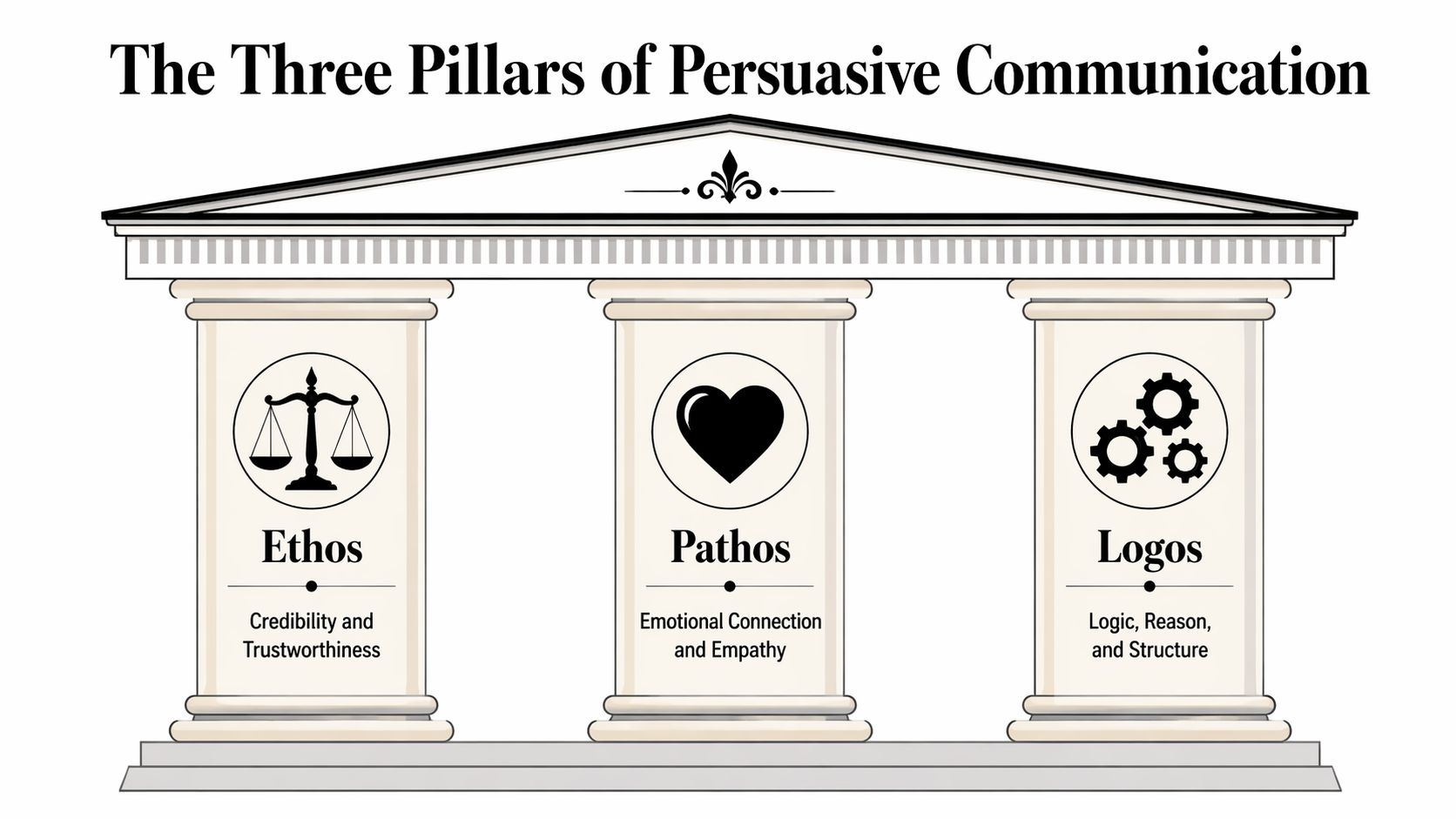
Think of your idea as software. Your communication is the hardware. Strong software on weak hardware still crashes. That’s what happens when a smart idea is delivered with weak credibility, muddy logic, or no emotional traction.
Ethos in the modern executive context
Ethos is credibility. Not your résumé on paper, but your perceived authority in the moment.
In executive settings, people infer ethos from signals such as how directly you answer, whether you over-explain, how calmly you handle interruption, and whether your voice sounds settled under scrutiny. This is why professionals with deep expertise can still be treated as too junior. The room is judging your command, not just your content.
Ethos also comes from restraint. Senior communicators don’t flood the room with every detail they know. They select the detail that matters most and present it without strain.
Logos is the architecture of thought
Logos is logic, but not in the narrow sense of “having data.” Logos is the architecture that helps the audience move from problem to conclusion with minimal resistance.
A persuasive leader doesn’t dump information. They sequence it. They show what’s happening, why it matters, what the trade-off is, and what decision follows.
A few signs your logos is weak even if your analysis is strong:
- You start too far back: The audience gets buried in background before they know the point.
- You answer the wrong question: You explain what the project is when the room cares about risk, timing, or consequence.
- You present facts without shape: People hear isolated truths rather than a clear recommendation.
If you want a practical next step for developing this kind of command, executive presence coaching for international professionals often focuses on exactly this intersection of message structure and delivery.
Pathos is business emotion, not theatrics
Pathos makes the message matter. In corporate environments, that doesn’t mean dramatic storytelling or forced charisma. It means understanding what your audience cares about and speaking to that concern directly.
A CFO may care about exposure. A board may care about strategic timing. A product team may care about execution risk. A founder may care about credibility with investors. The same recommendation lands differently depending on which pressure point you activate.
Practical rule: If your message is only accurate, it may be respected. If it is accurate and felt, it is far more likely to move a decision.
Here’s the simplest way to use the three pillars together:
| Pillar | What the audience is asking |
|---|---|
| Ethos | Why should we trust you? |
| Logos | Why does this make sense? |
| Pathos | Why should we care now? |
Most professionals overinvest in one pillar. Technical experts often lean on logos. Charismatic speakers may rely on pathos. Senior influence requires all three.
Building Your Ethos for Executive Credibility
Credibility isn’t static. You don’t either have it or lack it. You project it, lose it, reinforce it, or dilute it in real time.

This matters most when the situation holds considerable weight and the room is evaluating more than your answer. They’re evaluating your readiness for larger scope. International professionals often feel this acutely. You can know the business cold and still be misread if your tone rises at the wrong moment, your pacing speeds up under challenge, or your body language leaks uncertainty.
Use two-sided arguments to sound senior
One of the fastest ways to build ethos is to stop sounding like you’re selling and start sounding like you’ve already considered the resistance. Research summarized in this overview of persuasive strategies shows that messages presenting both sides and refuting the opposition are the most effective, producing 20-30% stronger attitude change durability than weaker approaches.
That finding matches what experienced executives already do naturally. They don’t hide the downside. They surface it, frame it, and neutralize it.
Instead of saying, “This rollout is the right move,” say:
- Acknowledge the risk: “The strongest concern is disruption during transition.”
- Show you understand it: “That concern is valid because the timing overlaps with an already stretched operating cycle.”
- Refute with judgment: “The reason to proceed anyway is that waiting preserves current friction and increases dependency on the old process.”
That pattern does two things at once. It strengthens your argument, and it signals maturity.
For a broader perspective on the behaviors leaders use to build executive presence, it helps to look beyond language alone and consider how others read your steadiness.
Vocal authority changes how people rank you
Ethos is heavily auditory. Before people process all your logic, they react to your sound.
Common credibility killers include upward inflection on declarative points, rushed pacing after interruption, and filler used to soften a recommendation that should sound firm. These habits often come from trying to be cooperative or precise. In senior rooms, they can make you sound uncertain.
A more credible vocal pattern usually includes:
- Lower urgency: Slow down slightly on key recommendations.
- Cleaner endings: Finish sentences decisively rather than fading out.
- Strategic pausing: Let important points land instead of filling every silence.
- Deliberate emphasis: Stress the business consequence, not every technical detail equally.
The following resource is relevant if accent and executive delivery intersect in your role: American accent coaching for C-level executives.
A simple way to test your ethos is to record yourself answering one hostile question. Not your presentation. Your answer. Then listen for three things: how long it takes to get to the point, whether your tone tightens, and whether your final sentence sounds concluded or apologetic.
Executive presence is visible before you speak
Many people underperform. They focus on words and ignore the silent cues that frame those words.
If you enter a meeting already compressed, fidgeting, or visually reactive, you’ve lowered your starting authority. If you keep your posture open, your gestures economical, and your face composed while listening, you’ve already raised it.
Later in the process, many professionals choose structured support to work on this more systematically. The Gravitas Method is a 12-week one-on-one executive presence coaching program for international professionals who want to communicate with more authority and influence at senior levels. The program is priced at $8,200 paid in full or $9,000 across three installments. Coached by Nikola, it covers vocal authority, strategic framing, executive body language, and high-stakes communication.
A useful example of delivery work in practice is below.
When you present objections fairly, answer them calmly, and hold your pace under pressure, people stop hearing “specialist” and start hearing “leader.”
Structuring Your Message with Impeccable Logos
A persuasive argument is not a pile of facts. It is a route. If the route is badly designed, the audience gets lost, even when the evidence is sound.

In executive communication, logos has to do more than prove correctness. It must reduce cognitive load. Your audience should not need to assemble your argument for you while also evaluating whether to support it.
Start with the decision, not the download
Many smart professionals begin too early. They open with context, process, definitions, history, and technical setup. By the time they reach the recommendation, the room has already started checking out.
A stronger sequence is:
- State the decision
- Name the business reason
- Address the main risk
- Explain the consequence of action versus inaction
- Ask for the specific next step
That sequence sounds more senior because it respects how executives think. They aren’t waiting to be educated from scratch. They’re deciding whether the recommendation is clear, sound, and worth backing.
Steel-man the opposing view
A weak rebuttal attacks a bad version of the other side. A strong rebuttal presents the opposing case in its strongest form, then answers it cleanly.
That’s the steel-man approach. It works especially well when the room includes skeptics, cautious operators, or stakeholders who fear you’re oversimplifying.
Here’s a practical template:
| Step | What to say |
|---|---|
| Position | “My recommendation is to move forward this quarter.” |
| Strongest objection | “The best argument against this is that execution risk is highest during the current planning cycle.” |
| Fair acknowledgment | “That concern is legitimate because team capacity is tight and the transition creates short-term complexity.” |
| Refutation | “The cost of delay is greater because the current process continues to slow decisions and compounds avoidable risk.” |
| Conclusion | “So the right move is a controlled rollout rather than postponement.” |
That structure creates trust because it tells the room you’re not protecting your idea from scrutiny. You’re inviting scrutiny and surviving it.
Use anchoring to shape interpretation
Numbers don’t speak for themselves. The first frame people hear affects how they interpret everything that follows.
According to this guide to data for persuasion, anchoring can increase agreement by 15-25%, and positive framing boosts compliance by 18%. In practice, that means your opening benchmark matters.
If you say, “This initiative requires investment,” the room starts with cost.
If you say, “We’re currently absorbing preventable delay and avoidable operational drag,” the room starts with loss.
Same topic. Different anchor.
A strong anchor doesn’t distort reality. It tells people where to look first.
Anchoring is especially useful when your audience is overwhelmed by detail. The benchmark gives them a mental shelf to place the rest of the information on.
For professionals working on clarity under pressure, improving English pronunciation for public speaking can help because clean delivery makes structured logic easier to follow.
Use a simple narrative spine
Even highly analytical messages need shape. One of the most reliable structures for executive persuasion is Situation, Complication, Resolution.
- Situation: What is true right now?
- Complication: What makes the status quo unstable, costly, or risky?
- Resolution: What action solves the problem with acceptable trade-offs?
Here’s the difference in practice.
Weak version:
“We reviewed the current workflow, gathered stakeholder feedback, analyzed alternatives, and identified several possible areas for improvement.”
Stronger version:
“Our current workflow slows decisions at a critical stage. That delay creates operational friction and weakens accountability. The fix is to simplify the approval path and assign one clear owner.”
The second version sounds sharper because the logic arrives in a pattern the brain can process quickly.
What strong logos sounds like in a meeting
When your logos is working, your audience can repeat your position after hearing it once. That’s the test.
A strong message usually has these traits:
- One recommendation, clearly named
- One central reason the recommendation matters
- One major objection addressed directly
- One next step with clear ownership
If any of those are missing, you may still sound intelligent, but you won’t sound decisive.
Connecting Through Pathos to Influence Decisions
Pathos gets misunderstood in business because people hear “emotion” and think “drama.” That’s not what moves decisions in senior environments.
Pathos is about motivational relevance. It answers the question beneath the stated objection. What does this audience want to protect, gain, avoid, or prove? Until you know that, your message may be logical but inert.
Speak to the pressure behind the question
When a board member asks, “Why now?” they may not be asking about timing alone. They may be asking whether this creates avoidable exposure. When a peer asks, “Have we tested this enough?” they may be expressing fear of reputational risk, not technical doubt.
That’s why emotionally intelligent persuasion sounds calm rather than emotional. You identify the pressure and speak to it directly.
A few examples:
- For a risk-sensitive audience: Emphasize control, downside protection, and staged execution.
- For a growth-focused audience: Emphasize speed, strategic position, and what delay costs.
- For a credibility-conscious audience: Emphasize consistency, discipline, and external perception.
Storytelling works when it sharpens consequences
In professional settings, storytelling isn’t about entertaining the room. It’s about making consequences vivid.
Instead of saying, “This process is inefficient,” show what that inefficiency feels like inside the organization. A team waits for approval. Deadlines slide. Ownership blurs. Customers feel the lag. Leaders lose visibility. That progression creates emotional texture without theatrics.
You don’t need a long story. You need enough specificity for the audience to picture the future you’re describing.
If people can’t picture the cost of inaction, they tend to tolerate it.
Repetition works only with the right audience
Repetition is often taught as a universal persuasion tactic. It isn’t. A 2023 study described in this Harvard health communication summary found that for favorably biased audiences, message repetition can increase support likelihood by 20% or more. For unfavorably biased audiences, the same repetition can reduce support by 15-25%.
That’s a useful executive lesson. If stakeholders are already aligned, repeating the core message can strengthen fluency and confidence. If they’re skeptical, repetition can feel patronizing or exhausting.
So the trade-off is simple:
| Audience condition | Better move |
|---|---|
| Already receptive | Repeat the core thesis consistently |
| Actively skeptical | Change angle, introduce a fresh frame, or shift messenger |
A frequent error among presenters is believing resistance means restating the same point more forcefully. Often, that only hardens the resistance.
Nonverbal pathos matters more than people admit
The emotional layer of communication often rides through tone, pause, and facial expression before the audience fully processes your words.
If you say, “This is a manageable risk,” but your speech tightens and your breathing becomes shallow, the room trusts your body more than your sentence. If you describe an urgent opportunity in a flat monotone, the urgency disappears.
For professionals who want a more complete view of high-stakes delivery, this article on confident communication in high-stakes situations is a useful complement because pathos depends as much on how you sound as what you say.
The professional version of pathos is controlled conviction. Not intensity for its own sake. Conviction that tells the room, “I understand the stakes, and I know why this matters.”
Applied Persuasion in High-Stakes Executive Scenarios
Theory becomes useful when you can hear it inside a real conversation. In high-pressure settings, communication as persuasion is rarely neat. People interrupt, challenge assumptions, test your confidence, and react to cues you didn’t realize you were sending.

Recent analysis reported in this discussion of the science behind persuasion suggests that up to 70% of influence in virtual boardrooms and similar high-stakes settings can occur non-verbally through cues like vocal tone, strategic pauses, and synchronized body language. That tracks with what many executives feel but don’t always articulate. The room often decides how credible you are before it finishes evaluating your slide.
The boardroom pitch
A product leader is asking the board to fund a difficult initiative. The proposal is sound, but the directors are wary. Cost is visible. Upside feels distant. Timing looks awkward.
The weak version of the pitch sounds like this: lots of detail, too much background, and defensiveness whenever a director pushes back. Even if the analysis is solid, the speaker appears attached to the project rather than in command of the decision.
The stronger version looks different.
First, the leader opens with logos. The recommendation is explicit. The business issue is named in one sentence. The status quo is framed as a continuing cost rather than a neutral baseline.
Then ethos appears. A director challenges the timeline. Instead of rushing to defend it, the leader pauses, acknowledges the concern, and answers in a measured voice. No visible irritation. No verbal scrambling. That pause matters. It signals control.
Finally, pathos enters through consequence. The leader doesn’t become theatrical. They make the future concrete. If the company delays, teams keep absorbing friction, decision speed stays slow, and the firm loses momentum where it matters.
The most persuasive boardroom speakers don’t sound eager for approval. They sound responsible for the decision.
The high-stakes negotiation
A finance executive needs alignment from a peer who resists a proposed change. The stakes are political as much as operational. If the conversation turns into a tug-of-war, both sides lose trust.
A poor approach would be to double down on facts and keep proving the point. That often creates more resistance because the other person doesn’t feel heard. Good persuasion includes listening, not just asserting. This guide on improving your active listening skills is useful because listening changes what kind of argument will land.
The stronger negotiator does three things.
- They surface the other side’s real concern: not just the spoken objection, but the pressure behind it.
- They mirror selectively: matching pace, level of directness, and emotional temperature without becoming artificial.
- They reframe the goal: from “my proposal versus yours” to “the best way to protect the shared outcome.”
What nonverbal control looks like under pressure
In both scenarios, unconscious cues do enormous work. Strong executive communicators tend to:
| Cue | Weak signal | Stronger signal |
|---|---|---|
| Pause | Filling silence immediately | Letting a challenge sit for a beat |
| Voice | Speeding up under stress | Slowing slightly on key points |
| Posture | Tight shoulders, collapsed chest | Grounded, open, settled stance |
| Eye focus | Darting between faces or slides | Holding attention on the questioner |
| Gesture | Frequent, nervous motion | Fewer, more deliberate movements |
These cues don’t replace substance. They determine whether substance gets believed.
A practical rehearsal method
If you want to apply this before your next high-stakes conversation, don’t rehearse the whole presentation first. Rehearse the pressure points.
Use this sequence:
- State your recommendation in one sentence
- Answer the hardest likely objection
- Say the consequence of doing nothing
- Deliver the closing ask
- Review the recording with the sound off
- Review it again for pace and vocal control
The sound-off review is especially revealing. You’ll see whether your face, posture, and reaction patterns support the authority your words are trying to project.
Turn Your Influence into Impact
Persuasion isn’t a dark art. It’s a professional skill. It can be learned, diagnosed, practiced, and improved.
When communication as persuasion is working, your expertise stops getting trapped inside your head. People trust you faster. Your ideas become easier to back. Your recommendations hold up better under challenge. You stop sounding like someone who merely understands the issue and start sounding like someone ready to lead through it.
That shift matters for international professionals because senior credibility is often judged through delivery before performance gets fully recognized. Better communication doesn’t change your intelligence. It changes whether other people can feel it quickly enough to act on it.
Here’s the simplest next move.
| Feature | Description |
|---|---|
| Book Your Free Executive Communication Assessment | Identify where your delivery, structure, vocal authority, and nonverbal signals may be lowering your perceived seniority in meetings, presentations, and high-stakes conversations. |
If your ideas are strong but your influence isn’t matching them, the gap is usually trainable. The right adjustments in ethos, logos, pathos, and delivery can change how you’re perceived in the moments that matter most.
If you want a clear, practical read on how your communication is landing at senior levels, start with the free Executive Communication Assessment from Intonetic. It’s the most useful first step if you want to identify the specific habits affecting your authority, influence, and executive presence before deciding what to work on next.