
How to Engage the Audience Like a Senior Leader
You're halfway through a presentation to senior leaders. Your slides are accurate. Your analysis is solid. Still, the room feels cold. A few people glance at laptops. One executive interrupts early. Another says, “Can you get to the point?”
That moment has very little to do with whether you're “good at public speaking.” It has everything to do with whether you know how to engage the audience in a way senior people respect.
For executive audiences, engagement isn't entertainment. It's speed to relevance. They don't want energy for its own sake. They want signals that you understand the business, respect their time, and can lead their attention with clarity. That's especially important if you're an international professional speaking in English under pressure. If your delivery feels hesitant, over-explained, or overly eager, strong ideas can lose force before they land.
Capturing Attention in the First 90 Seconds
Senior audiences decide fast. Not always consciously, but fast enough that a weak opening creates drag you keep paying for through the rest of the talk.

Start with something that earns attention
A slow opening usually sounds polite and professional. It also often sounds forgettable. “Thanks for joining.” “Today I'll walk you through…” “I'm here to discuss…” None of that gives a skeptical audience a reason to care.
A stronger opening uses a surprising statistic, bold business claim, or sharp tension point, then explains why it matters immediately. Hamilton College's oral communication guidance recommends facts that are “troubling, amusing, or remarkable,” then making them relevant and translating numbers into human terms in the same opening move (Hamilton College guidance on engaging your audience).
Practical rule: Your first lines should answer one question senior leaders ask silently: “Why should I care right now?”
If you want to sharpen the actual wording, this guide on how to write attention-grabbing hooks is useful because it focuses on openings that create immediate curiosity instead of generic introductions.
Use a simple opening sequence
I coach people to open in four moves:
- Lead with the tension. Name the problem, missed opportunity, or decision pressure.
- Attach a consequence. Show why it matters commercially, strategically, or operationally.
- State your point early. Don't make leaders wait for your recommendation.
- Preview the path. Tell them how you'll support the point.
That sounds like this:
- Weak opening: “Today I want to share some findings from our review of customer onboarding.”
- Stronger opening: “Our onboarding process is creating avoidable friction in the first customer interaction, and that's affecting how quickly new accounts reach value. I'm recommending three changes, and I'll show you where the friction is, what to fix first, and what decisions are needed today.”
That is how you engage the audience without performing for them.
For high-stakes settings, it also helps to prepare your opening differently from the rest of your talk. A short resource on confident communication in high-stakes situations can help if pressure makes you default to over-explaining.
What backfires early
A few habits lose senior attention quickly:
- Too much context first: Executives assume context will appear as needed. They want the issue, not the full history.
- Trying to sound warm before sounding useful: Rapport matters, but credibility comes first.
- Opening with apology language: “This may not be perfect,” “I didn't have much time,” or “You probably know this already” weakens authority before you've made a point.
Entertaining a room is optional. Making the room feel your message is worth their attention is not.
Establish Authority with Vocal Presence and Pacing
You can say the right words and still sound uncertain. Senior audiences hear authority before they fully process content.
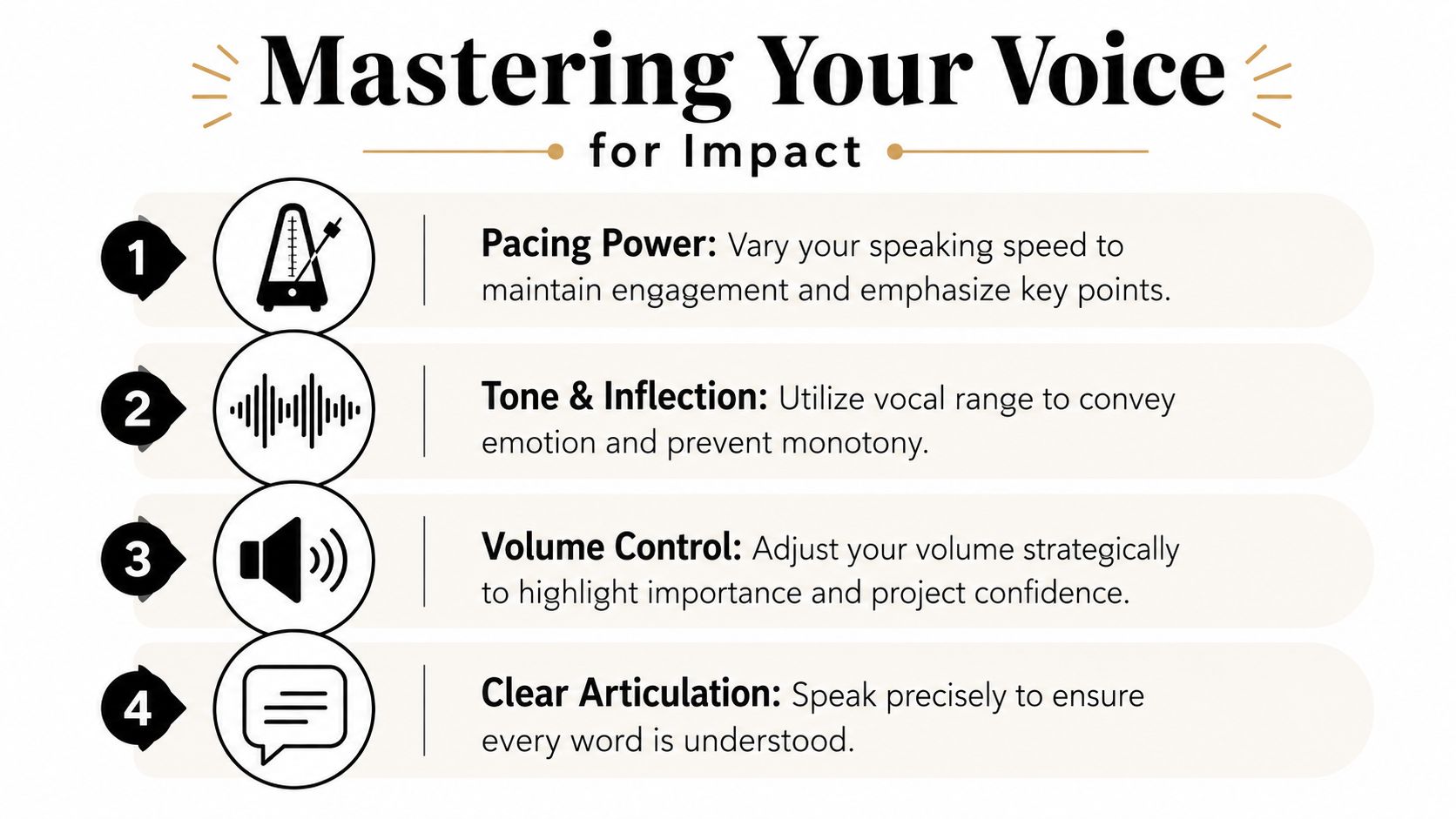
What your voice signals before your message lands
When professionals feel pressure, their voice often speeds up, rises in pitch, and loses contrast. The result is familiar. Smart person. Low authority signal.
Three patterns usually undermine presence:
- Uptalk: Statements sound like questions.
- Rush: Ideas arrive faster than the audience can absorb them.
- Fillers: “Um,” “so,” “kind of,” and “basically” dilute precision.
A more senior vocal pattern sounds different. It uses a settled pace, cleaner sentence endings, and deliberate pauses after important lines.
Use pause as a leadership tool
Individuals often pause only when they forget what to say. Strong communicators pause on purpose.
Try this adjustment in your next meeting. Deliver the key sentence, then stop. Not for drama. For processing.
For example:
| Weak delivery | Stronger delivery |
|---|---|
| “I think maybe the main issue is adoption across teams and we should probably address that first” | “The main issue is adoption across teams. That's the first problem to fix.” |
The words improve. The pause does even more.
Silence after a clear statement often sounds more senior than extra explanation.
If English isn't your first language, slowing down can feel risky because you may worry you'll sound less fluent. In reality, controlled pacing usually increases clarity and authority. This guide on how to speak slow for clearer English pronunciation is a practical place to work on that skill.
Drills that work better than generic advice
Don't tell yourself to “sound confident.” Train specific mechanics.
- Mark your landing words: In each sentence, identify the final important word and finish it decisively.
- Practice downward inflection: Read five declarative sentences and end each one flat or slightly downward.
- Use breath grouping: Speak in short thought units, not one long stream.
- Record one minute: Listen for pace changes when you explain something technical. That's often where anxiety speeds you up.
A confident voice is not a loud voice. It's a voice that sounds like it trusts its own message.
Command the Room with Executive Body Language
Before you speak, the room is already reading you. Your posture, gestures, facial control, and movement tell people whether to relax into your leadership or question your steadiness.

Do this, not that
The biggest body language mistake in executive settings isn't being too still. It's leaking tension through unnecessary movement.
Use this contrast:
- Instead of shifting weight constantly, plant both feet and let stillness do some of the work.
- Instead of gesturing on every phrase, gesture when contrast, scale, or priority matters.
- Instead of scanning the room nervously, hold eye contact long enough to complete a thought.
- Instead of folding inward at the chest, keep your sternum lifted and shoulders settled.
These aren't cosmetic tweaks. They change how your message is received.
Many international professionals overcompensate physically when speaking English. They smile too much, nod too often, or move their hands constantly to show cooperation. Those habits can read as approval-seeking when the room expects authority.
Use space deliberately
If you're standing, movement should signal structure. Move to start a new point. Stop when delivering the key line. Don't pace while explaining something complex.
If you're seated at a boardroom table, executive body language is smaller but just as visible. Sit back enough to avoid hunching. Keep your hands available above the table when making a point. Don't disappear into your notes.
A useful external perspective on mastering executive presence highlights many of the visible behaviors that shape how leaders are perceived in high-stakes rooms.
Here's a short visual primer worth studying before your next major presentation:
Eye contact without intimidation
Some speakers avoid eye contact because they feel exposed. Others overcorrect and stare. Neither works.
Try a cleaner pattern:
- Land one full sentence with one person.
- Shift to another side of the room for the next sentence.
- Include the center only after you've grounded the edges.
If you speak English with an accent, don't assume you need to “perform confidence” more aggressively. You need visible composure. Here, speaking English with confidence even with an accent becomes a presence issue, not just a language issue.
Frame Your Ideas for Maximum Impact
A lot of capable professionals lose executive audiences because they present information in the order they discovered it, not in the order leaders need to hear it.
That's a framing problem.
Senior listeners want the point before the journey
When an audience is skeptical or low-interest, adding more information usually doesn't solve the problem. Research on underserved-audience communication points in a different direction. Effective engagement often starts with dialogue and audience shaping, and communicators who listen first and adapt to existing audience interests do better than those who treat communication as one-way broadcasting. For senior professionals, the core task is to reduce friction and increase relevance fast (research summary on dialogue and audience shaping).
That principle matters in executive communication because leaders are constantly asking, “What does this mean for me, the business, and the decision in front of us?”
If your structure delays that answer, attention drops.
Use executive-first framing
Instead of chronological updates, use one of these patterns:
- Recommendation first: “I recommend we delay launch by one cycle because the current version creates a higher support burden than we can absorb.”
- Situation, complication, resolution: Useful when stakeholders need context, but not a long preamble.
- Decision, rationale, risk: Effective when the room is choosing among options.
- Problem, cost of inaction, next move: Strong for change proposals.
If the audience has to work too hard to find your point, they'll often decide the point isn't there.
A simple test helps. Read your first three sentences out loud. If the commercial implication appears only at the end, rewrite the opening.
Simplify without sounding simplistic
Many international professionals worry that concise framing will sound blunt or underdeveloped. In senior settings, the opposite is usually true. Long lead-ins can make you sound less certain, even when your analysis is excellent.
You don't need fewer ideas. You need clearer hierarchy.
That's one reason structured coaching can help. The Gravitas Method is a 12-week one-on-one executive presence coaching program for international professionals who want to communicate with more authority and influence at senior levels. The program is priced at $8,200 paid in full or $9,000 across three installments. Coached by Nikola, it covers vocal authority, strategic framing, executive body language, and high-stakes communication. The value of that kind of work is not “becoming more charismatic.” It's learning how to make strong ideas sound senior from the first sentence.
Use Strategic Interaction Not Just Q&A
Many presenters treat interaction as something that happens at the end. “Any questions?” Then silence. Or one person asks a detail question that takes the room sideways.
That isn't engagement. It's an afterthought.
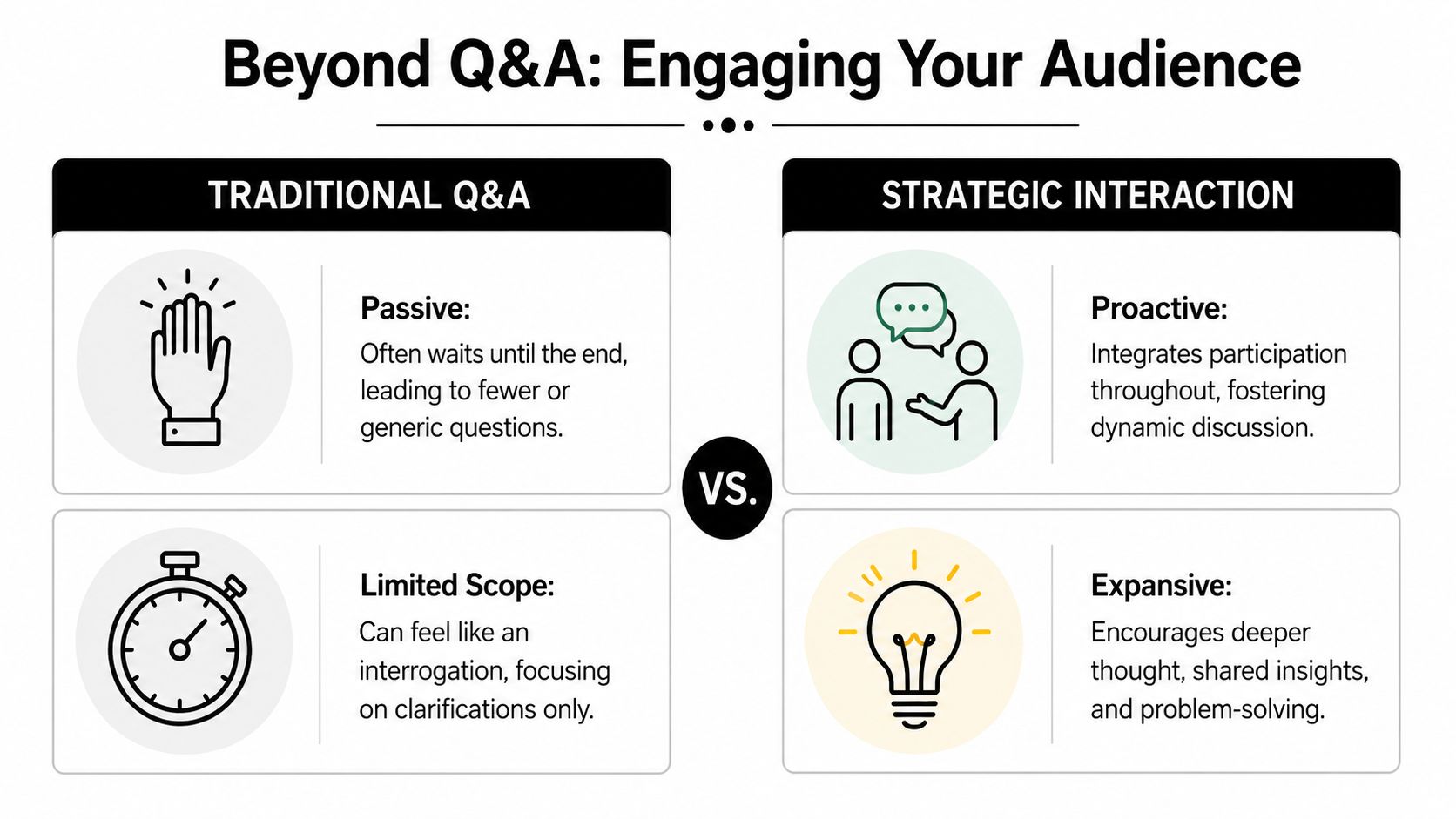
Why interaction works when it is designed well
Research on audience engagement shows that interactive content drives 52.6% more engagement, can double conversion rates, and boosts brand loyalty by 30% according to Insivia's interactive content statistics roundup. The lesson for executive communication is straightforward. People engage more when they participate, not when they passively receive information.
But not all interaction fits a senior room.
Executives often dislike broad, vague prompts such as “What do you all think?” early in a presentation. It creates social risk, wastes time, and can make the presenter look underprepared. Strategic interaction lowers friction.
Choose the format by risk level
A better approach is to match interaction to the room and the moment.
| Interaction type | Best use | Common mistake |
|---|---|---|
| Rhetorical question | Opening attention and framing tension | Asking something too obvious |
| Show-of-hands pulse check | Quick alignment on priorities or experience | Using it for trivial points |
| Targeted diagnostic question | Surfacing constraints from key stakeholders | Asking the whole room too early |
| Paired or small-group discussion | Complex trade-offs and reflection | Forcing it when time is tight |
One practitioner source on presentations recommends interacting within the first two minutes, then using direct-response questions again around the natural attention dip, often 10 to 15 minutes into a session, while using progressive disclosure and reveal sequences to prevent overload (presentation engagement guidance from Moxie Institute).
Don't rely on one tactic. Use interaction to punctuate the presentation, not hijack it.
If you run virtual sessions, moderation matters too. Basic tools like participant permissions, muting, and chat controls shape whether interaction feels focused or chaotic. For live online discussions, FOMOchat participant controls are a useful example of the operational side of engagement.
What works better than end-only Q&A
Try this sequence instead:
- Open with a framing question: Not for answers, but to focus the room.
- Midway, ask one concrete diagnostic question: Aim it at the decision makers who matter most.
- Close with a forward question: “What would need to be true for us to move on this this quarter?”
That sequence feels adult, efficient, and useful. It's how you engage the audience without making the interaction feel forced.
Adapt Engagement for Cross-Cultural Audiences
Advice on how to engage the audience often assumes one cultural norm. Speak up. Be animated. Invite debate. Push for visible participation.
That advice breaks down quickly in international rooms.
Engagement looks different across cultures
In multilingual and culturally mixed audiences, you need to tailor content to context, language access, and more relatable language. The deeper challenge for non-native English speakers is how to keep credibility, authority, and strategic clarity while engaging the room, which many generic guides fail to address (guidance on engaging underserved and multilingual audiences).
That means reading engagement more carefully.
Silence may mean reflection, not resistance. Limited public disagreement may reflect hierarchy, not lack of opinion. Fast, highly expressive delivery may read as confidence in one setting and lack of control in another.
Adjust three things first
- Pace: Slow enough for processing, especially when the room includes mixed levels of English fluency.
- Directness: Be clear on the business point, but calibrate how sharply you challenge ideas in public.
- Participation style: In some rooms, asking for open debate too early creates pressure. Targeted questions work better.
If you're a non-native English speaker, don't assume stronger presence requires sounding more native. It doesn't. It requires sounding more intentional. This is where improving your English accent without losing your culture becomes relevant to leadership, not just pronunciation.
Authority travels better across cultures when your language is clear, your structure is clean, and your delivery is controlled.
Your Next Steps to Authentic Engagement
To engage the audience like a senior leader, stop chasing attention and start building credibility. Open with relevance. Use a steadier voice. Remove anxious body language. Frame your point early. Design interaction instead of hoping for it. Adapt your style to the room in front of you.
If you want to know which part is weakening your presence most, start with the Executive Communication Assessment. It's the fastest way to identify whether your main gap is vocal authority, strategic framing, body language, or high-stakes delivery.
If you want structured support beyond self-study, Intonetic helps international professionals develop executive presence for meetings, presentations, and senior-level conversations. Start with the free assessment at Intonetic.