
Body Language for Leaders: Command & Inspire
You explain the numbers clearly. Your recommendation is sound. Nobody challenges the logic. Then the room moves on as if you said something optional.
That gap frustrates a lot of senior leaders, especially international professionals who've done the hard part already. You know your material. You've prepared for the objections. But your message still loses force somewhere between your mind and the room.
What's usually missing isn't intelligence or expertise. It's visible conviction.
In leadership settings, people don't just evaluate your argument. They read your steadiness, your certainty, your self-command, and whether your nonverbal signals support the weight of your words. That's why body language for leaders isn't a polish issue. It's an influence issue.
Why Your Message Is Getting Lost
A leader can speak with perfect logic and still look hesitant. That happens when the content says, “I'm sure,” but the body says, “I hope this is acceptable.”
Senior audiences notice this fast. A board member sees the shoulders tighten when a hard question lands. An investor notices the rushed breath before the key recommendation. A direct report sees the eyes drop right when authority is needed most.
The presence gap
The classic Mehrabian finding suggests that when communicating feelings or attitudes, 55% of meaning comes from body language, 38% from tone of voice, and 7% from words according to Berkeley Executive Education's discussion of leadership communication. That doesn't mean words don't matter. It means people often decide how much confidence to place in your words by reading the nonverbal layer first.
If your posture collapses at the end of a recommendation, your message weakens. If your face stays overly neutral while you claim urgency, your message blurs. If your gestures look busy rather than intentional, your authority leaks.
Practical rule: If the room has to choose between your words and your signals, it will trust your signals.
This is especially important for international leaders. You may already be translating in real time, adjusting for accent bias, and choosing your phrasing carefully. That extra cognitive load often shows up physically before you notice it. You speak more tightly. You over-monitor your face. You reduce movement so you won't “get it wrong,” and the result can read as restrained, guarded, or less senior than you are.
Why good leaders still struggle with this
Many professionals were taught to focus on correctness. In senior leadership, correctness alone rarely creates momentum. People need to feel that you can hold pressure, not just answer questions.
That's why body language for leaders should be trained the same way you train strategic communication. You can improve it through observation, repetition, and targeted adjustment. It isn't an inborn trait reserved for naturally charismatic people.
If you're working across cultures, there's an added layer. You're not just trying to be clear. You're trying to be read accurately. That's a different skill, and it's one reason many international professionals benefit from learning how to match verbal precision with visible executive presence. I've written elsewhere about breaking barriers for effective communication because often, the challenge isn't language alone. It's how language, voice, and nonverbal delivery land together.
The Five Pillars of Executive Presence
Strong executive body language is simpler than many assume. You don't need more movement. You need cleaner signals.
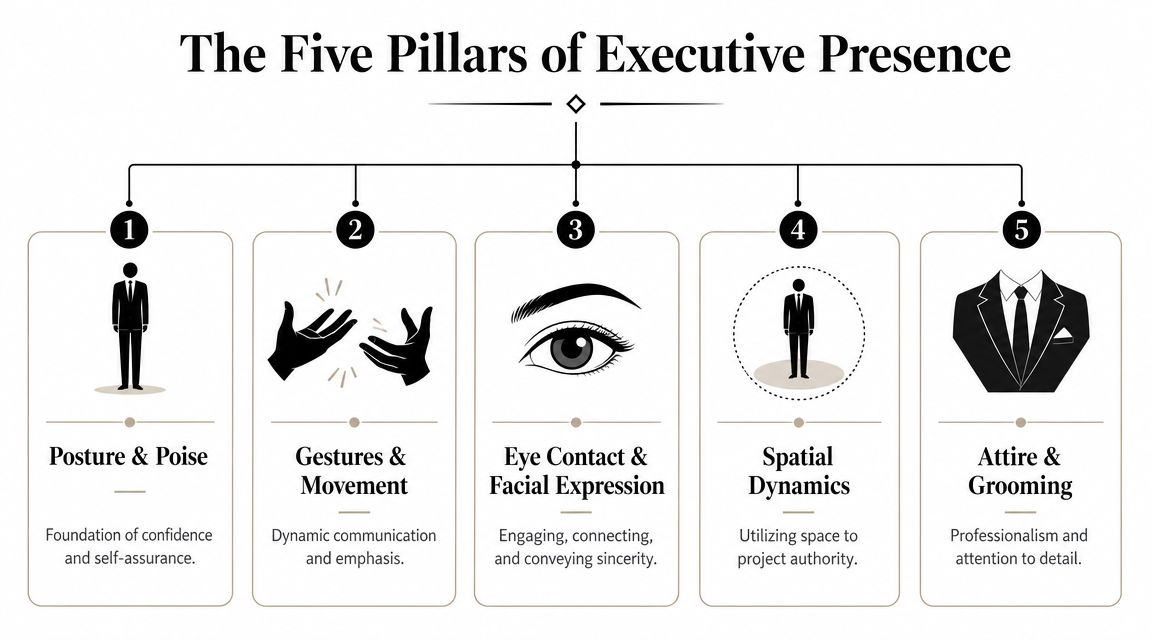
Posture and poise
Posture is your baseline. Before you speak, it tells people whether you expect to be heard.
A useful stance is stable, upright, and unforced. Feet grounded. Chest open. Shoulders relaxed rather than pulled back rigidly. Chin level. That creates a frame that reads as composed.
What doesn't work:
- Leaning back too far: This can look detached or overly casual.
- Hunching forward: This often signals defensiveness or uncertainty.
- Locking the body: Stiffness reads as self-consciousness, not confidence.
Try this in meetings. Sit back enough to claim your space, but not so far that you disappear from the interaction. If you're standing, plant your feet before making a key point. Leaders often lose authority when they begin speaking while still settling themselves physically.
Gestures and movement
Purposeful gestures help your audience follow your thinking. Nervous gestures distract from it.
The difference is timing. Effective gestures support structure, contrast, emphasis, and sequence. Ineffective gestures appear when anxiety leaks into the hands.
A few examples:
| Situation | Useful movement | Unhelpful movement |
|---|---|---|
| Making a recommendation | Open hand gesture near torso level | Pointing repeatedly |
| Explaining options | Controlled side-to-side comparison gesture | Fast chopping motions |
| Handling a challenge | Stillness first, then one clarifying gesture | Touching face, pen-clicking, fidgeting |
The key is to reduce random motion. Your hands shouldn't narrate your nerves.
Keep gestures inside a comfortable frame. If your movement looks larger than the idea deserves, people notice the performance before they notice the point.
Eye contact and facial expression
Eye contact builds authority when it looks steady, not aggressive. In practice, that means you hold someone's gaze long enough to complete a thought, then move naturally.
If you speak to groups, don't scan mechanically. Land your point with one person, then another, then another. That feels conversational and deliberate. Your face should also match the message. If you're delivering concern, your expression should show seriousness. If you're asking for trust, your expression should show openness.
A common mistake among senior professionals is over-correcting into blankness. They're trying to look controlled, but they end up unreadable.
Spatial dynamics
Space communicates rank. People who look uncomfortable occupying space often sound less authoritative too.
In a meeting room, don't shrink into the edge of the chair, clutch a laptop, or angle your body away when challenged. In presentations, avoid pacing without purpose. Movement should follow transitions, not nerves.
This applies to where you place materials as well. If notes, coffee cups, wires, and devices form a barrier between you and others, you create visual distance.
Attire and grooming
Clothing isn't executive presence by itself, but it does affect first impressions. The standard isn't “formal at all costs.” The standard is coherence. Your appearance should fit the room, support your authority, and remove distraction.
That's one reason executive presence is broader than posture alone. If you want a fuller view of how these elements work together, this guide on what executive presence is is useful context.
Commanding Presence in High-Stakes Scenarios
Body language for leaders changes with context. The signal you need in a boardroom isn't identical to the one you need on a global town hall or a hybrid strategy call.

In the boardroom
The boardroom punishes visible tension. Small habits become loud there.
A leader who keeps adjusting their jacket, glancing down before every answer, or rushing to fill silence starts to look less settled than the people questioning them. A better approach is slower and cleaner. Enter with measured pace. Sit or stand fully before speaking. Keep your hands visible. When challenged, pause, breathe once, and answer from stillness.
If you're speaking across cultures, don't assume energy equals authority. In many senior rooms, restraint reads stronger than enthusiasm. A contained presence often carries more weight than a highly animated one.
On a large stage or in a town hall
Big audiences require bigger clarity, not bigger acting. Your gestures can be slightly more expansive than in a meeting, but they still need shape and intention.
Use movement to mark transitions. If you shift position, let it signal a new topic or a change in emphasis. Don't drift. Wandering makes the audience work harder to track you.
For international leaders, a stage introduces another challenge. If you're already concentrating on language precision, your body may become too fixed. Build in a few planned gesture moments around key points so your delivery doesn't flatten under pressure.
In a critical one-on-one
Congruence is paramount. If you're delivering difficult feedback while smiling too much, your message gets mixed. If you're trying to build trust while checking your screen, you lose connection.
In private conversations, people read subtlety more closely. Sit at an angle that allows collaboration rather than confrontation when appropriate. Keep your torso engaged. Let your face respond honestly. And don't interrupt your own authority by softening every statement with apologetic body language.
When a conversation is sensitive, your calm matters more than your charisma.
In hybrid and virtual meetings
In this specific context, most leadership advice becomes too generic. “Maintain eye contact” sounds useful until you're on a video call with slides, chat, multiple faces, and a tiny camera lens positioned off-center.
Leadership guidance increasingly emphasizes that nonverbal communication must be adapted for virtual settings. Eye contact and posture need calibration for the camera, and over-gesturing or staring into the lens can reduce credibility on video, as noted in this leadership guidance on nonverbal communication in leadership.
That means:
- Frame intentionally: Show enough of your upper body for natural gestures to register.
- Use lens contact selectively: Look into the camera for key statements, not every second.
- Reduce gesture size: What looks normal in person can look exaggerated on screen.
- Sit with lift, not stiffness: Slumping reads tired. Rigid posture reads rehearsed.
- Manage the resting face: On camera, a neutral expression can look disengaged.
For hybrid meetings, the challenge is split attention. If some people are in the room and others are on screen, your body can accidentally exclude one group. Turn your torso, gaze, and pauses to include both. Senior leaders who handle this well appear more in command because they show they can hold the whole room, not just the nearest part of it.
If you regularly present in these environments, it helps to study how to present to senior executives with the medium in mind, not just the message.
Aligning Your Voice and Body for Authority
Authority breaks when the voice and body tell different stories. You can't sound grounded if your breath is shallow and your shoulders are tight. You can't project calm conviction if your hands are broadcasting urgency you didn't intend.
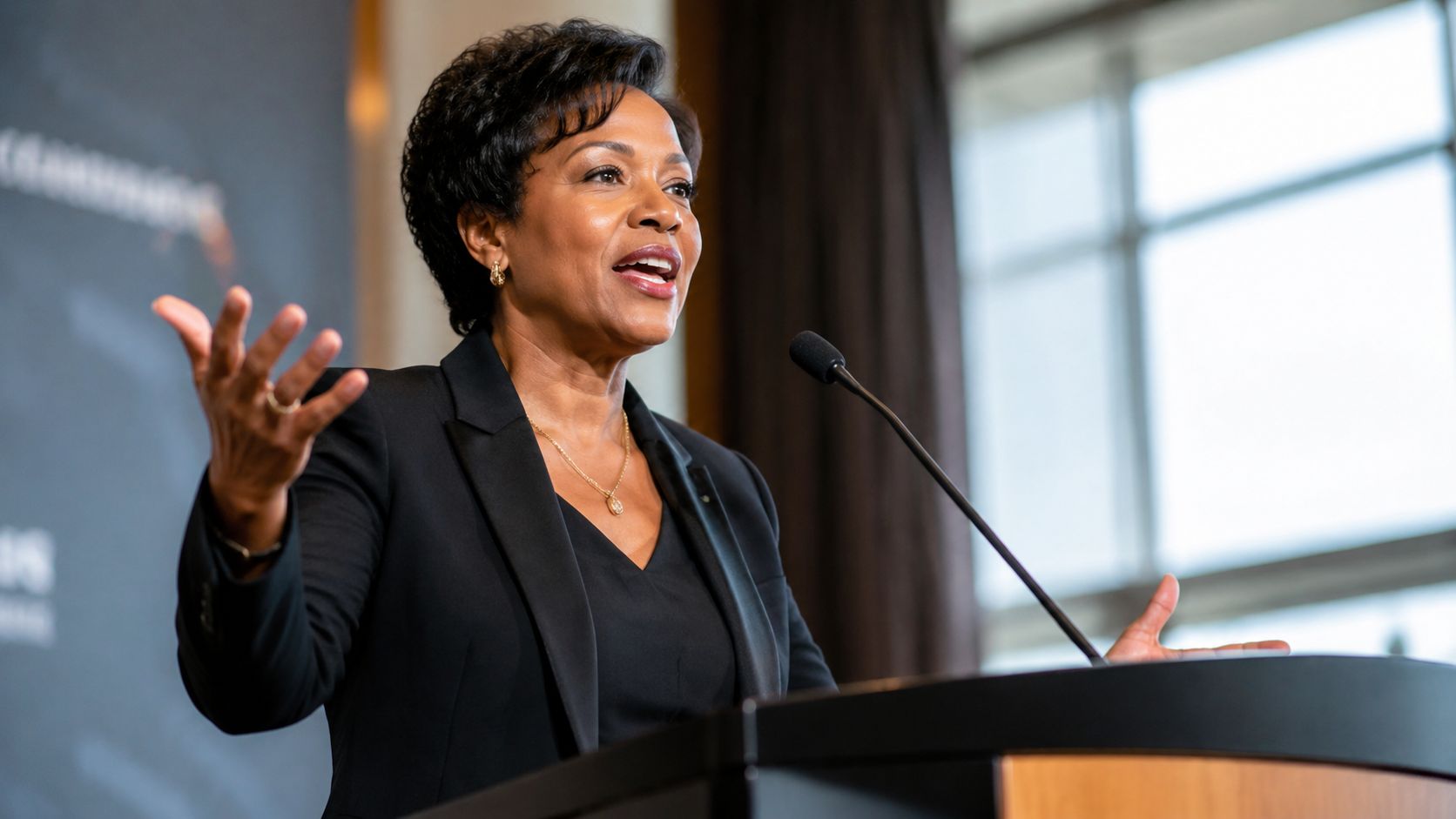
Why congruence changes how people read you
A 2025 review in PMC reported that followers rated leaders as warmer when they used affective communication techniques, and that leaders were rated as significantly more charismatic when they combined cognitive and affective techniques rather than relying on behavioral techniques alone, according to the PMC review on leader communication and charisma. In practice, that means people respond to more than your content. They respond to whether your delivery feels integrated.
That's the part many leaders miss. They try to “fix” body language as a separate layer. It works better when you train the whole system together.
What alignment looks like in practice
Start with the body because the voice sits inside it.
- Ground first: Put both feet down before a key statement.
- Release unnecessary tension: Jaw, neck, and shoulders often tighten when stakes rise.
- Pause physically: Stillness before a sentence gives the voice more authority.
- Match gesture to emphasis: Let the hand support the point, not compete with it.
A grounded body supports fuller breath. Fuller breath supports a steadier tone. A steadier tone makes shorter sentences sound more decisive.
I often see senior professionals make the same mistake in coaching. They work on stronger wording while their breath collapses at the end of each phrase. The result is a message that sounds less certain than the language itself.
Here's a useful companion resource on using your voice if you want to develop the vocal side in parallel.
A short demonstration helps more than theory alone:
Training authority as a repeatable skill
If you want this to change under pressure, don't rehearse only the words. Rehearse the physical delivery of the words.
Say your recommendation standing up. Record your opening. Watch where your eyes go when you make the critical point. Notice whether you rush through pauses because silence feels risky.
One structured option is The Gravitas Method, a 12-week one-on-one executive presence coaching program for international professionals who want to communicate with more authority and influence at senior levels. It's priced at $8,200 paid in full or $9,000 across three installments. Coached by Nikola, it covers vocal authority, strategic framing, executive body language, and high-stakes communication.
Your 8-Week Body Language Development Plan
You don't need a personality transplant. You need a practice plan. Most leaders improve fastest when they stop trying to fix everything at once.
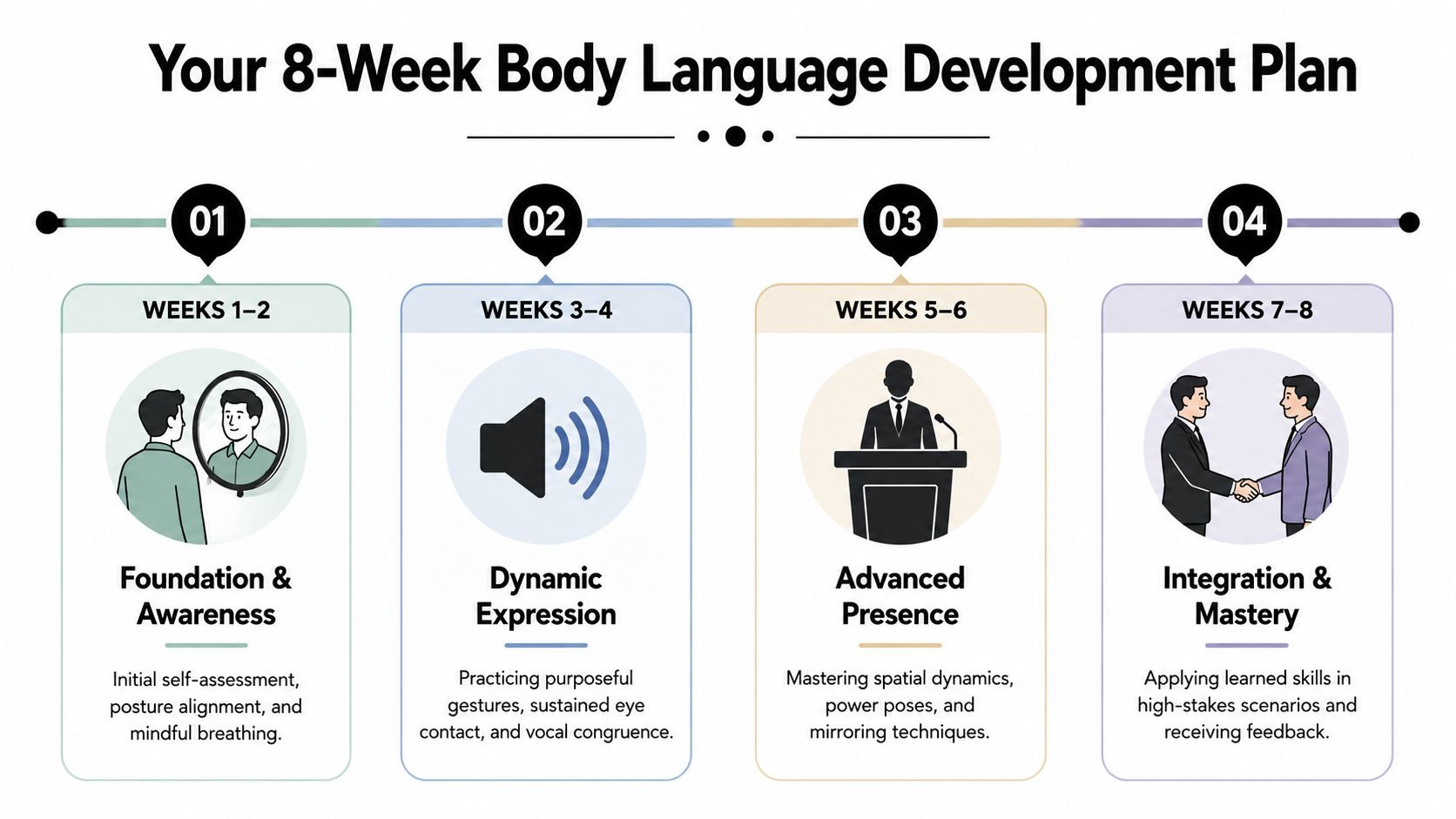
Weeks 1 and 2 foundation and awareness
Start by observing, not correcting. You need a baseline before you can build control.
Record yourself in one meeting, one presentation rehearsal, and one short unscripted update. Don't judge yet. Just look for patterns.
Focus on:
- Posture under pressure: Do you collapse, lean, or freeze?
- Hand behavior: Do your gestures support meaning or leak tension?
- Face and gaze: Do you look engaged, guarded, distracted, or overly intense?
Also choose one senior leader you respect and study them closely. Not to imitate them wholesale, but to notice pacing, stillness, gesture economy, and how they occupy space.
Weeks 3 and 4 posture and physical grounding
Now train your default stance. This stage should happen in low-stakes settings first.
Practice these drills daily:
- Standing reset: Feet grounded, knees soft, chest open, chin level.
- Seated authority drill: Sit away from the chair back slightly, then settle into a stable, open position.
- Breath before speaking: Take one quiet breath before your first sentence.
Use these in routine meetings so the behavior becomes familiar before stakes rise. The goal isn't to look impressive. The goal is to stop sending accidental signals of tension.
Small physical corrections repeated often beat dramatic “confidence” techniques used once in a high-pressure room.
Weeks 5 and 6 gesture and eye contact
At this point, add movement deliberately. Don't add more. Add better.
Choose three moments in your next presentation where a gesture would help the audience follow your thinking. Rehearse those gestures. Keep them compact and natural.
Then work on eye contact with structure:
- One person, one thought: Finish an idea before shifting your gaze.
- Camera emphasis for virtual meetings: Look into the lens only when making a key statement.
- Recovery after interruption: Re-center your gaze before continuing, instead of rushing forward.
If eye contact feels intense, soften the face rather than dropping the gaze. That preserves presence without becoming confrontational.
Weeks 7 and 8 integration and feedback
Now combine posture, gesture, gaze, and vocal steadiness in higher-stakes situations.
Use this checklist before a key meeting:
- Entrance: How will you walk in and settle physically?
- Opening sentence: What posture and pace will support it?
- Challenge moment: How will you pause before responding?
- Closing recommendation: What final physical signal will reinforce conviction?
Get targeted feedback from someone who can observe specifics. Don't ask, “How did I do?” Ask, “Did I look composed when I answered objections?” or “Did my gestures support the message or distract from it?”
The strongest improvements come from narrow feedback loops. One adjustment per week is enough if you practice it consistently.
Common Mistakes and Cultural Considerations
The biggest mistake leaders make with body language is trying to look like a leader instead of communicating like one. That's how you end up with stiff posture, over-rehearsed gestures, and eye contact that feels imposed rather than real.
What makes leaders look robotic
Over-correction usually shows up in predictable ways:
- Forced stillness: You stop moving so completely that you look tense.
- Scripted gestures: Every hand movement appears timed and unnatural.
- Permanent “executive” face: You remove expression in the name of gravitas.
- Conflicting signals: You deliver concern with a smile, or confidence with a shrinking posture.
The fix is restraint, not performance. Choose a few reliable behaviors that support your message and repeat them until they become natural.
Authentic authority looks simpler than most people expect.
Cultural awareness matters more than memorized rules
International leaders often ask for a universal formula. There isn't one. Eye contact, personal space, gesture range, interruption norms, and visible emotional expression can all carry different meanings across contexts.
What helps is awareness. Before a high-stakes interaction, ask yourself what the room tends to reward. Formal restraint or expressive engagement? Direct challenge or more measured turn-taking? Strong eye contact or a softer style of attention?
If you want a broader non-business lens on this, these insights for connecting with local cultures are useful because they reinforce a habit leaders need badly. Observe first, interpret carefully, and adjust without stereotyping.
For many international professionals, body language problems aren't really body language problems. They're alignment problems between culture, language, and delivery. That's why understanding direct vs indirect communication can sharpen your nonverbal choices too. Your posture, eye contact, pauses, and facial expression should support the communication style the moment requires.
Your goal isn't to become more animated, more dominant, or more polished for the sake of appearance. Your goal is to become easier to trust at senior level. When your body supports your message, people stop spending energy interpreting you and start engaging your ideas.
If you want a clear view of where your executive presence is helping you and where it's subtly weakening your influence, start with Intonetic's Executive Communication Assessment. It's the most practical first step if you want targeted feedback on body language, vocal authority, and how you come across in high-stakes leadership settings.