
How to Build Credibility as a Leader: A Playbook
You know the feeling. You’ve done the hard work, your analysis is solid, and your recommendation is the most commercially sensible option in the room. Then the meeting starts. You speak, people nod politely, and ten minutes later someone else repeats a simpler version of your point and gets the traction.
That usually isn’t an expertise problem. It’s a credibility problem.
For senior international professionals, this is one of the most frustrating gaps in corporate life. You may already be operating at a high level in strategy, delivery, and judgment. But if your message arrives with hesitation, over-explaining, weak framing, or visibly tense body language, people don’t experience your expertise at full value. They don’t say, “This person lacks skill.” They assign less weight to what you say.
Credibility is not only moral. It is perceptual. People decide, often very quickly, whether you sound reliable, whether your thinking feels sharp, and whether your presence signals leadership. That’s why learning how to build credibility as a leader is less about generic inspiration and more about mastering the signals that make others trust your judgment under pressure.
The Credibility Gap Why Smart Leaders Are Misunderstood
At senior level, people rarely tell you directly that your delivery is costing you influence. They’ll say your work is “strong,” then choose someone else to lead the initiative. They’ll tell you to “be more visible,” when what they really mean is that your authority isn’t landing.
That gap matters more than many leaders realize. Only 26% of Americans perceive CEOs as credible in their words and actions, according to SalesFuel’s 2023 State of Credibility report. If even CEOs face a credibility gap, title alone clearly doesn’t solve the problem.
Competence is private. Credibility is public
You can be technically brilliant and still be misread in a room.
That happens when your internal experience of authority doesn’t match your external signals. Common examples include:
- Overloading detail early instead of leading with the business point
- Speaking too fast when challenged, which makes strong thinking sound defensive
- Using flat or uncertain intonation that weakens otherwise good recommendations
- Softening statements too much with phrases like “just,” “maybe,” or “I’m not sure, but”
- Letting accent anxiety affect rhythm and clarity, which often matters more than the accent itself
For many non-native English speakers, the issue isn’t their intelligence or even their English level. It’s that they’ve never been taught how executive credibility is perceived through delivery. If that sounds familiar, this breakdown of how your accent really affects your career and what you can actually do about it gives useful context.
Credibility isn’t built when people discover how smart you are. It’s built when they can recognize it quickly.
What people actually respond to
In executive environments, people look for a short list of signals. They want to know whether you are trustworthy, whether you can make sense of complexity, and whether you remain composed when the stakes rise.
If those signals are weak, your message has to work too hard. If those signals are strong, people listen differently. They interrupt less. They ask more serious questions. They involve you earlier.
That shift is not cosmetic. It changes who gets trusted with decisions, visibility, and promotion.
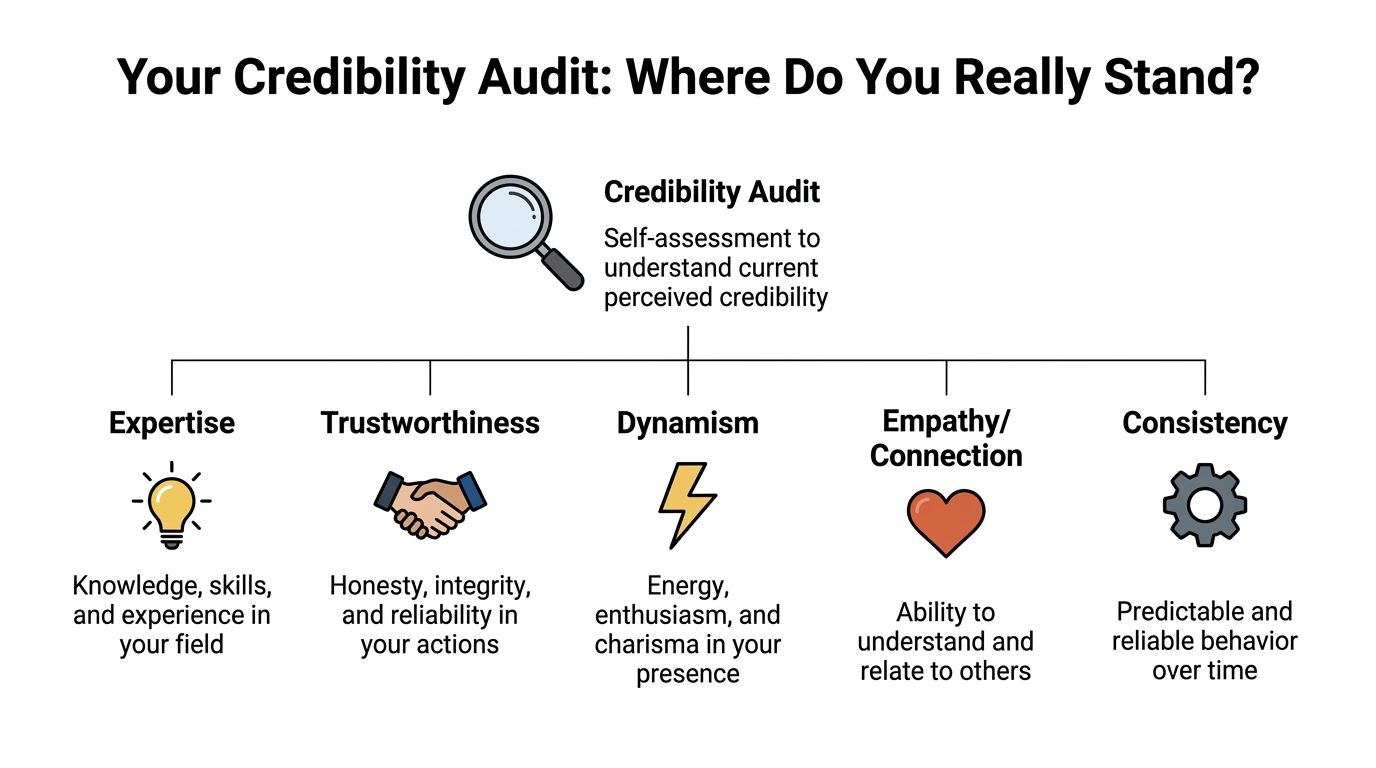
Your Credibility Audit Where You Really Stand
Most leaders assess credibility from the inside out. They look at qualifications, years of experience, or business results and assume those should speak for themselves. In practice, other people assess credibility from the outside in. They watch behavior, listen to delivery, and decide whether your character and competence feel believable.
A useful audit starts with two pillars: character and competence.
Character is what makes people trust your intent
The foundation is honesty. In every survey conducted by James Kouzes and Barry Posner since the 1980s, honesty has been selected more often than any other leadership characteristic, emerging as the single most important factor in the leader-constituent relationship, as summarized in this review of their work.
That finding matters because many senior professionals focus almost entirely on sounding smart. But people won’t fully trust sharp thinking if they don’t trust the person delivering it.
A character audit should include questions like these:
- Do people know where I stand? If your views change depending on the audience, people notice.
- Do I say hard things clearly and respectfully? Avoidance often looks political, not diplomatic.
- Do I keep verbal commitments? Small misses damage trust faster than leaders expect.
- Do I own mistakes promptly? Delay reads as self-protection.
Competence is what makes people trust your judgment
Competence is not just expertise. It is expertise made visible.
A leader can have deep knowledge and still project low competence if they ramble, bury the recommendation, answer vaguely, or sound scattered when challenged. This is where communication mechanics matter. Pronunciation, pacing, emphasis, and sentence structure all affect whether others experience you as decisive.
For professionals working on spoken clarity, this guide on how to build confidence while improving pronunciation is helpful because confidence and clarity reinforce each other.
Run a practical self-assessment
Don’t ask, “Am I credible?” Ask narrower questions that people can answer truthfully.
Use this three-part audit.
First, check your meeting pattern
Think about your last five high-stakes meetings. Look for patterns, not isolated moments.
| Situation | What you intended | What others likely perceived |
|---|---|---|
| You gave background first | Thoroughness | Lack of decisiveness |
| You softened your recommendation | Diplomacy | Low conviction |
| You spoke quickly under pressure | Energy | Anxiety |
| You used too many qualifiers | Precision | Uncertainty |
| You stayed quiet until invited | Respect | Lower status |
Second, collect language-based feedback
Ask three trusted colleagues these questions:
- When I speak in leadership meetings, what makes me sound senior?
- What weakens my authority even when my ideas are strong?
- Do I come across as clear, credible, and decisive under pressure?
Ask for examples, not reassurance. If someone says, “You’re fine,” ask, “What specifically should I keep doing, and what should I change?”
Third, score your visible habits
Use a simple green, yellow, red system.
- Green means this habit consistently supports credibility.
- Yellow means it’s inconsistent.
- Red means it regularly undermines you.
Score yourself on:
- Message clarity
- Vocal steadiness
- Brevity
- Response quality under pressure
- Follow-through
- Consistency across audiences
Practical rule: Audit the signals people can see and hear. Don’t rely on the strengths you assume they already know.
What the audit usually reveals
Most senior international professionals don’t have a broad credibility problem. They have a narrow but costly one.
Usually it’s one of these:
- strong thinking, weak framing
- high integrity, low vocal authority
- good relationships, inconsistent decisiveness
- solid expertise, overly cautious language
- capable leadership, but body language that collapses under scrutiny
That’s good news. Narrow problems are fixable. Once you know where your gap is, you can stop working on everything and start working on the few behaviors that change perception fastest.
Quick Wins for Immediate Authority
Some credibility gains take time. Others start the next time you open your mouth in a meeting.
The fastest improvements usually come from controlling three things: your pauses, your opening, and your physical stillness. None of these require a personality transplant. They require precision.

Use the strategic pause instead of filler
Filler words are rarely a language problem. They are usually a pacing problem.
When leaders feel pressure, they rush to keep their turn. That creates “um,” “so,” “you know,” and long circular starts. A pause feels risky, but it usually makes you sound more in control.
Try this tomorrow:
- Before answering a difficult question, pause for one beat.
- Breathe low, not high in the chest.
- Start with the conclusion, not the history.
Compare these two openings:
- “Um, so I think there are probably a few ways we could look at this.”
- “The main issue is margin pressure. I see two realistic options.”
The second answer sounds more credible before the content has even developed.
Fix your first 30 seconds
Senior professionals often lose authority at the very beginning. They open too softly, over-contextualize, or apologize for taking space.
Your first 30 seconds should do three things:
- establish the topic
- state the business relevance
- tell people your recommendation or direction
A simple structure works well:
- State the issue
- Name the implication
- Give the recommendation
Example:
“We have a delivery risk in the current timeline. If we hold the original sequence, we increase coordination pressure across teams. My recommendation is to simplify scope now and protect the launch date.”
That sounds like leadership because it reduces ambiguity.
If spoken English still feels effortful under pressure, focused practice on how to improve English pronunciation for business professionals can help you make these openings land more cleanly.
Claim space without looking theatrical
A lot of body language advice is bad because it pushes people into performance. Executive presence does not mean acting bigger than you are. It means removing the visible signs of internal friction.
Three fast corrections make a difference:
- Plant your feet before you speak. Don’t start talking while still adjusting your body.
- Keep gestures lower and slower. Fast hands often dilute authority.
- Finish the sentence with eye contact. Many professionals look away at the exact moment they should land the point.
A short reset routine before any meeting
Use this in the hallway, elevator, or one minute before your camera turns on.
- Exhale fully: Long exhale lowers visible tension.
- Drop the shoulders: Tension in the upper body shows up in the voice.
- Say one sentence out loud: Use your first line, not a warmup phrase.
- Choose one outcome: Decide what you need the room to understand, not everything you know.
If you can’t sound perfect, sound clear. Clear wins more trust than complicated.
What works and what doesn’t
Here’s the trade-off most leaders need to accept.
| Works | Doesn’t work |
|---|---|
| Short, well-framed answers | Long answers that prove effort |
| Pauses before key points | Filling silence to seem fluent |
| Calm conviction | Over-explaining to avoid pushback |
| Stillness with purpose | Constant movement that leaks nerves |
| Direct recommendation | Endless options with no point of view |
Quick wins matter because they create momentum. Once people start responding to you differently, you get better data. You can see which shifts in delivery improve influence, and which ones only feel safer.
Mastering the Mechanics of Executive Communication
Lasting credibility comes from repeatable mechanics. If you only rely on confidence, your authority will vary with stress, audience, and topic. If you build the right communication habits, your credibility becomes more stable across all three.
For senior international professionals, the mechanics usually fall into three areas: vocal authority, strategic framing, and executive body language.

Build vocal authority
People often talk about “sounding confident” as if it were a mindset. In practice, vocal authority is a set of trainable behaviors.
The key variables are:
- pitch stability
- pace control
- phrase endings
- emphasis placement
- breath management
Many non-native speakers unintentionally rise at the end of statements, compress words when nervous, or speak in long unbroken units. That combination makes even strong ideas sound less settled.
A practical vocal routine
Use this for five minutes a day.
-
Read one paragraph slowly
Mark the three words that carry the meaning. Stress those words only. -
Practice downward endings
End statements with completion, not lift. You’re not asking for permission. -
Insert deliberate pauses
Pause after the headline sentence. Pause before the recommendation. -
Record and review
Listen for speed spikes. Listeners are often surprised by where they rush.
A common coaching correction is not “speak louder.” It’s “finish the sentence fully.” Leaders often lose authority in the final three words of a point.
Strategic framing changes how people value your thinking
Many accomplished professionals present information in the order they discovered it. Executives need it in the order they can use it.
That means your message should move from decision to support, not from background to conclusion.
A reliable framing model is:
- Headline
- Why it matters
- Recommendation
- Support
- Next step
If you struggle with this, it helps to think carefully about mastering the difference between strategy and tactics. Leaders lose credibility when they confuse the high-level direction with the execution detail. Senior audiences want to know which problem matters, what choice follows from that, and what action comes next.
Weak framing versus strong framing
| Weak framing | Strong framing |
|---|---|
| “There are several things to consider” | “The decision turns on two risks” |
| “I wanted to walk you through the analysis” | “My recommendation is to proceed, with one condition” |
| “We looked at different scenarios” | “The most viable path is option B” |
| “It depends” | “It depends on one assumption” |
Strong framing doesn’t mean sounding rigid. It means making your thinking easy to follow.
A useful pressure test is this: can someone repeat your point after hearing it once? If not, your message probably isn’t framed tightly enough.
Here’s a useful reference before practicing live delivery:
Executive body language is mostly about reducing leakage
Good executive body language is quiet. It doesn’t pull attention away from your message.
The biggest issues I see are not dramatic mistakes. They are small leaks:
- entering a room while already speaking
- nodding while making a firm point
- smiling reflexively when discussing risk
- fidgeting with a pen, ring, or clicker
- shrinking physically when challenged
Three non-verbal adjustments with high payoff
First, arrive before you begin. If you’re standing, stop moving, then speak. If you’re seated, settle your posture before your first sentence.
Second, match your face to the message. If the issue is serious, let your expression carry seriousness. Constant friendliness can weaken authority in high-stakes moments.
Third, hold the room for one beat after the point. Many leaders finish a strong sentence and immediately look down or start talking again. Let the point land.
Credibility also depends on visible accountability
Communication mechanics matter, but they harden into credibility only when behavior matches delivery. One practical framework is to model core behaviors, conduct weekly self-audits, and use the A.R.T. protocol for errors: Acknowledge, Rectify, Track. The same source notes that Doug Fisher emphasizes a communication cadence of daily alignment and bi-weekly feedback, correlating with 50% higher “competent leader” perceptions, according to this leadership credibility summary.
That point matters because many leaders want to sound credible without creating the rhythm that supports credibility. You can’t disappear for long stretches, then expect a polished town hall to repair trust.
What methodical improvement looks like
The professionals who improve fastest don’t try to “be more executive” in a vague sense. They isolate one delivery issue at a time. One month it may be rushed pace. Another month it may be weak message openings. Then eye contact, then challenge handling.
One structured option is Intonetic’s Executive Communication Assessment, which is the entry point to The Gravitas Method, a 12-week one-on-one executive presence coaching program for international professionals. It’s coached by Nikola and focuses on vocal authority, strategic framing, executive body language, and high-stakes communication. The program is priced at $8,200 paid in full or $9,000 across three installments.
The point is not that every leader needs coaching. The point is that executive communication improves fastest when you stop treating credibility as personality and start treating it as a trainable performance system.
Build Unshakeable Trust Through Action and Consistency
A polished communicator can make a strong first impression. Only consistent behavior makes that impression durable.
Leaders lose credibility when their actions create unpredictability. The team doesn’t know how decisions are made, where priorities really sit, or whether commitments will survive pressure. That uncertainty spreads quickly.

Make your decision process visible
Trust rises when people can follow your reasoning, even if they don’t get their preferred outcome.
According to 3×5 Leadership’s guidance on establishing credibility, credible leaders who implement a transparent, systematic decision-making process see teams 40-60% more aligned on priorities daily, with decision ownership correlating with 25% higher initiative adoption rates. The same source notes that inconsistency can erode trust by 35%.
Those figures point to a practical reality. People don’t need endless consensus. They need clarity about how you think.
A credible decision sequence
Use a repeatable pattern:
-
Define the decision clearly
State what is being decided. Don’t let meetings drift into abstract discussion. -
Name the criteria
Tell people what matters most. Cost, timing, risk, customer impact, or strategic fit. -
Invite input before closure
Involve the right people early enough that their input can still change the outcome. -
Decide and own it
Don’t hide behind the group when the call is yours to make. -
Debrief afterward
Show what worked, what didn’t, and what changes next time.
Own mistakes in a way that increases trust
A lot of leaders think admitting mistakes lowers authority. Usually the opposite is true.
What weakens authority is partial ownership. People hear explanations, caveats, and subtle blame shifting. They conclude that the leader is protecting status rather than solving the problem.
Use a cleaner formula:
- Acknowledge the miss plainly
- State the correction
- Give the timeline for follow-through
- Return with an update
That pattern is especially important for international leaders who already feel pressure to appear flawless in English. Flawlessness is not the target. Reliability is.
Teams trust leaders who correct quickly more than leaders who defend elegantly.
Consistency is what makes your communication believable
A single good presentation won’t make you credible if your day-to-day behavior creates confusion.
That means:
- your priorities can’t change with every conversation
- your tone can’t swing wildly by audience
- your standards can’t become flexible when pressure rises
- your follow-up can’t depend on whether the work is visible
If you want to strengthen spoken authority while making that consistency more audible, focused work on how to speak English clearly and confidently can support the behavioral side of credibility too. Clear speech doesn’t create trust by itself, but it removes noise from the trust-building process.
What reliable leaders do differently
Instead of another checklist, it’s more useful to look at contrast.
| Low-trust pattern | Credible pattern |
|---|---|
| Explains decisions after the fact | Clarifies criteria before the decision |
| Avoids hard messages | Delivers them directly and respectfully |
| Shares credit selectively | Shares it publicly and specifically |
| Defends errors for too long | Corrects them early |
| Gives mixed signals across stakeholders | Stays consistent across rooms |
Leaders often ask how to build credibility as a leader when what they really mean is, “How do I get people to trust me faster?” The answer is not faster charisma. It is visible consistency.
When your words, decisions, and follow-through start matching each other, people stop spending energy decoding you. They can focus on the work. That’s when credibility becomes durable.
Your Path to Becoming a Credible Leader
Credibility grows when three things reinforce each other. Your communication sounds clear. Your thinking feels structured. Your behavior stays consistent.
That combination is why some leaders feel trustworthy within minutes, while others keep trying to prove themselves long after they’ve earned the title. One strong presentation helps. One honest conversation helps. But the shift comes from repetition.
A weekly credibility routine
Keep this simple enough to do even during heavy weeks.
Daily practice
Spend a short block of time on three drills:
-
Voice drill
Read a paragraph aloud and mark where you’ll pause and where the meaning sits. -
Message drill
Take one live business issue and summarize it in three sentences: issue, implication, recommendation. -
Reflection drill
Ask: where did I sound clear today, and where did I start explaining instead of leading?
Weekly review
Once a week, review one meeting or presentation.
Look for:
- where you lost brevity
- where your tone weakened your point
- where your body language became busy
- where you avoided stating a direct recommendation
- where your actions did or didn’t support your message
Measure outcomes that matter
Don’t track credibility with vanity metrics.
Better signs include:
- people ask for your view earlier
- your recommendations get adopted with less repetition
- senior stakeholders respond to your message rather than your wording
- colleagues describe you as clear, grounded, or decisive without prompting
- difficult conversations become less draining because you stop over-managing perception
Keep your development principle-based
If you want a broader leadership lens alongside communication work, this article on essential principles of leadership is a useful complement. It pairs well with communication training because credibility isn’t only about style. It’s style aligned with judgment, responsibility, and service.
The standard to aim for
You do not need to become louder, more extroverted, or more American-sounding.
You do need to become easier to trust.
That means speaking in a way that makes your expertise accessible. It means framing ideas so others can act on them. It means handling pressure without leaking panic. And it means backing your words with behavior that stays steady across time.
That’s the practical answer to how to build credibility as a leader. Not performance for its own sake. Not generic advice about confidence. Clear signals. Consistent action. Repetition until trust becomes the default response to your presence.
If you want a precise view of what’s strengthening your authority and what’s weakening it, start with Intonetic’s free Executive Communication Assessment. It’s the most useful next step if you want a personalized roadmap for sounding more credible in meetings, presentations, and high-stakes leadership conversations.