
Professional Short Form: A Guide to Executive Impact
You're in a leadership meeting. You've done the thinking, you understand the trade-offs, and you can see the risk before anyone else in the room names it. Then your turn comes. You explain the background, add context, qualify the assumptions, and try to be precise.
A colleague speaks after you for less than a minute and gets immediate traction.
That gap is frustrating, especially for senior international professionals. It's not usually a knowledge gap. It's a compression gap. You know more than you're able to deliver under pressure, and the longer you speak, the easier it is for listeners to miss the core point.
That's where professional short form matters. Not as a social media tactic. Not as a trick for sounding punchy. As a leadership skill.
Professional short form is the ability to express a strategic idea with brevity, authority, and direction. It helps you sound senior in the moments that shape perception most: the first answer in a boardroom, the opening of a difficult presentation, the follow-up email after a tense discussion, the thirty seconds when an executive sponsor decides whether your point deserves attention.
The New Language of Leadership Is Brief
Senior professionals rarely lose influence because they lack substance. They lose influence because substance arrives too late.
I see this often with highly capable international leaders. They over-explain because they care about accuracy. They add context because they don't want to sound simplistic. They soften recommendations because they want to appear collaborative. The result is that their message becomes harder to carry.
A strong idea needs a strong container. In fast-moving organizations, that container is usually short.
Brevity changes how authority is perceived
When leaders speak briefly and clearly, people assume they've done the deeper thinking already. When leaders ramble, even smart listeners start to doubt the recommendation. That isn't always fair, but it's real.
A concise opening does three jobs at once:
- It establishes command: You signal that you know what matters most.
- It reduces listener effort: Executives don't have to dig through your explanation to find the point.
- It creates momentum: The conversation moves toward decision, not clarification.
If you've ever drafted a formal professional conference opening speech, you already know the discipline involved. The opening can't carry every idea. It has to frame the room, set direction, and make people trust the speaker quickly. The same discipline applies in executive communication.
That's also why many professionals who work on executive communication fundamentals start by learning how to shorten without flattening meaning.
Practical rule: If your audience has to wait too long for your point, your expertise won't rescue the message.
Professional short form is not casual communication
Some people hear “short form” and think of quick posts, reels, or informal snippets. That misses the leadership version entirely.
In a senior context, short form means disciplined expression. You're not trying to sound trendy. You're trying to sound decisive, composed, and strategically useful. The language is shorter, but the thinking behind it is deeper.
The professionals who do this well don't speak in fragments. They speak in distilled thought. They know what the decision is, what the risk is, and what the room most needs to hear first.
Defining the Professional Short Form
Most advice about short-form communication comes from marketing. It focuses on hooks, clips, visibility, and engagement. That world has its place, but it doesn't solve the problem senior international professionals face inside meetings, presentations, and high-stakes conversations.
What it actually is
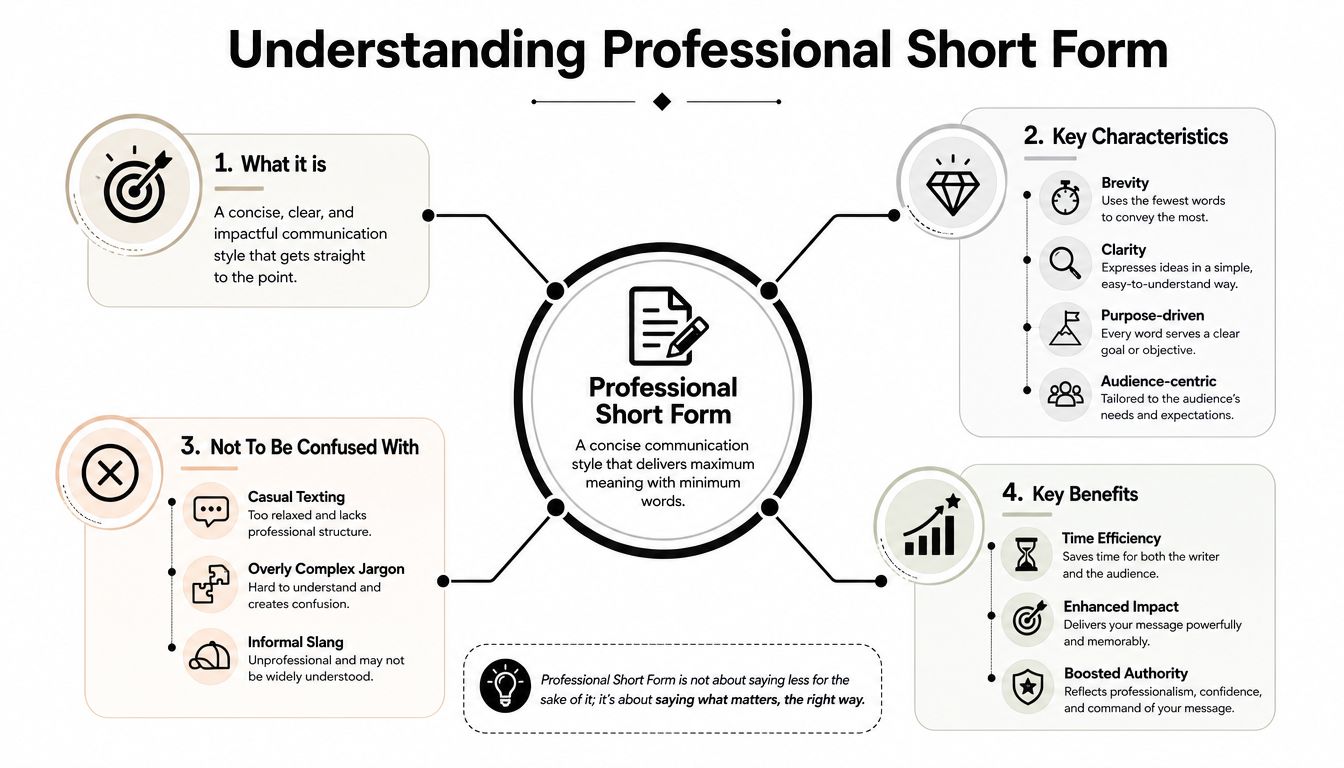
Professional short form is the disciplined reduction of a message to its highest-value core, delivered in language that preserves credibility.
That definition matters because brevity alone isn't enough. A message can be short and still sound weak, rushed, vague, or junior. The standard isn't “fewer words.” The standard is “clearer authority.”
I think of it as intellectual distillation. You remove what is not carrying executive value. Background. Repetition. Defensive qualifiers. Side roads. What remains is the idea in its leadership shape.
Why most short-form advice falls short for senior professionals
The gap in existing guidance is obvious. Existing content on “professional short form” overwhelmingly treats it as a tactical video format focused on Reels, Shorts, ad angles, and filming tricks, while neglecting how non-native English speakers can use short-form communication to project executive authority without sounding informal or inexperienced, as noted in this discussion of the missing executive-authority framework.
That same source highlights another problem. Popular sales-style angles may work for attention, but they don't always translate well into senior leadership settings, where controversy, forced emotional framing, or a “cute” tone can weaken gravitas.
The real question for many international professionals isn't how to get attention. It's how to compress a complex idea into a brief, credible statement that still sounds senior.
This is one reason I often borrow from learning design rather than content marketing. Good microlearning strategies for engagement rely on focused units, clear objectives, and reduced cognitive load. Executive short form works the same way. You don't shrink the thinking. You sharpen the delivery.
What professional short form is not
A few distinctions make this easier:
| Not this | But this |
|---|---|
| Casual shorthand | Structured brevity |
| Clever phrasing for its own sake | Useful framing for decisions |
| Informal social tone | Senior, composed tone |
| Word reduction | Meaning concentration |
If you strip a message down so far that it becomes simplistic, you haven't created professional short form. You've created under-explained communication. The right version sounds compact, but still carries judgment.
Choosing Your Format Elevator Pitch to Email
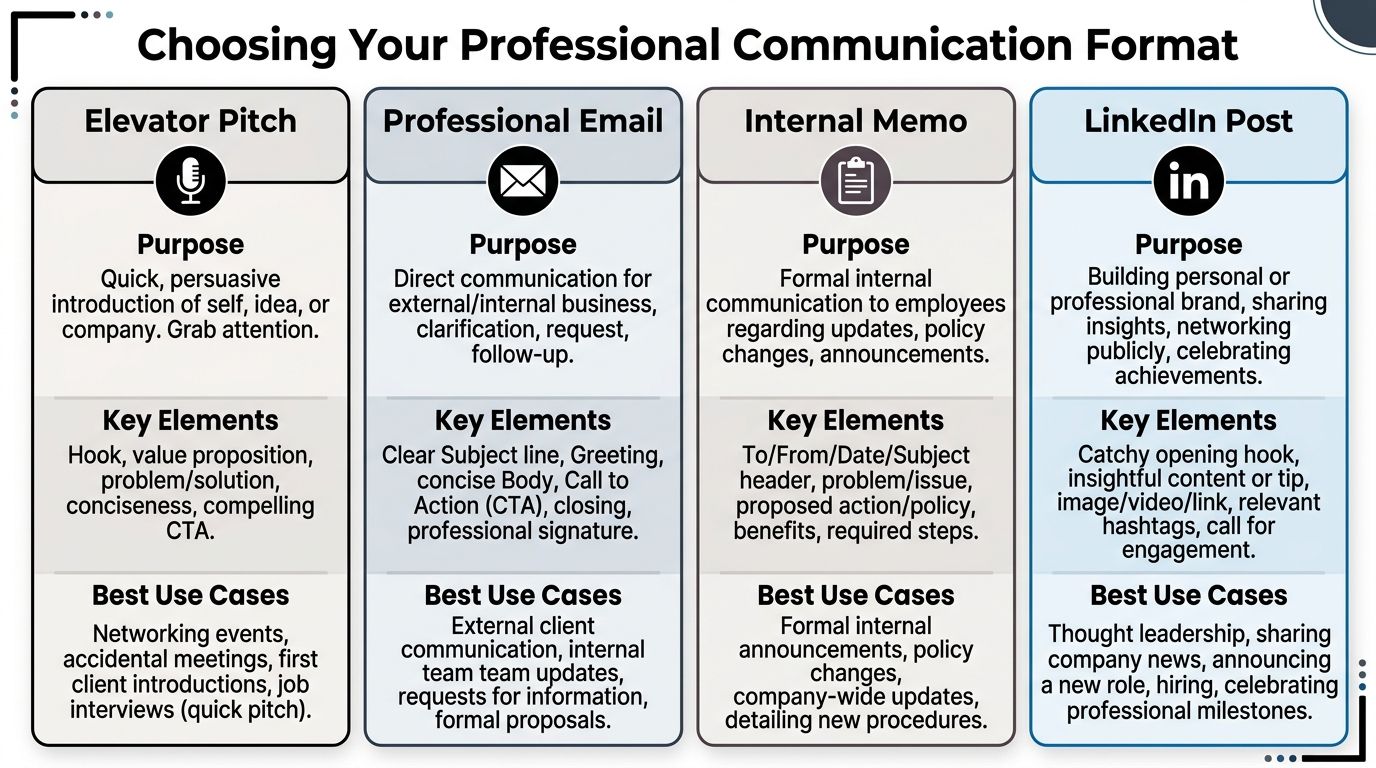
Short form isn't one format. It's a family of formats, and each one does a different job. Problems start when leaders use the wrong format for the situation.
The format should match the decision pressure
An elevator pitch isn't an executive summary. A LinkedIn headline isn't a high-stakes email. They may all be short, but they create different outcomes.
Here's a practical comparison:
| Format | Strategic job | What works | What fails |
|---|---|---|---|
| Elevator pitch | Spark interest | Clear problem, relevance, next step | Full biography, too much setup |
| Executive summary | Enable decision | Recommendation first, supporting logic second | Storytelling tone when the room needs a decision |
| Micro-presentation | Frame discussion | One core point per slide, visible takeaway | Dense slides that force you to narrate everything |
| LinkedIn headline or profile line | Position expertise | Clear authority signal and domain focus | Generic labels like “results-driven leader” |
| High-stakes email | Drive action | Purpose, decision needed, timing, ownership | Long context with no clear ask |
Elevator pitch when access is brief
A senior elevator pitch shouldn't sound like networking theater. It should answer one question: why should this person continue the conversation?
Use this structure:
- Who you help
- What strategic problem you solve
- Why it matters now
Example:
I lead data products for enterprise clients. My focus is reducing decision lag between reporting and operational action. Right now, many organizations have visibility but not speed.
That works because it sounds specific and useful. It doesn't try to impress through adjectives.
Executive summary when leaders need a call
The executive summary is where many professionals become too explanatory. They think senior readers want the journey. Usually, they want the judgment.
Lead with your position. Then support it.
A useful sequence is:
- Recommendation
- Business reason
- Risk or trade-off
- Decision needed
If you want to improve this in writing, studying a strong written email example for executive contexts helps because the discipline is similar. The point comes early. The ask is visible. The wording carries responsibility.
A short message sounds senior when the reader knows what you want them to decide before they reach the second paragraph.
Micro-presentation, LinkedIn line, and high-stakes email
A micro-presentation often means one slide, one opening minute, or one framing statement before discussion begins. Its purpose is not to prove everything. Its purpose is to control the lens through which the room sees the issue.
A LinkedIn headline or profile line is brand positioning in compressed form. Senior people often waste this space on broad labels. “Global leader,” “innovator,” and “strategic thinker” don't carry much weight without a domain, a business context, or a problem orientation.
A high-stakes email should be tighter than most professionals expect. If the email exists to move a decision, the reader should see the recommendation, owner, and expected action quickly. If it exists to align stakeholders, the reader should understand what changed and what happens next.
The trade-off is simple. The shorter the format, the less room you have for recovery. That's why the opening sentence matters so much.
Concise Phrasing for Authority and Influence
Authority lives in phrasing. Not just in ideas.
Two professionals can hold the same position and be heard very differently because one sounds tentative while the other sounds deliberate. This is especially important for non-native English speakers, who often add cushioning language to avoid sounding too direct. The intention is polite. The effect is weaker.

Replace hesitation with position
Here are common shifts I coach:
| Weaker phrasing | Stronger phrasing |
|---|---|
| I was thinking maybe we could… | My recommendation is that we… |
| I just wanted to say… | The key issue is… |
| Perhaps one option might be… | We have two options. I recommend the first. |
| Sorry, this may not make sense, but… | Let me frame this clearly. |
| I'm not sure, but I think… | Based on the current information, my view is… |
None of the stronger versions are aggressive. They're more accountable.
Four moments that shape senior perception
Stating a position
Don't open with uncertainty unless uncertainty is the point.
Use lines like:
- My view is that…
- The strongest path is…
- The core issue is…
- What matters most here is…
These phrases tell the listener you're taking responsibility for the frame.
Making a request
Many international professionals bury the ask under courtesy. Keep the courtesy, but surface the action.
Try:
- Please review this by Thursday so we can finalize the decision.
- I need your approval on the revised scope.
- Confirm whether you want us to proceed with option A or pause.
That's more effective than writing three paragraphs of context and ending with a soft hint.
Giving a strategic update
The strongest updates answer three questions quickly:
- What changed
- Why it matters
- What happens next
For example:
“The timeline has shifted because legal review is taking longer than expected. The business impact is limited if we keep the pilot scope unchanged. My recommendation is to protect the launch window and revise phase two.”
Disagreeing without sounding defensive
Senior disagreement should sound calm, not reactive.
Useful phrases include:
- I see it differently for one reason.
- I agree with the objective. I disagree with the current path.
- The risk in that approach is…
- Before we decide, we should separate urgency from importance.
Language test: If your sentence apologizes for your own judgment before expressing it, revise it.
A practical way to get better at this is to study examples of trimming wordiness for clarity, then rewrite your own sentences until the main verb appears earlier and the ask becomes visible faster.
I also encourage professionals to build a personal bank of high-utility vocabulary. Not ornate words. Useful ones. Terms that help you sound precise and senior under pressure. A focused list of tier 2 words for professional communication can help you expand range without slipping into jargon.
For leaders who want deeper work on these patterns, The Gravitas Method is a 12-week one-on-one executive presence coaching program for international professionals who want to communicate with more authority and influence at senior levels. The program is priced at $8,200 paid in full or $9,000 across three installments. Coached by Nikola, it covers vocal authority, strategic framing, executive body language, and high-stakes communication.
Quick Drills to Build Your Short Form Skill
Professional short form is a performance skill. Reading about it helps. Repetition changes it.
That matters because the broader communication environment keeps rewarding shorter, lower-friction formats. Short-form video is the dominant content format in global marketing, used by 60% of marketers in 2025, while blog posts and long-form video each account for 38%, according to HubSpot's marketing statistics. You don't need to become a content creator to learn from that shift. You need to train your message to land faster.
Drill one, the one-sentence summary
Take a report, proposal, or meeting topic and force yourself to summarize it in one sentence.
The sentence must include:
- The issue
- Why it matters
- What should happen
Example pattern:
We're seeing delay in X, which affects Y, so I recommend Z.
This drill teaches prioritization. Most professionals discover they've been speaking in background-first order.
Drill two, the voicemail pitch
Record yourself speaking for under a minute about a live business issue. Then listen back once for content and once for delivery.
Check for these points:
- Did you state the point early
- Did your voice drop into the end of sentences
- Did you use fillers when making your recommendation
- Did you sound like someone asking for permission
If impromptu speaking is difficult, focused practice with impromptu speaking skills for professionals can help because it builds response structure under time pressure.
Drill three, the meeting opener
Before every important meeting, write a sixty-second opening.
Use this pattern:
- Here's the issue
- Here's why it matters now
- Here's the outcome we need today
This one changes how others experience you. Instead of entering discussion mode immediately, you begin by leading the frame.
Record the opener standing up, not sitting down. Posture changes breath support, and breath support changes authority.
Drill four, the ruthless rewrite
Take one email you've already written. Cut it by a third without losing meaning.
Then ask:
- Is the ask now clearer
- Does the first sentence carry more weight
- Did I remove explanation that only protects me, not the reader
That final question matters. Much professional wordiness is self-protection disguised as thoroughness.
How to Know If Your Communication Is Improving
Improvement in executive communication rarely shows up first in confidence. It shows up in response.

Watch for operational signals, not vanity signals
If your communication is getting stronger, you'll notice shifts in behavior around you.
Look for signs like these:
- People ask fewer clarifying questions: Your message arrives cleaner the first time.
- Your recommendation gets referenced in later discussion: The room retains your framing.
- Emails produce decisions instead of long threads: Your ask is easier to act on.
- Meetings move faster after you speak: You've reduced ambiguity.
- Colleagues start borrowing your phrasing: Your structure is becoming the model.
These are better measures than whether people compliment your communication style. Senior impact is visible in action.
Perception changes before title changes
One of the most useful indicators is whether people start treating you as if you're already operating at the next level. That can show up in subtle ways. You're invited into earlier discussions. Your opinion is requested sooner. Your summary becomes the version others repeat.
A formal communication skill assessment for executive presence can help you identify patterns, but you can also track your own progress with a simple review after important interactions.
Use three questions:
| Question | What to notice |
|---|---|
| Did I state the core point early? | If not, you probably made the audience work too hard |
| Did the audience understand the decision or ask? | If not, the structure was likely unclear |
| Did I sound composed and accountable? | If not, the wording or delivery diluted authority |
Improvement is not “I felt more fluent.” Improvement is “the room moved with less friction after I spoke.”
That's the standard worth using.
Mastering Brevity Is Mastering Leadership
Leaders don't earn authority only through expertise. They earn it through transmission. Can they move an idea from their mind into another person's judgment clearly enough to shape action?
That's why professional short form matters. It closes the distance between what you know and what others can absorb. It helps your thinking survive real conditions: limited time, impatient stakeholders, politically sensitive rooms, and conversations where nobody wants the full backstory first.
This is not about sounding slick. It's about sounding senior.
When you become more concise, several things change at once. Your recommendations become easier to trust. Your updates become easier to follow. Your disagreements become easier to respect. People stop hearing effort and start hearing judgment.
For international professionals, this shift is often decisive. You may already have the technical depth, business understanding, and cross-cultural range needed for more senior roles. What's missing is often the brief, high-authority delivery that makes others experience you at that level immediately.
Brevity is learnable. It's trainable. And once it becomes part of how you think, not just how you edit, your presence changes.
If you want a practical starting point, begin with Intonetic's free Executive Communication Assessment. It's the clearest first step if you want to identify where your delivery, framing, and executive presence are reducing your impact, then build a plan to communicate with more authority at senior levels.