Master Your Communication Skill Assessment: A Leader’s Guide
You've probably lived through some version of this. You present a solid idea in a meeting. The analysis is strong. The recommendation is sensible. Yet the room stays quiet. Ten minutes later, someone else restates the same point with cleaner framing, stronger presence, or better timing, and suddenly the idea lands.
That gap is why communication skill assessment matters.
For ambitious professionals, especially international professionals moving toward director, VP, or C-suite responsibility, communication isn't judged as a bonus trait anymore. It's judged as visible evidence of readiness. People watch how you explain trade-offs, how you handle challenge, how you respond when you don't have perfect wording, and whether others trust your message under pressure.
A good assessment makes that visible. A bad one reduces everything to a vague impression. The difference matters.
Why Your Communication Skills Are Under a Microscope
Companies used to evaluate communication informally. A hiring manager would leave an interview saying someone was “polished,” “rough around the edges,” or “not executive enough.” That kind of judgment still happens, but more organizations now want a more structured way to assess what they're seeing.
There's a business reason for that shift. A widely cited McKinsey finding reports that better collaboration and communication enabled by social technologies can improve productivity by 20% to 25%, which helps explain why communication skill assessment is now treated as a practical business tool rather than a soft-skill formality (McKinsey finding cited here).
What leaders are really evaluating
When a company assesses communication, it usually isn't asking one simple question like “Can this person speak well?”
It's asking several harder questions at once:
- Can this person explain complexity clearly
- Can they adapt their message to different audiences
- Can they stay composed under challenge
- Can they build trust across functions
- Can they represent the team or company credibly
That's why a communication skill assessment often covers speaking, listening, writing, tone, nonverbal presence, conflict handling, and interpersonal judgment rather than one broad score.
If you want a useful primer on how this plays out in organizational settings, business communication in practice is a helpful lens. It shows why communication isn't just about delivery style. It's about whether people can act on your message.
Practical rule: Senior leaders rarely reward raw intelligence alone. They reward intelligence that others can follow, trust, and repeat.
Why informal feedback often fails
The biggest problem with unstructured evaluation is that it confuses impression with capability.
A fast talker may sound confident while saying very little. A thoughtful professional with an accent may be judged harshly even when their reasoning is sharper. Someone with elegant slides may get credit for clarity they didn't create in the room.
Structured assessment is an attempt to reduce that noise. It asks evaluators to look for observable behaviors. Did the speaker organize the message? Did they answer the actual question? Did they pick the right level of detail? Did they notice confusion and adapt?
That shift matters if you're trying to move up. At senior levels, communication affects promotions because it affects execution. Teams need direction. Stakeholders need confidence. Cross-functional work needs precision. If your communication weakens at the exact moment pressure rises, people notice.
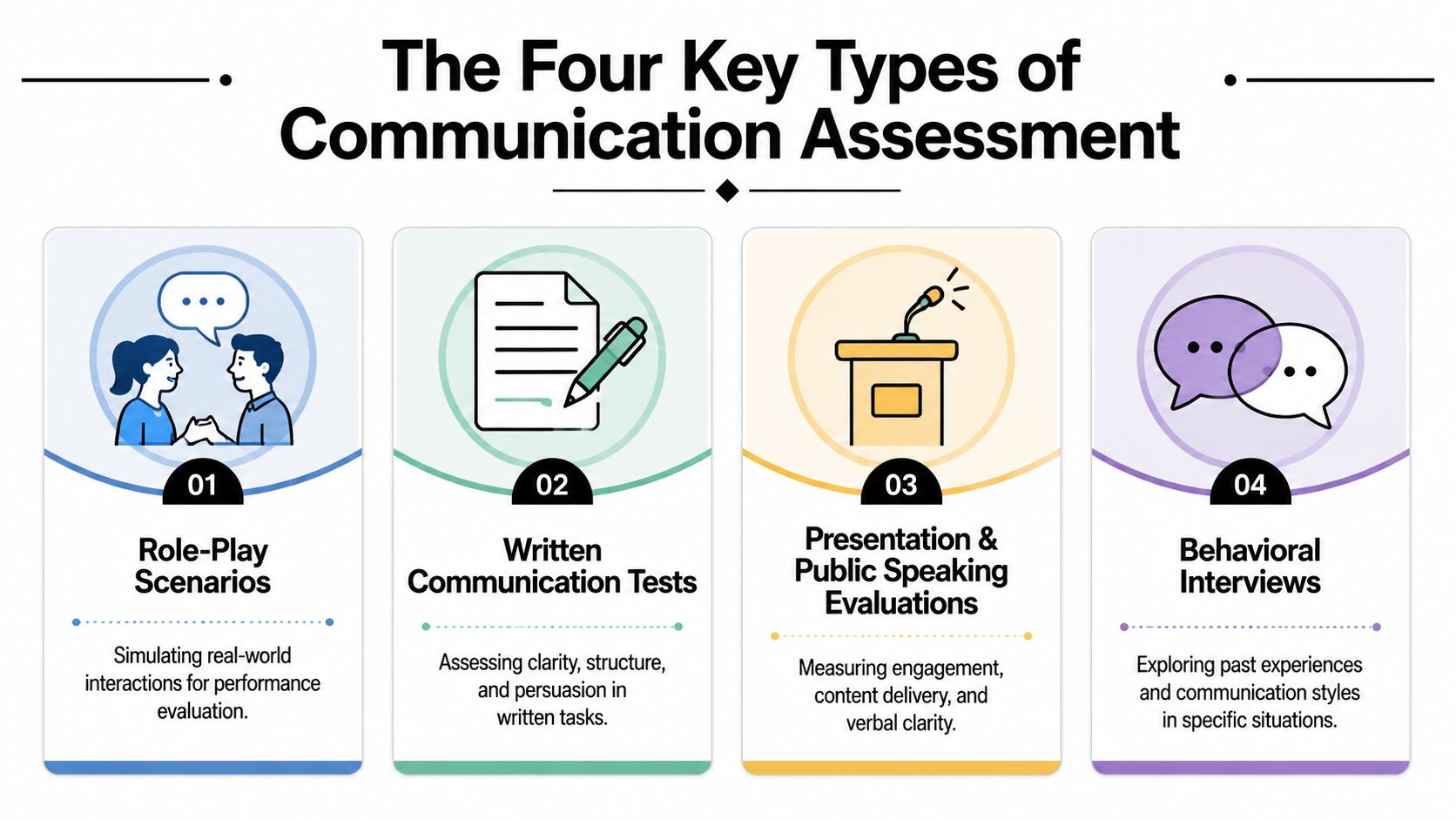
The Four Key Types of Communication Assessment
Most professionals prepare for communication assessment the wrong way. They assume there is one test. In reality, organizations use several different formats depending on whether they're hiring, promoting, coaching, or reviewing performance.
The visual below gives a quick overview of common formats used to evaluate communication in practice.
A practical comparison
| Assessment type | What it shows well | What it misses | Best use case |
|---|---|---|---|
| Self-assessment | Self-awareness, reflection, perceived strengths and gaps | Objectivity, pressure performance, blind spots | Early development work |
| Peer feedback | Day-to-day impact on colleagues | Politics, inconsistency, limited context | Team development and internal reviews |
| 360-degree feedback | Broader pattern across manager, peers, and direct reports | Can blur specifics if questions are vague | Leadership development |
| Simulated exercises | Observable performance in realistic scenarios | Can feel artificial if poorly designed | Hiring, promotion, executive coaching |
Self-assessment
Self-assessment is useful when it forces specificity. It's less useful when it invites fantasy.
If you ask yourself, “Am I a good communicator?” you'll get a vague answer. If you ask, “Do I structure recommendations clearly in meetings?” or “Do I lose authority when challenged?” you'll get something more actionable. The limitation is obvious. Individuals often aren't good judges of how they sound in real time.
Peer feedback and 360 input
Peer feedback can reveal patterns you won't catch alone. Colleagues often know whether you interrupt, over-explain, bury your recommendation, or sound hesitant when stakes rise.
A broader 360 process adds range. Your manager may judge your executive updates one way, while your peers experience your collaboration style very differently. That contrast is often where insight sits.
The downside is that this kind of input can become muddy if the questions are too broad. “Communicates effectively” is almost useless. “Summarizes decisions clearly after complex meetings” is much better.
Simulated exercises
The highest-value assessments usually include some kind of simulation. That might be a role-play, a stakeholder conversation, a written response, a presentation, or a behavioral interview with follow-up pressure.
That's where communication becomes visible.
For professionals who want a benchmark before a promotion process or coaching engagement, an executive presence assessment can be useful because it focuses attention on how your message is received, not just what you intend to say.
A short video can also help you recognize the difference between general communication advice and performance-based evaluation.
The strongest assessment format is usually the one that makes you perform, not the one that asks you to describe yourself.
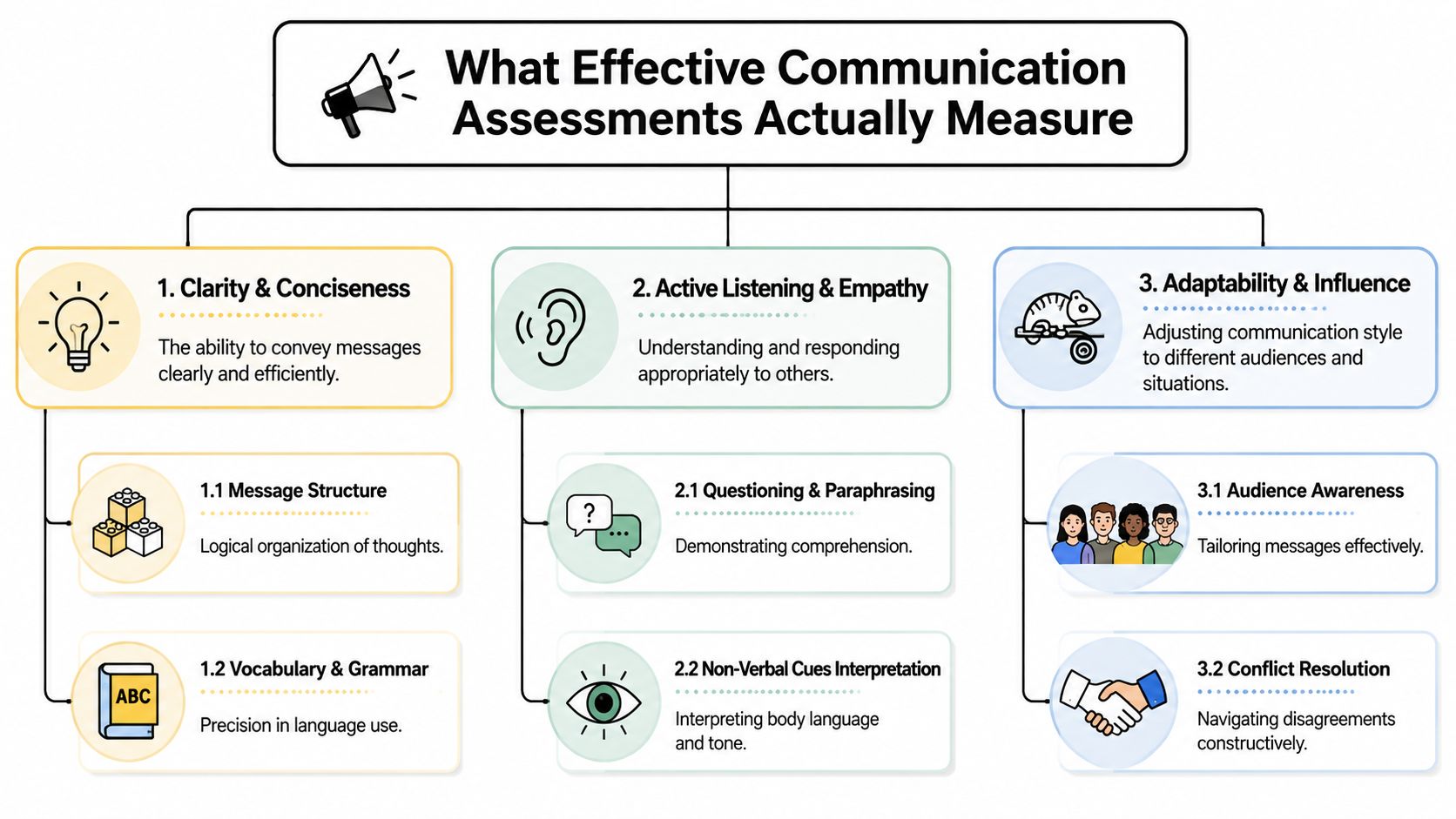
What Effective Communication Assessments Actually Measure
A weak communication skill assessment gives one generic score. A strong one breaks communication into parts.
That distinction matters because “communication” is not one skill. A person can think clearly but speak too abstractly. Another person can sound smooth but fail to listen. Someone else may write with precision yet lose composure in live discussion.
High-quality communication skill assessment should be multidimensional, typically separating written communication, verbal communication, active listening, non-verbal cues, and situational judgment so evaluators can identify which capability is limiting performance (breakdown discussed here).
The dimensions that actually matter
Here's what skilled evaluators usually look for.
Clarity and structure
This is the backbone. Can you answer in a way people can follow?
A strong communicator doesn't just talk fluently. They sequence information well. They lead with the point, support it with the right evidence, and stop before the message gets buried. In senior settings, poor structure is often mistaken for poor thinking.
Active listening
Many professionals think communication assessment focuses on speaking. It doesn't. Listening is often the hidden differentiator.
Evaluators watch whether you answer the question that was asked, whether you notice tension in the room, and whether your response reflects what the other person said. If your answer sounds prepared but disconnected, your score should drop.
Vocal authority and verbal control
This includes pace, pause, emphasis, and steadiness. It's not about having a dramatic voice. It's about sounding settled enough that people can trust your message.
When a professional rushes, trails off, or fills silence too quickly, the issue usually isn't vocabulary. It's control. Under pressure, vocal habits reveal confidence far more than polished wording does.
What often gets misread
Some features are easy to overvalue.
| Common signal | What people assume | What should be assessed instead |
|---|---|---|
| Fast speech | Confidence | Precision and control |
| Fancy vocabulary | Intelligence | Clarity and relevance |
| Constant eye contact | Presence | Appropriate audience connection |
| Smooth tone | Authority | Credibility under challenge |
Many assessments frequently err. They reward style markers that look impressive rather than communication behaviors that create understanding.
Key distinction: Executive communication is not performance for its own sake. It is message design, audience judgment, and composure working together.
The practical checklist
If you want to self-audit before any formal communication skill assessment, start here:
- Message structure. Can you state your point in one sentence before adding context?
- Responsiveness. Do your answers track the question, or do you default to your prepared talking points?
- Verbal economy. Do you use the number of words the moment requires?
- Nonverbal consistency. Does your body language support your message, or contradict it?
- Adaptability. Can you shift tone for a board update, conflict conversation, and team check-in?
Those are separate muscles. Treating them as one trait slows improvement.
Sample Questions and Scoring Rubrics Explained
Communication feels subjective until you see how a good rubric works. Then it becomes much easier to understand what evaluators are observing.
A foundational academic perspective is that communication skill assessment works best when it is direct, observable, and feedback-oriented, often using standardized procedures to score responses to hypothetical communication scenarios (academic perspective summarized here).
What scenario-based assessment looks like
A strong assessment prompt usually puts you in a realistic leadership situation. Not a trivia test. Not a personality quiz. A situation that forces judgment.
Examples:
- Stakeholder tension. A key stakeholder is unhappy with a delay. How do you structure a short update that is honest, calm, and credible?
- Bad news delivery. You need to tell a team their preferred option won't be approved. How do you explain the decision while maintaining trust?
- Executive recommendation. You have limited time with a senior leader. How do you present a recommendation, the core rationale, and the risk?
If you also want to sharpen the written side of communication, studying a strong written email example can help because many of the same scoring principles apply. Clarity, sequencing, audience awareness, and tone all show up in writing too.
A simple rubric that works
| Criterion | Low score behavior | Strong score behavior |
|---|---|---|
| Message structure | Wanders, buries the point, lacks sequence | Leads with the point, organizes clearly, closes cleanly |
| Audience awareness | Gives generic answer, ignores stakeholder concerns | Tailors tone and content to the listener |
| Clarity | Uses vague language, too much jargon, incomplete answer | Uses precise language and understandable phrasing |
| Composure | Sounds flustered, defensive, or rushed | Stays calm, measured, and credible |
| Listening and responsiveness | Answers a different question or misses cues | Responds directly and adapts to what is said |
How evaluators should score fairly
The rubric only works if the evaluator scores observable behavior rather than personal preference.
For example, “I liked their style” is not useful. “They opened with the recommendation, addressed likely concern, and adjusted tone when challenged” is useful. The first is taste. The second is evidence.
This also helps with coaching. If someone receives a weak result, they need to know whether the issue is:
- Structure
- Clarity under pressure
- Tone and composure
- Audience adaptation
- Listening accuracy
Without that diagnosis, development turns into generic advice like “be more confident,” which rarely changes performance.
A good rubric doesn't eliminate judgment. It disciplines judgment.
What candidates should do with this information
If you're preparing for a formal assessment, practice out loud with short time constraints. Don't just formulate your answer without vocalizing. Most communication breakdowns appear during live delivery.
Use a simple routine:
- Start with the answer
- Add the reasoning
- Name the risk or trade-off
- Close with a recommendation or next step
That framework works well because it forces visible executive thinking. It also makes scoring easier for the person evaluating you.
Navigating Assessments as an International Professional
For international professionals, communication assessment can feel loaded from the start. You may wonder whether people are evaluating leadership communication or just reacting to accent, idiom, pace, or cultural style.
That concern is legitimate.
A nuanced question is whether current assessments inadvertently penalize accent or cultural norm differences rather than actual executive effectiveness, making it essential to separate language proficiency from leadership communication ability (discussion here).

What bias often looks like in practice
Bias in communication assessment is rarely announced openly. It usually shows up as loose language.
Someone says you need to sound “more polished,” but they can't identify what was unclear. Another evaluator says your delivery lacks presence, but what they really mean is your style is less direct than the dominant culture around you. A third person reacts to accent as if it automatically signals low authority.
The right question is not “Do you sound exactly like local leadership?” The right question is “Can senior stakeholders understand you, trust you, and act on your message?”
That's a very different standard.
For many professionals, cultural style plays a role too. If you were trained to communicate with more deference, more context, or more indirectness, you may be judged harshly in environments that reward blunt executive summaries. Understanding direct versus indirect communication styles can help you separate a style mismatch from an actual capability gap.
What should be assessed instead
A fair communication skill assessment for international professionals should focus on these questions:
- Does the speaker organize ideas clearly
- Do they adapt appropriately to the audience
- Can they handle pressure without losing coherence
- Do they project credibility in context
- Are language differences interfering with meaning, or just sounding unfamiliar to the evaluator
That distinction is critical. Accent is not the same as lack of authority. Non-native phrasing is not the same as weak thinking. A culturally different rhythm is not automatically poor executive presence.
Where targeted coaching helps
This is also where personalized coaching can make a real difference. Some professionals need language support. Others don't. They need sharper strategic framing, stronger vocal authority, more concise answers, or body language that matches their level.
One option in this category is The Gravitas Method, a 12-week one-on-one executive presence coaching program for international professionals who want to communicate with more authority and influence at senior levels. The program is priced at $8,200 paid in full or $9,000 across three installments. Coached by Nikola, it covers vocal authority, strategic framing, executive body language, and high-stakes communication.
That kind of work is most useful when it separates surface-level difference from high-impact communication habits. Otherwise, people spend months trying to erase identity markers when the issue is that they're answering too broadly, speaking too quickly, or under-signaling confidence.
If you're an international professional, don't accept feedback that stays vague. Ask what behavior reduced clarity, trust, or influence. If the evaluator can't answer, the assessment may be measuring comfort, not competence.
From Assessment to Action Your Development Blueprint
Assessment is only useful if it changes behavior.
Too many professionals finish a communication skill assessment with a stack of notes and no plan. They know they need to “be clearer” or “sound more senior,” but they haven't translated that into specific practice. That's where progress usually stalls.
Turn the result into a focused plan
Start by identifying the one or two patterns that create the biggest downstream cost. Not ten things. Just the few that affect most of your visible interactions.
For example:
- If structure is weak, practice opening with your recommendation before explanation.
- If listening is weak, slow down and paraphrase the question before answering.
- If authority drops under pressure, rehearse shorter, steadier responses with deliberate pause.
- If written communication is stronger than spoken delivery, convert written logic into spoken frameworks you can use live.
Match practice to real situations
Your blueprint should fit the contexts where your career is being judged.
That may include board updates, stakeholder disagreement, interview panels, skip-level meetings, investor conversations, or cross-functional alignment. Generic communication advice won't help much if your real challenge is defending a recommendation when someone senior pushes back.
A broader resource on improving team communication can also be useful if your assessment reveals that your impact problem isn't only individual delivery, but how your message lands across a team system.
Build a feedback loop
You need a repeatable cycle:
- Assess one situation
- Choose one target behavior
- Practice in realistic conditions
- Review what changed
- Adjust and repeat
If you want support with that process, coaching for communication skills can provide the external feedback many professionals need, especially when their own self-perception doesn't match how others experience them.
The important point is simple. Don't chase a vague goal like “be a better communicator.” Build a narrow plan such as “state recommendations earlier,” “reduce over-explaining,” or “sound steadier in Q&A.” Precision makes development possible.
If you want an objective starting point, begin with Intonetic's free Executive Communication Assessment. It's a practical way to benchmark how your communication currently lands, identify the specific gaps affecting authority and credibility, and decide what to improve first.