Executive Presence Assessment Guide: Interpret Results
You're good at your job. People rely on your judgment. You deliver. Yet when promotion discussions happen, or when a high-stakes meeting ends, you get a familiar signal that's hard to pin down: your expertise is respected, but your influence doesn't fully match it.
That gap is where an executive presence assessment becomes useful.
Most ambitious professionals hear vague feedback at some point. “Be more strategic.” “Show more confidence.” “Come across as more senior.” None of that helps unless someone can translate it into specific behaviors you can observe, measure, and change. The core value of assessment is that it turns a blurry career problem into a practical diagnosis.
What Is an Executive Presence Assessment
You leave a leadership meeting thinking you were clear, prepared, and measured. Later, the feedback sounds different. You came across as tentative. Your point got lost. A sharper recommendation would have helped.
An executive presence assessment gives that gap a structure. It examines how other people experience your authority, credibility, clarity, and composure in the moments that shape senior-level decisions. The point is not to judge whether you have some innate quality called presence. The point is to identify the specific behaviors that strengthen trust in you, and the habits that weaken it under pressure.
That distinction matters because research from HCI, summarized here, describes executive presence as desired but ill-defined. Once a concept is vague, feedback gets sloppy. People start using shorthand such as “more senior” or “more confident” without naming what they observed. A good assessment corrects that problem by tying perception to evidence: word choice, pacing, response to challenge, physical composure, message structure, and consistency across settings.
What it measures
A useful assessment focuses on patterns such as:
- How you speak under pressure: Do you hedge, over-explain, rush, or state a clear point with a clear recommendation?
- How you respond to challenge: Do you stay composed when someone questions your judgment, or do you become defensive, vague, or apologetic?
- How you signal authority: Do you frame your ideas as permission-seeking suggestions, or as informed recommendations with ownership?
- How consistent you are across contexts: Do you sound confident in one-on-one conversations but lose clarity in group discussions or formal presentations?
These are observable behaviors. They show up in meetings, presentations, stakeholder conversations, and decision points where people form opinions quickly.
Executive presence improves faster when it is treated as a behavior pattern, not a personality trait.
Why high performers use it
The people who benefit most are often already strong performers. They are senior managers, technical experts, functional leaders, and rising executives whose capability is not in doubt. Their challenge is narrower and more frustrating. They know the work. Others do not always experience them as ready for broader scope.
That is why assessment earns its place early, before someone spends months polishing the wrong skill. I often see leaders work on polish when the actual issue is indecisive framing. Others try to project confidence when their main problem is that their thinking stays hidden until too late. Some rehearse body language while continuing to answer simple questions with five-minute explanations.
A structured executive communication assessment helps because it gives you a baseline tied to real situations and visible habits. From there, development becomes more precise. You can decide what to change, what to keep, and which trade-offs make sense for your role, your industry, and the level you want next.
The Three Core Dimensions of Executive Presence
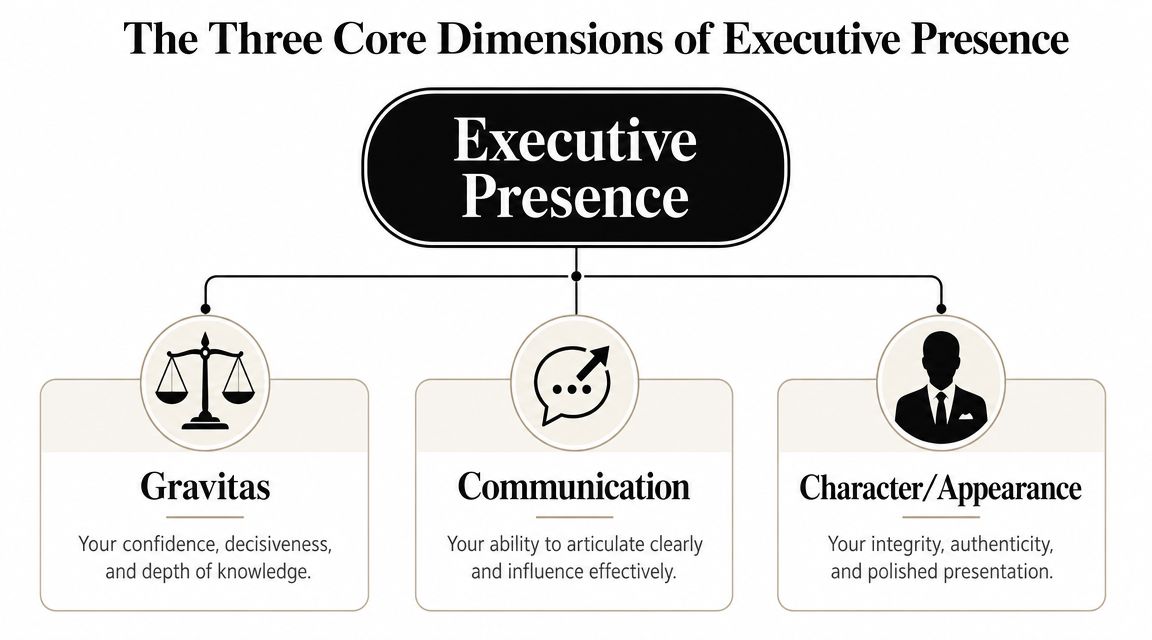
Most executive presence problems become manageable once you break them into components. In practice, three dimensions show up repeatedly: gravitas, communication, and character or appearance. They overlap, but they aren't the same.
A leader can be articulate and still seem uncertain. Another can look polished and still fail to influence a room. Assessment works when it separates these dimensions instead of blending them into one vague impression.
Gravitas
Gravitas is the part people usually mean when they say someone has executive presence. It's your steadiness, judgment, decisiveness, and ability to project confidence without forcing it.
A major survey of senior leaders found that 67% consider gravitas the most important quality of executive presence, and the behaviors that most undermine it are being indecisive (88%), timid (85%), and lacking confidence (84%), according to this executive presence research summary.
In real terms, gravitas shows up when:
- a board member pushes back and you answer without getting defensive
- a project is off track and you give direction without panic
- a room gets noisy and your recommendation still lands with weight
It does not mean acting dominant. It means people trust your center of gravity.
Communication
Communication is where many capable professionals lose senior-level impact. They know their material, but they bury the point. They answer questions with context before conclusion. They sound informative rather than directional.
An assessment usually looks for markers such as:
- Message structure: Do you lead with the recommendation or with the background?
- Verbal precision: Do you overuse filler, qualifiers, and softeners?
- Audience adaptation: Can you explain a technical issue to non-technical stakeholders?
- Vocal delivery: Do you rush, flatten key points, or trail off at the end of sentences?
For many international professionals, articulation also matters. Not because they need to erase identity, but because unclear enunciation can distract from authority in critical situations. If that's relevant in your case, focused work on how to enunciate better can support the communication side of presence.
Strong communication in senior settings usually sounds shorter, clearer, and more directional than people expect.
Character and appearance
This dimension is often misunderstood as clothing. Presentation matters, but assessment should look more broadly at whether your external signals support trust and authority.
That includes:
- posture and physical composure
- facial expressiveness
- congruence between tone and message
- professionalism of presentation
- visible authenticity and integrity
A useful example is the leader who speaks with calm confidence but avoids eye contact, fidgets through questions, or appears disengaged on video calls. Their words may be solid, but their nonverbal cues dilute authority. Assessment helps pinpoint that mismatch.
This dimension also includes a less obvious question: do people experience you as coherent? In senior roles, presence weakens when behavior feels inconsistent across contexts. You don't need to become theatrical. You need your message, body language, and professional image to point in the same direction.
Common Formats for Executive Presence Assessments
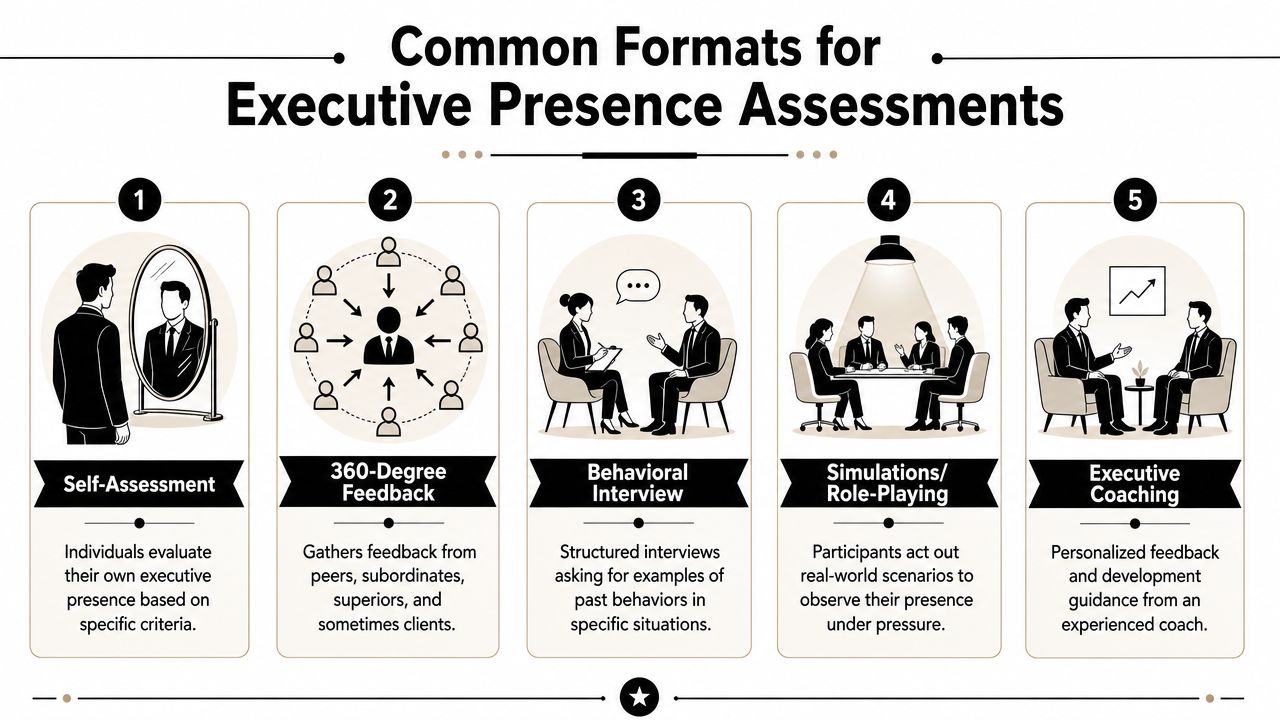
There isn't one standard format for an executive presence assessment. Different tools answer different questions. The right choice depends on whether you need speed, objectivity, context, or depth.
Some people start with a self-check because it's easy. Others need multi-rater data because they suspect a perception gap. Senior leaders often benefit most from live observation because the problem only appears in real moments.
Self-assessment questionnaires
A self-assessment is the simplest format. You rate yourself against statements about confidence, clarity, body language, influence, and composure.
This format works well when you want:
- A low-friction starting point: You can identify likely weak spots quickly.
- A reflection tool: It helps you notice patterns you've normalized.
- A baseline before coaching: It creates language for what feels off.
Its limitation is obvious. You're rating your own intent, not your real-world impact. Individuals tend to be either too harsh on themselves or too generous. Self-assessment is useful, but rarely sufficient on its own.
360-degree feedback
A 360 process gathers input from managers, peers, direct reports, and sometimes clients, enabling executive presence to become much more concrete as patterns emerge across raters.
A stronger 360 can reveal questions like:
| Format | Best for | Main limitation |
|---|---|---|
| Self-assessment | Personal reflection | Subjective |
| 360-degree feedback | Perception gaps across audiences | Can feel complex or political |
| Live observation | Real-time behavioral diagnosis | Requires an experienced observer |
The biggest advantage of 360 feedback is contrast. You may think you sound concise, while peers experience you as over-explaining. You may believe you're calm, while your team experiences you as unreadable. That discrepancy is often the core insight.
Live observation by a coach
Live observation is the most context-sensitive format. A coach watches you in real situations, or reviews recordings of presentations, meetings, and stakeholder conversations.
This works especially well when your issue is situational. For example:
- you sound strong in prepared presentations but weak in unscripted Q&A
- you lead your team effectively but lose authority with senior executives
- your delivery changes when stress rises
A good observer won't just say “be more confident.” They'll tell you where authority dropped. Maybe you answered too early. Maybe you smiled while delivering a hard recommendation. Maybe your first sentence framed you as tentative.
Other useful formats
Some organizations also use structured interviews, simulations, and role-play. These can be valuable when the goal is to test behavior under pressure rather than collect impressions after the fact.
If communication across accents or speech patterns is part of the picture, a targeted accent reduction assessment can help separate language-delivery issues from broader executive presence concerns.
Selection rule: Choose the lightest assessment that will still give you honest data. If your self-awareness is strong, start simple. If stakes are high, get outside observation.
Sample Assessment Questions and Scoring Explained
Assessment becomes less intimidating when you see what it looks like. Most executive presence tools are built from behavioral statements, not abstract labels. Raters respond to what they can observe.
A common format uses a simple frequency scale such as 1 to 5, from Rarely to Almost Always. The point isn't to create a perfect score. The point is to find patterns.
Sample Executive Presence Assessment Items
| Dimension | Sample Assessment Item |
|---|---|
| Gravitas | Remains composed when challenged in meetings |
| Gravitas | States recommendations decisively without excessive hedging |
| Communication | Structures ideas logically under pressure |
| Communication | Adapts message clearly for non-technical audiences |
| Character/Appearance | Uses body language that supports credibility and calm |
| Character/Appearance | Presents as polished, engaged, and professionally aligned with role expectations |
These items can be rated by you, your manager, peers, and other stakeholders. Once the responses are collected, the interesting part begins.
How to read the scores
Don't obsess over whether you got a high or low number on one item. Look for these three signals instead:
-
Large self-versus-others gaps
If you rate yourself highly on concise communication but others don't, that's a perception issue worth investigating. -
Consistent low ratings across audiences
That often points to a behavior you display in most settings. -
Split ratings by audience type
If peers rate you strongly but senior leaders don't, your issue may be more contextual and role-specific.
The most valuable insight is not your absolute score, but the gap between how you rate your performance and how your key stakeholders rate it.
What good scoring discussion sounds like
A useful interpretation sounds like this:
- “You're not weak across the board.” Your strongest ratings may show where your authority already holds.
- “Your problem is concentrated.” Maybe executive-level communication drops when you need to answer briefly and decisively.
- “Your self-perception is partially accurate.” You may know you're thoughtful, but others may experience that thoughtfulness as hesitation.
This is why tracking progress matters. If speech clarity or pronunciation is part of the feedback, you also need a way to monitor improvement objectively. Practical frameworks for measuring your accent reduction progress accurately can help when vocal delivery is one of the variables affecting perceived authority.
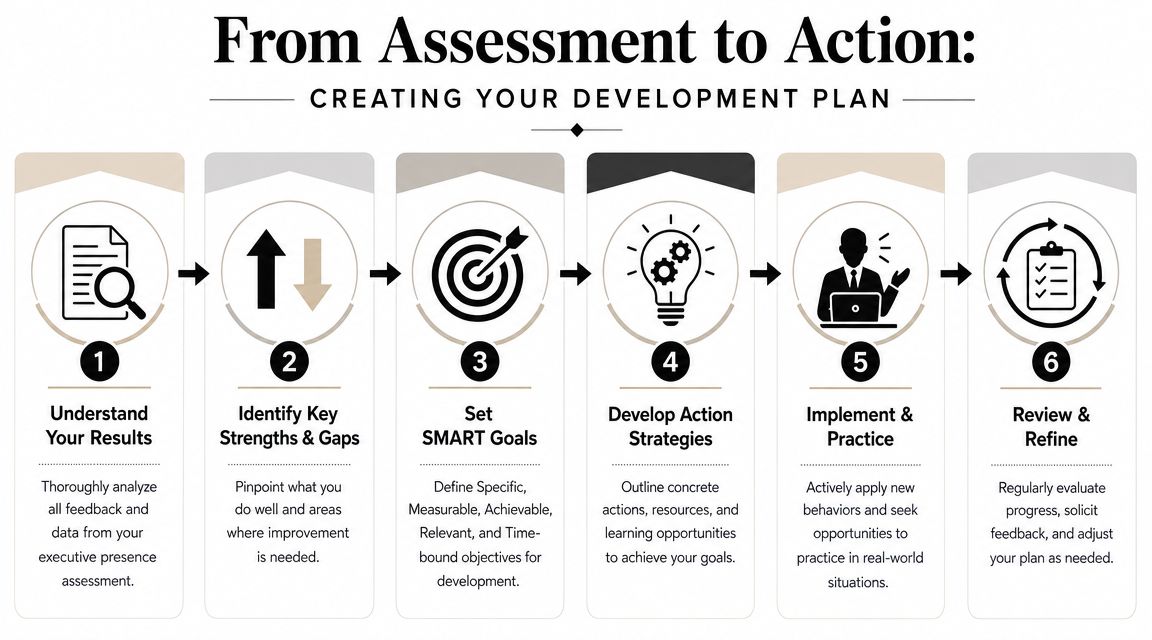
From Assessment to Action Creating Your Development Plan
A diagnosis only matters if it changes behavior. Too many professionals complete an assessment, feel briefly validated or discouraged, and then do nothing different in the meetings that matter.
A useful development plan is narrow. It targets a few behaviors with high impact and gives them enough repetition to become credible to other people, not just noticeable to you.
Start with the biggest gaps
Look for the behaviors that create the most drag on your influence right now. Don't try to fix everything.
Good priorities often sound like:
- “I bury my recommendation.”
- “I speak too quickly when challenged.”
- “My face and tone go flat in high-stakes discussions.”
- “I over-explain to prove competence.”
One or two well-chosen behaviors can shift how you're perceived far more than a generic goal to “improve presence.”
Research-based diagnostic frameworks also show why patience matters. Behavioral change and perception change don't happen on the same timetable. One model suggests behavioral changes in expression can appear in 8 to 12 weeks, while stakeholder perception may take 3 to 6 months, as described in this diagnostic framework for developing executive presence.
Turn feedback into practice targets
Use your assessment to write behavioral goals you can rehearse. For example:
- For brevity: Open every recommendation with the decision first.
- For composure: Pause before answering difficult questions.
- For authority: Replace permission-seeking phrases with clear points of view.
- For visibility: Narrate key reasoning instead of processing internally.
Here is the embedded video referenced in this section:
Build a development cycle
The most effective plans usually follow a simple loop:
- Review one target behavior
- Practice it in live situations
- Get feedback from a trusted observer
- Refine and repeat
Many professionals also benefit from support outside formal coaching. If your challenge includes sounding more self-assured in meetings, practical communication habits that boost career confidence at work can reinforce the behavioral work between higher-stakes conversations.
Practical rule: Practice in the settings where your presence currently breaks down, not only where you already feel comfortable.
Keep the plan realistic
A strong development plan is specific enough to observe. “Be more executive” is useless. “In my next three leadership meetings, I will state my recommendation in the first sentence and pause before defending it” is usable.
The most common mistake is impatience. People often change behavior before others update their opinion of them. That lag doesn't mean the work isn't landing. It means your audience needs repeated evidence before they revise their mental model of you.
Choosing a Reputable Coach and Your Next Step
You finish a senior meeting thinking you were clear, prepared, and appropriately concise. Later, the feedback is harder to hear. You seemed hesitant. Your point did not fully land. You sounded knowledgeable, but not quite ready for the next level.
That gap is exactly why coach selection matters. Executive presence work should diagnose what other people are seeing and hearing under pressure. It should never reduce your career prospects to a vague verdict about charisma.
What to look for in a coach
Start with method. A credible coach should assess observable behaviors: how you open a point, how long you take to get to a recommendation, what happens to your voice when challenged, how your facial expression and posture change in high-stakes moments, and whether your message structure helps or hurts perceived authority.
Context matters too. A coach who has worked with technical leaders, international professionals, or client-facing executives will usually spot different issues than someone using broad leadership advice. The trade-off is straightforward. A generalist may help with confidence in a broad sense, but a specialist is often better at identifying the specific behavior that is weakening your presence in your actual environment.
Ask how progress is measured. The answer should include a baseline, a short list of target behaviors, and a way to test whether those behaviors change how others experience you. If the process stays abstract, the results usually do too.
A useful screening step is to review these questions to ask before hiring a communication coach, especially if your executive presence challenge includes vocal authority, clarity, or communicating across accents and cultures.
One structured option
Some professionals prefer a defined program rather than piecing together support from several sources. Intonetic offers The Gravitas Method, a 12-week one-on-one coaching program focused on vocal authority, strategic framing, executive body language, and high-stakes communication for international professionals.
The format matters less than the diagnosis.
Before you commit to any coach or program, get clear on the actual problem. An executive presence issue might be message structure, vocal delivery, visible tension, weak advocacy, or a mismatch between how you see yourself and how senior stakeholders perceive you. Those are different problems. They require different practice.
If you want a starting point, book a complimentary Executive Communication Assessment with Intonetic. The goal is simple: identify the specific behaviors shaping how you are perceived in senior-level conversations, then decide what to change first. That kind of baseline saves time, reduces false starts, and gives you a more realistic next step.