
Tier 2 Words: Your Guide to Executive Vocabulary
You speak up in a meeting. Your analysis is solid. Your recommendation is practical. But someone else says a simpler version of the same idea, using sharper language, and the room responds to them.
Many international professionals know this feeling. In your first language, you sound nuanced, credible, and senior. In English, you may sound correct but too basic. You say “good,” “bad,” “big,” “small,” “need,” and “think” when what you really mean is “compelling,” “problematic,” “significant,” “limited,” “require,” and “evaluate.”
That gap matters. Senior leaders don't judge you only on technical competence. They also judge how clearly and precisely you frame ideas under pressure. If your vocabulary is too simple, people may mistake language limits for thinking limits.
Tier 2 words become particularly useful. While often introduced in school settings, they're just as valuable in boardrooms, project reviews, investor conversations, and cross-functional meetings. They help you sound more precise without hiding behind jargon. They help your ideas land with the authority they deserve.
If you've ever wondered why your English sounds fluent but not fully executive, this is often part of the answer. A stronger vocabulary won't change who you are. It helps other people hear your real level more accurately. If you want a broader view of that shift, this guide on executive presence in professional settings gives helpful context.
From Overlooked to Influential How Words Shape Your Authority
A product leader I once coached had a common problem. In private, she was thoughtful and strategically sharp. In meetings, she'd say things like, “I think this is a good plan,” or “There may be some problems later.” Nothing was wrong with the grammar. The issue was impact.
Her peers used language like “This is a viable approach, but we need to consider downstream risks,” or “The proposal is compelling, yet the assumptions need to be substantiated.” Their ideas didn't become stronger because of those words. Their authority became more visible.
That's the frustrating part for many international professionals. You're not underperforming. You're being underheard.
When simple English creates the wrong impression
In high-stakes conversations, basic vocabulary can accidentally make your thinking sound basic too. A senior finance manager may say “the numbers are not good” when they really mean “the variance is significant.” A tech lead may say “we should change this” when the stronger message is “we should revise the approach to reduce risk.”
Practical rule: If your idea is complex, your language should be clear and precise enough to carry that complexity.
This doesn't mean trying to sound academic all the time. It means selecting words that show judgment, scale, and nuance. That's what senior communication often does well.
Why vocabulary affects influence
People listen for cues. They notice whether you can distinguish between a minor issue and a critical factor, between a preference and a rationale, between a delay and a structural constraint. The words you choose shape how others interpret your confidence and your level.
Technical skill gets you into important rooms. Language helps you hold your position once you're there.
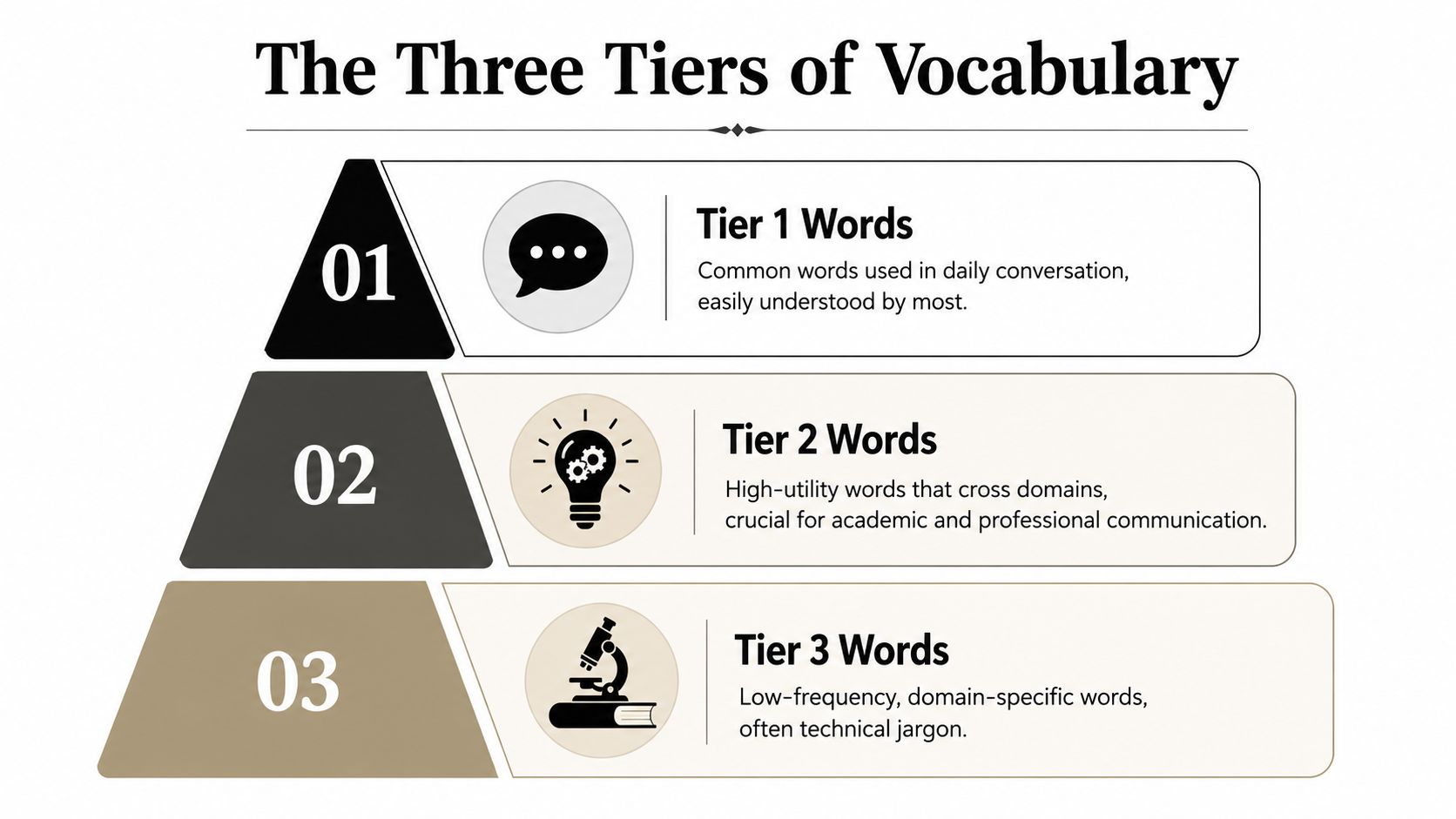
Tier 2 words are especially useful because they sit in the middle ground. They're more advanced than everyday speech, but they're not narrow technical jargon. That makes them ideal for professionals who need to communicate across functions, cultures, and seniority levels.
The Three Tiers of Vocabulary Explained
Think of vocabulary as a professional toolkit.
Some tools are basic and universal. Some are highly specialized. The most useful set for influence sits in the middle.
Tier 1 words are your basic tools
These are everyday words such as “walk,” “house,” “baby,” or “good.” You learn them through normal conversation. They help you function, but they don't carry much precision in a professional setting.
If you say, “This is a good result,” people understand you. But they don't learn much. Good in what way? Strong? Sustainable? Encouraging? Profitable? Reliable?
Tier 2 words are your power tools
These are high-utility words that appear across many subjects and contexts. They aren't tied to one field. According to Structural Learning's explanation of vocabulary tiers, Tier 2 words function across multiple content domains and include words such as “analyse,” “synthesize,” and “evaluate.”
These words matter because they help you explain thinking, not just facts. Instead of saying “look at,” you can say “evaluate.” Instead of “show,” you can say “demonstrate.” Instead of “difference,” you can say “contrast.”
For international professionals working on Business English communication at senior levels, this category is often the missing link between fluency and authority.
Tier 3 words are your specialist instruments
These are technical words tied to a field. In science, it might be “photosynthesis.” In finance, it might be “amortization.” In software, it could be “containerization.”
Tier 3 vocabulary is important, but it doesn't solve the influence problem on its own. Many professionals already know the technical terms in their field. The problem is what happens between those terms. If every sentence is either very basic or highly technical, your communication can sound uneven.
Here's a simple way to remember the framework:
| Tier | What it includes | Professional effect |
|---|---|---|
| Tier 1 | Everyday language | Clear but often too basic |
| Tier 2 | Cross-domain academic and professional language | Precise, credible, versatile |
| Tier 3 | Domain-specific terminology | Expert, but narrow |
Tier 2 words are often the language of explanation, comparison, judgment, and decision-making. That's why they matter so much in leadership contexts.
Why Tier 2 Words Are Your Secret Weapon for Executive Presence
Many non-native English speakers become conversationally fluent and still feel stuck. They can participate. They can explain. But they don't sound fully senior.
That usually isn't a grammar problem. It's an authority gap.

The gap between speaking English and shaping decisions
Tier 2 words are distinct from Tier 1 words because they appear frequently in print but much less often in spoken conversation. That creates a specific vocabulary gap for non-native speakers who won't absorb them naturally through everyday talk, as explained in this overview of Tier 2 word lists and lessons.
That point explains a lot. You can spend years in English-speaking workplaces and still not naturally acquire the words that dominate reports, strategy documents, business cases, and executive summaries.
So you may say:
- “This will help us a lot”
- “There are some issues”
- “We need to think about this”
A senior leader often says:
- “This could strengthen our position”
- “There are several constraints”
- “We need to assess the implications”
The second version sounds more controlled and more credible because it's more precise.
Precision creates presence
Executive presence isn't just visual. Language is one of the clearest markers of maturity in communication. If you want your profile to reflect that same level of professionalism online, strong visuals matter too. Clean, senior-looking headshots such as Professional AI executive photos from Secta Labs can support the impression your words are already building.
A useful test is this: when you speak, do your words help people classify your thinking quickly? Leaders often speak in language that signals evaluation, prioritization, causation, and judgment. Tier 2 words are rich in exactly those functions.
Here's a short way to see the difference:
| Basic phrasing | Executive phrasing |
|---|---|
| good result | significant outcome |
| bad timing | unfavorable timing |
| big change | substantial shift |
| think about | consider |
| show | demonstrate |
A quick video can help you hear how stronger language supports stronger delivery.
Strong vocabulary doesn't make weak ideas sound smart. It helps strong ideas sound complete.
Curated Tier 2 Word Lists for Ambitious Professionals
The Academic Word List framework includes exactly 570 high-utility words that appear across subjects rather than belonging to a single domain, as outlined in this review of Tier 2 vocabulary and the AWL. You do not need to memorize all of them at once.
You need a practical shortlist that fits your daily work.
General business and professional words
Use these in meetings, updates, reports, and email.
-
Articulate: to express clearly
Example: “She articulated the client's concern in a way the whole team could act on.” -
Evaluate: to judge quality, value, or effectiveness
Example: “We need to evaluate both options before committing resources.” -
Significant: important enough to deserve attention
Example: “The delay could have a significant effect on the launch timeline.” -
Factors: elements that influence an outcome
Example: “Several factors contributed to the lower forecast.” -
Contrast: to compare by showing differences
Example: “The report contrasts customer demand in the two regions.”
If you often soften your opinions too much, these phrases can help. This guide on stronger ways to say in my opinion is especially useful when you want to sound clear without sounding aggressive.
Tech and finance words that sound precise without sounding dense
These are useful because they add clarity without turning your speech into jargon.
| Word | Plain meaning | Professional example |
|---|---|---|
| Mitigate | reduce the impact of something | “We need to mitigate implementation risk before rollout.” |
| Substantiate | support with evidence | “Can we substantiate that claim with user data?” |
| Discrepancy | a mismatch or inconsistency | “There's a discrepancy between the forecast and actual spend.” |
| Constraint | a limit or restriction | “Budget remains the main constraint for this quarter.” |
| Aggregate | combine into a whole | “The dashboard aggregates data from multiple sources.” |
Leadership and strategy words
These words help you sound more senior because they reflect decision-making and direction.
-
Rationale
Use it when you need to explain the logic behind a decision.
Example: “I want to clarify the rationale behind the pricing change.” -
Imperative
Use it when something is necessary, not optional.
Example: “It's imperative that we resolve ownership before expansion.” -
Catalyst
Use it for a person, event, or decision that triggers change.
Example: “The partnership could become a catalyst for growth.” -
Sustain
Use it to describe maintaining momentum or performance over time.
Example: “The question isn't whether we can improve results. It's whether we can sustain them.” -
Viable
Use it when discussing whether an option is realistic and workable.
Example: “Option B looks more viable under current conditions.”
Bookmark this approach: Don't collect random advanced words. Build a personal list based on your real meetings, your industry documents, and the situations where you want to sound more authoritative.
The Art of the Swap From Everyday to Executive Language
It's not a bigger vocabulary problem that's needed. A replacement system is.
That matters because existing content often treats Tier 2 words as a classroom topic, while adult professionals need a way to use them for authority and contextual power. That gap is described in this discussion of how Tier 2 words are commonly framed.
Start with phrases you already overuse
Listen to your own speech for one week. You'll probably notice a handful of default words. Often they are “good,” “bad,” “important,” “thing,” “problem,” “help,” “show,” and “think.”
Those words are not wrong. They're too broad for executive communication.
Here's a practical swap table:
| Instead of this everyday phrase | Try this executive alternative |
|---|---|
| a good idea | a compelling proposition |
| a big problem | a significant issue |
| we need to think about it | we need to consider the implications |
| this will help | this will strengthen our position |
| it will be hard | it presents a formidable challenge |
| I want to show | I want to demonstrate |
| there is a difference | there is a clear contrast |
| this is the reason | this is the underlying rationale |
| we should use this | this appears to be the most viable option |
| the results were good | the results were favorable |
Don't swap blindly
A stronger word only works when it fits the context. If you replace every simple word with a formal one, you'll sound stiff. Good executive communication feels intentional, not inflated.
Use this quick filter before you upgrade a phrase:
- Ask about precision: Does the new word say something more exact?
- Check the audience: Will everyone understand it immediately?
- Read it aloud: Does it sound like something you would say in a meeting?
If you want more examples of how word choice shapes tone, this article on how to improve writing through diction is useful because it shows how small wording changes alter impact.
Build your own swap bank
Create a private document with three columns:
- Your overused phrase
- A better Tier 2 alternative
- One sentence from your real work
For example:
- “good result” → “meaningful outcome” → “The pilot produced a meaningful outcome for the support team.”
- “bad fit” → “limited fit” → “That approach has limited fit for enterprise clients.”
- “we need to check” → “we need to verify” → “We need to verify the assumptions before approval.”
The goal isn't to sound fancier. The goal is to sound more exact.
A Practical Framework to Learn and Master Tier 2 Words
Memorizing long vocabulary lists rarely changes how you speak under pressure. What works better is repeated use in realistic contexts.
A five-part method that fits professional life
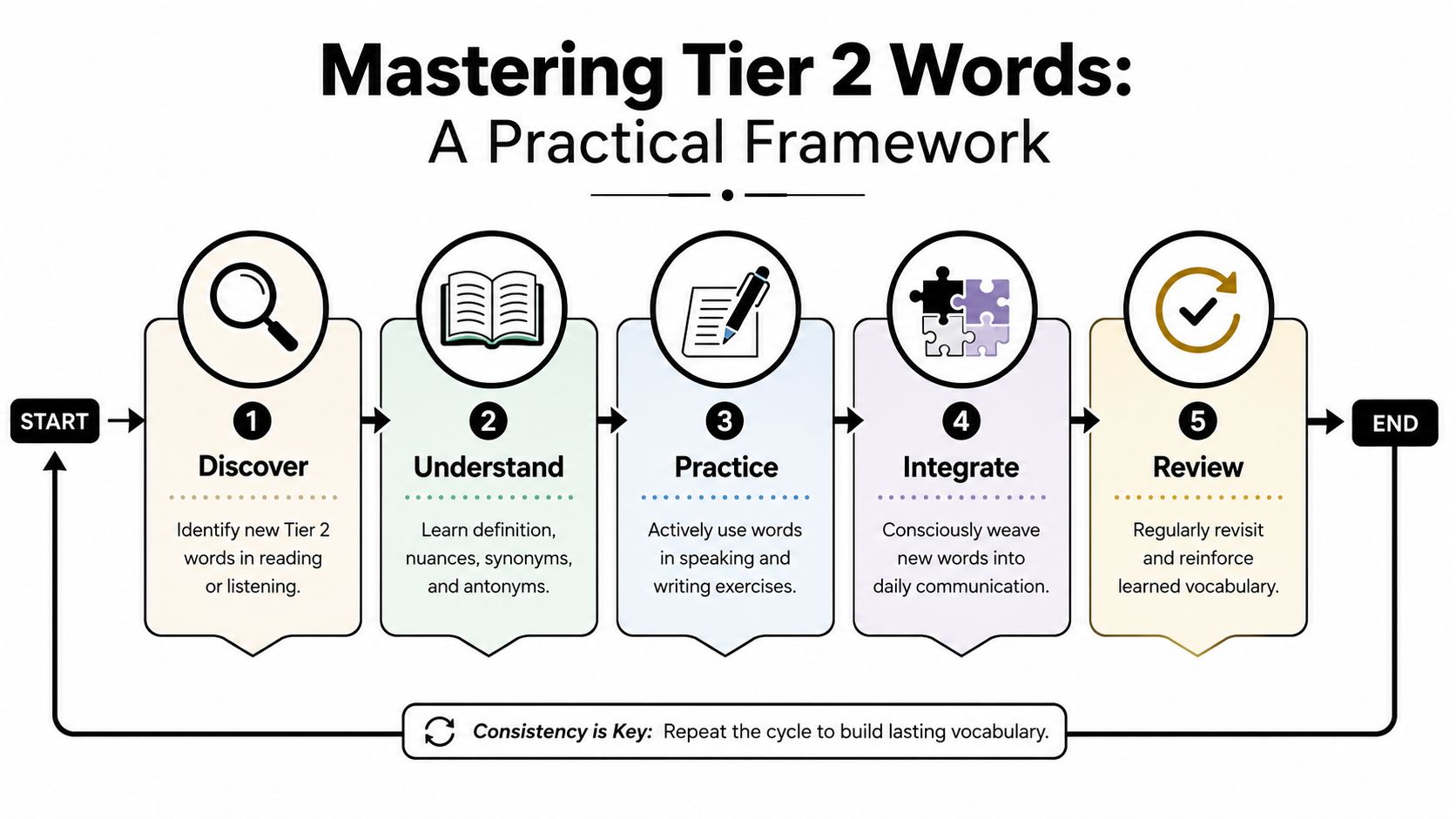
Discover
Find Tier 2 words in places you already read. Good sources include board memos, strategy decks, market commentary, product documents, and stakeholder emails. When a word appears across different contexts, it's often worth learning.
Understand
Don't stop at the dictionary meaning. Learn the nuance.
For each new word, note:
- Definition: what it means in plain English
- Synonyms: nearby alternatives
- Antonyms: what it contrasts with
- Typical use: the kind of sentence it appears in
Practice
Write three original sentences from your own work. Not generic examples. Real ones.
If you work in product, write product sentences. If you work in finance, write finance sentences. If you lead teams, use meeting language. For spoken practice, business English speaking drills for professionals can help you turn passive recognition into active use.
Integration matters more than study intensity
The strongest learning happens when a word becomes part of your normal communication. Try low-risk environments first.
- Internal email updates: safer than client-facing communication
- Meeting notes: useful because you can revise before sending
- Practice conversations: ideal with trusted colleagues or mentors
A spaced review system also helps. If you want a simple method, Cramberry's spaced repetition tips offer a practical way to revisit vocabulary before you forget it.
Keep the learning cycle small
The most effective instructional approaches often focus on only 3 to 4 target Tier 2 words per lesson, using repeated exposure in reading, writing, and speaking rather than large lists, as described in the earlier AWL-based source. That same principle works for adults.
Here is a simple weekly rhythm:
| Day | Task |
|---|---|
| Monday | Choose 3 Tier 2 words from real work materials |
| Tuesday | Write original sentences |
| Wednesday | Use one in a meeting or email |
| Thursday | Rewrite one old message using stronger wording |
| Friday | Review which word felt natural and which still felt forced |
Working rule: Small vocabulary sets used repeatedly beat long lists you never say out loud.
Beyond Words Building True Gravitas
Tier 2 words can sharpen your communication, but vocabulary alone won't create executive presence. Real gravitas also depends on delivery. Your pacing, your pauses, your posture, and your ability to stay composed under pressure all shape how people experience your authority. Stronger language works best when it's paired with calm delivery and grounded body language for leaders in high-stakes settings.
This broader picture matters because senior leaders don't evaluate presence evenly. According to Sylvia Ann Hewlett's Center for Talent Innovation study of 4,000 professionals, executive presence is judged through three pillars, with gravitas at 67%, communication at 28%, and appearance at 5%.
That finding is useful. It means better vocabulary is not a cosmetic upgrade. It supports one part of a larger leadership signal. When you choose more precise words, you make your thinking easier to trust. When you deliver those words with steadiness, you make your leadership easier to believe.
The Gravitas Method is a 12-week one-on-one executive presence coaching program for international professionals who want to communicate with more authority and influence at senior levels. The program is priced at $8,200 paid in full or $9,000 across three installments. Coached by Nikola, it covers vocal authority, strategic framing, executive body language, and high-stakes communication.
If you want to see where your current communication may be weakening your authority, start with Intonetic's free Executive Communication Assessment. It's the clearest first step if you're ready to sound as senior as you already are.