
Master Business English For International Professionals
You already know enough English to do your job. You can write the email, explain the project, answer the question, and join the meeting. Yet something still feels off when the stakes rise.
Your ideas are solid, but they don’t always land with the same weight as those of less qualified colleagues. In executive meetings, you may sound more detailed than decisive, more careful than commanding, more reactive than strategic. That gap is where many senior international professionals get stuck.
That’s why business english for international professionals at the senior level has very little to do with textbook grammar. It has everything to do with influence. When you're aiming for director, VP, founder, or C-suite credibility, the question isn't only whether your English is correct. It's whether your English makes people trust your judgment.
What Is Business English for Senior Leaders
At early and mid-career levels, business English usually means practical workplace language. You learn how to write emails, join meetings, give updates, and use professional vocabulary. Those skills matter. They just aren't enough once your role shifts from execution to leadership.
Senior leaders use English differently. They don't only share information. They set direction, reduce ambiguity, frame decisions, handle pressure, and project confidence when the room is uncertain.
It stops being a language problem and becomes a leadership problem
A senior international professional often faces a frustrating pattern. You may be fully fluent in your field, but in a board meeting your message becomes too long, too technical, or too cautious. Someone else summarizes the same point in two sentences and gets credit for strategic clarity.
That isn't usually a vocabulary issue. It's a communication authority issue.
The demand for specialized business English reflects that shift. The global Business English Language Training market was valued at USD 21.44 billion in 2023 and is projected to reach USD 42.56 billion by 2032, with over 1.2 billion professionals worldwide seeking stronger English proficiency for career growth, according to DataIntelo's business English language training market report.
Practical rule: If your English helps you complete tasks, you're functional. If your English helps you shape decisions, you're operating at a senior level.
What senior-level business English actually includes
For leaders, business English includes skills such as:
- Decision language: saying what matters, what changed, and what should happen next
- Stakeholder language: adapting the same message for executives, clients, peers, and technical teams
- Boardroom language: sounding composed under scrutiny, especially when challenged
- Influence language: framing trade-offs without sounding defensive or uncertain
Basic fluency gets you into the room. Senior communication determines how you're perceived once you're there.
This is why many experienced professionals eventually need a different kind of support than a standard course can offer. If you're trying to understand what that higher-level work looks like in practice, executive presence coaching for non-native English professionals is the closest category. The focus shifts from language accuracy to perceived seniority.
How to recognize the real issue
You may need advanced business English work if any of these sound familiar:
- Your message gets diluted: You explain thoroughly, but people still ask, “So what do you recommend?”
- Your voice loses authority under pressure: You speed up, soften your statements, or over-explain when challenged.
- Your expertise sounds narrower than it is: You sound like a specialist, not a strategic leader.
- You know what to say later: After the meeting, the sharper version appears in your head.
Senior business English is the language of leadership presence. It is not about sounding like a native speaker. It is about sounding like someone who belongs at the level you want to lead.
Why General English Falls Short in the Boardroom
General English teaches you the notes. Senior leadership requires performance.
A musician can know every scale and still fail on stage if the delivery has no control, no confidence, and no interpretation. Many international professionals have the same problem in English. They know the language, but under pressure they don't sound like the most senior version of themselves.

Fluency is the entry ticket, not the differentiator
Most standard programs focus on familiar areas: grammar, vocabulary, email writing, presentations, and polite meeting language. Useful, yes. But the boardroom doesn't reward usefulness alone. It rewards judgment that sounds steady and clear.
That gap is larger than most professionals realize. A 2023 LinkedIn Global Talent Trends report noted that 72% of executives cite executive presence as the top unwritten promotion rule, yet only 15% of non-native professionals receive targeted coaching in this area, as cited by the University of Toronto's business English for international professionals page.
When people talk about “communication issues” at senior levels, they often mean something more subtle:
- You sound informative, but not decisive
- You sound intelligent, but not concise
- You sound prepared, but not fully in command
What general courses usually miss
Generic programs often fail in high-stakes environments because they don't train the behaviors that shape executive perception.
Those behaviors include:
- How you begin: Senior speakers don't warm up for three minutes before making the point.
- How you hold silence: They pause without appearing lost.
- How you frame risk: They don't dump details. They clarify the implication.
- How you respond when interrupted: They recover without losing structure.
A lot of professionals also carry an extra burden that doesn't show up on a syllabus. Accent bias, pacing, and perceived hesitation affect how listeners interpret authority long before they consciously evaluate your content. If you've experienced that dynamic, understanding accent bias at work for non-native speakers helps explain why being correct isn't always enough.
The problem isn't that your English is weak. The problem is that leadership communication uses signals most language courses never teach.
Signs you may have an executive presence gap
The gap often shows up in patterns, not dramatic failures. Look for these:
| Situation | What happens | What it signals |
|---|---|---|
| Senior meeting update | You give background before the conclusion | Weak strategic framing |
| Challenging question | Your voice rises or your answer becomes long | Pressure affects authority |
| Cross-functional discussion | You stay highly technical | Message isn't adapted to audience |
| Presentation to leadership | You sound polished but not memorable | Delivery lacks executive weight |
This is why ambitious professionals can feel confused. Their English may be objectively strong, but their communication still doesn't convert into influence. In the boardroom, how you speak carries leadership meaning. General English prepares you to participate. It rarely prepares you to lead.
The Four Pillars of Executive Communication in English
Executive communication works like a structure. If one pillar is weak, the whole message loses force. You may have strong content, but if your delivery collapses under pressure or your framing is scattered, senior listeners won't experience you as fully credible.
The four pillars below are the ones I see matter most in real leadership settings.
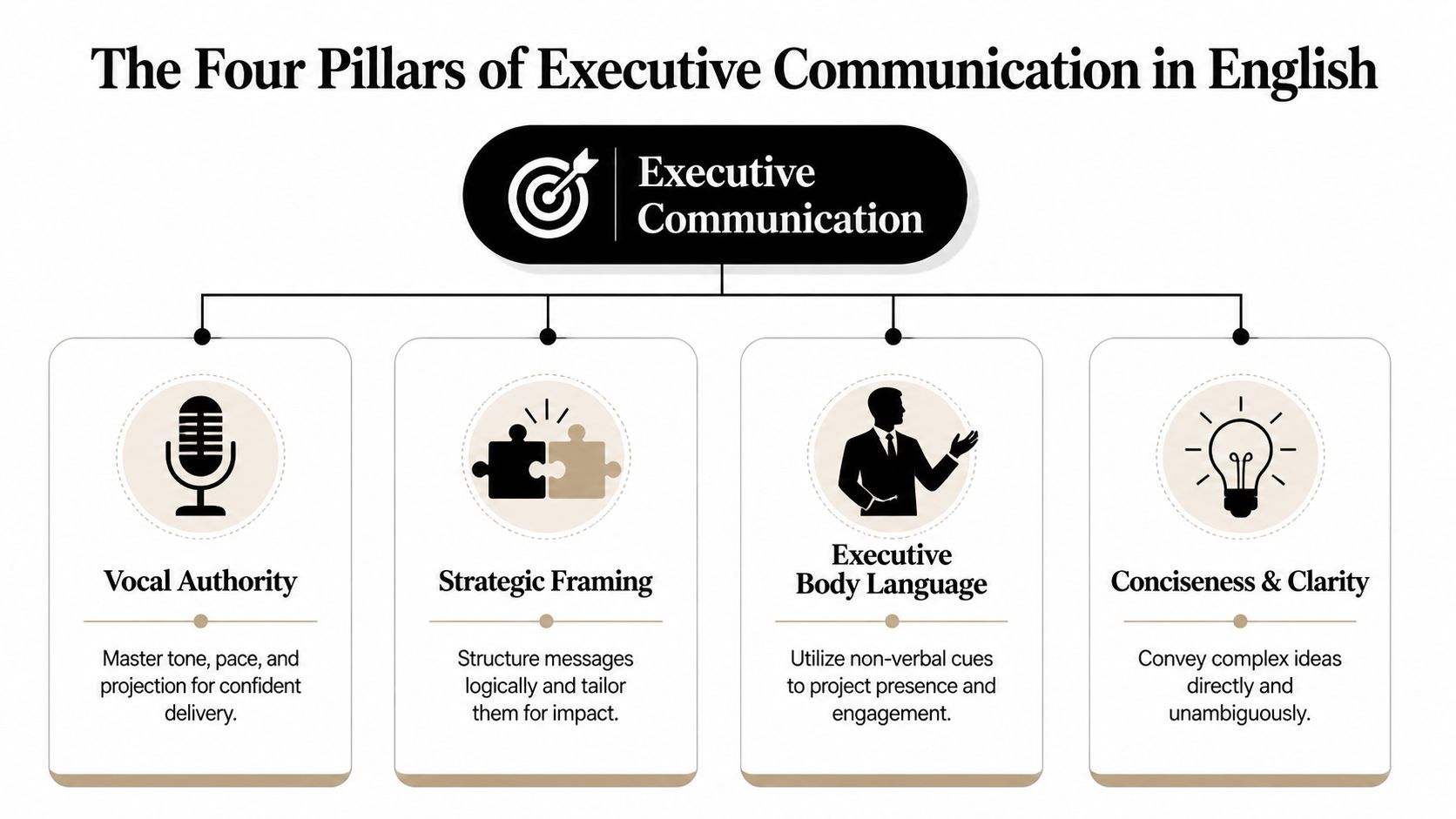
Vocal authority
Your voice tells people how to interpret your message before they process the words. Pace, pitch, volume, and sentence endings all affect whether you sound settled or unsure.
Common senior-level problems include rushing, speaking in a narrow pitch range when nervous, trailing off at the end of key statements, and adding filler that weakens impact.
A stronger version sounds different:
- Instead of speaking quickly to prove fluency, you slow down enough to sound deliberate
- Instead of softening every point, you land the sentence cleanly
- Instead of filling silence, you use pauses to signal control
Professional training frameworks show that work on pronunciation, tone, and context-specific vocabulary improves public speaking and meeting confidence, while negotiation, presentation, and technical writing skills specific to a sector support faster decision-making, according to this overview of business English skills.
If vocal control is one of your weak points, improving English pronunciation for work and career growth is often a useful starting point. Not because pronunciation alone creates authority, but because unclear sound patterns often trigger rushing and self-monitoring.
Here is a short demonstration of how delivery shapes authority in practice:
Strategic framing
This is the pillar many strong professionals underestimate. Strategic framing means you know how to organize your message so busy stakeholders understand the point immediately.
Senior people don't want a transcript of your thinking. They want a structured answer.
A well-framed update often follows this order:
- The headline: what changed or what matters
- The implication: why leadership should care
- The recommendation: what you want them to do
- The support: only the detail needed to back it up
A useful test: If someone interrupts you after your first two sentences, have they already understood your main point?
Executive body language
Body language matters even on Zoom. Eye line, posture, facial control, gestures, and how still you remain when listening all affect perceived composure.
This isn't about performative confidence. It is about removing signals that dilute authority.
Examples:
- Looking down while making a recommendation weakens conviction
- Over-nodding can read as approval-seeking
- Excessive movement on camera distracts from substance
- A stable posture makes your message feel more settled
Conciseness and clarity under pressure
The last pillar matters most when you don't have time to prepare. A difficult question from a CFO. A skeptical stakeholder. A client who asks for your recommendation without warning.
In those moments, many non-native speakers become either too brief and vague or too detailed and defensive. Neither works.
Use a simple pressure structure:
| Pressure moment | Better response pattern |
|---|---|
| You need to answer fast | Start with your position, then support it |
| You don't fully know yet | State what is known, what is unclear, and what happens next |
| You are challenged | Acknowledge the concern, clarify the trade-off, restate your recommendation |
These four pillars are coachable. Once you can name them, improvement becomes much easier. Instead of saying “I need better business English,” you can say, “My framing is weak in leadership meetings,” or “My voice loses authority when I'm interrupted.” That level of precision changes everything.
Common Communication Pain Points by Industry
The phrase business english for international professionals sounds broad, but the communication failures are rarely broad. They are specific to the job you do, the stakeholders you face, and the kind of pressure your role creates.
A product leader and an investment analyst can both be fluent in English and still struggle for completely different reasons. One may over-explain technical dependencies. The other may sound accurate but overly cautious when presenting market risk. The solution should match the role, not just the language level.
Tech professionals
In tech, senior people often lose influence when they communicate only for other technical people. That becomes costly when the audience is a leadership team, client, investor, or cross-functional partner.
A high-value skill in IT is translating technical concepts for non-technical stakeholders. One practical example from this guide to business English for IT professionals is using analogies like “Think of the API like a waiter in a restaurant” to keep explanations accurate and accessible.
If stakeholders don't understand your explanation, they won't approve your recommendation. They may approve a simpler, worse idea instead.
For teams working across languages and customer channels, operational clarity matters just as much externally as it does internally. A useful example is cxconnect.ai's Bright Horizons insights, which show why multilingual communication has to be designed for real user understanding, not just literal translation.
Finance and consulting roles
Finance professionals usually face a different problem. Their language is often precise, but their delivery can become too dense, too hedged, or too reporting-focused. In senior settings, that can make strong analysis sound less actionable than it is.
Consultants often struggle with another version of the same issue. They may present polished frameworks, but when executives push back, the response becomes overly explanatory instead of commercially sharp.
Here’s a practical breakdown.
Industry-specific communication challenges
| Industry / Role | Common Pain Point | Key Skill to Develop |
|---|---|---|
| Tech / Software Engineer | Explains systems in technical detail that business stakeholders can't use | Strategic framing |
| Tech / Product Manager | Gives updates with too much context before the recommendation | Conciseness and clarity |
| Finance / Investment Analyst | Sounds cautious when presenting uncertain or volatile information | Vocal authority |
| Finance / FP&A Manager | Reads numbers clearly but doesn't translate them into business decisions | Strategic framing |
| Consulting / Engagement Manager | Presents well in prepared settings but becomes verbose under challenge | Structured speaking under pressure |
| Consulting / Senior Associate | Sounds smart but too junior in client conversations | Executive body language and presence |
What works better than generic polishing
Industry-specific improvement usually comes from three adjustments:
- Use role-relevant scenarios: practice investor questions, steering committee updates, client pushback, or board summaries
- Translate expertise into decisions: don't stop at analysis. State the implication and recommendation
- Adapt your level of abstraction: senior listeners want patterns, risks, and choices before they want detail
If you work in a global function, your communication shouldn't sound generically “professional.” It should sound credible in your actual arena.
How to Assess Your Executive Communication Skills
Most professionals assess their English by asking, “Was my grammar correct?” That question is too small for senior leadership. A better question is, “How did I sound when the stakes were high?”
You need evidence, not intuition. The fastest way to get it is to record yourself in a realistic work scenario. Use a mock project update, decision recommendation, or difficult stakeholder response. Then review it with a structured checklist.
Review your speaking in four categories
Use the four pillars as your diagnostic lens.
Vocal authority
- Sentence endings: Do your statements land firmly, or do they fade?
- Pace under stress: Do you speed up when explaining something important?
- Fillers: Do “um,” “you know,” or “so” appear when you're challenged?
- Breathing: Do you sound physically rushed?
Strategic framing
- Opening clarity: Do you state the main point early?
- Recommendation quality: Can a senior listener tell what you want from them?
- Message structure: Is your answer organized, or does it unfold as you think?
- Audience fit: Did you adapt the language to who is listening?
Check the non-verbal layer
Your body language may be weakening your message even when the words are strong.
- Posture: Do you look grounded or compressed?
- Eye line: On video, do you look engaged or visually absent?
- Facial control: Do you react visibly when interrupted or questioned?
- Gestures: Do your hands support clarity or create distraction?
Record one answer to a difficult question and watch it twice. First with sound on. Then with sound off. The second viewing tells you a lot about perceived seniority.
Test your pressure response
Self-assessment becomes honest. Give yourself a prompt you haven't prepared for. For example: “Why should we prioritize this now?” or “What's the commercial downside if we're wrong?”
Then check:
| Question | If the answer is no, that's a clue |
|---|---|
| Did I answer directly? | You may be delaying your position |
| Did I sound calm? | Pressure may be affecting vocal control |
| Did I give structure? | Your framing may collapse under stress |
| Did I stop at the right point? | You may be over-explaining |
If you want an external benchmark, a targeted evaluation often reveals patterns you can't hear yourself. A useful starting point is an accent reduction assessment for professional communication, especially if accent, clarity, and delivery are all blending together in your self-evaluation.
Assessment matters because improvement without diagnosis becomes random. Senior communication gets better when you identify the exact behaviors that lower your authority and work on those, not when you keep collecting more vocabulary.
A Phased Roadmap for Building Communication Authority
Trying to “sound more executive” all at once usually fails. The better approach is phased development. Build awareness first, then consistency, then performance under real pressure.
That matters because authority isn't one skill. It's a set of repeatable communication behaviors that have to hold up in meetings, presentations, and difficult conversations.

Phase one builds awareness and quick wins
At this stage, you are not trying to transform everything. You are trying to notice the few habits that most weaken your authority.
Start with one week of observation in real meetings.
Track:
- Filler words: count how often they appear in one answer
- First-sentence clarity: note whether you reached the point quickly
- Vocal stability: listen for trailing endings and rushing
- Physical habits: check eye contact, posture, and visible tension
A simple phase-one exercise is this: before any meeting where you may speak, write your position in one sentence. Then say that sentence out loud twice, slowly, before joining.
Phase two turns insight into repeatable habits
Now the work becomes behavioral. You practice on purpose in lower-risk situations until the patterns begin to hold.
This phase is where many professionals need more structure. Gartner reports that 65% of international tech professionals struggle with strategic framing in English during Scrum standups or pitch decks, as cited in FluencyCorp's roadmap to business English fluency. That struggle is rarely solved by more grammar study. It improves when you repeatedly practice how to frame a point for a senior listener.
Use a weekly routine such as:
- In team updates: lead with the recommendation, not the background
- In stakeholder meetings: translate one technical point into business impact
- In virtual calls: practice pausing before your main point instead of rushing into it
If confidence is part of the issue, practical mindset and speaking drills can help alongside executive communication work. This guide on improve your English speaking confidence offers useful reinforcement for the habit-building phase.
Don't measure progress by whether you felt nervous. Measure it by whether your structure held even while you were nervous.
Phase three applies the skills in high-stakes moments
The work becomes fully relevant to promotion, leadership visibility, and credibility. You use the same tools in situations that carry consequence.
Examples include:
| High-stakes scenario | What to practice |
|---|---|
| Executive presentation | Open with headline, implication, recommendation |
| Difficult client question | Acknowledge, answer directly, then support |
| Promotion interview | Show strategic scope, not only execution detail |
| Cross-functional conflict | Stay calm, concise, and non-defensive |
A strong phase-three exercise is rehearsal with pressure. Ask a colleague, coach, or trusted peer to interrupt you, challenge your assumptions, or ask for a clearer recommendation. Then repeat until your answer stays concise.
The roadmap matters because many senior international professionals work hard but practice the wrong thing. They keep polishing language they already know instead of training the communication behaviors that senior roles require.
How to Choose the Right Business English Coaching
A senior leader walks out of a meeting knowing the idea was right and the delivery was not. The recommendation came late. The answer ran long. The voice lost steadiness the moment the room pushed back.
That is the standard you should use when evaluating coaching.
By the time you reach a senior role, everyday fluency is rarely the issue. The bigger problem is how your English performs under pressure. Strong coaching addresses executive presence in practice: how you frame a decision, how you use your voice, how you control pace, and how you stay composed when the discussion turns difficult.
What to look for in a serious program
A credible program should be able to explain exactly how it works and what it improves.
- Senior-level outcomes: Look for coaching tied to influence, decision communication, leadership visibility, and credibility with executives.
- Practice on real material: Your presentations, board updates, investor conversations, Q&A, and difficult stakeholder discussions should be the training ground.
- Delivery, not only language: The work should include vocal authority, pacing, structure, executive presence, and how you respond under pressure.
- A clear diagnostic process: A skilled coach should be able to tell whether the main barrier is framing, pronunciation, pace, vocal tension, or pressure management.
- Role-specific context: A finance leader, consultant, operator, and tech executive face different communication tests. The feedback should reflect that.
If you are selecting a provider for L&D or an education business, delivery systems matter as well. Scheduling, learner tracking, and program management shape whether training runs smoothly at scale. Tutorbase's language school software overview gives a useful view of that operational side.
What usually falls short
Senior professionals often waste time on formats that improve awareness but do not change behavior in the room.
- Self-paced courses without live correction: You may understand what good communication sounds like and still repeat the same speaking habits.
- Large group programs for highly specific executive issues: They are efficient for broad training but weak for fixing individual patterns that affect authority.
- Offers focused mainly on sounding native: Senior audiences respond first to clarity, judgment, structure, and presence.
- Courses built around generic business topics: Broad content often transfers poorly to promotion interviews, executive presentations, and high-stakes client conversations.
Buying well also means asking sharper questions. These questions to ask before hiring an accent coach are useful here because they reveal whether a provider can diagnose the communication problem or only teach standard language skills.
One option in this area is The Gravitas Method, a 12-week one-on-one executive presence coaching program for international professionals who want to communicate with more authority and influence at senior levels. Coached by Nikola, it focuses on vocal authority, strategic framing, executive body language, and high-stakes communication. For current investment details, book an assessment rather than relying on article pricing.
Choose coaching that changes how you are perceived in consequential leadership moments. You should finish with a clearer point of view, steadier delivery, and stronger command when the pressure rises.