
Nonverbal Communication in Business: Executive Presence
The most popular advice about nonverbal communication in business is also some of the least reliable. “Maintain eye contact.” “Stand tall.” “Use open gestures.” Those rules can help in a familiar setting, but they assume that confidence looks the same in every culture, hierarchy, room, and communication channel.
It doesn't. A direct gaze can signal confidence in one boardroom and disrespect in another. Silence can suggest discomfort to one audience and careful judgment to another. On video, a speaker's camera position and response timing may shape perception more than a traditional handshake ever could.
Executive presence isn't a collection of power poses. It's the disciplined ability to make your signals fit the audience, the stakes, and the message.
Why Most Body Language Advice Fails International Professionals
Confident-looking body language has no universal definition. Many Western business environments reward direct eye contact, visible energy, expressive gestures, and quick verbal participation. In other settings, restraint, deference to seniority, measured facial expression, and strategic silence can communicate professionalism. Applying one culture's signals everywhere can make an international professional appear aggressive, theatrical, or socially unaware.
That's why nonverbal communication should be treated as a context-sensitive leadership variable, not a checklist of gestures. A major review of 260 studies on leader communication distinguishes video, aural, and textual communication and connects observable delivery signals with leadership outcomes, including vocal variation, gesture, speech errors, and interruption patterns. The evidence points toward adaptation and observation, not performance of a universal “confident” character. Research on leader communication and observable signals supports that more precise view.

The cost of copying universal rules
International professionals often face a double bind. If they follow advice written for an American executive, they may overcorrect by making more eye contact, occupying more space, interrupting more readily, or using larger gestures. If they retain habits from a high-context or strongly hierarchical culture, colleagues in a direct-speaking environment may misread their composure as uncertainty.
Neither response solves the core problem. The professional needs to identify what the audience reads as authority, then preserve authenticity while adjusting the signal.
A useful starting point is the role of cultural barriers in communication. Before entering a meeting, ask:
- Who holds status: Is authority expressed through direct participation, formal deference, or demonstrated expertise?
- What signals respect: Does the group expect sustained gaze, attentive listening, physical distance, or carefully timed responses?
- What is the meeting's purpose: A negotiation, brainstorming session, performance conversation, and board update require different degrees of energy and restraint.
- Which cues are reliable: A single gesture rarely tells you enough. Look for clusters involving posture, voice, timing, and facial expression.
Read the room before changing your behavior
The strongest executive communicators don't enter every room with identical body language. They observe how senior people greet one another, how long participants pause before responding, who speaks first, and whether disagreement is expressed openly or indirectly.
Practical rule: Match the room's level of formality first. Then introduce enough of your own style to remain clear, credible, and authentic.
The objective isn't to erase your cultural identity. It's to prevent an audience from making avoidable assumptions about your authority. In global work, flexibility is often more persuasive than exaggerated confidence.
The Six Channels of Nonverbal Communication in Business
Nonverbal behavior works through several channels at once. A Harvard Business School overview identifies six channels relevant to negotiation and professional interaction: facial expressions, eye movements, physical gestures, paraverbal cues, posture, and personal space. Signals can contradict spoken words, operate below full awareness, and influence how an exchange develops. Harvard Business School's overview of nonverbal communication in negotiation provides a practical framework for examining what happens beyond the script.
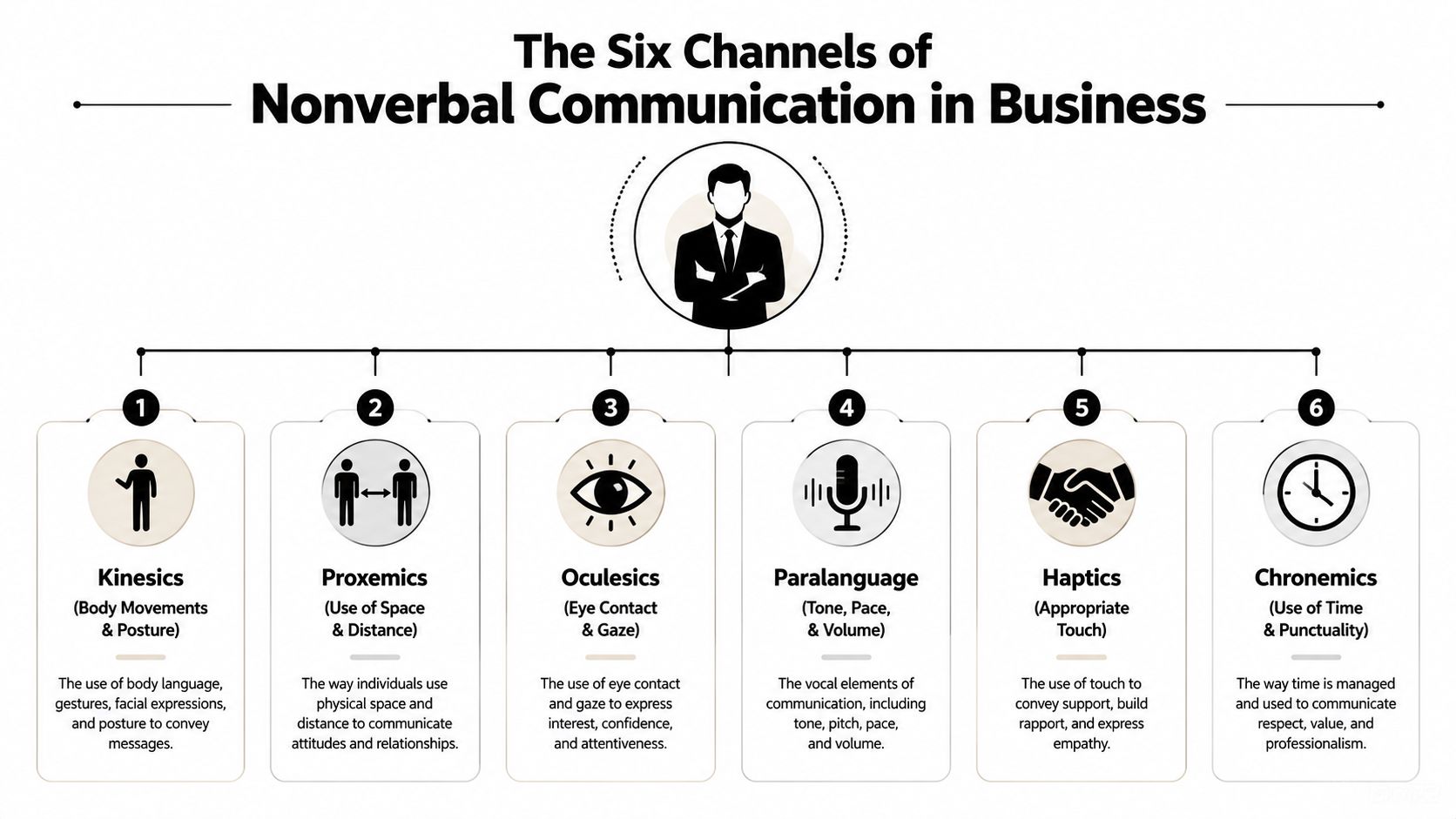
Facial expression and eye movement
Your face shows how you are receiving information. A tightened jaw during a stakeholder presentation can make a neutral question appear threatening. A blank expression while listening may look like disinterest, even when you are concentrating. A restrained smile can communicate warmth in one setting and nervousness in another. More guidance on interpreting these signals appears in this resource on facial expression and meaning.
Eye movement also shapes attention and participation. Looking at a speaker signals engagement, while shifting your gaze toward other participants can show that you are including the room. In a group discussion, a leader who acknowledges the person speaking and then briefly scans the wider group distributes ownership of the conversation. On video, looking toward the camera during a key sentence can strengthen connection, while constant camera focus during active listening may appear unnatural.
Gestures and posture
Gestures should clarify structure rather than compete with it. Use one deliberate movement to mark a transition, distinguish two options, or emphasize a decision. Repetitive tapping, hand wringing, and constant movement create visual noise, making a technically strong presentation feel less controlled.
Posture communicates your relationship to the room. Sit upright without holding your shoulders rigidly. Keep your chest open, feet grounded, and hands available for natural movement. Leaning slightly forward can signal engagement, while leaning away during a challenge may appear defensive.
Paraverbal cues and space
Paraverbal communication includes tone, pace, volume, pitch, and pauses. A senior leader who rushes through complex reasoning can sound uncertain even when the analysis is sound. A measured pace gives listeners time to process, while vocal variation prevents minor details and major decisions from receiving the same emphasis.
Personal space includes where you sit, how close you stand, and how you use the meeting environment. A German negotiator may expect more physical distance than a Latin American counterpart, where closer positioning can support rapport. Moving too close can feel intrusive in one setting; standing too far away can seem detached in another. Set the distance by observing the other person's comfort rather than treating proximity as a universal confidence signal.
Timing runs through all six channels. Arriving prepared, allowing others to finish, and responding after a thoughtful pause communicate respect and control. Under time pressure, the channels interact: a rushed answer, clipped tone, fixed posture, and reduced facial response can make decisiveness look like irritation. Reading those combinations helps leaders adjust one mechanic without performing an entirely different personality.
How Nonverbal Signals Shape Leadership Perception
Leadership perception forms before the room has tested the recommendation. A clear proposal can lose force when its delivery signals hesitation, strain, or poor control. A flat voice, repeated speech errors, or a collapsing posture may weaken an otherwise sound argument before anyone examines the evidence.
Research gives practitioners more useful tools than generic advice to “look confident.” A review of 260 studies on leader communication examined observable signals such as vocal variation, gesture, speech errors, and interruption patterns. These mechanics shape judgments about control, engagement, credibility, and authority. The review of leader communication research helps international professionals diagnose delivery with precision rather than copy a universal body-language formula.
Congruence builds trust
Verbal and nonverbal signals should support the same meaning. Saying a project is under control while speaking rapidly, avoiding the audience, and showing visible tension creates competing messages. Listeners may give greater weight to the uncertainty they can observe than to the reassurance in the sentence.
A workplace study of 505 respondents across business organizations found frustration and distrust when supervisors' verbal and nonverbal signals conflicted. Its practical recommendations included increasing eye contact, observing facial expressions, and asking questions when cues do not match. The workplace study on discrepant supervisor signals supports a disciplined response: investigate the mismatch instead of assuming you know what it means.
Delivery changes by leadership moment
The same executive may need different nonverbal emphasis in a promotion conversation and a retention conversation. When seeking advancement, a concise recommendation, steady vocal energy, and a clear finish help others see readiness for greater scope. When retaining a valued colleague, the priority shifts toward attentive listening, responsive facial expression, and enough silence for concerns to surface. Excessive performance in either setting can reduce trust. Authority requires calibration, not a permanently forceful style.
The seniority gap in delivery
International professionals may have strong analysis but bury the recommendation beneath deference, repeated qualification, or rising intonation. A small voice can make precision sound tentative. State the position, pause, give the necessary evidence, and stop. Do not fill the silence with an apology or a second version.
Strategies for building credibility as a leader through delivery, not just content begin with practicing that complete sequence. Leadership perception is not fully controllable, especially across cultures, yet you can align voice, timing, expression, and words so they reinforce the level of responsibility you are prepared to carry.
Cross-Cultural Nuances That Change the Rules
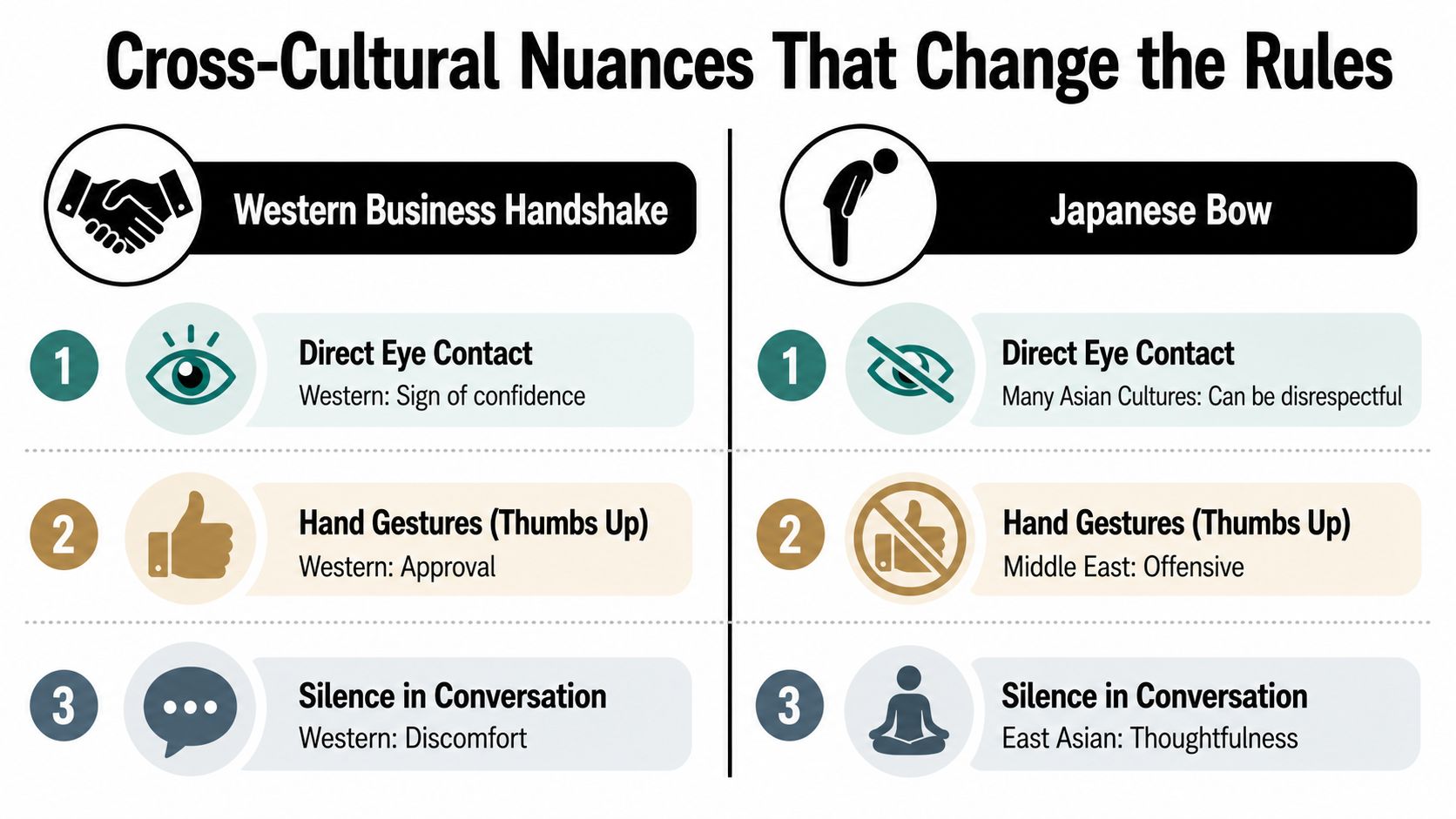
The same behavior can carry different meanings across business cultures. A Western boardroom may reward direct eye contact and fast, explicit disagreement. Many Asian business contexts may place greater value on hierarchy, restraint, and indirect disagreement. Middle Eastern business interactions can also differ in expectations around gesture, proximity, greeting, and personal boundaries.
These are patterns, not instructions for stereotyping individuals. Nationality doesn't determine behavior, and multinational teams contain different generations, industries, personalities, and organizational norms. The practical discipline is to treat cultural knowledge as a hypothesis, then verify it by observing the specific group.
Assertiveness versus restraint
In many American-led business settings, a leader may be expected to state a view early, maintain visible engagement, and use direct language. Silence can create discomfort if participants interpret it as a lack of preparation. In East Asian settings, silence may provide room for thought, protect harmony, or show respect for the hierarchy. A quick answer isn't always the strongest answer.
The contrast also appears in eye contact and gesture. Direct gaze can support confidence in one environment while feeling confrontational in another. A thumbs-up may be understood as approval in some Western contexts but can be offensive in parts of the Middle East. These examples are why universal rules create risk.
A calibration framework
Before a cross-border meeting, determine the audience's expectations across four dimensions:
- Status: Who is expected to speak first, challenge openly, or make the final decision?
- Directness: Does disagreement happen in public, through questions, or after the meeting?
- Expressiveness: Are large gestures and visible enthusiasm normal, or does restraint signal seriousness?
- Time and silence: Do participants expect immediate responses, or do pauses show consideration?
The high-context culture framework helps explain why some audiences rely more heavily on relationship, shared understanding, and indirect signals. Adaptation doesn't mean imitating every local behavior. It means reducing avoidable friction so your expertise can be evaluated on its merits.
The following video offers another perspective on cultural interpretation and business interaction.
Adapting Executive Presence for Video and Hybrid Work
A camera removes information and exaggerates what remains. Participants may see only your head and shoulders, hear a compressed version of your voice, and interpret a short delay as hesitation. Traditional eye contact becomes an approximation because looking at the other person on screen means looking away from the camera. Leaders need a different operating system for nonverbal communication in business when the room is digital.
Start with the frame. Position the camera close to eye level, keep your face clearly visible, and use lighting that allows others to read your expression. A low camera angle can make the image feel unnatural, while a distant frame reduces connection. On a group call, your posture and stillness become more important because small gestures may disappear from view.
Make your voice carry the structure
Video compresses physical presence, so your voice must do more organizational work. Slow down at transitions, vary emphasis around the recommendation, and use a clean pause before answering a difficult question. Don't compensate for the medium by becoming theatrical. Excess energy can sound like anxiety when the camera captures only your face and voice.
During hybrid meetings, acknowledge remote participants through gaze, address, and timing. Turn toward the camera when making a key point, but also look toward people in the room when responding to them. Invite remote colleagues into the discussion rather than allowing the physical room to become the only visible audience.
This guide to leader presence from Acheloa Wellness, Inc. is a useful complementary resource for thinking about how presence is perceived beyond spoken content.
Digital paralanguage is still communication
In asynchronous work, nonverbal cues haven't vanished. They've been redesigned as punctuation, formatting, response timing, emoji, message length, and tone. A terse “Noted.” can sound dismissive. A delayed response can be interpreted as low priority, even when the sender is handling a demanding workload. An emoji may soften a message for one colleague and create confusion for another.
A 2025 virtual team communication study reported that 68% of respondents use emojis daily, while 52% report misunderstandings about emoji meaning. The study on emoji use and virtual team communication highlights a practical risk: digital signals need shared norms.
Use explicit wording in important situations. State the decision, owner, timing, and next action instead of expecting punctuation or emoji to convey urgency. For more detailed camera mechanics, consult this resource on body language on camera.
Common Nonverbal Mistakes That Undermine Authority
A technical director enters a board meeting with excellent analysis. The first question arrives, and she answers at speed, adds multiple caveats, and ends with a slight upward inflection. Her colleagues hear intelligence, but they also hear uncertainty. The correction isn't to speak louder or adopt a more forceful personality. She should lead with the conclusion, slow the first sentence, and let the evidence follow.
A different pattern appears with a senior manager from a strongly hierarchical culture. He waits for the chair to invite his view, avoids interrupting, and gives a small nod when challenged. In his previous environment, those behaviors communicate respect and control. In a direct-speaking boardroom, colleagues may mistake them for a lack of conviction. He can preserve respect while making his position visible earlier, using a sentence such as, “My recommendation is to continue, subject to these conditions.”
When the face contradicts the message
A founder says the company is ready for a difficult negotiation, but her expression tightens whenever the buyer raises price. Her words remain calm, yet the buyer sees each reaction. The face becomes an unintended disclosure channel.
The solution isn't to suppress every expression. It's to separate listening from reacting. Keep the jaw relaxed, take notes, and pause before responding to a provocative point. If the issue changes the recommendation, name that change directly instead of allowing facial tension to carry the message.
When control becomes overcontrol
Another executive tries to look composed by freezing his body. He keeps his hands still, limits facial movement, and speaks in an even monotone. The result feels less like confidence and more like distance.
Nonverbal communication works through alignment, not immobility. A leader can remain still while listening, then use a natural gesture when explaining a decision. The workplace research review on nonverbal behavior formalized the topic across what employees signal, how managers interpret signals, how leadership and credibility are judged, and how behavior affects organizational interaction. That broader view is more useful than treating one posture as universally authoritative.
Practical Techniques to Build Executive Presence
Practice one channel at a time, then combine them under realistic pressure. Recording yourself on a laptop or phone reveals habits you won't notice while presenting. Ask a trusted colleague to identify the moment your authority rises or falls, and request observations about pace, gaze, facial reaction, and interruption rather than a vague judgment about confidence.
Rehearse for the situation
For a board presentation, write the recommendation in one sentence and practice delivering it with a grounded posture, a complete breath, and a pause afterward. The pause prevents you from weakening the statement with unnecessary explanation.
For negotiations, rehearse silence. Ask a colleague to challenge your proposal, then wait before answering. Keep your hands visible, maintain a culturally appropriate gaze, and respond to the substance rather than the emotional pressure.
For difficult conversations, practice your listening face. Record yourself hearing a criticism without smiling, frowning, or looking away. The goal isn't a neutral mask. It's an expression that communicates attention without prematurely agreeing or rejecting.
Use simple physical resets
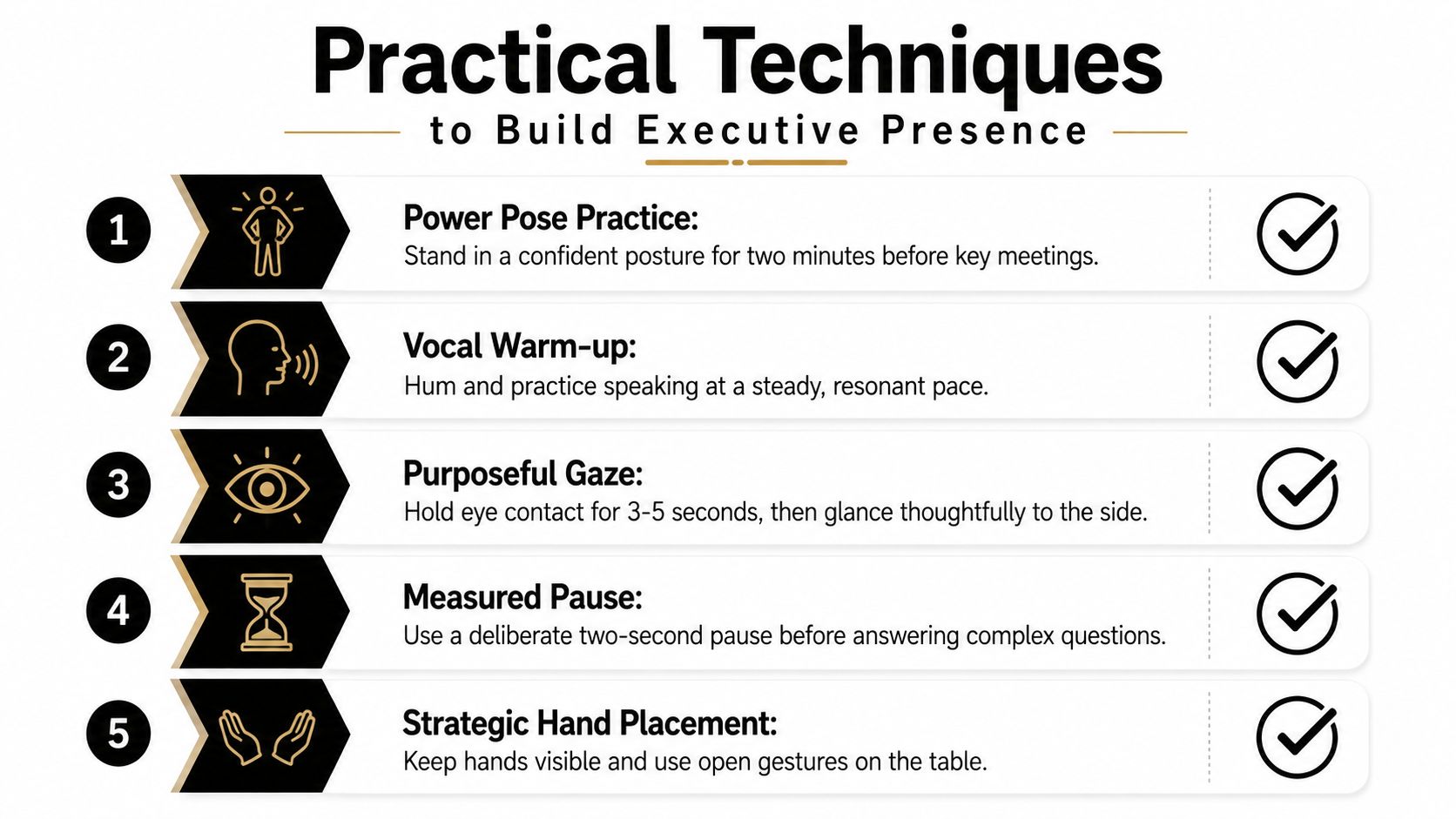
Before a video call, place both feet on the floor, lower your shoulders, and check that your camera is at eye level. Hum gently or read a paragraph aloud at a steady, resonant pace before a presentation. These small actions prepare the vocal and physical systems without forcing a theatrical persona.
The infographic's suggested drills include a two-minute posture practice, a purposeful gaze lasting three to five seconds, and a deliberate two-second pause before answering complex questions. Those exact exercises should be treated as practice prompts, not universal cultural rules. Adjust gaze and timing to the audience and the relationship.
For presentation preparation, an authentic professional photo guide from AiHeadshots can also help you think about how framing, expression, and visual consistency affect professional impressions.
Get personalized feedback
Generic advice stops at awareness. Personalized feedback identifies the channel that's limiting you. The Gravitas Method is a 12-week one-on-one executive presence coaching program for international professionals who want to communicate with more authority and influence at senior levels. Priced at $8,200 paid in full or $9,000 across three installments, the program is coached by Nikola and covers vocal authority, strategic framing, executive body language, and high-stakes communication.
If your expertise is stronger than the authority your delivery currently communicates, start with Intonetic's free Executive Communication Assessment. It gives you a practical view of the vocal, verbal, and nonverbal patterns affecting your senior-level presence, so you can decide what to practice next.