
What Is High Context Culture? A Guide for Leaders
Your idea is solid. The data is right. The slide is clear. Then the meeting ends, and nothing moves.
A colleague later tells you that you came across as too forceful. Or too fast. Or not senior enough. That feedback can feel irrational when your content was stronger than everyone else's. But in many international settings, content isn't judged on content alone. People also judge how you entered the room, how directly you challenged someone, how much relational groundwork you laid, and whether your tone matched the status dynamics around you.
That's where the question what is high context culture stops being academic and becomes career-relevant. If you work across borders, your authority can rise or fall on signals you were never taught to notice.
When What Is Said Matters Less Than How
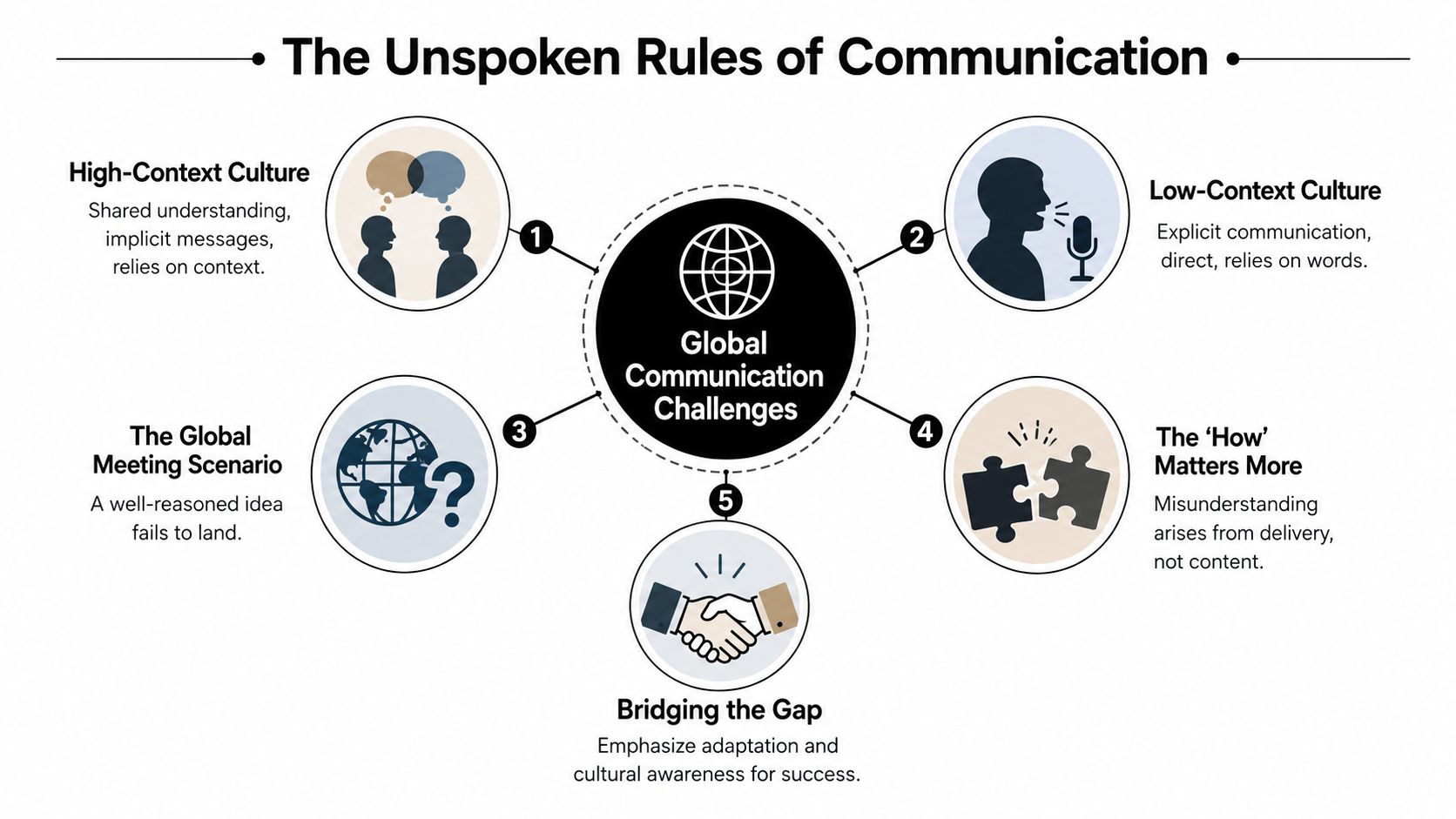
A lot of professionals discover high-context communication the hard way. They present a recommendation clearly, support it with logic, answer questions directly, and expect the group to decide. Instead, the room goes quiet. No one openly objects, but the proposal stalls. Later, they learn the issue wasn't the recommendation itself. It was the delivery.
In a high-context culture, people don't rely only on the literal words spoken. They draw meaning from relationship history, status, shared assumptions, timing, tone, pauses, and the situation around the message. If low-context communication is like reading the instructions printed on the box, high-context communication is more like joining a conversation that began long before you entered the room.
Anthropologist Edward T. Hall introduced this framework in the 1970s, and it remains influential because it treats communication as a spectrum rather than one universal standard. In Hall's model, meaning in high-context environments is carried heavily by relationships, shared assumptions, and nonverbal cues, a distinction still used in cross-cultural business communication across major regions, as explained in Smartling's overview of Edward T. Hall's high-context culture framework.
What this looks like in real meetings
You'll often notice a few patterns:
- Indirect responses: “That may be difficult” might mean “no.”
- Careful pacing: Fast, blunt answers can signal poor judgment rather than confidence.
- Attention to hierarchy: Who speaks first, who summarizes, and who remains silent all carry meaning.
- Relational framing: Trust often comes before open disagreement.
Practical rule: If a message feels unusually subtle, assume the meaning may be sitting in the tone, timing, or relationship, not just the sentence.
This is one reason technically strong international professionals can struggle in senior rooms. They may have the right answer but package it in a way that sounds junior, abrasive, or culturally tone-deaf.
Why this matters for executive communication
High-context cultures don't reward only correctness. They also reward calibration. Senior leaders in these settings often sound measured rather than hyper-explicit. They imply where they can, leave space for others, and show awareness of the group dynamic.
That doesn't mean you should become vague. It means you need range. If your speaking style is naturally more direct, strengthening delivery tools like pause placement and pitch movement can help you sound clearer without sounding aggressive. Work on those mechanics matters because meaning often rides on vocal nuance, not just vocabulary. A useful starting point is learning how American English intonation shapes meaning in conversation.
Understanding High-Context vs Low-Context Communication
The cleanest way to understand the difference is this. Low-context communication puts the message in the words. High-context communication puts much of the message around the words.
One is closer to sheet music. The notes are written down, and everyone is expected to follow them clearly. The other is closer to jazz. Structure still exists, but timing, feel, relationships, and what isn't said matter just as much.
The core contrast
In low-context environments, people usually value explicitness. They expect direct answers, documented expectations, and a clear distinction between agreement and disagreement. If something matters, it should be stated.
In high-context environments, people often expect others to infer meaning from context. Communication can sound less definitive on the surface while carrying strong meaning underneath. That can confuse professionals who are waiting for a direct yes, no, or objection that never comes.
| Characteristic | High-Context Culture | Low-Context Culture |
|---|---|---|
| Communication style | Indirect, layered, often implied | Direct, explicit, verbally clear |
| Source of meaning | Context, tone, status, shared assumptions | Words, written detail, stated intent |
| Relationship-building | Often central to trust and cooperation | Often secondary to task clarity |
| Approach to time | More flexible around process and relationship needs | More rigid around schedules and deadlines |
| Conflict handling | Often softened, indirect, or delayed | Often addressed directly and early |
| Feedback style | Nuanced, face-saving, situational | Clear, candid, and specific |
Where people get tripped up
The mistake isn't just “being direct.” The mistake is assuming directness is always read as honesty and competence.
In a low-context office, a concise correction may sound efficient. In a high-context setting, the same sentence may sound like public disrespect. In one culture, interrupting shows engagement. In another, it shows poor control.
If you keep asking, “Why won't they just say what they mean?” you're probably applying a low-context standard to a high-context situation.
Voice also matters here. Many professionals confuse verbal variation with authority, when what matters is how listeners interpret the movement of your voice. If you want a sharper ear for that distinction, it helps to understand the difference between intonation and inflection in spoken English.
A better question to ask
Instead of asking whether one style is better, ask this: Where is the meaning located in this culture?
If meaning lives mostly in explicit wording, be precise and direct. If meaning lives partly in context, your job is to listen beyond the sentence. That shift alone prevents a surprising number of leadership mistakes.
High-Context Communication in Global Business
High-context communication becomes easiest to recognize when you see it in business situations that carry real consequences. Negotiations, stakeholder updates, hiring conversations, and feedback meetings all expose the same truth. People may hear the same sentence and walk away with completely different interpretations.
EBSCO notes that China, Japan, Korea, India, Latin America, the Pacific islands, France, Greece, Ireland, Italy, Russia, many African societies, and Muslim nations are commonly considered high-context cultures. In these environments, much of the message is inferred from context, nonverbal behavior, and group membership instead of being spoken directly, as described in EBSCO's summary of high-context and low-context cultures.

Japan and East Asia
A senior team reviews a proposal. Nobody openly challenges it. Several participants say they understand the recommendation. A low-context communicator may hear that as momentum.
It may not be momentum. It may mean the group has heard you.
In parts of East Asia, direct refusal can be softened to preserve harmony. Silence can signal caution. Questions may indicate concern rather than curiosity. If you push for immediate verbal commitment, you may damage trust exactly when you think you're clarifying alignment.
The Middle East
In many relationship-driven environments, business doesn't start with business. It starts with the person.
A leader who jumps straight into agenda items may think they're being respectful of time. Local counterparts may experience that as cold or immature. Coffee, conversation, and informal rapport aren't distractions from the work. They are often part of the work because they establish the trust that makes later commitments meaningful.
Latin America
In many Latin American business settings, warmth and interpersonal sensitivity shape how messages land. A blunt correction delivered in front of others can weaken your credibility even if the point itself is right. Leaders often build influence through relational attentiveness first, then move into disagreement with more tact and cushioning.
This is one reason accent and delivery bias become more visible in cross-border work. People don't only evaluate grammar. They evaluate confidence, belonging, and authority through subtler signals too. That's part of why understanding accent bias in the workplace matters for international professionals.
Strong cross-cultural communicators listen for intention, not just wording.
The Executive Presence Gap in High-Context Settings
A senior leader presents a sound recommendation, answers quickly, and gets straight to the decision. The room goes polite and quiet. No one openly objects, but the idea stalls after the meeting.
That is often read as a strategy problem. In many high-context settings, it is a perception problem. Executive presence depends on more than expertise or fluency. It also depends on whether other people experience your communication as socially aware, well-timed, and appropriately calibrated for the room.

High-context environments are demanding for outsiders because authority is judged through signals that are easy to miss. Pacing. Restraint. Status awareness. Indirect framing. A capable international professional can know the business cold and still be seen as junior, abrasive, or uncertain because the delivery does not match local expectations.
Why competence does not always read as authority
I see this pattern often with global professionals who were trained to be clear, efficient, and decisive. Those are strong habits. They just do not carry the same meaning in every executive room.
A few examples come up repeatedly:
- Fast answers: intended as confidence, heard as impatience or over-eagerness
- Direct disagreement: intended as rigor, heard as public challenge
- Task-first updates: intended as efficiency, heard as weak relationship judgment
- Filling silence: intended as helpfulness, heard as nerves or low status
These are not character flaws. They are interpretation gaps, and they affect perceived seniority more than many leaders expect.
What senior presence often looks like in these rooms
In high-context settings, authority is often conveyed through composure and control. Senior people may speak later, ask fewer questions, and leave some points implied. They protect dignity while still guiding the outcome. They show they understand the hierarchy, the relationships, and the cost of forcing clarity too early.
Leadership signal: Calm timing often carries more authority than verbal intensity.
This creates a real challenge for international professionals. Many have spent years being told to speak up, be concise, and show confidence. In a high-context environment, those same habits can reduce influence if they come across as hurried, overly explicit, or socially tone-deaf.
Executive presence works on two levels:
-
Content authority
The quality of your thinking, judgment, and expertise. -
Context authority
The way you use timing, pacing, status awareness, and unspoken norms.
Strong content without context authority is a common reason talented leaders get underestimated.
The hidden cost for international professionals
For non-native English professionals, the gap can be sharper. Listeners often form an impression of authority from pause control, vocal weight, and interpersonal timing before they fully evaluate the idea itself. That has direct consequences for executive presence. A leader may be fully qualified for the moment and still sound less established than peers who better match the room's communication norms.
This is why executive communication work cannot stop at pronunciation or generic confidence advice. It has to address how authority is perceived in high-stakes interactions, especially when you are influencing upward, disagreeing carefully, or representing your team across cultures. Professionals who want a structured way to assess that can start with an executive presence coaching assessment.
Strategies for Communicating with Authority Across Cultures
Adapting to high-context environments doesn't mean acting fake. It means learning how to preserve your judgment while changing the delivery so people can receive it. That's a leadership skill, not a compromise.
Read the room before you push the point
Start by treating the first part of any meeting as data collection. Notice who speaks first, who summarizes, how disagreement shows up, and whether silence feels reflective or uncomfortable. If the room relies heavily on hierarchy and subtle signaling, your job is to calibrate before you drive.
What works is observation with intent. What doesn't work is arriving with a fixed script and assuming every room values speed and bluntness.
Build relational credit early
In many high-context settings, trust opens the door to candor. Without that trust, even a well-framed point can feel abrupt.
Try this in practice:
- Open with connection: Brief personal rapport, local courtesy, or acknowledgment of shared history can soften the room.
- Reference alignment first: Before introducing tension, name the shared objective.
- Respect informal process: If conversations before or after the meeting matter, treat them as part of decision-making.
That approach isn't inefficient. It often creates the conditions for real influence.
“People are more likely to hear your point when they feel you've understood the relationship around it.”
Use clarifying questions instead of forced certainty
When messages are indirect, pushing for a binary answer too early can backfire. You'll get politeness instead of clarity.
Questions often work better than declarations:
- “How is this landing with the broader group?”
- “What concerns should we consider before moving forward?”
- “Would it be more effective to revisit this after internal discussion?”
These questions invite the unstated concerns into the room without forcing anyone to lose face.
Soften the edges without losing the message
You don't need to become vague. You do need to become more flexible.
If feedback is sensitive, don't lead with the bluntest version of the truth. Frame the shared objective first, then introduce the concern, then suggest a path forward. That sequencing preserves dignity while keeping standards high.
A simple pattern works well:
- Acknowledge context
- State concern carefully
- Offer a constructive next step
Professionals who do this well often sound calmer, more senior, and more persuasive, even when the substance of their message hasn't changed.
Becoming a More Adaptable Global Leader
A senior leader can walk into a cross-border meeting with the right answer and still lose authority if the answer is delivered in the wrong way for that room.
That is why understanding what is high context culture matters at leadership level. Expertise travels. Communication norms often do not. A style that signals confidence and clarity in one market can read as blunt, impatient, or politically unaware in another.
The global leaders who build trust across cultures treat adaptability as part of executive judgment. They pay attention to where meaning sits, how alignment is formed, and what credibility sounds like locally. The goal is not to imitate everyone around you. The goal is to keep your standards and your message intact while adjusting the way you deliver them so people can hear your authority, not just your words.
For international professionals, that shift often changes how others read seniority. Colleagues may already respect your competence but still hesitate to see you as a leader if your communication style creates unnecessary friction. I see this often with high performers who are direct, capable, and well prepared, yet get judged on tone, timing, or presence more than they expect. In global business, those signals affect promotion, influence, and stakeholder trust.
If you want structured support with that transition, The Gravitas Method is a 12-week one-on-one executive presence coaching program for international professionals who want to communicate with more authority and influence at senior levels. The program is priced at $8,200 paid in full or $9,000 across three installments. Coached by Nikola, it covers vocal authority, strategic framing, executive body language, and high-stakes communication.
Clear speech also matters. If people have to work too hard to process your delivery, they are less likely to fully register your judgment and presence. This guide on how to improve English pronunciation for business professionals is a practical place to start.
Cultural adaptability is a leadership skill. It shapes how people assess your judgment, composure, and authority under pressure. When you adjust your communication without diluting your thinking, you become easier to trust in senior, cross-cultural environments.
If you want a clearer picture of how your communication style is affecting your authority, start with Intonetic's free Executive Communication Assessment. It is a strong first step if you want more influence in senior, cross-cultural settings.