
Facial Expression and Meaning: A Leader’s Guide
You're in a meeting with senior stakeholders. You present a recommendation you know is strong. One person keeps a neutral face. Another gives a quick half-smile. Someone else tightens their jaw for a moment, then says, “That sounds reasonable.”
If you're an international professional, this moment can be exhausting. You're already tracking language, pace, hierarchy, and politics. Now you're also trying to decode whether the room is aligned, skeptical, irritated, or concentrating.
I see this constantly in coaching. Smart, capable leaders often treat facial expression as either obvious or unknowable. Neither view helps. Facial expression and meaning sit in a middle ground. Faces do communicate real information, but not in the simplistic way popular emotion charts suggest.
What matters in leadership is not becoming a human lie detector. It's learning to notice patterns, avoid misreads, and use your own face strategically so your authority matches your expertise. If confidence is part of your bigger communication challenge, this guide on how to build confidence while improving pronunciation can help you work on the verbal side too.
The Unspoken Language of Leadership
A blank face can rattle even experienced leaders.
You finish speaking, look around the table, and your mind starts filling in the gaps. “They didn't react.” “That person looks annoyed.” “Maybe I lost credibility.” Often, the stress comes less from what people say and more from what their faces seem to imply.
Why senior professionals misread the room
At executive level, stakes are higher and reactions are more controlled. People don't always nod enthusiastically. They may be evaluating risk, protecting their position, or thinking. If you interpret every neutral expression as rejection, you'll start speaking defensively. That shift shows up quickly in your tone, pace, and presence.
For international leaders, there's another layer. You may already worry that your accent, phrasing, or communication style is being judged more harshly. That pressure can make facial cues feel louder than they are.
A leader who misreads the room often changes their delivery too soon.
I've seen professionals soften a strong recommendation because one stakeholder frowned briefly. I've also seen leaders miss growing support because they expected visible enthusiasm from people who rarely show it.
What facial cues really do in meetings
Facial signals shape how people perceive authority, trust, warmth, and intent. They also affect how you feel in real time. A tense room can push you into overexplaining. A warm expression from one ally can help you stay composed and persuasive.
That's why this topic isn't cosmetic. It's part of executive communication. Your face influences how others read you, and their faces influence how you regulate yourself.
A better approach starts with one shift. Stop asking, “What does that expression mean with certainty?” Ask, “What information might this expression add to the wider pattern?” That question is calmer, smarter, and far more accurate.
Decoding the Science of Our Expressions
The study of facial expression didn't begin with social media body language advice. One important historical milestone was Charles Darwin's 1872 book, The Expression of the Emotions in Man and Animals, which helped frame facial expressions as biologically rooted rather than purely learned social behaviors, a foundation that still matters in how we think about quick judgments of trust and intent from faces today, as summarized in this overview of facial expression research and history.
The face has structure, not magic
Many readers get confused here. They assume facial meaning is either fully universal or completely subjective. In practice, it's more useful to think of facial expression as a system with recognizable building blocks.
Words are made of letters. Music is made of notes. Facial expressions are made of muscle movements.
Researchers often analyze these movements through the Facial Action Coding System, or FACS. Instead of saying “that's a happy face,” this approach asks which muscles moved, in what combination, and in what sequence. That's a much stronger model for anyone who wants to read expressions with discipline rather than guesswork.
Think in patterns, not labels
A face doesn't mean much because of one feature in isolation. A smile alone can signal warmth, politeness, relief, or even discomfort, depending on timing and the rest of the face.
That's why visual professionals often train themselves to observe tiny differences in eyes, jaw, and mouth tension. Even outside leadership, you can see this in fields where expression matters under the camera. These 43frames headshot tips for actors are useful because they show how small facial adjustments change the impression a face creates.
Here's a simple way to think about the science:
- Movement matters: A raised brow, tightened jaw, or pulled lip corner each adds information.
- Combination matters more: Multiple facial movements together create the expression people interpret.
- Timing changes meaning: A fast flash of emotion can mean something different from a sustained expression.
- Context still matters: The same face in a negotiation, a performance review, or a board meeting won't be read the same way.
Practical rule: Don't read faces as fixed symbols. Read them as moving patterns.
For leaders, this is liberating. You don't need mystical intuition. You need observation, restraint, and a better framework.
Key Models for Understanding Emotional Meaning
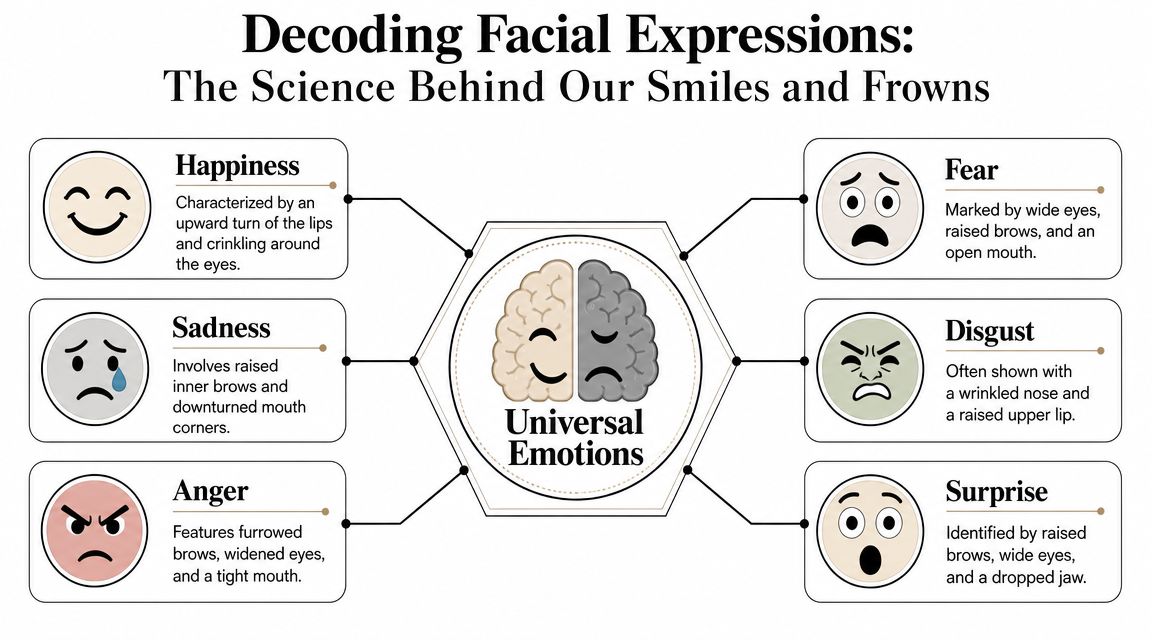
The most practical model for daily use is still the family of basic emotions often associated with Paul Ekman's work: happiness, sadness, fear, anger, surprise, disgust, and contempt. You don't need to memorize technical jargon to use this model well. You need a clean visual vocabulary.
A simple field guide
| Emotion | Key Facial Markers |
|---|---|
| Happiness | Lip corners pull upward, cheeks lift, eyes may narrow slightly |
| Sadness | Inner brows may lift, mouth corners turn downward, face can look heavier or softer |
| Fear | Eyes widen, brows rise, mouth may part |
| Anger | Brows draw down, jaw tightens, eyes narrow or harden |
| Surprise | Brows rise, eyes widen, jaw may drop |
| Disgust | Nose wrinkles, upper lip raises, eyes may squint |
| Contempt | One side of the mouth lifts |
This model helps because it gives you a starting point. It doesn't give you certainty. That distinction matters.
If you work with teams, hiring, or people management, this broader piece on understanding emotional intelligence in HR is useful because it places emotional reading inside a larger leadership skill set instead of reducing it to facial cues alone.
Why micro-expressions get so much attention
Micro-expressions are easy to romanticize and easy to misuse. The Paul Ekman Group defines them as expressions that occur within a fraction of a second and expose a person's true emotions, which is why they're so relevant in high-pressure settings where words and feelings may not align, as described in this explanation of micro-expressions.
That doesn't mean every fleeting expression reveals a hidden truth you can decode instantly. It means brief emotional leakage can happen, especially under stress or conflict.
Here's where readers often go wrong:
- They overtrust speed: A fast expression isn't automatically more important than a sustained one.
- They ignore emotion regulation: Senior professionals often manage their facial expressions deliberately.
- They jump to deception: Incongruence may signal stress, hesitation, or internal conflict. Not dishonesty.
In a negotiation, a flash of irritation matters. It doesn't give you the whole story.
For executive communication, micro-expressions are best treated as prompts for curiosity. They tell you to slow down, observe more, and test your interpretation against words, tone, and context.
Reading the Whole Message Beyond the Face

One of the biggest mistakes I see is treating the face like an isolated truth machine. It isn't.
Meaning comes from the cluster. Face, voice, posture, gesture, and words work together. When those signals align, people feel clear about what they're seeing. When they clash, people feel uncertainty or tension, even if they can't explain why.
Congruence creates credibility
Suppose a colleague says, “I'm happy to support this,” with a relaxed face, open posture, and steady tone. The message feels coherent.
Now change the delivery. Same words. But the jaw is tense, the eyes narrow, and the voice goes flat. You won't trust the sentence in the same way. You'll sense resistance, pressure, or emotional conflict.
That's not because one facial feature gave you the answer. It's because your brain read a mismatch.
A technical version of this comes from FACS-based analysis. Meaning is inferred from combinations of Action Units, not one isolated signal. For example, happiness is commonly mapped to AU6 (cheek raiser) plus AU12 (lip corner puller), which shows why expression is a pattern-recognition problem rather than a simplistic “smile means positive” formula, as explained in this FACS and automated expression analysis overview.
What to do with mixed signals
Mixed signals don't automatically mean manipulation. Usually they mean one of four things:
- The person is stressed: Their words are controlled, but their face leaks tension.
- They're still deciding: Verbal agreement may arrive before emotional agreement.
- They're managing status: In senior settings, people often mask reactions until they know the room.
- You need more data: One moment is rarely enough.
If your own delivery feels inconsistent, this guide on how to enunciate better can help with the vocal side of alignment. Clearer speech often reduces visible strain in the face because you stop forcing articulation under pressure.
A more accurate reading habit
Try this sequence in live meetings:
- Notice the first signal: a tightened mouth, lifted brows, or sudden stillness.
- Check the voice next: warmer, flatter, slower, sharper?
- Look at body behavior: leaning in, pulling back, folding arms, turning away.
- Compare with the words: does the message fit the delivery?
That habit is much more reliable than trying to decode one smile.
Common Misinterpretations and Hidden Biases
Individuals often become less accurate the moment they feel more confident about reading faces.
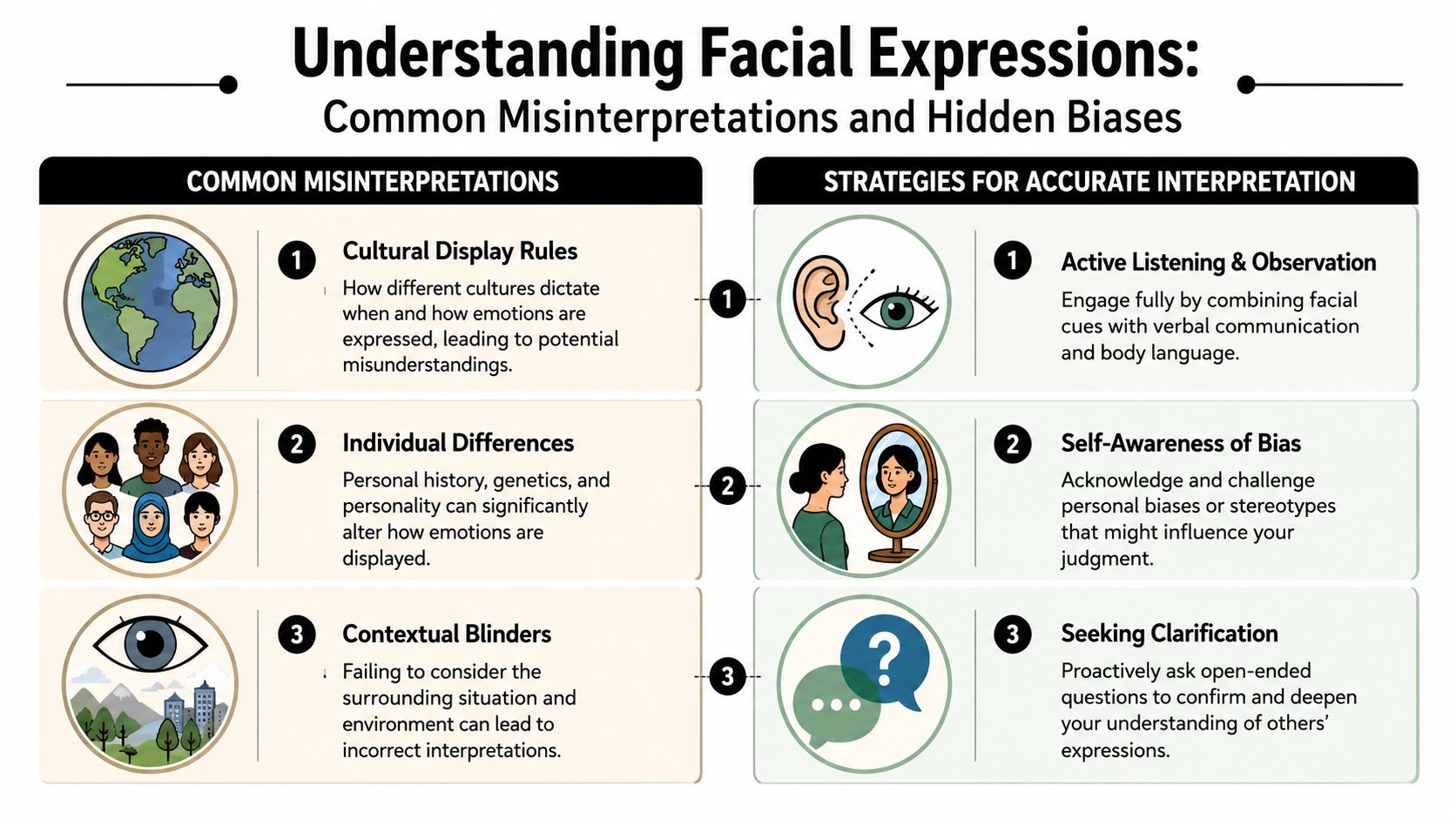
That overconfidence is dangerous for leaders. It turns quick impressions into fixed judgments. It also hits international professionals especially hard, because people often misread unfamiliar communication styles as emotional problems.
Culture changes display, not just language
A respectful face in one culture can look distant in another. A restrained smile may signal professionalism, not coldness. A highly animated face may communicate engagement, not instability.
If you work across regions, this guide to international business etiquette is helpful because it reminds you that expression is always shaped by social norms, hierarchy, and context.
Many teams don't struggle because no one cares. They struggle because people express care differently.
Negative signals get overweighted
There's another problem. Human perception often gives more weight to possible threat than possible warmth.
A 2022 crowd-perception study found that people overestimated the proportion of angry faces in a group more often than happy faces, and this difference was especially evident when only one face expressed emotion, with the effect reported as statistically significant (p = .03, ηp² = .24) in the study on crowd perception of angry and happy expressions.
For leaders, the practical implication is sharp. One visible sign of anger in a room may dominate your impression of the group mood more than it should.
Your brain may treat one angry face as the headline, even when the room is mostly neutral.
Three common errors I want you to catch
- Assuming neutrality is negativity: Many senior people listen with still faces.
- Ignoring your own filters: If you're anxious, you'll often perceive more threat.
- Missing bias against difference: Unfamiliar accents, facial features, or expression styles can distort how competence gets judged.
That last point matters deeply for non-native speakers. This article on accent bias in the workplace shows how quickly people attach unfair assumptions to communication style.
A stronger interpretation standard
Before you decide what someone's face “means,” ask:
| Question | Why it matters |
|---|---|
| What else is happening in the room? | Context changes interpretation |
| Is this expression typical for this person? | Baseline matters |
| Do voice and body language match? | Alignment increases confidence |
| Could culture or fatigue explain this? | Not every cue is emotional |
That small pause protects you from a lot of bad leadership decisions.
Strategic Facial Expression for Executive Presence

Reading others well matters. Managing your own face matters more.
Many capable professionals accidentally send the wrong message when they concentrate. Their neutral face looks irritated, skeptical, or withdrawn. In senior settings, people may not ask what's wrong. They'll adjust how they respond to you.
Build a neutral professional face
Your goal isn't to smile all the time. It's to remove accidental hostility.
Stand in front of a camera and say nothing for a few seconds, as if you're listening in a leadership meeting. Then review the recording. Check for a clenched jaw, compressed lips, or heavy brow tension. Those are common concentration habits.
A recent NIH review notes that facial expression deviations can signal health impairments such as pain, stroke, or migraines, and for leaders that matters because flat affect or reduced expressiveness from fatigue or pain may be mistaken for low confidence, disinterest, or lack of empathy, as discussed in this NIH review on facial expression deviations and health conditions.
That means you should be careful both in judging others and in managing yourself on difficult days.
Use the strategic smile
A strategic smile is brief, purposeful, and well-timed. It's useful when you greet the room, acknowledge a contribution, or soften the opening of a tough message.
It should not stay pasted on your face during serious content. Constant smiling can reduce perceived seriousness. No smiling can make you look hard to approach.
Try this exercise:
- At the start: greet with warmth in the eyes and mouth.
- During substance: let your face settle into calm focus.
- At moments of agreement: use a short confirming smile.
- At close: reintroduce warmth to reinforce trust.
For professionals who want guided practice around this kind of visible authority, executive presence coaching can help. The Gravitas Method is a 12-week one-on-one executive presence coaching program for international professionals who want to communicate with more authority and influence at senior levels. The program is priced at $8,200 paid in full or $9,000 across three installments. Coached by Nikola, it covers vocal authority, strategic framing, executive body language, and high-stakes communication.
A short demonstration helps if you want to see how facial habits affect executive delivery in practice.
Show active listening with your face
The strongest leaders don't just look composed. They look available.
Use small signals: a slight brow lift when someone makes a good point, a contained nod when you understand, softer eyes when receiving concern. These cues help people feel heard without making you look overanimated.
Calm authority usually looks interested, not frozen.
If you master only one facial skill, make it this one.
Your Next Step to Mastering Communication
The wrong question is often the starting point: “How do I read faces perfectly?” A better question is, “How do I become more accurate, more strategic, and less reactive?”
That shift changes everything.
What strong leaders understand
They know that facial expression and meaning are real, but not simple. Faces carry information. They do not carry certainty. Skilled leaders read expression in context, watch for congruence, and resist snap judgments.
They also understand that their own face is part of their message. If your words are thoughtful but your face looks tense, distant, or irritated, people may trust the expression over the sentence.
Here's the practical summary:
- Observe patterns, not isolated moments
- Interpret with context, culture, and bias in mind
- Use your face intentionally to support authority and trust
- Treat this as a trainable communication skill
If public speaking adds pressure to your delivery, this guide on improving English pronunciation for public speaking is a good companion resource because vocal clarity and facial control often improve together.
Mastery comes from feedback
You can learn a lot from self-observation, recorded meetings, and structured practice. But most professionals still have blind spots. You may not notice the exact moment your face tightens under challenge. You may not realize that your listening face looks detached when you think you're appearing thoughtful.
That's why feedback matters. Not generic advice. Specific feedback tied to real executive moments.
If you want to communicate with more authority, your next step shouldn't be another article. It should be a sharper diagnosis of what your face, voice, and delivery are already signaling.
If you want a practical starting point, book the free Executive Communication Assessment with Intonetic. It's the clearest way to identify the specific habits affecting your executive presence, including how your facial expressions, voice, and delivery are shaping perception in high-stakes conversations.