Barriers of Culture: Navigating the Path to Leadership
You're in the meeting for a reason. You know the numbers. You understand the risks. You've already done the hard thinking before anyone else has finished framing the problem.
Then you speak, and the room doesn't quite move with you.
A colleague with less technical depth says something similar ten minutes later, only shorter, flatter, and with more visible certainty. This time people nod. Someone writes it down. Suddenly that idea has momentum.
If you're an international professional working in English, this experience can feel personal. It often isn't. It's usually a collision between expertise and the invisible rules of how authority is recognized in a particular workplace culture. That's what makes the barriers of culture so difficult. They don't announce themselves clearly. They show up as muted reactions, delayed trust, unclear feedback, and the exhausting sense that you have to overperform to be interpreted correctly.
These barriers hit hardest when your work is already strong. At that level, your problem usually isn't competence. It's signal. You know what you mean, but the room may be reading your pacing, tone, deference, timing, or structure through a different cultural filter.
The Invisible Walls in the Workplace
A senior product leader shares a well-researched recommendation in a cross-functional review. She opens carefully, gives useful context, acknowledges stakeholder concerns, and presents a measured path forward. No one objects, but no one acts. Later, another leader summarizes the same recommendation in two blunt sentences, adds a firm ask, and the group aligns.
That kind of moment creates quiet damage. The first speaker often concludes, “I should've been more aggressive,” or worse, “Maybe I'm not executive enough.” But the issue is usually more specific than that. The room didn't only assess the content. It assessed whether the content matched its unspoken expectations of leadership.

Why this is bigger than one awkward meeting
This isn't a niche communication issue. In organizational data initiatives, 90% of executives identified cultural factors such as people and process issues as the principal barrier to success, ahead of technology, according to MIT Sloan Management Review on why culture is the greatest barrier to data success. In other words, even when teams have the tools, culture still decides what gets heard, trusted, and used.
For ambitious international professionals, that same pattern shows up in promotion discussions, stakeholder updates, board meetings, and client negotiations. Your analysis may be excellent. If it doesn't arrive in the form the culture recognizes as credible, it won't carry the authority it should.
What these walls often look like
The walls are invisible because they rarely sound explicit. They show up as:
- Ideas being adopted late because someone else repackages them in the dominant style
- Feedback that stays vague with comments like “be more concise” or “show more presence”
- Leadership doubts triggered by delivery style rather than strategic judgment
- Accent-based assumptions, often subtle, which you can understand better in this piece on accent bias in the workplace
If you manage multicultural teams, it also helps to study practical approaches to handling cultural variations at work, especially when misunderstandings come from mismatched norms rather than bad intent.
The hardest barriers of culture are the ones everyone feels and no one names.
Decoding the Four Types of Cultural Barriers
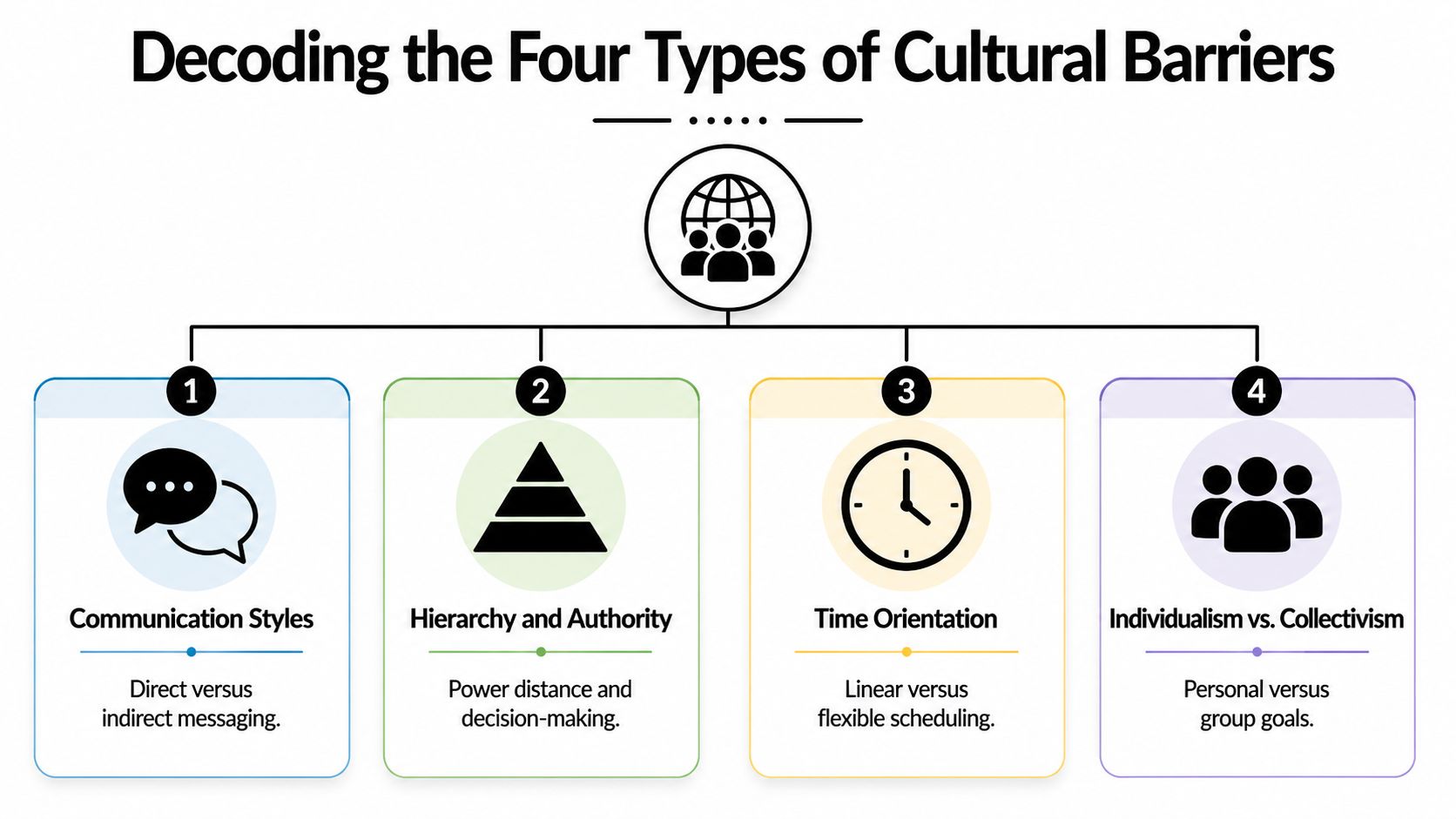
You can't adapt to what you can't identify. “Cultural difference” is too vague to be useful in a boardroom. In practice, I see four categories create most of the friction for senior international professionals.
Existing research often misses a key point for senior leaders. The problem isn't just access, it's credibility. There is a gap in data on how accent, speech patterns, or culturally-shaped communication styles affect promotion rates, negotiation outcomes, or stakeholder trust among high-performing international executives, as noted in this discussion of the credibility gap.
Communication styles
Some cultures reward precision through context, diplomacy, and gradual positioning. Others reward speed, directness, and clear personal ownership.
Neither is better by nature. But in many senior English-speaking business environments, especially in tech and finance, a direct structure often gets interpreted as confidence. An indirect structure can be misread as uncertainty, even when the thinking behind it is stronger.
A few common mismatches:
- Indirect recommendation can sound hesitant when the room expects a firm point of view first.
- Relationship-first framing can feel slow to an audience trained to prioritize decision speed.
- Careful qualification can be mistaken for a lack of conviction.
Hierarchy and authority
Power distance shapes how people speak to senior stakeholders. In some environments, respect means waiting to be invited, not interrupting, and not overstating your position. In others, leadership means challenging openly, taking verbal space, and showing independent judgment before being asked.
That mismatch creates unnecessary penalties.
| Cultural pattern | Common workplace interpretation |
|---|---|
| Waiting to speak until invited | Low confidence or passivity |
| Deferring strongly to senior leaders | Lack of executive readiness |
| Challenging directly and early | Confidence, or in some teams, disrespect |
The interpretation depends on the room. That's why rigid advice fails. You need range.
Non-verbal cues
This category is where many talented professionals lose influence without realizing it.
Eye contact, facial expressiveness, gesture size, physical stillness, posture, and turn-taking all carry meaning. A restrained style can signal professionalism in one culture and low presence in another. A highly animated style can read as passionate in one setting and uncontrolled in another.
Watch for these signals:
- Minimal gesture use may reduce visible energy
- Looking down to process language may be read as uncertainty
- Smiling while delivering difficult points can soften authority when firmness is needed
Time orientation
Time isn't only about punctuality. It affects how people build trust, run meetings, and make decisions.
Some professionals treat meetings as linear. Agenda first, decision path, action owner, end on time. Others use meetings more flexibly, allowing more relational context and lateral discussion before committing. Conflict appears when each side assumes the other is being inefficient or abrupt.
A senior leader who values compressed decision cycles may interpret a contextual communicator as unfocused. The contextual communicator may interpret the same leader as careless or politically tone-deaf.
That's the practical reality of barriers of culture. They're often protocol mismatches, not capability problems.
How Cultural Misinterpretations Impact Your Influence
Most careers don't stall because of one dramatic communication failure. They stall because small misread signals accumulate into a reputation. People start describing you with words that don't match your actual ability: thoughtful but not decisive, smart but not influential, collaborative but not commanding.
That translation error matters because senior roles are awarded partly on trust under pressure. If people can't quickly read leadership in your communication, they may hesitate to back you in visible situations.

In tech, the cost is being overlooked
A staff engineer in a design review may wait for a clean opening before speaking. That sounds respectful in many cultures. In a fast-moving discussion, it can mean the moment passes. Someone more verbally assertive steers the architecture decision, and the quieter engineer is later described as technically strong but not driving direction.
That's one reason many international professionals become interested in the practical side of how accent affects your career and what you can do about it. Accent is rarely the whole issue. It often interacts with timing, brevity, interruption norms, and vocal delivery.
In finance, caution can be misread
A finance leader may present risk with nuance because nuance is responsible. But if the room expects a crisp headline first, detailed caution can land as a lack of executive judgment. The issue isn't that the analysis is too careful. The issue is that the caution arrives before the decision frame.
In consulting, diplomacy can weaken perceived authority
Consultants from high-context cultures often work hard to preserve relationships while delivering difficult advice. They may soften conclusions, build context gradually, or avoid blunt disagreement with senior clients. In many consulting environments, that can reduce impact. The client hears “one perspective” instead of “the recommendation.”
Practical rule
If your audience has to work too hard to locate your position, they may assume you don't fully own it.
Why teams fall back into the wrong habits
When people mistrust what they hear, they go back to familiar patterns. That's not only frustrating. It also slows execution. CDO Trends notes that mistrust in communication, often rooted in cultural misinterpretation, can amplify decision latency by 25-40% in high-stakes environments.
Inside a team, that looks like this:
- Leaders default to familiar voices rather than the best-informed voices
- Meetings get longer because people keep rechecking what was already said
- Recommendations lose force when they are interpreted as tentative
- Trust narrows around style similarity instead of actual competence
These patterns create a credibility ceiling. You keep delivering. Others keep hesitating. Over time, that affects stretch assignments, sponsorship, and promotion readiness.
Bridge Gaps with Strategic Framing and Vocal Authority
Trying to “sound more senior” usually fails because it's too vague. What works is learning a few concrete delivery habits that make your thinking easier to trust in real time.
Start with strategic framing
In many high-stakes English-speaking business settings, leaders expect the conclusion early. They don't want the full path before they know where you're going. A useful discipline is Bottom Line Up Front, often shortened to BLUF.
Instead of building up slowly, structure your point like this:
- State the recommendation
- Name the reason
- Give the supporting evidence
- End with the decision or ask
Compare these two openings.
- “I reviewed several scenarios, and there are a few dependencies we should consider before choosing an approach.”
- “My recommendation is to delay the launch by two weeks because the current rollout plan creates avoidable support risk.”
The second version is easier to trust under pressure because your position is clear.
Make the room feel your certainty
Vocal authority isn't accent erasure. It's control over pace, pausing, emphasis, and sentence endings.
Three adjustments usually make the biggest difference:
- Slow your first sentence down so the room calibrates to your voice
- Pause before the key point instead of rushing into it
- Finish statements cleanly rather than letting the pitch drift upward and sound tentative
If pronunciation clarity is part of the issue, focused drills can help. This guide on how to enunciate better is useful because it targets delivery mechanics rather than personality.
What works and what doesn't
A lot of bad advice tells international professionals to just be more confident. Confidence is not a technique. It doesn't tell you what to do in the next meeting.
What usually works:
- Shorter openings that get to the point faster
- Signposting language such as “My recommendation is…” or “The main risk is…”
- Intentional pauses after high-value statements
- Stronger verbal ownership with “I recommend” instead of “Maybe we could consider”
What usually doesn't:
- Overexplaining to prove competence
- Using too many qualifiers like “just,” “perhaps,” or “I think maybe”
- Copying a local style too closely until you sound stiff or unnatural
You don't need a different personality. You need a delivery system that lets your expertise register faster.
Master Executive Body Language and Non-Verbal Cues
Body language shapes the room before your first sentence lands. If your verbal message says “I'm clear and ready,” but your physical signals say “I'm unsure whether I should take space,” people tend to trust the physical message first.

The body language shifts that change perception
You don't need theatrical gestures or exaggerated confidence poses. You need visible composure.
Focus on a few controllable elements:
-
Posture
Stand or sit with length through the spine and grounded shoulders. This reads as settled rather than defensive. -
Gesture timing
Let gestures support a point, not leak nervous energy. If your hands move constantly, your message loses sharpness. -
Stillness at key moments
Stillness is underrated. When you deliver an important recommendation, a brief moment of physical steadiness gives weight to your words. -
Eye contact patterns
Don't stare. Distribute attention across the room. In virtual meetings, look into the camera when making your main point.
Cross-cultural signaling matters
Non-verbal authority isn't one-size-fits-all. In one environment, energetic overlap and direct eye contact may signal engagement. In another, that same behavior can feel domineering. The goal isn't to memorize every cultural rule. It's to read the setting and adjust deliberately.
A simple check before a high-stakes interaction:
| Signal | Ask yourself |
|---|---|
| Posture | Do I look grounded or compressed? |
| Face | Does my expression match the seriousness of the message? |
| Gesture | Are my movements purposeful or restless? |
| Space | Am I taking enough space to match my role? |
For professionals who want structured support in this area, Intonetic’s executive presence coaching includes work on vocal authority, strategic framing, executive body language, and high-stakes communication. The Gravitas Method is a 12-week one-on-one executive presence coaching program for international professionals who want to communicate with more authority and influence at senior levels. The program is priced at $8,200 paid in full or $9,000 across three installments. Coached by Nikola, it covers vocal authority, strategic framing, executive body language, and high-stakes communication.
A quick visual walkthrough helps here:
What to practice this week
Don’t try to fix everything at once. Pick one live situation and rehearse these three moves:
- Enter slower than usual and settle before speaking.
- Deliver your first point with one clear gesture instead of many small ones.
- Hold eye contact for one extra beat after your recommendation.
Those small shifts often change how seniority is perceived far more than people expect.
Take Your First Step Toward Authoritative Communication
The barriers of culture don’t disappear because you work harder. They narrow when you learn how your communication is being interpreted, then adjust with precision.
That distinction matters. You’re not trying to erase your background or imitate someone else’s personality. You’re building range. You’re learning how to keep your intelligence, judgment, and cultural identity intact while making your message land with more authority in the environments that matter to your career.
What changes when you do this well
When your communication aligns with senior-level expectations, several things start to shift:
- Your ideas travel faster because people grasp your position quickly
- Your presence feels steadier in meetings, interviews, and negotiations
- Stakeholders trust your judgment earlier because your delivery matches your expertise
- You stop overcompensating with too much explanation or unnecessary caution
That’s why these skills are worth treating as leadership skills, not polish.
A practical first move
Most professionals don’t need more generic tips. They need an accurate diagnosis. Which part is weakening your authority right now? Is it your structure under pressure, your pacing, your vocal presence, your body language, or the way cultural habits are being misread in senior rooms?
If confidence is part of the challenge, this article on how to speak English with confidence even with an accent is a useful starting point. Then get specific about your own pattern.
You’ve already earned your seat through performance. The next step is making sure your communication sounds and looks as senior as your work already is.
If you want a clear view of what’s holding back your authority in English, start with the free Executive Communication Assessment from Intonetic. It’s the simplest way to identify the specific habits affecting how your leadership is perceived, and what to change first.