
Excel in International Business Communication Skills
You know the feeling. You've done the analysis, anticipated the objections, and built a recommendation that would save time, money, or political friction. Then the meeting starts. A more locally fluent colleague summarizes a simpler idea with more certainty, and suddenly the room follows them.
For many international professionals, that's the primary communication problem. It isn't lack of intelligence. It often isn't even lack of English fluency. It's that senior leadership communication is judged through delivery, structure, timing, and presence, not just content.
At higher levels, people don't only evaluate what you know. They evaluate whether you sound like someone they can trust with risk, ambiguity, and influence across markets. That's why international business communication skills matter so much. They determine whether your message sounds tentative or decisive, scattered or strategic, technically correct or commercially useful.
Beyond Fluency The Communication Gap for Global Leaders
A senior product leader joins a regional steering call. She knows the market constraints better than anyone in the room. When she speaks, her point is accurate but long. She starts with background, adds caveats, and softens her recommendation to sound polite. By the time she reaches the actual decision, the group has already moved on.
That pattern is common in global companies. Strong professionals assume the gap is accent, vocabulary, or confidence. Sometimes those factors play a role. More often, the issue sits elsewhere. The message isn't landing in the format senior audiences expect.
Fluency doesn't equal authority
A leader can be grammatically excellent and still sound junior. Another can make minor language mistakes and still command the room. The difference is usually communication design.
Senior audiences listen for signals such as:
- Decision orientation. Do you state the recommendation early?
- Commercial relevance. Do you connect detail to business impact?
- Executive pacing. Do you rush, over-explain, or leave space for the point to land?
- Cultural calibration. Do you know when to be direct, when to soften, and when to escalate?
If you work across cultures, those signals get harder to manage. Norms around directness, interruption, hierarchy, and disagreement vary widely. Many professionals end up sounding less senior because they are constantly translating not just language, but behavior. If that challenge feels familiar, this breakdown of barriers of culture in communication is a useful reference point.
Your expertise can be strong and still be undervalued if your delivery makes decision-makers work too hard to understand you.
The invisible cost of being “clear enough”
“Clear enough” works at mid-level. It rarely works in board-level or cross-functional settings. Global leaders need communication that travels well across functions, countries, and status levels.
That's also why operational team habits matter. Organizations trying to improve organizational communication often discover that the underlying issue isn't message volume. It's whether people know how to frame requests, confirm decisions, and reduce ambiguity under pressure.
The shift is simple, but not easy. Stop thinking about communication as language performance. Start treating it as a leadership instrument.
Why These Skills Define Senior Leadership
Communication gets mislabeled as a soft skill because people remember the surface features: speaking, listening, presenting, writing. They miss the business consequence. In senior roles, communication is how leaders align people, reduce ambiguity, manage risk, and move decisions through complex systems.
When those mechanisms fail, the cost isn't abstract. One 2026 workplace communication review reports that ineffective communication costs U.S. businesses an estimated $1.2 trillion annually, while effective communication can increase productivity by up to 25% and improve employee retention by 4.5 times, according to this workplace communication review. In international environments, the risk expands because every handoff crosses more variables: language, time zone, hierarchy, and local norms.
Senior leaders are paid to reduce confusion
A director who explains a change clearly can shorten alignment cycles. A finance lead who handles a tense earnings discussion with composure can stabilize stakeholders. A country manager who can disagree without triggering defensiveness can keep a deal alive.
That's why executive presence isn't cosmetic. It changes how others interpret the same information. A concise recommendation delivered with control sounds more investable than a technically stronger point delivered with hesitation. If you want a precise definition, this overview of what executive presence is is useful because it connects communication behavior to leadership perception.
The real trade-off in global business
International professionals often face a difficult calculation:
- Be highly direct, and risk sounding blunt, political, or culturally tone-deaf.
- Be highly diplomatic, and risk sounding vague, cautious, or non-committal.
Senior communication means handling both pressures at once. You need enough clarity to drive action and enough judgment to preserve trust. That balance is a leadership competency, not a personality trait.
Practical rule: If people regularly leave your meetings unsure about the decision, owner, or timeline, the issue isn't style. It's leadership execution.
Why this becomes visible at promotion level
As professionals move toward VP, regional leadership, or enterprise-facing roles, their communication is judged less on correctness and more on transferability. Can they brief a board, influence peers, calm a client, challenge a senior stakeholder, and represent the company externally without creating friction?
That is why communication capability becomes a proxy for readiness. At senior levels, people won't separate your ideas from the way you deliver them. They assume your communication is your operating model.
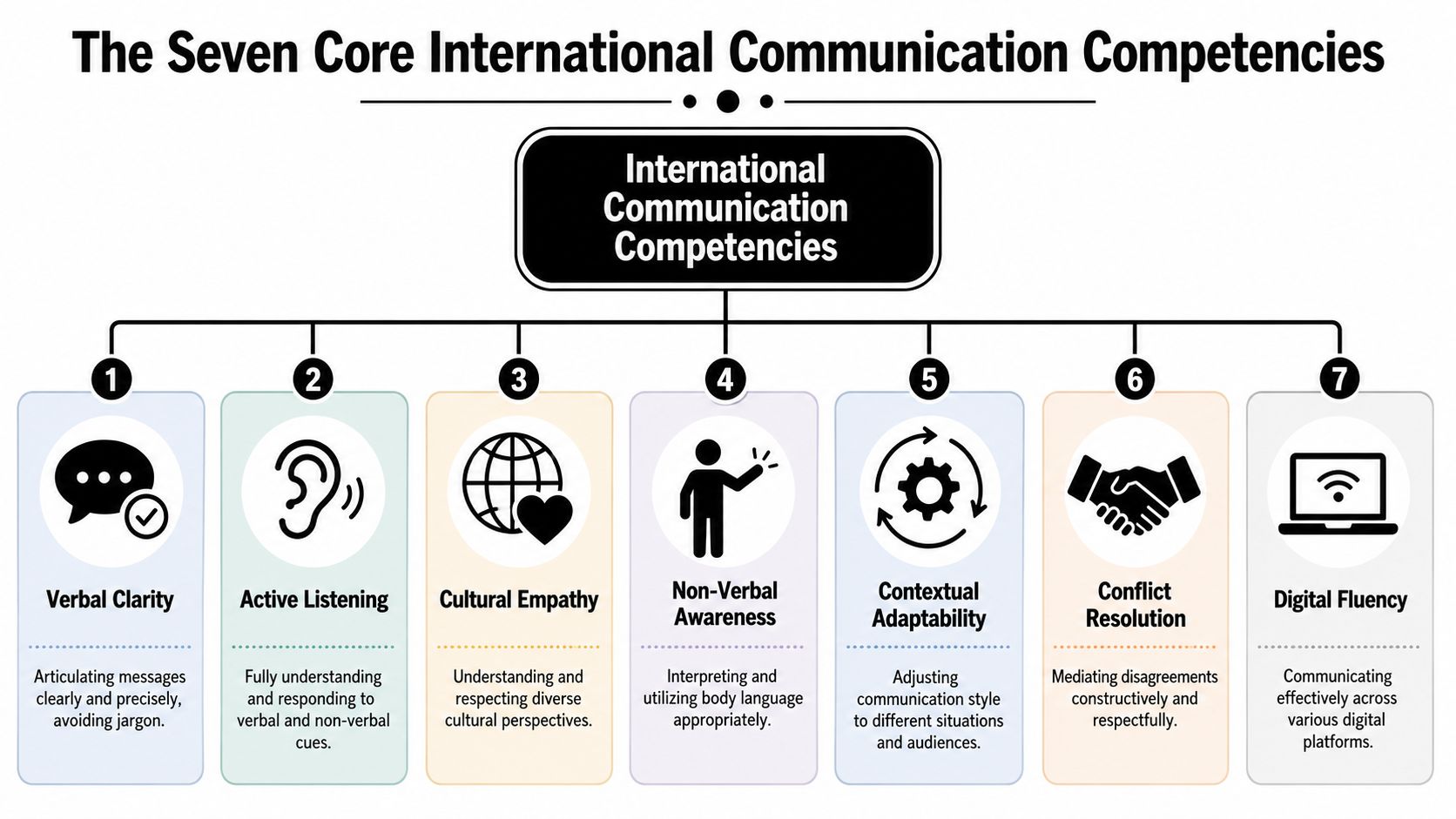
The Seven Core International Communication Competencies
The most useful way to think about international business communication skills is as a set of observable competencies. Each one affects how senior you sound, how trustworthy you appear, and how easy you are to follow across cultures.
Early in that stack sits verbal clarity. In a 2026 recruiter survey, 54% ranked verbal communication skills as most important for international business, ahead of presentation skills (46%), digital communication skills (35%), active listening (32%), negotiation (25%), and cross-cultural communication (19%), as summarized in these recruiter-ranked communication statistics. That ranking tells you something important. People often evaluate seniority first through how clearly you speak.
Verbal clarity
This is your ability to express a point in language that is concise, specific, and easy to act on. It means fewer detours, less throat-clearing, and no hiding the point behind excessive context.
A senior version sounds like this: “My recommendation is to delay launch by two weeks to reduce implementation risk in the German market.” A weaker version starts with a history lesson and reaches the recommendation too late.
Vocal authority
Voice shapes perceived confidence before content is fully processed. Pace, pauses, downward inflection, and breath control all affect whether you sound composed or uncertain.
This matters a lot for international professionals because linguistic effort often pushes people into rushed delivery. The result is that they sound less certain than they are. Vocal authority doesn't mean sounding louder. It means sounding in control.
A useful distinction is the one between direct and indirect communication styles. Your voice has to support the level of directness your audience will accept.
A quick visual example can help:
Strategic framing
Strategic framing is how you position information so a senior audience understands the business significance quickly. This includes opening with the decision, stating the stake, naming the risk, and then supporting the point with evidence.
Without it, even smart professionals sound operational instead of strategic.
Executive body language
Body language still matters on Zoom, and even more in person. Posture, eye focus, stillness, gesture discipline, and facial control influence whether others read you as credible.
Common problem: people overcompensate for nerves with too much movement, too much smiling, or too little visual contact. Senior presence usually looks simpler, not more animated.
Cross-cultural fluency
This is not generic cultural awareness. It's the ability to read how communication norms change by market, team composition, and power structure.
What this looks like in practice
- In hierarchical settings you may need to challenge an idea without publicly cornering the decision-maker.
- In egalitarian teams you may need to speak more directly and earlier than feels natural.
- In mixed groups you often need to translate between both modes without sounding inconsistent.
Virtual presentation mastery
Global leadership happens through Microsoft Teams, Zoom, Google Meet, Slack, and email. If your camera framing is weak, your pacing is flat, or your slides bury the point, your influence drops even when your content is right.
Virtual communication rewards deliberate structure. Shorter sentences. Better signaling. Cleaner transitions.
High-stakes conversation handling
Many capable professionals lose status when their otherwise strong communication skills are tested. They can present. They can update. But they struggle when someone interrupts, questions their judgment, or disagrees in public.
High-stakes communication requires three moves:
- Stay structurally clear under pressure.
- Respond without defensiveness.
- Protect the relationship while holding the line.
In global leadership, the hardest moment isn't sharing information. It's staying credible when the conversation becomes political, ambiguous, or tense.
How to Assess Your Communication Footprint
People frequently judge their communication by intent. Senior audiences judge it by effect. That's why self-assessment has to move from “Am I a good communicator?” to “What pattern do others experience when I speak?”
A useful starting point is a formal executive presence assessment, but you can also diagnose your own communication footprint by looking for visible green flags and red flags in everyday interactions.
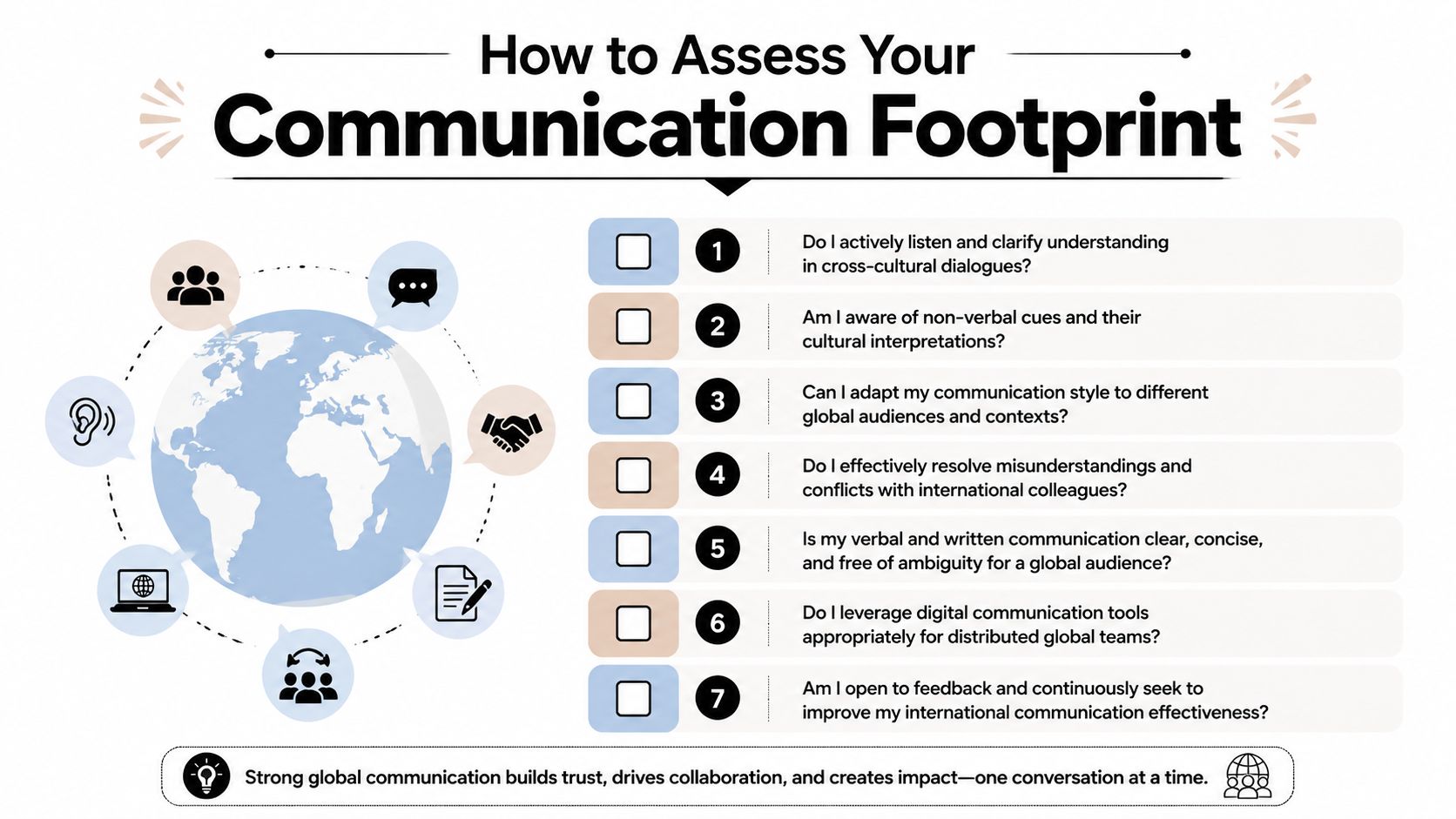
Quick Communication Assessment Checkpoints
| Competency Area | Green Flag (Effective Practice) | Red Flag (Area for Improvement) |
|---|---|---|
| Verbal clarity | You can explain your recommendation in one sentence | You need several minutes before the point becomes clear |
| Vocal authority | You use pauses deliberately and finish key lines cleanly | You rush, trail off, or fill silence with verbal clutter |
| Strategic framing | You lead with decision, impact, and next step | You open with background and hope listeners infer the point |
| Body language | You look grounded, still, and attentive | You fidget, over-gesture, or avoid visual connection |
| Cross-cultural fluency | You adapt tone and directness by audience | You use one default style in every market and setting |
| Virtual mastery | Your calls are concise, well-paced, and visually professional | Your online delivery feels flat, cluttered, or hard to follow |
| High-stakes handling | You stay calm when challenged and answer directly | You become defensive, vague, or overly apologetic |
Red flags that matter more than people think
Some communication weaknesses look harmless because they're socially acceptable. They aren't harmless at senior level.
- Over-explaining often signals low confidence, not thoroughness.
- Excessive softening can make a strong recommendation sound optional.
- Late positioning of the point forces senior listeners to do interpretive work.
- Polite ambiguity creates rework because people leave with different assumptions.
A simple audit you can run this week
Record one internal update, one client-facing call, and one high-stakes meeting if policy allows. Then review them with three questions:
- Can a busy executive identify my point in the first moments?
- Do I sound settled enough to carry authority?
- Would my communication style work equally well with a direct audience and a hierarchy-sensitive one?
If the answer is no in any one of those contexts, that's your highest-value development area.
Navigating High-Stakes Scenarios Across Industries
The principles become real when pressure rises. Different industries surface different weaknesses, but one issue appears everywhere: if the message architecture is weak, trust drops quickly. In international business, structuring emails and presentations so the recipient can immediately identify the request or decision is critical because cross-cultural audiences may misread indirect or overloaded messages, especially when hierarchy and power distance norms differ, as noted in Thunderbird's guidance on international business skills.

Tech leadership
A tech lead needs approval for an architecture change affecting teams in two regions. The technical logic is strong, but the approving stakeholders include finance, operations, and a country leader who doesn't want disruption.
The weak version starts with system history, engineering trade-offs, and implementation detail. The stronger version sounds more like an executive brief:
- Decision first. “I'm asking for approval to phase the migration over two releases.”
- Risk second. “That reduces service instability during peak regional demand.”
- Operational ask third. “We need finance sign-off this week to protect the delivery sequence.”
That's the standard behind effective presenting to senior executives. Senior audiences don't want less rigor. They want the rigor arranged in the right order.
Finance and board communication
A finance executive presents difficult quarterly results to a global board. In this scenario, the danger isn't just saying the wrong thing. It's signaling instability through tone or pacing.
The strongest communicators do three things well:
- State the reality cleanly without dramatic language.
- Separate controllable issues from external factors.
- Move quickly to response, ownership, and timeline.
When finance leaders bury the hard news, boards get suspicious. When they overcompensate and sound mechanical, they lose trust another way. The right tone is candid, measured, and forward-moving.
When the news is difficult, composure becomes part of the message.
Consulting and client influence
A consultant enters a skeptical client meeting in a market where hierarchy matters and public disagreement can be sensitive. If the consultant pushes too hard, the relationship tightens. If they stay too indirect, the client leaves without committing.
The practical move is layered influence. Start with alignment, name the commercial issue, then offer a recommendation that preserves dignity. For example: “Given your team's priority on market timing, our concern is implementation strain. We recommend a narrower first phase so your leadership team can review performance before expansion.”
That approach respects status while still advancing the decision.
Enterprise leadership across regions
Regional leaders in multinational companies often face the hardest version of all. They have to align legal, sales, HR, product, and local leadership across different communication norms. In that environment, too much communication creates noise. Too little creates drift.
What works is disciplined communication:
- One clear owner per decision
- One explicit next step
- One written summary after the meeting
- One escalation path if alignment fails
Senior international communication is rarely about saying more. It's about reducing interpretive burden for people operating under different assumptions.
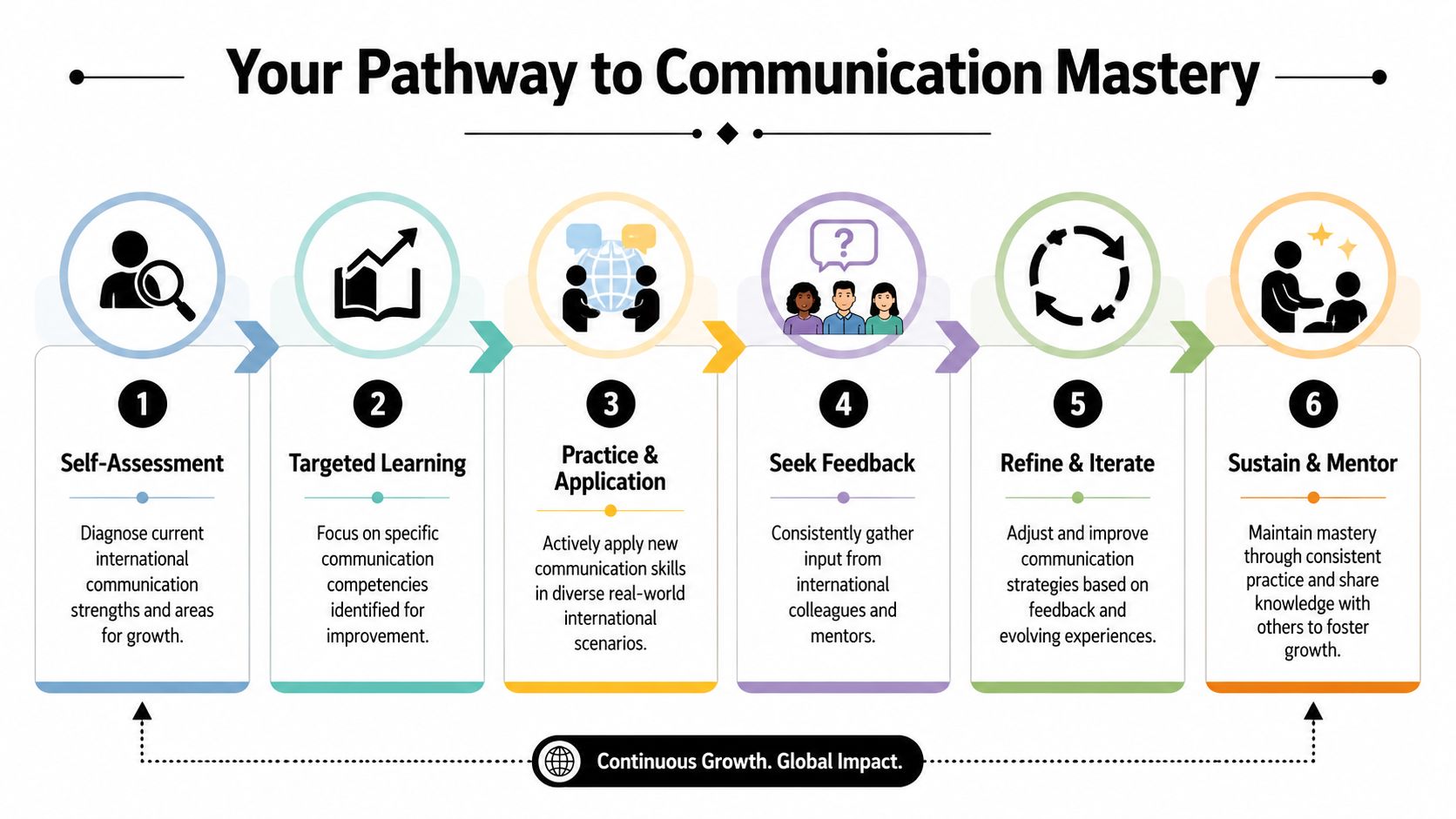
Your Pathway to Communication Mastery
Improvement happens when communication stops being an abstract goal and becomes a repeatable practice. Most professionals don't need more theory. They need a better training loop.
Research on international business skills also points to a gap many leaders feel directly: existing guidance often overlooks how to disagree or influence upward without violating norms in high-power-distance cultures or mixed global teams, and it suggests that strategic restraint and audience-specific framing can work better than merely more communication in those settings, as discussed in this HBS Online perspective on international business skills.
Build with micro-practices
Big intentions rarely change executive communication. Small repeatable behaviors do.
Try this rhythm:
- Before a meeting write your core message in one sentence.
- Before a presentation decide where you'll pause, where you'll slow down, and what must be remembered.
- After a conversation ask what the other side likely heard, not just what you intended.
- After a tough exchange review whether you protected both clarity and relationship.
These micro-practices help because they create consistency under pressure.
Use feedback that reflects senior reality
Generic feedback like “You did well” won't change much. Ask sharper questions:
- Was my recommendation obvious early enough?
- Did I sound convincing or just informed?
- At any point did I become hard to follow?
- Did my tone fit the audience's culture and level?
For distributed teams, it also helps to improve your remote communication skills with habits suited for asynchronous work, video calls, and written follow-through.
Choose a development structure
Self-correction works up to a point. After that, most professionals need outside calibration because their blind spots are in delivery, not intent.
One structured option is The Gravitas Method, a 12-week one-on-one executive presence coaching program for international professionals who want to communicate with more authority and influence at senior levels. It's coached by Nikola and covers vocal authority, strategic framing, executive body language, and high-stakes communication. The program is priced at $8,200 paid in full or $9,000 across three installments.
Whether you use coaching, peer review, or internal leadership development, the principle is the same. Practice on real scenarios, get precise feedback, and repeat until the stronger behavior becomes your default.
Better communication doesn't come from sounding more polished. It comes from becoming easier to trust in moments that carry risk.
Moving from Competent to Commanding Presence
Many international professionals are already competent. They're respected, informed, and capable. But senior leadership asks for more than competence. It asks for communication that can carry authority across borders, functions, and power dynamics.
That shift happens when your message becomes easier to follow, your delivery becomes steadier under pressure, and your style adapts without becoming vague. You stop aiming merely to be understood. You start aiming to move decisions.
If you want to keep sharpening that edge, resources on mastering communication skills can be useful, especially when they focus on influence rather than generic confidence.
The main advantage isn't perfection. It's command. When people consistently trust your words, your structure, and your presence, they treat you like someone who belongs at the next level.
If you want a clearer view of how your communication currently lands, start with the free Executive Communication Assessment from Intonetic. It's the most practical first step if you want to identify where your delivery, structure, and presence are helping you, and where they may be subtly limiting your influence.