
Influencer Marketing Course: A Complete Guide for 2026
You're probably here because the phrase influencer marketing course keeps showing up in job descriptions, client briefs, and strategy meetings. Maybe your manager wants creator partnerships in the next campaign. Maybe you run a business and you're tired of guessing which creators are worth paying. Or maybe you've noticed that “social media experience” no longer feels specific enough if you want to move into a stronger marketing role.
That uncertainty is normal. A lot of professionals can spot that influencer marketing matters. Fewer can tell the difference between a shallow course that teaches platform tricks and a serious course that teaches judgment.
That distinction matters more than people think. If you invest time in the wrong training, you might learn how to send outreach messages and track posts, but still miss the bigger decisions that determine whether a campaign earns trust, drives results, or wastes budget.
Why Is Everyone Talking About Influencer Marketing
A common scenario looks like this. A marketer who built their career on email, paid ads, PR, or brand campaigns starts hearing the same request from every direction: “Can we work with creators?” Suddenly, influencer marketing is no longer a niche skill. It's part of the conversation in retail, B2B, hospitality, tech, and personal brands.
That shift didn't happen by accident. The influencer marketing industry grew from $1.7 billion in 2016 to $16.4 billion in 2022, with a projection of $32.6 billion in 2025 according to Sprout Social's influencer marketing statistics. Those numbers matter because they show this channel moved from experimentation into a major marketing discipline.
If you're still trying to understand the mechanics behind the category, this overview of AI-powered influencer marketing insights gives a useful high-level look at how brands now approach discovery, matching, and campaign decisions.
Why this feels urgent for professionals
When a channel grows that quickly, employers stop treating it as a bonus skill. They start treating it as expected literacy. You don't need to become a full-time influencer manager to benefit, but you do need to understand how campaigns are chosen, briefed, measured, and defended internally.
That's especially true if your job already involves persuasion. A campaign lead has to justify spend. A founder has to explain why a creator partnership fits the brand. A PR manager has to judge reputational risk. A rising leader has to present recommendations clearly enough that decision-makers trust them. That's also why broader communication skill still matters alongside marketing training, especially if you're shaping strategy in meetings or presentations. Communication as persuasion becomes part of the job once your role moves beyond execution.
The real question usually isn't “Should I learn influencer marketing?” It's “Do I understand it well enough to make sound decisions with money, brand reputation, and stakeholder trust on the line?”
What an Influencer Marketing Course Actually Teaches
A strong influencer marketing course doesn't just teach you how to find creators on Instagram or TikTok. It gives you a working model for planning, running, and evaluating campaigns. The easiest way to judge course quality is to look for four pillars.
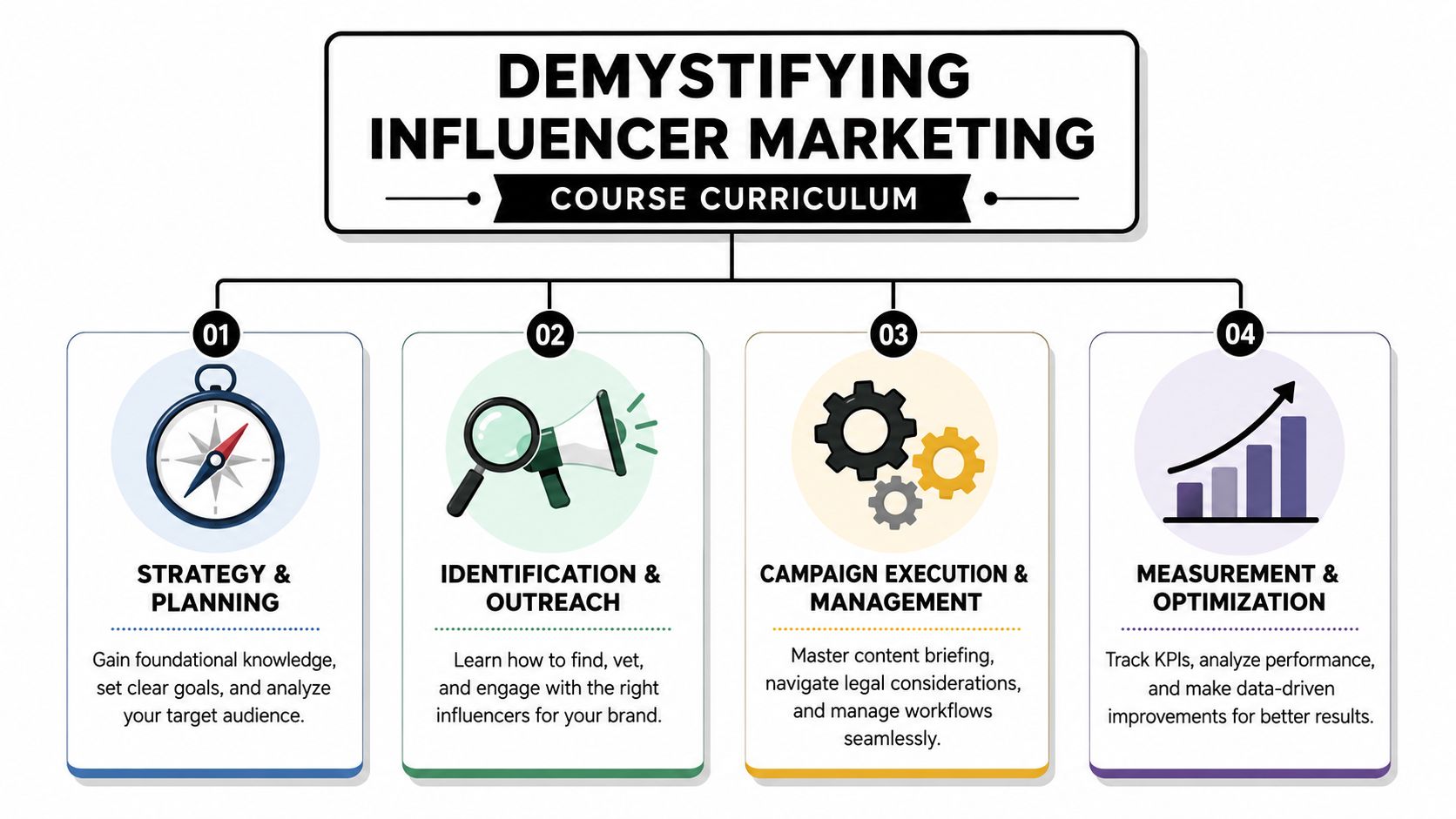
Strategy and planning
Good courses differentiate themselves from shallow ones. Many programs drift into predictable “pay for post” thinking. Better instruction starts earlier. As noted in Jason Falls' commentary on creative concepts in influencer marketing, the stronger approach is to identify a target market, set measurable objectives, and build a creative strategy before choosing creators.
That sounds simple, but many learners find this confusing. They assume the influencer is the strategy. They aren't. The strategy is the reason the campaign exists, who it needs to reach, what action matters, and what kind of concept gives the content a chance to feel credible.
A useful course will help you answer questions like:
- Business goal: Are you trying to drive awareness, leads, credibility, or product trial?
- Audience fit: Who exactly needs to see this content, and why would they care?
- Campaign concept: What makes the collaboration feel relevant instead of forced?
Identification and outreach
After strategy comes creator discovery. This part includes search criteria, shortlisting, outreach messages, and initial evaluation. A practical course won't stop at “find creators in your niche.” It should teach you how to judge audience alignment, content style, tone, category fit, and professionalism.
Some courses also help learners think more clearly about influence itself. A creator with a smaller but highly relevant audience can be more useful than a large account with weak alignment. That's one reason many professionals benefit from frameworks that sharpen their understanding of influence beyond raw visibility, such as these materials on influencing skills training.
Campaign execution and management
This is the operating system of the work. Students should learn how to write a brief, define deliverables, approve content, manage timelines, and coordinate with legal or brand teams when needed.
A weak course treats this as administrative work. A strong course teaches it as risk management and quality control. Clear briefs reduce rework. Approval rules protect the brand. Better workflows make the campaign easier to repeat and improve.
Measurement and optimization
This final pillar tells you whether the campaign worked. You should expect instruction on selecting KPIs, tracking outcomes, interpreting performance, and turning results into decisions.
Practical rule: If a course talks a lot about platforms and trends but very little about objectives, creative logic, and measurement, it's probably teaching activity rather than strategy.
Practical Skills You Can Expect to Develop
The best reason to take an influencer marketing course isn't that it helps you “learn social media.” It's that it can develop a set of practical business skills that transfer into broader marketing and leadership work.
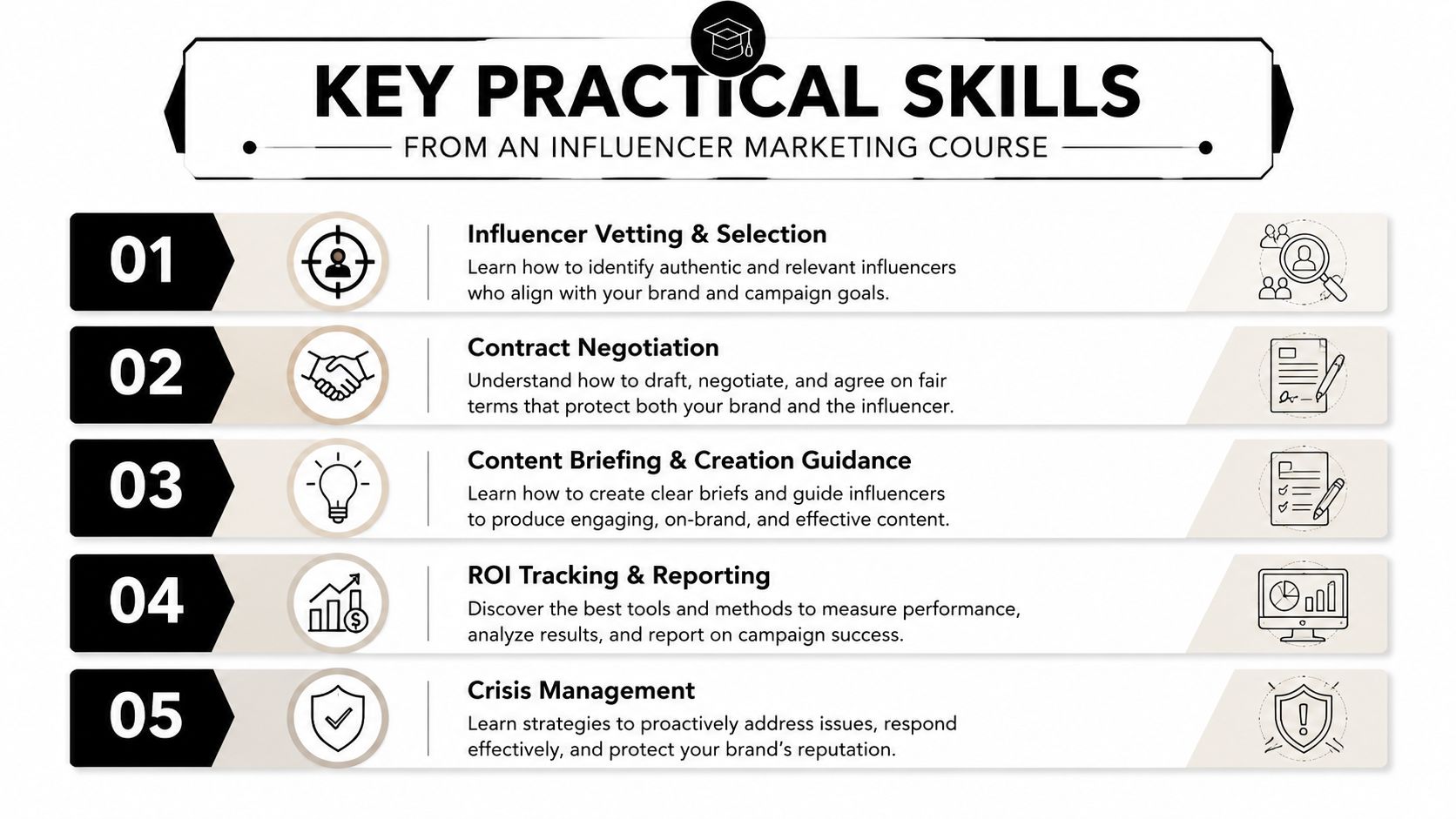
Judgment about creator quality
This is the skill many beginners underestimate. Advanced training should cover trust, authenticity, and fraud controls as core technical variables. Expert course material warns that inflated follower counts and low engagement can turn an influencer into a broadcast channel with audience fatigue, reducing campaign effectiveness, as discussed in this expert training video on influencer vetting and fraud controls.
In plain language, that means you learn to ask better questions. Does this creator still have real audience trust? Is their sponsored content overwhelming the organic content? Do comments feel relevant, or generic? Does the account look active but somehow unconvincing?
Campaign management under real constraints
An actual campaign isn't just a creative idea. It has deadlines, revisions, stakeholders, payment terms, and sometimes legal review. A strong course helps you become the person who can keep all of that moving without letting the quality collapse.
That usually includes skills such as:
- Brief writing: Turning a vague business ask into clear creator guidance.
- Negotiation: Discussing usage rights, deliverables, and expectations without creating friction.
- Workflow discipline: Keeping approvals, edits, and reporting organized.
ROI thinking
One reason marketers look for outside frameworks is that measurement gets messy fast. If you want a practical reference point on how teams think about performance, SponsorRadar data for influencer ROI is a useful companion resource for understanding measurement conversations and reporting logic.
A course with strategic depth helps you move from vanity metrics to business logic. Instead of asking, “Did this post get attention?” you start asking, “Was this the right creator for this objective, and what evidence supports that?”
Sponsored content that looks polished can still fail. The missing piece is often not production quality. It's weak fit between audience, message, and creator credibility.
Communication and presentation
There's also a less obvious skill layer. Once you manage creator campaigns, you have to explain your choices to other people. You need to justify budget, defend creator selection, summarize outcomes, and sometimes recommend why a proposed partnership should be rejected.
That's why presentation skill becomes part of marketer credibility. If you're learning to report campaign performance or pitch collaboration ideas internally, strong presentation skills training can make the difference between having good analysis and getting your recommendation approved.
Who Should Take an Influencer Marketing Course
Not everyone needs the same kind of course. The value depends on where you are in your career and what decisions you need to make.
The marketer updating their toolkit
If your background is in content, PR, brand, email, or paid media, this kind of training helps you stay current without starting from zero. You already understand campaigns. What you need is a framework for creator selection, brief development, and measurement.
For this group, an influencer marketing course works best when it adds strategic judgment, not just platform familiarity.
The business owner who needs clarity
Owners often face a practical problem. Agencies, freelancers, and creators all promise reach, but it's hard to know what good looks like. A course can give you enough fluency to evaluate proposals, ask better questions, and avoid paying for weak-fit collaborations.
You don't need to become an operator. You need to become a better buyer.
The PR or communications professional shifting toward creator relations
Traditional media and creator ecosystems overlap, but they aren't the same. A PR professional may already know relationship management, messaging, and reputation. What they often need is sharper judgment on content partnerships, disclosure realities, and creator evaluation.
That overlap matters because influence without formal authority is becoming central in modern communications work. The same mindset appears in leadership settings too, which is why frameworks on how to influence without authority often resonate with professionals moving into creator-led strategy.
The early-career marketer or aspiring manager
This group usually benefits the most from structure. A well-chosen course can accelerate vocabulary, confidence, and practical thinking. It also gives you something concrete to discuss in interviews.
The key is not collecting credentials for their own sake. It's learning how to think through campaign decisions with enough maturity that a hiring manager trusts your judgment.
How to Choose the Right Course for You
The biggest mistake people make is choosing a course the way they'd choose a streaming tutorial. They compare price, duration, and platform, then enroll. Those things matter, but they don't tell you whether the course teaches the part that protects your budget and reputation.
A more useful test is this: does the course help you judge creator quality beyond follower count?
Independent guidance highlighted in Stukent's discussion of topics missing from social media marketing courses notes that many programs omit how to determine the potential effectiveness of an influencer. That gap is serious because it leaves learners with tactics but not discernment.
Free versus paid
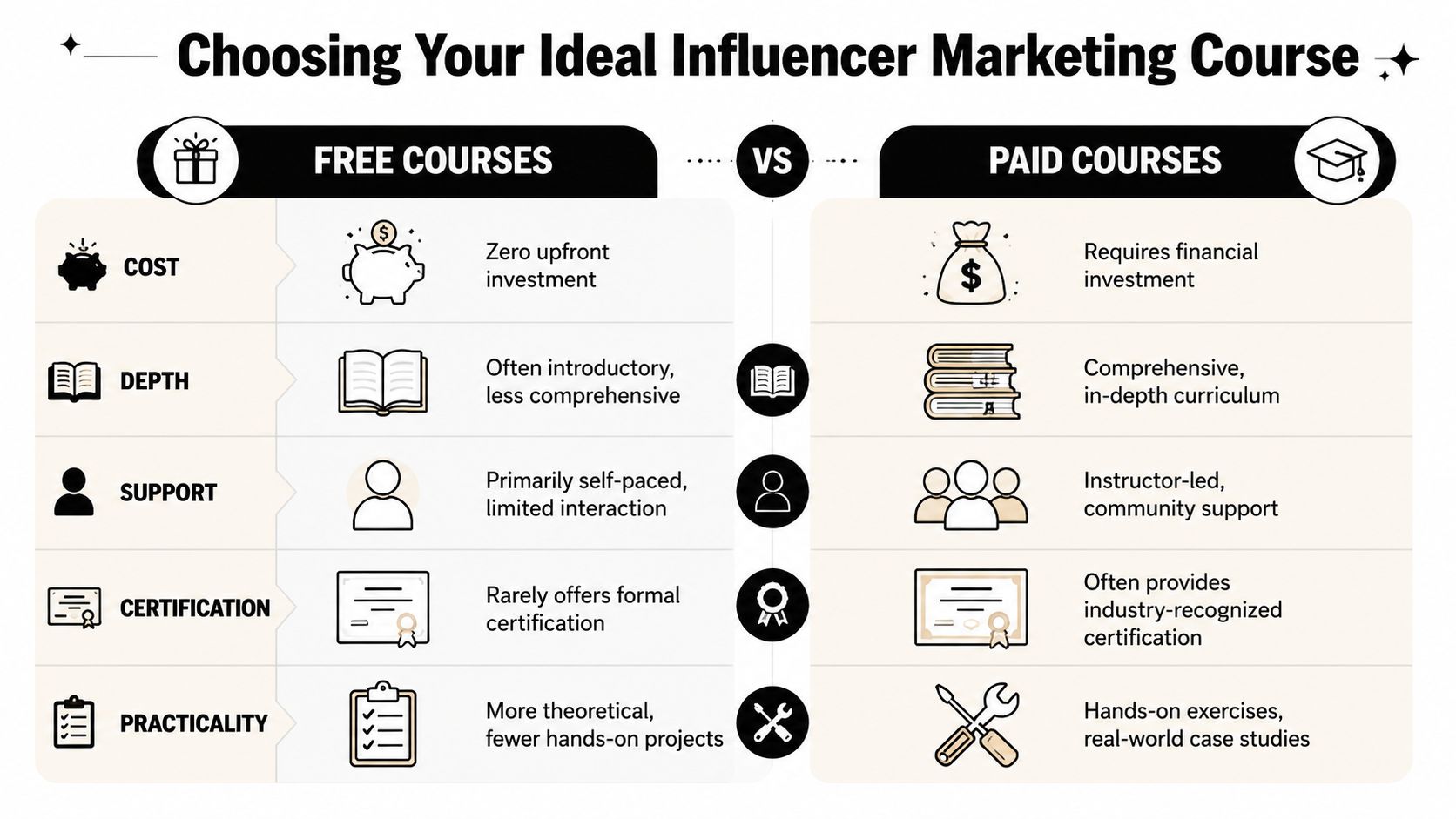
Free courses are useful for orientation. Paid courses tend to make more sense when you need structure, projects, feedback, or a clearer path to application.
| Criterion | Free Courses | Paid Courses |
|---|---|---|
| Cost | No upfront payment | Requires budget |
| Depth | Usually introductory | Often more comprehensive |
| Support | Mostly self-serve | More likely to include guidance or community |
| Certification | Sometimes absent or lightweight | More likely to provide completion credentials |
| Practicality | May lean theoretical | More likely to include exercises and templates |
That table won't choose for you, but it helps clarify the tradeoff. If you need basic familiarity, free can be enough. If you need to perform in-role, train a team, or build portfolio evidence, paid often makes more sense.
Questions worth asking before you enroll
Don't read the sales page like a student. Read it like a buyer.
- Creator vetting: Does the course teach how to assess authenticity, engagement quality, and fit?
- Strategy depth: Does it explain target market, objectives, and creative concept development?
- Measurement: Does it teach ROI logic, not just reporting screenshots?
- Real work product: Will you leave with a brief, a shortlist, a reporting framework, or a sample campaign plan?
- Instructor credibility: Has the instructor managed campaigns, or only taught about them?
Here's a useful video perspective to pair with that evaluation process:
What senior professionals should screen for
If you're aiming for a more senior role, don't overvalue the certificate. A credential can help. It's not the main asset. The main asset is decision quality.
Look for courses that teach you when to reject a creator, when to redesign a campaign concept, and when influencer marketing isn't the right move yet because the organization lacks a clear narrative or approval process. That's the kind of thinking leaders trust.
If your work increasingly involves executive visibility, stakeholder buy-in, or high-stakes communication around strategy, broader leadership development can become just as important as technical marketing training. That's where focused support such as executive presence training online often enters the picture for experienced professionals.
A course is worth paying for when it improves your judgment, not just your vocabulary.
A Sample Learning Roadmap and Next Steps
A lot of people avoid enrolling because the field feels messy. A simple roadmap makes it easier to see how the skill develops in practice.
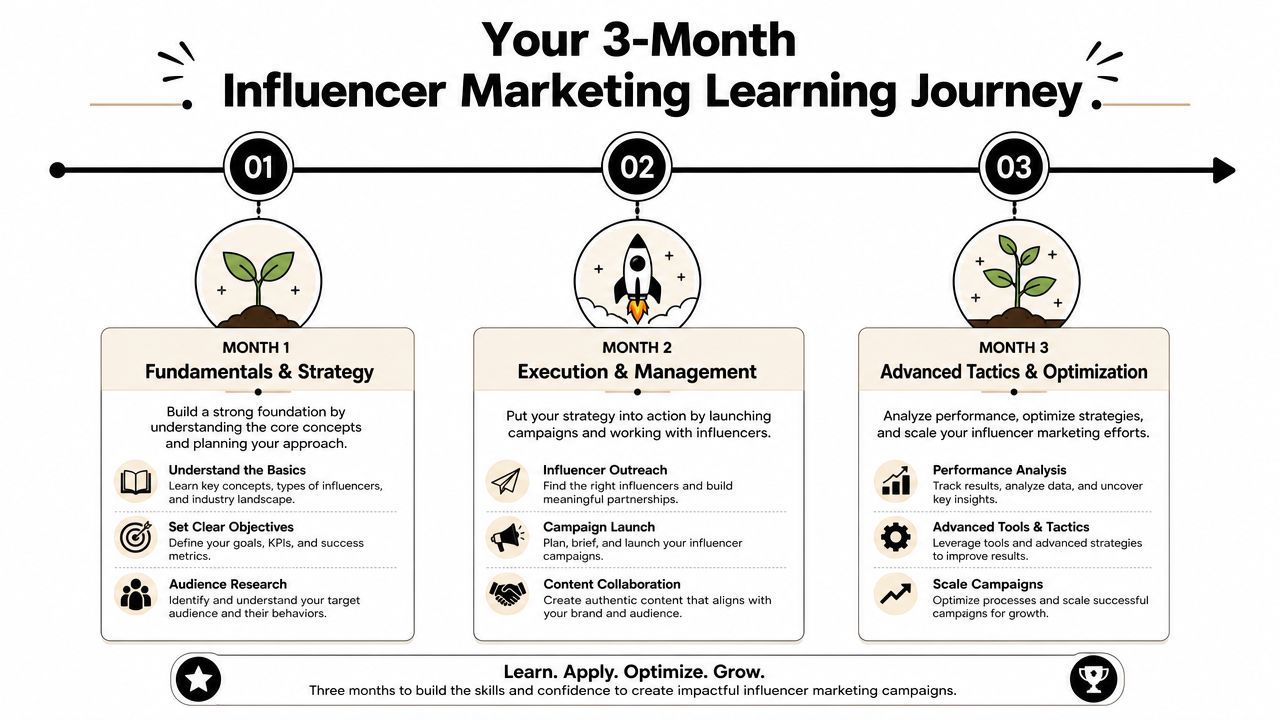
Month one and fundamentals
Start with core concepts. Learn campaign objectives, audience definition, creator categories, briefing basics, and measurement language. Keep notes on examples of good creator fit and weak creator fit. That habit builds judgment faster than passive watching.
A strong first month should end with one output: a simple campaign plan for a real brand, even if it's hypothetical.
Month two and execution practice
Next, build a mock campaign. Create a shortlist of creators, write a brief, define deliverables, and map how approval would work. If possible, use a real business case from your employer, a freelance client, or your own company.
Here, learning becomes employable. You're not just consuming content. You're producing artifacts that show how you think.
Month three and optimization
Now review outcomes, even if they're simulated. What would you measure? What would count as success? What would make you change the creator mix, the concept, or the platform choice?
That performance mindset matters because influencer marketing can generate measurable return when executed well. A Coursera course summary cites research showing businesses make an average of $6.50 in revenue for every $1 spent, with 70% earning $2 or more, while 30% of campaigns are unprofitable, which underscores the need for proper training, as noted in Coursera's influencer marketing strategy course overview.
What to do after the course
Once you finish, don't stop at completion. Turn the learning into proof.
- Build a small portfolio: Include sample briefs, creator evaluations, and reporting summaries.
- Apply the skill immediately: Volunteer for a pilot project at work or test a small creator collaboration for your own brand.
- Practice the strategic explanation: Learn to present why a campaign was designed a certain way, not just what was done.
For professionals moving toward senior roles, the next leap often isn't technical knowledge alone. It's executive communication. The Gravitas Method is a 12-week one-on-one executive presence coaching program for international professionals who want to communicate with more authority and influence at senior levels. The program is priced at $8,200 paid in full or $9,000 across three installments. Coached by Nikola, it covers vocal authority, strategic framing, executive body language, and high-stakes communication.
Putting Your Knowledge into Action
The smartest way to choose an influencer marketing course is to ignore the hype and study the depth. You're not just buying access to lessons. You're investing in your ability to judge creator quality, shape stronger campaigns, and explain results in a way that earns confidence.
That's the dividing line. Basic courses teach tasks. Better ones teach decisions.
If you want to keep sharpening your eye for what makes creator work effective, this roundup of proven growth strategies for creators is a useful companion resource because it helps you understand the pressures and priorities creators themselves are navigating.
Learning influencer marketing is a career move. Using it well is a leadership move. The professionals who stand out aren't the ones who know the most jargon. They're the ones who can connect audience insight, creator fit, creative judgment, and business outcomes, then communicate that logic clearly under pressure.
If you're ready to strengthen not just your marketing judgment but also how you communicate it, start with Intonetic's free Executive Communication Assessment. It's the best entry point if you want to understand how your current speaking style, strategic framing, and executive presence affect how your ideas are received in senior-level conversations.