Executive Presence Training Online: A Complete Guide
You're strong at the actual work. You solve problems fast, you know your domain, and people rely on you when the stakes are high. Yet in senior meetings, your ideas don't always land with the weight they deserve. Someone with less substance speaks after you, uses a cleaner structure or calmer delivery, and suddenly the room pays attention.
That gap is rarely about intelligence. It's usually about how your competence is perceived in real time.
For international professionals, that gap can feel sharper. You may be translating while thinking, managing accent bias, monitoring grammar, and trying to sound concise under pressure at the same time. On video, the margin for error gets even smaller. Senior leaders often judge confidence from a narrow frame, a short comment, or the first thirty seconds of a presentation.
That's why executive presence training online has become so useful. Done well, it doesn't teach performance or fake charisma. It trains the visible and audible behaviors that make senior stakeholders trust your judgment faster.
The Missing Link to Your Next Promotion
You know the pattern. You present a solid recommendation in a leadership call. The analysis is correct. The logic is sound. But your point lands softly, gets only partial uptake, or disappears until a more forceful colleague restates it.
That's not just frustrating. Over time, it affects who gets seen as ready for bigger scope.
A landmark Coqual study found that executive presence constitutes 26% of the factors required to propel leaders to the next career level (Coqual statistic via Garfinkle Executive Coaching). Technical ability still matters. But after a certain level, promotion decisions also depend on whether other people experience you as credible, steady, and influential.
Why expertise alone stops being enough
Early in your career, strong output can carry you. Senior roles are different. Leaders don't just evaluate what you know. They evaluate whether you can represent the business, persuade skeptical stakeholders, and stay composed when the conversation turns uncertain.
For international professionals, that often creates a hidden tax:
- You may over-explain: To avoid being misunderstood, you add context that weakens your punch.
- You may rush: Nerves and language load can speed up delivery.
- You may sound tentative: Even when your recommendation is right.
- You may self-edit too much: Which makes your contribution arrive late.
If any of that sounds familiar, the issue may not be your expertise. It may be your delivery. This is especially common if you've noticed that your accent affects first impressions. If that's a live concern for you, this guide on how your accent really affects your career and what you can actually do about it gives a realistic view of what matters and what doesn't.
Practical rule: At senior levels, people often decide whether to trust your judgment before they've fully evaluated your content.
Why online training fits this problem
Presence used to be treated like a vague in-person quality. That's outdated. Much of modern leadership happens through Zoom, Teams, recorded updates, and virtual stakeholder meetings. The behaviors that shape authority can be trained in the same medium where you need them.
That includes rehearsing for virtual meetings, reviewing recorded delivery, and improving how you show up on camera. If part of your role includes recording high-quality internal firm videos, that practice can sharpen executive presence too, because it forces clarity, framing, vocal control, and visual discipline.
The point is simple. If your capability is already there, presence becomes the bridge between being respected for your work and being trusted with larger authority.
What Exactly Is Executive Presence in a Virtual World
Executive presence gets talked about as if it's mystical. It isn't. In practice, it's a pattern of signals that make other people read you as senior, credible, and reliable under pressure.
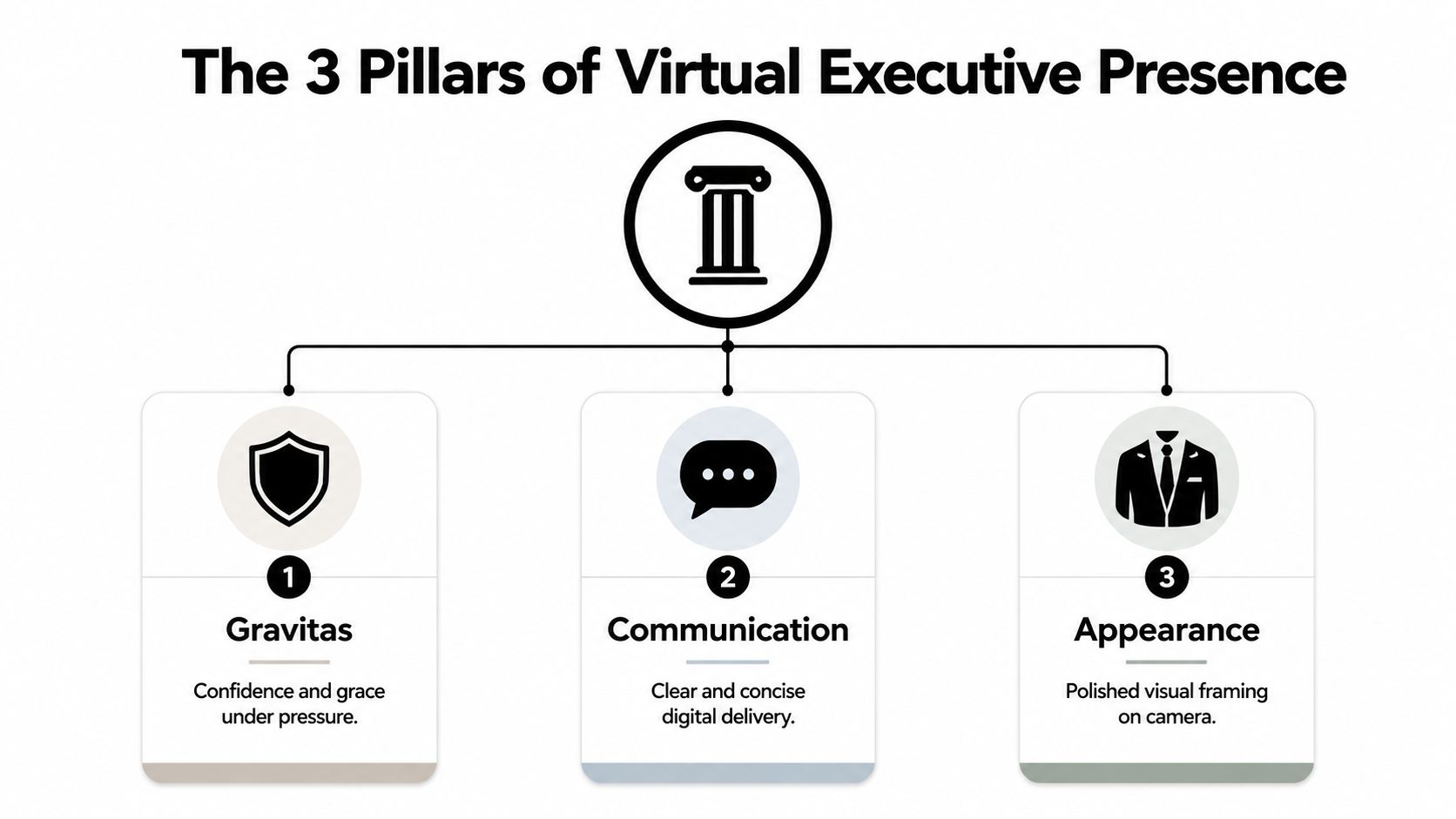
The most useful model breaks it into three parts: gravitas, communication, and appearance. Online, those same pillars still apply. They just show up through a webcam, a microphone, and a more compressed version of your behavior.
Gravitas
Gravitas is the weight your words carry. It's not stiffness. It's not trying to sound important. It's the impression that you can think clearly, hold your ground, and respond without losing your center.
Online, gravitas shows up in small moments:
- How you answer a hard question
- Whether you pause before responding
- Whether your tone stays steady under challenge
- Whether you can disagree without sounding defensive
A person with gravitas doesn't need many words. They sound anchored.
Communication
Communication is where many international professionals either gain authority or lose it. You can be brilliant and still sound less senior if your structure is messy, your pacing is rushed, or your key point arrives too late.
Virtual communication raises the standard because the channel removes so many cues. The audience can't read your full body language. They rely more heavily on voice, timing, and structure. That's why concise verbal framing matters so much on calls. If you want to improve that specifically, this guide on speaking English more clearly on video calls and presentations is useful preparation.
On video, clarity often beats energy. Senior people trust what they can follow.
Appearance
Appearance online doesn't mean expensive clothes. It means visual coherence. Does your camera angle support authority? Is your framing distracting? Do you look like someone ready to lead a decision, or someone squeezed between meetings?
Appearance in a virtual setting includes:
| Element | What it signals |
|---|---|
| Camera framing | Professionalism and stability |
| Lighting | Attention to detail |
| Attire choice | Context awareness |
| Background | Judgment and focus |
A polished frame won't create executive presence by itself. But a sloppy frame can undermine it quickly.
What changes in a virtual environment
In person, a room gives you more channels to influence people. Online, the bandwidth narrows. That means weaknesses become louder.
For example, a weak structure is more noticeable on Zoom than in a boardroom. In the same way, rushed speech feels more chaotic through headphones than across a conference table. This is why executive presence training online has to train the medium itself, not just generic confidence.
The strongest programs don't stop at advice like “speak up more.” They help you control what people experience through the screen.
The Four Core Skills of Online Executive Presence
Most professionals don't need vague encouragement. They need a trainable skill set. In practice, executive presence training online works when it focuses on four areas that can be observed, practiced, and corrected.
Top-tier programs from institutions like Wharton and Cornell report high enrollment among senior professionals, driven by data showing executive presence as a “critical advantage” in competitive markets like tech, finance, and consulting (Wharton executive presence program overview).

Vocal authority
Your voice tells people how to interpret your message. If your pace is too fast, your idea sounds less settled. If your ending drops into uncertainty, your recommendation sounds optional. If you fill every silence, you signal strain.
Vocal authority rests on control, not volume.
A strong executive voice usually sounds:
- Measured: It gives the listener time to process.
- Intentional: It doesn't waste emphasis.
- Stable: It holds shape under challenge.
This is one reason many professionals benefit from resources on speaking with confidence for modern businesses. The useful part isn't generic confidence advice. It's learning how delivery changes business outcomes.
Strategic framing
Senior leaders rarely reward the person who says the most. They remember the person who organizes complexity quickly.
Strategic framing means you can answer with a clean structure even when the situation is messy. For example, instead of narrating your thought process, you lead with a decision, then support it. Instead of giving every detail, you surface what matters to this audience now.
A product manager in a cross-functional review might say:
“I recommend we delay launch until the dependency risk is resolved. There are two reasons. Customer impact and implementation cost.”
That sounds senior because the thinking arrives in a usable shape.
Executive body language
On video, body language is reduced but not irrelevant. The audience still notices posture, eye line, facial tension, head movement, and whether your gestures support or distract from your message.
Common problems include leaning too close to the camera, looking at your own image instead of the lens, nodding excessively while speaking, or disappearing physically when challenged.
A better video presence often comes from simple adjustments:
- Sit tall with back support
- Keep gestures inside the frame
- Look into the camera for key points
- Let your face settle between sentences
A short demonstration helps more than description alone:
Handling high-stakes conversations
Executive presence gets tested for real in these moments. You can look polished in practice and still lose authority in a tense budget review, a board update, or a conflict with a senior stakeholder.
High-stakes communication requires three things at once:
- Composure
- Clear structure
- Control of interaction
If a leader interrupts your point, do you collapse into explanation? If someone challenges your judgment, do you defend every detail? If the room goes cold, do you speed up?
The professionals who rise don't avoid pressure. They show they can stay useful inside it.
The goal isn't to sound perfect. The goal is to sound trustworthy when conditions aren't perfect.
From Theory to Practice Training Exercises and Outcomes
Good training doesn't leave executive presence at the level of theory. It turns it into drills, recordings, feedback loops, and repeatable habits. That matters because most professionals already know what they “should” do. The problem is doing it under live pressure.
One of the strongest advantages of online training is that it can make progress visible. In online executive presence programs, real-time AI-driven vocal analysis can measure metrics like pitch variance and speech rate, with an optimal 120 to 180 Hz range for gravitas and 110 to 150 words per minute for composure, and targeted training has been associated with 25 to 30% improvements in perceived credibility (Speakeasy on online vs in-person executive presence training).
A practical exercise set
Here's what useful training often looks like when translated into actual work.
Vocal authority drill
Record a sixty-second answer to a leadership prompt such as, “What's your recommendation and why?” Then review it for pace, endings, pausing, and vocal steadiness.
The before state is usually obvious. The speaker rushes the first sentence, softens the key point, and fills silence with extra language. After several rounds of guided practice, the answer becomes shorter, calmer, and easier to trust.
Strategic framing sprint
Use a timed exercise where you must summarize a complex issue in three parts: recommendation, rationale, risk. This forces prioritization.
The benefit is immediate. Instead of talking your way toward a point, you start with the point. That shift alone often changes how senior stakeholders rate your judgment.
Role-play for pressure handling
A coach or peer challenges your proposal, interrupts, or asks for a sharper answer. You practice holding your structure instead of reacting emotionally.
That's where simulation becomes powerful. If you want a practical look at this method, these role-playing and simulation exercises for improving English accent and communication under pressure show why rehearsal matters so much for international professionals.
Repetition matters because pressure doesn't erase your habits. It exposes them.
What measurable improvement actually looks like
Not every result needs a number to be real. In practice, strong outcomes often show up as observable changes your colleagues notice before you do.
Look for these signs:
- Meetings become easier to steer: People interrupt you less because your opening is clearer.
- Your recommendations get adopted faster: The structure reduces friction.
- You sound calmer in disagreement: Which raises perceived seniority.
- You recover better under stress: You don't lose the thread after a challenge.
What doesn't work
A lot of professionals waste time on the wrong methods.
These usually underperform:
- Watching generic confidence videos without practice
- Trying to “sound native” instead of sounding clear and credible
- Memorizing scripts word-for-word
- Focusing only on pronunciation while ignoring structure
Presence improves when training connects delivery, thinking, and pressure. If a program treats them separately, progress tends to stay shallow.
How to Choose the Right Online Executive Presence Program
Not all executive presence programs solve the same problem. Some are designed for broad exposure. Others are built for behavior change. If your goal is a real shift in how senior people experience you, the format matters as much as the content.
The most important distinction is this: information is not the same as transformation.
Personalized one-on-one coaching in remote executive presence programs has been reported to boost influence by as much as 35% in C-suite interactions when it uses rhetorical strategy frameworks and structured feedback (Wharton program outcomes page). That doesn't mean every professional needs the same level of support. It does mean personalized correction has clear value for critical professional situations.
Three common program formats
Self-paced courses
These work well if you're curious, disciplined, and early in your development. They're usually the cheapest and easiest to fit into a full schedule.
The downside is obvious. A self-paced course can teach concepts, but it can't tell you which habits are weakening your authority today.
Group coaching
Group programs can be useful if you learn well through observation and shared practice. You hear other people's mistakes, borrow language patterns, and get some live feedback.
The trade-off is specificity. Group feedback rarely goes deep enough into your exact speech patterns, framing habits, or pressure responses.
One-on-one coaching
This format is best when your communication problem is personal, high-stakes, or already affecting promotion. It allows direct diagnosis, repeated correction, and scenario practice tied to your real role.
For instance, The Gravitas Method is a 12-week one-on-one executive presence coaching program for international professionals who want to communicate with more authority and influence at senior levels. The program is priced at $8,200 paid in full or $9,000 across three installments. Coached by Nikola, it covers vocal authority, strategic framing, executive body language, and high-stakes communication. That's one example of a program built for individualized communication change rather than general leadership education.
Checklist for evaluating executive presence programs
| Evaluation Criteria | What to Look For |
|---|---|
| Personalization | A real audit of your current speaking patterns, not generic tips |
| Practice format | Live drills, role-play, recordings, and feedback loops |
| Relevance to your role | Scenarios from tech, finance, consulting, enterprise leadership, or your field |
| Focus on delivery | Work on voice, pacing, pausing, and body language, not just mindset |
| Focus on structure | Training on how to frame recommendations, updates, and disagreement |
| Accountability | Regular review, follow-up tasks, and correction over time |
| Fit for international professionals | Support for accent-related clarity, processing load, and cross-cultural communication |
| Evidence of method | Clear explanation of how training works, not vague promises of confidence |
If you’re comparing providers, these seven questions to ask before choosing the right accent coach will also help you separate generic coaching from targeted communication work.
What to avoid when evaluating programs
Some offers sound refined but won’t help much in practice.
Be cautious if a program:
- Promises charisma
- Talks mostly about mindset
- Uses large group lectures as the main method
- Gives little or no recorded feedback
- Doesn’t address your real work situations
A strong program should be able to tell you exactly how it trains authority. Not in slogans. In exercises, review methods, and specific behavior change.
If a provider can’t explain how they diagnose weak executive presence, they probably can’t fix it.
A simple decision standard
Choose the lightest format that can still solve your actual problem.
If you need basic exposure, a short course may be enough. If you need to reshape how senior stakeholders read your voice, structure, and composure, you’ll likely need repeated live feedback. That’s especially true if English isn’t your first language and your issue appears most strongly under pressure rather than in prepared settings.
Take the First Step Toward Authentic Authority
Executive presence isn’t a gift handed to a lucky few. It’s a set of behaviors that people can learn, refine, and stabilize through practice. That’s good news, because it means the gap between your expertise and your influence is workable.
The online format can be especially effective for international professionals because it trains the environment where the problem happens. Video calls, stakeholder updates, client meetings, board presentations, and promotion discussions all leave a communication trail. When you review that trail carefully, patterns become visible. Then they become trainable.
The key is to stop treating presence as a personality issue. In most cases, it’s a performance issue. Your pacing may be too fast. Your structure may bury the point. Your body language may leak uncertainty. Your response style under challenge may sound more reactive than senior. Those are all fixable.
If you want a realistic baseline before committing to any program, a diagnostic is the smartest place to start. Intonetic also offers a free accent reduction assessment, but for professionals focused on senior-level authority, the more useful next step is an executive communication assessment that looks at presence more broadly.
If you want to understand exactly what’s weakening your authority on calls, in presentations, or during high-stakes conversations, start with the free Executive Communication Assessment from Intonetic. It’s the most practical first step because it shows you where your delivery, framing, and executive presence are helping you, and where they’re holding you back.