
Presentations Skills Training: A Guide for Leaders
A senior leader walks into a meeting with the right answer and still loses the room. The analysis is solid. The recommendation is commercially sound. But the delivery sounds tentative, the structure feels crowded, and the discussion drifts toward louder voices with weaker ideas.
That gap is why presentations skills training matters at the executive level.
For directors, VPs, technical leads, and international professionals aiming higher, presentation skill isn't about performing. It's about making sound judgment visible. It's the difference between being seen as the person with useful input and being trusted as the person who should shape the decision.
Beyond Slides The True Meaning of Executive Presence
A polished deck won't rescue a weak signal. Senior audiences decide quickly whether they trust the speaker's judgment, not just the content on the screen.
That matters even more for international professionals. A brief hesitation, an overloaded explanation, or a flat vocal pattern can be misread as uncertainty when the issue is delivery, not expertise. Strong presentations skills training corrects that misreading.

What senior audiences are actually judging
Many consider presentation training to mean slide design, posture, and a few public speaking tips. That view is too narrow for leadership roles.
Senior stakeholders tend to assess four things at once:
- Clarity of thought: Can this person state the point early and hold a line?
- Command under pressure: Do they stay composed when challenged?
- Commercial relevance: Are they speaking to business consequences, not just facts?
- Leadership signal: Do they sound and look like someone ready for a bigger scope?
A useful outside perspective on this problem is Baz Porter's piece on how to stop being overlooked. It captures a pattern many high performers know well. Good work alone rarely creates visible authority.
Why this is harder than it looks
Fear is part of the story, even for accomplished professionals. In a survey of 1,135 undergraduate students aged 17 to 58, over 63.9% reported a fear of public speaking according to this public speaking anxiety study. That pattern doesn't magically disappear at senior levels. It becomes harder to admit.
Practical rule: Executive presence starts before the first slide. If your opening sounds like you're still searching for your point, the room assumes your thinking is still forming.
The actual standard is higher than “speak confidently.” You need to frame the issue, guide attention, and make your recommendation feel dependable. That's why many experienced professionals look beyond generic presentation classes and toward more targeted support such as an executive communication assessment, where the goal is to identify the exact habits that lower perceived seniority.
Decoding Training Formats Workshops Coaching and Courses
Not all presentations skills training solves the same problem. A team workshop can build shared basics. A self-paced course can help someone organize ideas. Neither automatically fixes the delivery habits that hurt a senior professional in a board update or investment discussion.
The right format depends on the stakes, the timeline, and how specific the problem is.
Presentation Skills Training Formats Compared
| Format | Best For | Personalization | Typical Cost |
|---|---|---|---|
| Workshops | Teams that need a common communication baseline | Low to moderate | Varies |
| One-on-one coaching | Senior professionals with visible, high-stakes communication gaps | High | Premium |
| Self-paced courses | Independent learners building fundamentals | Low | Lower cost |
Workshops work well for shared language
Group workshops are useful when an organization wants everyone to improve the same fundamentals. They can help teams stop reading slides, tighten structure, and speak more directly in client or internal meetings.
The trade-off is obvious. General feedback helps a group, but it rarely gets precise enough for a director whose issue is vocal authority, overexplaining, or weak handling of interruptions.
Workshops are also constrained by time. People practice, get feedback, and leave with notes. That can be enough for a capable manager with modest needs. It usually isn't enough for someone whose promotion depends on how they come across in senior rooms.
Coaching is for targeted correction
One-on-one coaching is the strongest format when the stakes are personal and specific. It allows direct observation of how a person opens, how they pause, what happens to their voice under pressure, and how they answer questions when challenged.
That level of detail matters for international professionals. Accent is often not the actual problem. The issue is usually a cluster of smaller signals: rushed phrasing, imprecise stress, trailing endings, defensive body language, or structure that buries the recommendation.
Coaching is the right choice when the cost of staying unclear is higher than the cost of fixing it.
A practical way to evaluate specialist support is to review criteria like those in this guide on how to choose the right accent coach. The same logic applies more broadly to executive communication coaching. You want someone who can diagnose, not just encourage.
Courses are flexible but easy to overestimate
Self-paced courses are attractive because they're convenient. They can introduce useful frameworks for organizing a presentation, improving slide hygiene, and rehearsing more effectively.
They also rely heavily on self-awareness. That is their biggest weakness.
Most senior professionals don't struggle because they lack information. They struggle because they can't hear the exact moments where authority drops. A recorded module can't interrupt and say, “That sentence was too long,” or “Your answer started with apology language,” or “You lost the room when you explained the methodology before the decision.”
A simple way to choose
Use this filter:
- Choose a workshop if your goal is team consistency.
- Choose a course if you need foundational knowledge and can self-correct.
- Choose coaching if your communication affects promotion, funding, stakeholder trust, or strategic influence.
The more senior the role, the less useful generic advice becomes.
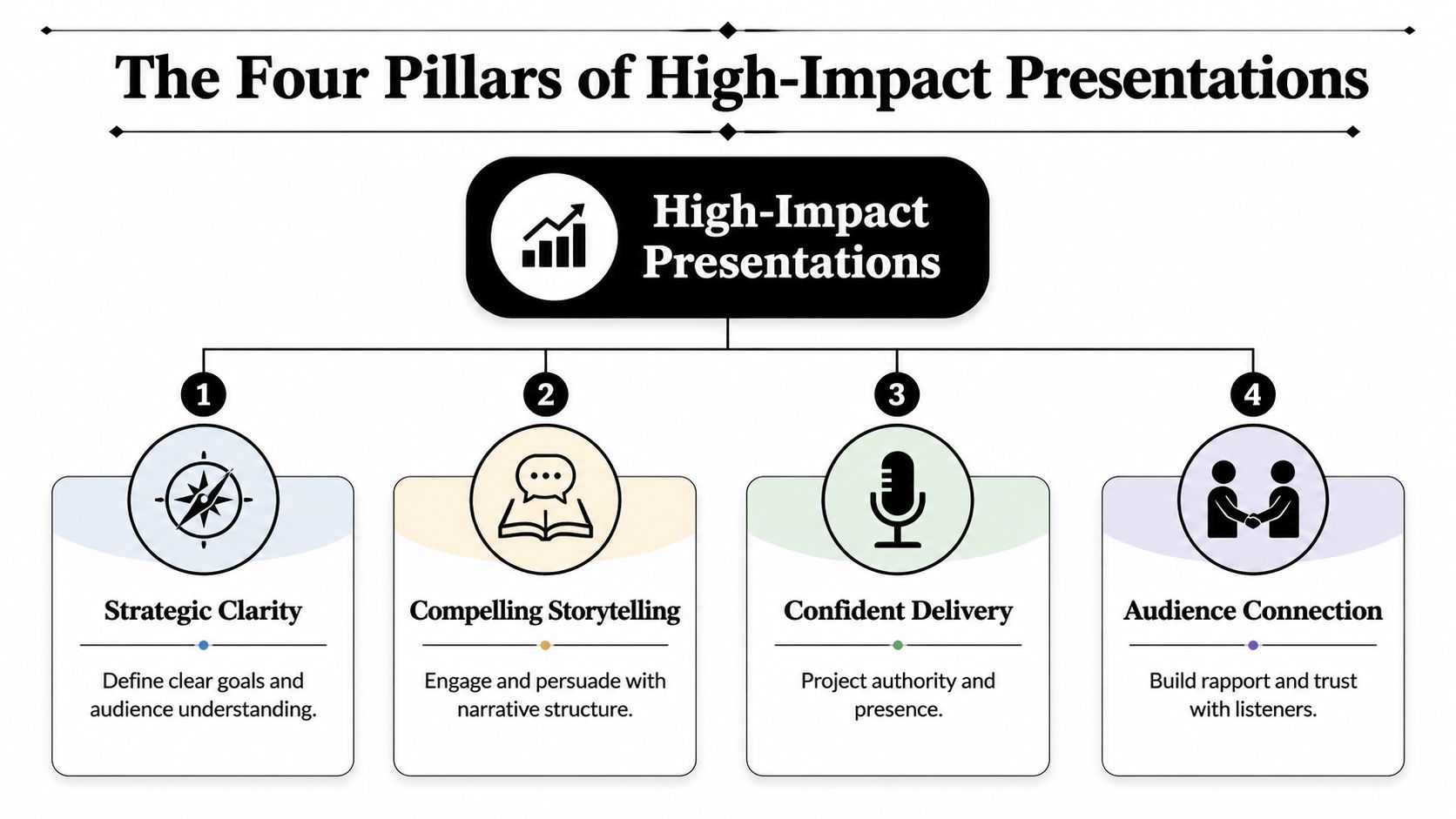
The Four Pillars of High-Impact Presentations
Most weak presentations don't fail because the speaker lacks intelligence. They fail because the message is overloaded, the delivery doesn't carry authority, and the speaker treats questions as interruptions instead of part of the decision process.
High-impact presentations rest on four capabilities. If a training program can't develop these, it won't change much.
Strategic structure
A senior audience doesn't want a museum tour of your thinking. They want a recommendation they can evaluate.
Many technical experts often encounter difficulty. They present every angle because they want to prove rigor. The result is cognitive clutter. The audience hears effort, not judgment.
Effective training teaches presenters to decide what belongs in the room and what belongs in the appendix. For data-heavy presenters, one of the most useful habits is the “So What?” filter. It forces the speaker to select only the information that drives action, rather than explaining everything they know.
A strong structure usually does three things:
- State the decision early: Give the room the headline before the evidence.
- Limit supporting points: Keep only what moves the recommendation forward.
- Sequence for relevance: Put business consequence before technical detail.
When people adopt this decision-focused approach, executive audiences understand faster and challenge more constructively.
Vocal authority
Voice carries rank. Not formal rank, but perceived rank.
A speaker can have perfect grammar and still sound junior if the pace is rushed, the volume collapses at the end of sentences, or every important point receives the same flat emphasis. International professionals often work hard on correctness and ignore authority. That is a mistake.
Useful presentations skills training works on:
- Pacing: slowing down enough for key ideas to land
- Strategic pausing: creating space after a critical point
- Stress and emphasis: making the important word sound important
- Sentence endings: finishing statements cleanly rather than fading out
A frequently missed area in standard training is pressure handling when English isn't your first language. This matters because engagement skills such as strategic pausing can reduce performance anxiety by 40 to 50%, as noted in this presentation skills course landscape reference. For non-native speakers, pausing isn't just a calmness tactic. It's a credibility tactic.
For more on sounding clearer in live meetings, this guide on speaking English more clearly on video calls and presentations is a practical complement.
A rushed answer sounds less certain, even when it's correct.
Executive presence
Body language doesn't create authority on its own, but it can erode it. Poor camera framing, collapsed posture, restless gestures, and inconsistent eye contact all drain trust.
The correction is not theatrical. It is controlled.
A senior presenter needs to look physically settled. That means grounded posture, deliberate gestures, stable eye line, and movement that serves emphasis instead of leaking energy. In virtual settings, this becomes even more visible because the camera magnifies every sign of tension.
Watch for these common errors:
- Over-gesturing: movement without purpose
- Visual apology: smiling when delivering hard truths
- Scanning notes too often: breaking connection at key moments
- Shrinking after challenge: shoulders tighten, voice thins, point softens
Handling pressure
Q&A reveals what the prepared presentation can hide. Under pressure, structure often disappears and personality takes over.
Strong speakers don't answer every question with the same pattern. They absorb the challenge, frame the issue, and respond in a way that preserves authority. Sometimes that means answering directly. Sometimes it means correcting the premise before answering. Sometimes it means narrowing the scope of the question so the room doesn't drift.
In practice: If you can't stay calm in the first five seconds after a hard question, your content won't save you.
Pressure handling improves when people rehearse the moments most likely to destabilize them: interruption, skepticism, data challenge, hostile framing, and time compression. Generic rehearsal helps. Targeted rehearsal changes outcomes.
Case Snapshots From Technical Expert to Trusted Advisor
Transformation usually looks less dramatic from the inside than it does from the outside. The person doesn't become someone new. They stop communicating in ways that hide their judgment.

The engineering leader who stopped presenting for approval
One common pattern shows up with senior software engineers and data leaders. They know the subject better than anyone else in the room, so they assume the safest approach is to explain the logic in full.
That approach often backfires.
Data professionals in particular can lose the room by presenting every analytical angle. Effective training teaches them to use a “So What?” filter, selecting only the information tied to decision outcomes, and that approach can improve comprehension by 2.5x in executive settings according to this data communication training analysis.
The shift is not cosmetic. The presenter stops saying, “The background information is relevant here,” and starts saying, “The decision is X because the current pattern creates Y business risk.” That single change moves them closer to trusted advisor territory.
For consultants and client-facing technical experts, sharper spoken delivery matters just as much as structure. This article on the best pronunciation coach for consultants delivering client presentations addresses that layer well.
The finance director who changed how the room heard her
A second pattern is more subtle. An international finance director may already have excellent content, polished slides, and strong command of the numbers. Yet in board meetings, the same recommendation can sound softer than intended because the delivery carries hesitation.
That usually comes from three places: starting with too much context, answering objections too quickly, and speaking in a way that doesn't mark the hierarchy of ideas. When those habits change, credibility rises fast.
One structured option in this space is The Gravitas Method, a 12-week one-on-one executive presence coaching program for international professionals who want to communicate with more authority and influence at senior levels. Coached by Nikola, it covers vocal authority, strategic framing, executive body language, and high-stakes communication. The program is priced at $8,200 paid in full or $9,000 across three installments.
Video can be useful here because it makes invisible habits visible.
When these leaders improve, colleagues often describe the change in simple terms: more concise, more grounded, more senior. That's the point. The room stops focusing on delivery friction and starts focusing on the recommendation.
Choosing the Right Program A Decision Framework for Senior Leaders
Senior international professionals usually outgrow standard communication training quickly. The problem isn't effort. It's mismatch.
Most programs are designed for broad audiences. They teach confidence, eye contact, and slide basics. Those things matter, but they don't address the executive-level friction that shows up in board updates, investor conversations, or cross-functional conflict.
Start with the real problem, not the label
Many leaders say they need public speaking help when the actual issue is narrower. It may be weak vocal authority. It may be overexplaining. It may be composure under challenge. It may be that their English is clear, but not forceful.
That distinction matters because most presentation skills training for non-native English speakers inadequately addresses vocal authority, which can lead to a misperceived lack of seniority, as noted in this presentation training overview from AMA. Standard programs rarely work at the level of personalized delivery gaps.
Four criteria worth using
Use a decision framework that reflects senior-level reality.
- Executive relevance: The program should focus on high-stakes influence, not classroom-style presenting.
- Experience with non-native speakers: The coach or trainer should understand how pausing, phrasing, and vocal pattern affect perceived authority.
- Scenario specificity: Training should use your real situations, such as board updates, strategic recommendations, or investor Q&A.
- Direct feedback: You need diagnosis and correction, not broad encouragement.
A useful program should also tell you what it won't do. If someone promises to “make you confident” without showing how they diagnose structure, delivery, and pressure habits, be cautious.
Questions to ask before you commit
Don't evaluate a program by how polished the website looks. Evaluate it by the quality of its method.
Ask questions like these:
- What kinds of professionals is this built for?
- How do you assess delivery problems beyond accent or nerves?
- Will I practice using my own presentations and live scenarios?
- How is feedback delivered between sessions, if at all?
- What happens when the issue is authority under pressure, not stage fright?
The right program should make you feel accurately understood, not generically encouraged.
The best investment is usually the one closest to your actual communication risk. For a senior leader, that risk is rarely “I don't know how to make slides.” It's more often “My expertise isn't landing with the authority my role requires.”
Measuring the ROI of Presentation Skills Training
The return on presentations skills training is rarely limited to confidence. Confidence is useful, but it isn't the business case.
The stronger case is influence. Can a leader secure buy-in faster, defend a recommendation more effectively, and communicate in a way that earns wider scope? Those outcomes affect careers and decisions directly.
Why the market treats this as an investment
Organizations continue to spend in this category because communication failure is expensive. The global presentation skills training market was valued at $7.4 billion in 2025 and is projected to reach $14.2 billion by 2034, reflecting a 7.5% compound annual growth rate, according to this presentation skills training market analysis. That scale suggests companies don't see this as a cosmetic skill.
The same source notes that presentations using visual aids are 43% more persuasive. That doesn't mean visuals do the work for you. It means strong communication combines message, medium, and delivery.
Where ROI actually shows up
For senior professionals, return usually appears in a few concrete places:
- Faster decision support: Stakeholders understand the recommendation sooner.
- Stronger promotion case: Senior leaders see clearer executive readiness.
- Better meeting outcomes: Fewer presentations dissolve into unfocused discussion.
- Higher trust: Colleagues stop second-guessing the speaker's conviction.
There are also softer gains that matter in practice. Teams align more easily behind leaders who speak with precision. Clients and investors tend to trust a recommendation more when the presenter sounds measured and commercially grounded.
If you're weighing timing and value, this guide on how long accent coaching costs and when to expect ROI offers a practical lens for thinking about communication investment more broadly.
The strongest ROI often comes from preventing a weak impression in a room that matters.
That is why high-level communication training should be judged against real business moments. The key question isn't whether the speaker feels better afterward. It's whether the room responds differently.
Your Next Step Take the Executive Communication Assessment
Presentation skill at senior levels is not a presentation problem alone. It is a leadership signal problem.
People decide whether to trust your recommendation by listening to how you frame it, how you sound when challenged, and how steadily you hold the room. Those are learnable skills. They improve fastest when someone identifies the precise habits that weaken your authority.
If you're an international professional aiming for broader influence, don't start with generic tips. Start with diagnosis. Find out whether your main obstacle is structure, vocal authority, executive body language, or pressure handling.
That is what makes a proper assessment useful. It gives you a clearer map of what to change and what to ignore. You don't need more random advice. You need a sharper understanding of what your communication is currently signaling in senior environments.
If you want a practical first step, take the free Executive Communication Assessment from Intonetic. It helps identify the delivery and executive presence gaps that may be affecting how your ideas land in high-stakes conversations.