How to Influence Without Authority: Master Leadership
You are in the meeting for a reason. You know the problem. You have the cleanest solution in the room. Then someone with a broader title speaks after you, repeats part of your point in simpler language, and the room moves with them instead.
That experience is common for high-performing professionals, especially in cross-functional environments where nobody fully controls the outcome. It is even more common for international professionals who are already doing senior-level work but are still judged through a communication lens they did not create.
Learning how to influence without authority is not about becoming louder, more political, or artificially charismatic. It is about becoming easier to trust, easier to follow, and harder to dismiss.
Beyond Titles The True Source of Workplace Influence
Formal authority still matters. Titles decide budgets, approvals, and reporting lines. But titles no longer explain who shapes most important decisions inside modern organizations.
The shift is structural. The National Career Development Association notes that organizations now rely more heavily on collaboration and cross-functional communication, moving away from traditional hierarchies toward flatter, more collaborative environments. It also points out that employees who influence effectively, regardless of title, create stronger reputations for results and open doors to promotion (NCDA).
That matters because many professionals still use the wrong model. They think influence starts when they finally get the title. In practice, promotion often follows influence, not the other way around.
Influence is not a softer version of power
Influence is the ability to affect decisions, action, and direction without needing formal control. In senior environments, that usually comes from four things:
- Credibility: People trust your judgment.
- Relevance: Your idea solves a problem they care about.
- Delivery: You communicate in a way the room can absorb quickly.
- Follow-through: You consistently help things move.
If one of those is weak, your expertise can still be ignored.
For this reason, influence should not be treated as a vague interpersonal talent. It sits inside the broader category of professional capability. If you want a useful framing of that difference, this guide to understanding soft skills is worth reading because it clarifies why communication, judgment, and collaboration drive outcomes just as much as technical skill.
Why international professionals often feel the gap more sharply
Many international professionals assume the issue is only language proficiency. It usually is not.
The primary problem is often perceived authority. You may be technically strong, strategically sound, and well prepared, but if your message arrives with rushed pacing, hesitant openings, or overly dense explanation, senior stakeholders read uncertainty where none exists. Accent can also shape perception in ways many workplaces do not discuss directly. This breakdown of how your accent really affects your career and what you can do about it explains that dynamic in practical terms.
Influence grows when people can quickly understand your value, trust your intent, and repeat your recommendation to others.
The old career formula was simple. Do good work, get noticed, get promoted, gain authority.
The newer formula is less comfortable but more accurate. Do good work, make that work legible to others, build alignment early, communicate with clarity under pressure, then gain authority because people already treat you as a leader.
That is the true source of workplace influence. Not position first. Perceived leadership first.
Lay the Groundwork with Stakeholder Mapping and Coalition Building
Most failed proposals fail before the meeting. Not because the idea is weak, but because the social architecture around the idea is missing.
When people say “network more,” they are usually too vague to be useful. Influence comes from targeted relationship work. You need to know who matters, what they care about, what they fear, and what they need to hear before they will support movement.
Product Marketing Alliance’s cross-functional framework is useful here because it emphasizes mapping stakeholders and their motivators, building alliances, using collaborative language like “yes, and,” documenting wins publicly, and linking efforts to company OKRs. It also notes that aligning influence efforts to company OKRs can increase buy-in by 40 to 60% (Product Marketing Alliance).
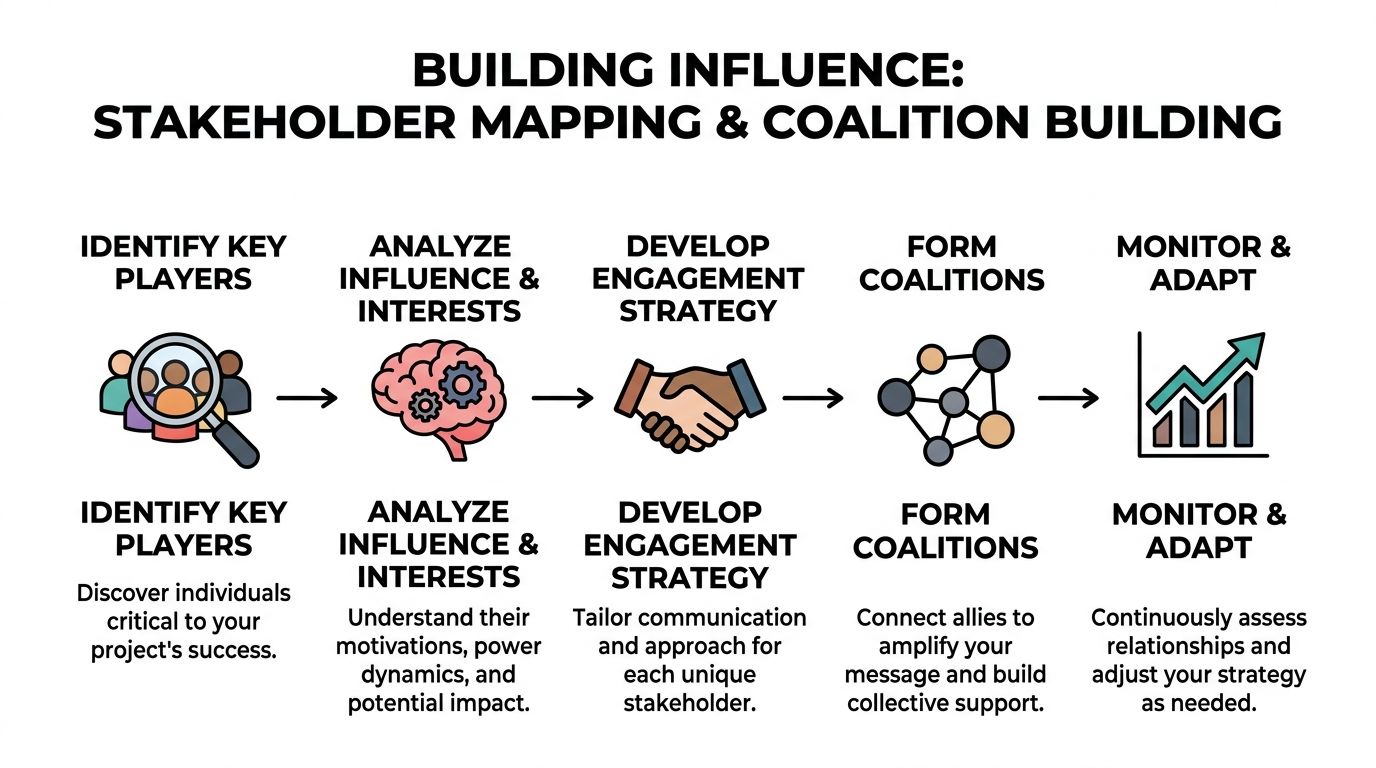
Build a stakeholder map before you build a pitch
Use a simple working map with four groups:
| Group | What they usually do | What you need from them |
|---|---|---|
| Champions | Support your idea publicly | Early feedback and visible backing |
| Blockers | Resist, delay, or challenge | Concerns surfaced privately before the main meeting |
| Influencers | Shape opinion behind the scenes | Informal endorsement |
| Neutrals | Have limited initial commitment | Clear reason to care |
Then go one level deeper. For each person, answer these questions:
- What are they measured on
- What problem are they trying to avoid
- What would make your proposal useful to them
- What language do they trust
- Who influences them
Many high performers get impatient at this point. They assume the strength of the idea should carry the room. It rarely does. People support what fits their incentives, reduces their risk, and respects their pressures.
A practical way to map motivations
A fast stakeholder audit can fit on one page.
- Business priority: Revenue, speed, quality, risk, customer experience, operational stability
- Decision style: Analytical, consensus-driven, fast-moving, skeptical
- Likely objection: Cost, timing, disruption, ownership confusion
- Best approach: Short memo, private conversation, data summary, working session
Keep it current. Stakeholder maps expire quickly when priorities shift.
Do not ask, “Who has authority over this?” Ask, “Whose support changes the likelihood of adoption?”
Coalition building is quiet work
The strongest coalitions are often built in low-drama conversations. A short discussion after a team review. A note asking for input before a proposal is finalized. A targeted request for concern, not approval.
A common mistake is trying to win everyone individually. A better move is to connect compatible allies around a shared gain.
For example, consider a senior software engineer pushing for a major refactoring effort. If they present it only as code quality, product may hear delay and finance may hear cost. But if they first meet with the product manager and frame the work as improving future feature velocity, that creates one ally. If they then speak with a DevOps lead and frame it as a stability win with fewer fire drills, that creates a second ally. By the time the proposal reaches the main forum, the conversation is no longer one engineer asking for cleanup time. It is a cross-functional recommendation tied to delivery and reliability.
That changes the room.
What works and what does not
What works
- Early one-to-one conversations: People will often voice real concerns privately that they hide in group settings.
- Language that links to shared goals: Use the team’s scorecard, not your own professional preference.
- Visible credit: Publicly acknowledge contributors. It lowers resistance and increases repeat support.
- Post-project follow-up: A short post-mortem helps you learn which messages landed and which did not.
What does not
- Surprising stakeholders in big meetings: This creates avoidable defensiveness.
- Over-explaining the technical solution before the business case is accepted: People tune out when they do not yet care.
- Treating blockers as enemies: Many blockers are protecting risk, not attacking you.
- Trying to “sell” before you understand motivations: Influence starts with diagnosis.
Coalition building is not manipulation. It is respect for how decisions move.
Design Your Message for Maximum Impact with Strategic Framing
You are in a leadership meeting. You know your recommendation is sound. Then someone more senior summarizes the issue in two crisp sentences, names the business risk, and gets immediate traction.
The difference is often framing.
Senior leaders rarely respond to effort alone. They respond to relevance, timing, trade-offs, and consequence. If your message starts with the work you did, the hours involved, or how strongly you feel, you make the audience do the translation. In high-stakes environments, that costs you influence.
Wharton’s guidance on influencing without authority is useful on this point. It emphasizes understanding what the other person wants, building trust, and using your expertise in a way that helps other people make decisions faster (Wharton on influencing without authority).
Start with their decision, not your request
A lot of capable professionals open with language like this:
- I need more time.
- I need engineering support.
- I want approval to change the process.
- I think we should revisit the plan.
That language creates extra work for the listener. They have to figure out why your request matters to the business.
A stronger frame names the decision and its consequence.
| Weak framing | Strong framing |
|---|---|
| I need more time to complete this properly. | A short extension now reduces rework later and protects launch quality. |
| I need support from data engineering. | Involving data engineering now gives us cleaner reporting and avoids a late-stage handoff problem. |
| I think we should revisit the process. | The current process is creating delay between teams. A simpler handoff would reduce friction and speed decisions. |
That shift sounds small. In senior settings, it changes how people place you. You sound less like someone asking for help and more like someone exercising judgment.
Frame for the audience’s scorecard
Different stakeholders hear the same proposal through different filters. Product may listen for speed, adoption, and customer impact. Finance may listen for budget exposure, forecast accuracy, and return. Legal may listen for risk. A country manager may care about local execution realities that headquarters ignores.
Good framing respects those differences without changing the core recommendation.
Before an important conversation, answer these three questions in plain language:
- What problem are we solving?
- Why does it matter now?
- What changes if we act, and what is the cost if we do not?
If your answer is still full of process detail, technical explanation, or background history, tighten it again. Senior leaders do not need the full path of your thinking at the start. They need the shape of the decision.
Build a message that moves
A practical structure works well in executive conversations:
- Situation: What is happening now
- Complication: What risk, friction, or missed opportunity exists
- Recommendation: What you propose
- Impact: Why it helps the business
- Next step: What decision or action you need
For example:
“Right now, handoffs between product and engineering are slowing delivery on high-priority work. That is creating churn in planning and avoidable debate during execution. I recommend we add a scoping review at the start of each sprint. It should improve decision quality earlier and reduce downstream friction. If you agree, I will run a pilot in the next cycle and bring back results.”
Clear messages reduce decision friction.
They also give you more authority as a speaker because the room can follow your logic without effort. That matters even more for non-native English speakers. If your language is too dense, too fast, or too indirect, people may underestimate the quality of your thinking. Work on sentence shape as much as word choice. Focused practice on how to enunciate better in professional conversations helps when you need senior stakeholders to catch your point the first time.
Use data to sharpen the decision
Technical experts often bring too much proof. The intent is good. The effect is usually weaker than they expect.
A leadership team does not need every supporting detail upfront. They need the few facts that clarify the choice, the risk, and the likely payoff. Put the rest in reserve for follow-up questions.
I often advise clients to separate evidence into two buckets. The first bucket earns attention. The second bucket defends the recommendation if challenged. If you lead with everything, your main point gets buried.
Reduce resistance without sounding passive
You do not need to agree with everything in the room. You do need to keep the conversation moving.
One useful pattern is to acknowledge the valid part of the other person’s point, then add the condition, risk, or adjustment that matters.
- “Yes, and we need one safeguard before rollout.”
- “Yes, and a pilot with this segment lowers execution risk.”
- “Yes, and that timeline depends on one upstream decision.”
This approach works well in cross-functional settings because it preserves collaboration while protecting your position. It is especially effective if your tone stays steady and your pace stays controlled. Strategic framing is not only about what you say. It is also about whether people can hear confidence, structure, and restraint in the way you say it.
Careful framing helps other people recognize your judgment faster. That is a major part of influence.
Command the Room with Executive Presence and Vocal Authority
The content of your message matters. The delivery often decides whether people treat that message as leadership.
Many international professionals get unfairly penalized here. Generic advice on influence usually talks about trust, relationships, and confidence. It often ignores the physical and vocal signals people use to decide who sounds senior.
That gap is real. A 2025 LinkedIn report cited in this discussion of influence for international professionals found that 68% of international tech and finance professionals report communication as the top barrier to C-suite promotion, and 42% cite “perceived lack of authority” in English-dominated interactions (analysis referenced here).
Body language that supports authority
Executive presence is not theatrical. It is controlled, economical, and deliberate.
Start with posture. If you collapse your chest, tuck your chin, or make yourself physically smaller while speaking, you reduce the authority of your own message. Open posture signals readiness. Stillness signals control.
Try these drills:
- Anchor drill: Before speaking, plant both feet and let your shoulders settle. Do not begin while adjusting your laptop, notes, or chair.
- Gesture discipline: Use gestures to mark structure, not to release nerves. If your hands move constantly, your message feels less stable.
- Eye contact pattern: In person, finish one thought while looking at one person, then move. Online, look at the camera when delivering a key point, not only at faces on screen.
Small changes create large perception shifts because senior listeners read your body before they process all your words.
Vocal authority for non-native English speakers
Many professionals try to fix authority by speaking faster. That usually backfires.
Fast speech often sounds anxious, especially if pronunciation becomes less clear under pressure. Authority comes more from pace, precision, and pause than from speed.
Use these vocal checks:
| Signal | Weak version | Stronger version |
|---|---|---|
| Pace | Rushed and breathless | Deliberate, with room between ideas |
| Pitch | Rises at the end of statements | Settles on key points |
| Volume | Trails off or varies unpredictably | Stable and supported |
| Pausing | Filled with “um,” “so,” “you know” | Silent pause before important points |
A practical drill is to record yourself answering one leadership question in under one minute. Listen for three things only:
- Did I start too quickly?
- Did I rush the important sentence?
- Did my voice drop at the end?
If the answer is yes to any of these, fix the delivery before you rewrite the content.
The next video offers a useful reference point for observing delivery in practice.
Room command is behavioral, not positional
People who command a room without formal authority usually do three things well.
First, they enter with intention. They do not begin with apology language like “This may be a silly point” or “I’m not sure, but.” They speak as someone contributing value, not requesting permission to exist.
Second, they structure verbally. They say, “There are two risks here,” or “My recommendation has three parts.” Structure calms the room and makes you sound more senior.
Third, they hold the floor without fighting for it. They do not ramble. They do not overreact to interruption. They pause, then continue or redirect.
If your expertise is high but your delivery is hesitant, people often misread polish as competence and hesitation as weakness.
For professionals who want focused support on these delivery elements, including voice, body language, and high-stakes communication, this executive presence coaching page outlines the core areas that typically shape perceived authority.
The point is not to imitate a native speaker or a louder executive. The point is to remove signals that wrongly downgrade your seniority.
Managing High-Stakes Conversations and Handle Pushback with Composure
Influence is easy when people already agree. It becomes visible when they do not.
Many professionals lose ground at this point. They prepare the recommendation but not the resistance. Then a stakeholder pushes back, the pulse rises, the pace gets faster, and the message weakens exactly when it needs to strengthen.
That challenge is more common in flatter and remote organizations. A 2025 McKinsey Global Survey cited in discussion on this topic found that 73% of organizations are now “ultra-flat” due to AI, while 61% of mid-senior managers fail to sustain impact beyond six months without formal power. The same discussion references Harvard Business Review analysis noting a 49% drop in perceived leadership in remote interactions, which is why hybrid-specific “virtual gravitas” matters (coachingforleaders.com discussion).
Scenario one. “We do not have the resources”
This objection often hides a prioritization issue, not a literal resource issue.
A weak response is defensive:
“But this is important and we really need it.”
A stronger response sounds like this:
“I understand the constraint. If resources are tight, we can narrow scope and focus on the part with the highest operational impact. Would it help if I showed a lighter version that still addresses the main risk?”
Why it works:
- You acknowledge the constraint.
- You reduce perceived burden.
- You keep the conversation alive.
Scenario two. “This is not a priority right now”
Do not argue with the word priority. Diagnose what sits behind it.
Try:
“Understood. So I can align this better, what would need to be true for this to move higher? Is the issue timing, competing initiatives, or uncertainty about the upside?”
That question does two things. It lowers tension and gives you useful data.
Scenario three. “We are worried about the risk”
Many people become too abstract at this point.
A better response:
“That makes sense. The main risk as I see it is disruption during transition. We can manage that by testing on a smaller scale first, agreeing on a rollback point, and defining what success looks like before we start.”
You are not trying to eliminate concern. You are showing that you think like an owner.
How to stay composed when challenged
Composure is not silence. It is regulated response.
Use this sequence when pushback comes fast:
- Pause before answering: Even one beat helps.
- Name the concern cleanly: “You are concerned about timing.”
- Respond to the underlying issue: Not the emotional tone.
- Offer a path: Alternative, pilot, narrower scope, next step.
If you want more practical ways to improve conversation skills in difficult exchanges, that resource gives a useful foundation for listening and response habits that support influence.
Virtual gravitas matters more than many realize
Remote communication strips away some of the signals that help people trust your presence. That means you need to be more intentional, not more animated.
In high-stakes virtual meetings:
- Frame your point early: State your recommendation before giving background.
- Use shorter verbal units: Long monologues lose the room online faster.
- Pause after key sentences: Video delay makes rushed speech feel worse.
- Watch your face while listening: Looking distracted weakens your authority even when you are silent.
A lot of high performers assume they just need thicker skin. Usually they need better pressure habits.
For professionals who need support specifically in high-pressure communication, this resource on confident communication in high-stakes situations addresses the delivery side that often gets ignored.
Pushback does not reduce your authority. Poor recovery does.
Your 12-Week Action Plan for Building Sustainable Influence
Influence grows through repetition. Not intensity.
If you treat it like a personal operating system instead of a personality trait, progress becomes measurable. The following plan is designed to build influence in layers. Observation first. Then message design. Then delivery. Then higher-stakes application.
A realistic timeline matters. If you are also working on speech clarity, pacing, or authority in English, this guide on setting realistic goals for accent improvement in 3 months offers a grounded way to think about progress.
Your 12-Week Influence Action Plan
| Phase | Week | Focus Area | Actionable Goal |
|---|---|---|---|
| Foundation | 1 | Decision patterns | Observe three meetings and note who influences outcomes, how they speak, and when they enter the conversation |
| Foundation | 2 | Stakeholder map | Build a map for one live initiative using Champions, Blockers, Influencers, and Neutrals |
| Foundation | 3 | Motivation audit | For each key stakeholder, write down their likely priorities, pressures, and decision style |
| Foundation | 4 | Relationship building | Schedule two short conversations to ask for perspective before asking for support |
| Framing | 5 | Message simplification | Rewrite one proposal using problem, recommendation, impact, and next step |
| Framing | 6 | Business language | Translate one technical idea into business outcomes for product, finance, and leadership audiences |
| Framing | 7 | Objection prep | List the top five pushbacks you are likely to hear and draft calm responses |
| Delivery | 8 | Vocal authority | Record yourself delivering a one-minute recommendation and review pace, pause, and ending strength |
| Delivery | 9 | Body language | Practice posture, stillness, and eye contact in one live meeting and one virtual meeting |
| Delivery | 10 | Room command | Use verbal signposting in meetings such as “two points” or “my recommendation is” |
| Application | 11 | Low-stakes influence | Test your full approach in a smaller meeting where the risk is manageable |
| Application | 12 | High-stakes review | Apply the method in a more important conversation, then do a written post-mortem on what landed and what did not |
How to use the plan well
Do not try to improve everything at once. Pick one live initiative and treat it as your training ground.
A few rules make the plan more effective:
- Work on one message at a time: Repetition builds control.
- Review recordings without self-attack: Listen for patterns, not flaws.
- Ask for specific feedback: “Did I sound clear and decisive?” works better than “How did I do?”
- Document wins publicly when appropriate: This helps others associate you with movement and results.
Sustainable influence comes from consistent signals. Clear thinking. Calm delivery. Reliable follow-through.
Most professionals do not need to become more impressive. They need to become more legible at senior level. When your ideas are aligned to stakeholder priorities, framed well, and delivered with composure, people stop waiting for your title before they treat you like a leader.
If you want a practical next step, start with Intonetic’s free Executive Communication Assessment. It is the best entry point if you want to understand what is weakening your authority in high-stakes conversations and what to fix first. For international professionals aiming for senior leadership, that kind of focused diagnosis is often faster and more useful than collecting more generic communication advice.