Influence Without Authority Training: A Complete Guide
You know your subject. You prepare well. You deliver work that others rely on.
Yet in meetings with senior stakeholders, your ideas don't land with the same force as those of colleagues who seem less experienced. Someone repeats your point in smoother English and suddenly the room responds. You leave thinking, “The idea was good. Why didn't it carry?”
That experience is common, and it isn't a sign that you're lacking substance. In many organizations, influence doesn't come from expertise alone. It comes from how clearly you frame a point, how confidently you deliver it, and how effectively you align other people's interests around it.
For international professionals, that gap often feels especially unfair. You may already be doing senior-level work while still being judged through the lens of accent, hesitation, or communication style. That's exactly why influence without authority training matters. It helps you turn strong thinking into visible leadership.
The Invisible Barrier to Your Next Promotion
You can be the person with the sharpest analysis in the room and still get overlooked.
That usually happens when colleagues and leaders don't just evaluate your idea. They also evaluate your delivery, your timing, and your perceived authority. For many international professionals, this creates a hidden career ceiling. The work is strong, but the signal doesn't travel.

A major part of the problem is perception. According to the verified data provided for this article, recent Harvard Business Review data from 2025 found that non-native leaders are 35% more likely to be perceived as less competent than native peers despite identical performance metrics. That doesn't mean the bias is fair. It means it's operating whether you invited it or not.
Why strong performers still get passed over
Modern companies depend on cross-functional work. You often need buy-in from peers, product teams, finance partners, regional leaders, or executives who don't report to you. In that environment, title helps less than many people think.
What gets noticed instead:
- Clear framing: Can you connect your idea to business priorities quickly?
- Executive delivery: Do you sound steady under pressure?
- Social credibility: Do others trust you to move work across teams?
- Cultural fluency: Can you adapt your message to different expectations in the room?
If those skills are underdeveloped, your promotion path can slow down even when your results are solid.
Practical rule: Career growth stalls when other people experience you as technically strong but hard to follow, easy to interrupt, or uncertain under pressure.
Why this hits international professionals harder
Standard leadership advice often tells you to “speak up more” or “be more strategic.” That's incomplete. If English isn't your first language, the challenge isn't only confidence. It's speed, phrasing, tone, rhythm, and knowing how direct to be in a specific corporate culture.
That's why many readers find resources on how to talk to senior leadership effectively more useful than generic confidence advice. The issue usually isn't whether you have something valuable to say. It's whether others instantly hear it as senior-level thinking.
Influence without authority is the skill that closes that gap.
What Is Influence Without Authority
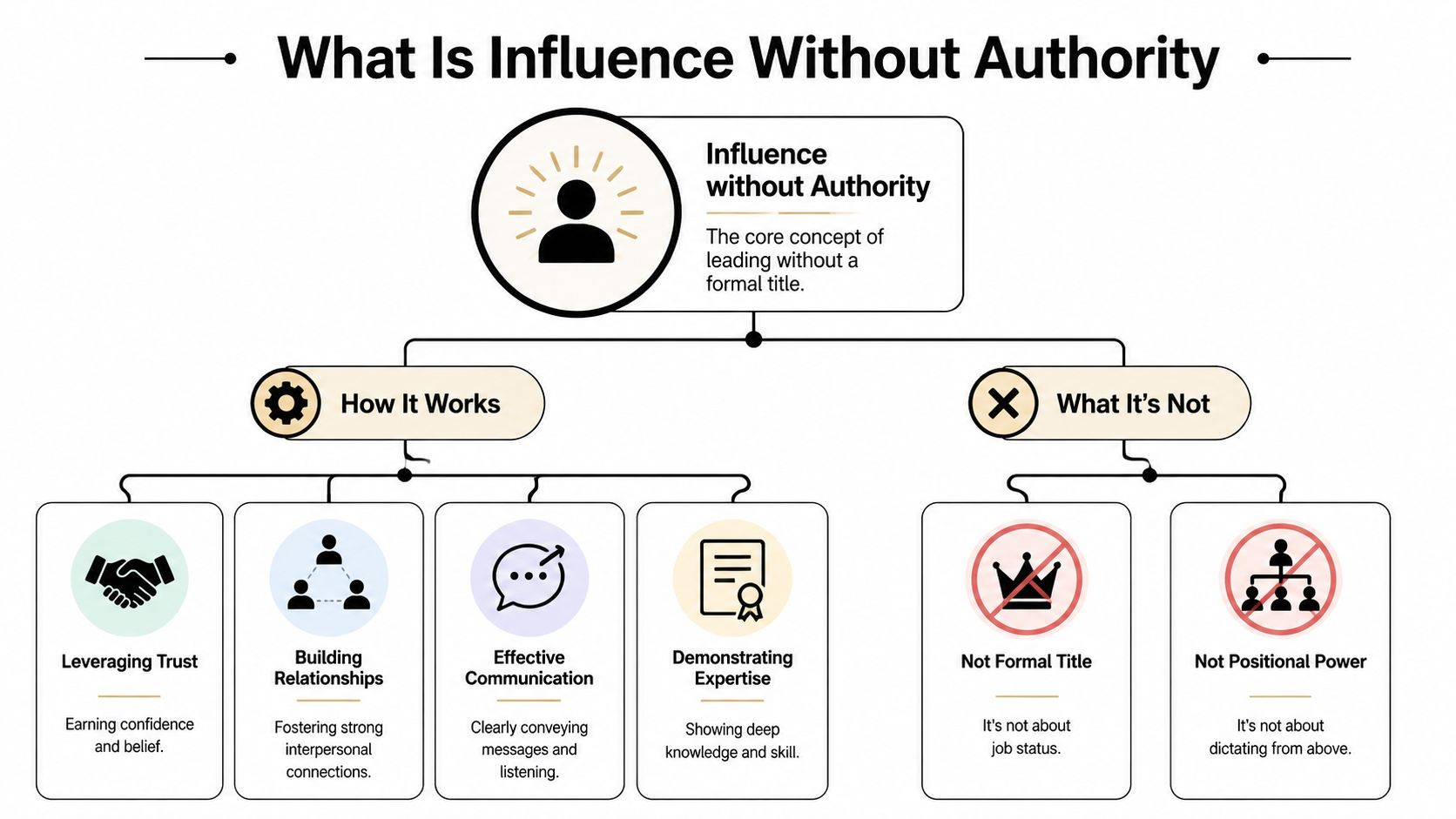
Influence without authority means getting cooperation, movement, or support from people who don't formally report to you.
Think of an orchestra conductor. The conductor doesn't play every instrument. The musicians are experts in their own parts. But the conductor aligns timing, interpretation, and energy so that individual contributions become one coherent performance. That's how influence works in organizations. You don't need formal power over every person involved. You need enough credibility and clarity to bring people into motion together.
A formal definition that matters
Wharton published a clear framework in 2021 that defines influence without authority as gaining compliance and assistance from people over whom you have no direct authority in its article on influencing without authority. That framework outlines four steps:
- Engage and ask
- Frame the angle
- Legitimize your leadership
- Activate hope by giving people a reason why
The topic has moved beyond vague soft-skill advice; it is now treated as a structured leadership capability.
What people often misunderstand
Many professionals hear this phrase and assume it means office politics or polished persuasion tricks. It doesn't.
Influence without authority is not:
- Not manipulation: You aren't trying to outsmart people.
- Not dominance: You don't need to sound aggressive.
- Not charisma theater: A louder style isn't automatically a stronger one.
It is a repeatable way to build trust, reduce resistance, and help other people see why acting with you serves a shared goal.
A lot of readers also confuse influence with executive presence. They overlap, but they aren't identical. If you want a useful distinction, this guide to what executive presence means in practice helps clarify why delivery and influence often rise together.
Later in your development, it helps to see the concept in action, not just definition. This short video gives a useful overview of how the idea works in real workplace situations.
Why the skill has become essential
Organizations have flattened. Work now runs through projects, dotted-line relationships, vendors, regional teams, and matrix reporting. That means influence increasingly depends on three things:
| What you need | What it looks like at work |
|---|---|
| Credibility | People trust your judgment |
| Alignment | Your message fits their priorities |
| Follow-through | Others believe you'll deliver |
If you can do those three things consistently, you can lead long before you get a bigger title.
The Core Techniques You Will Learn
Good influence without authority training doesn't tell you to “be more persuasive.” It teaches behaviors you can repeat under pressure.
One useful model comes from Seapoint Center's summary of the Cohen-Bradford approach in its article on influence without authority. The model identifies several sources of potential power, including character, expertise, information, connectedness, social intelligence, network, collaboration, and funding. In practice, training programs turn those ideas into skills such as stakeholder analysis, persuasion, and credibility-building.
Stakeholder mapping
Before you push an idea, you need to know whose support matters.
A stakeholder map usually answers four questions:
- Who decides
- Who influences the decision
- Who may block progress
- Who benefits if this works
For international professionals, this step reduces guesswork. Instead of trying to impress everyone, you learn where attention should go. A finance leader may care about risk. A product leader may care about adoption. A regional manager may care about implementation pain. One message won't persuade all three.
Strategic framing
A strong idea can fail because it's framed around your logic instead of their priorities.
If you say, “I think this is the right process change,” you put the burden on others to translate your point into their world. If you say, “This will reduce rework for operations and make approvals easier for finance,” you do that translation for them.
When your audience has to work hard to understand why your idea matters to them, influence drops fast.
Many non-native speakers struggle unfairly. They may know what they mean, but under pressure they explain in the order they thought it through, not in the order the listener needs to hear it.
That's why focused work on communication as persuasion can have such a large practical effect. Better influence often starts with better sequence.
Credibility signals
People rarely say, “I don't trust your leadership yet.” They show it indirectly. They ask for more proof, revisit settled decisions, or defer to someone with a smoother delivery style.
You strengthen credibility when you:
- Bring evidence: Support recommendations with relevant facts or examples
- Show command: Speak in shorter, cleaner sentences
- Stay composed: Don't rush to fill every silence
- Follow through: Small commitments build authority over time
Relationship building
Many professionals resist this part because it sounds political. It isn't. Relationship building means understanding what matters to people before you need something from them.
That can be as simple as asking better questions in regular meetings, offering help on a shared problem, or briefing key colleagues before a high-stakes discussion. If you're also building visibility externally, the same principle appears in effective content strategy for thought leaders. Influence grows when your message is clear, relevant, and repeated in ways people can absorb.
Executive presence in delivery
The same words can sound strategic or tentative depending on delivery. Your voice, pacing, pauses, and body language all affect whether others hear leadership.
One option in this space is The Gravitas Method, a 12-week one-on-one executive presence coaching program for international professionals who want to communicate with more authority and influence at senior levels. It is coached by Nikola and covers vocal authority, strategic framing, executive body language, and high-stakes communication. The program is priced at $8,200 paid in full or $9,000 across three installments.
The broader lesson is simple. Influence training works best when it connects thinking, language, and delivery instead of treating them as separate issues.
Common Training Formats Explained
Once you decide to build this skill, the next question is practical. What kind of training will help?
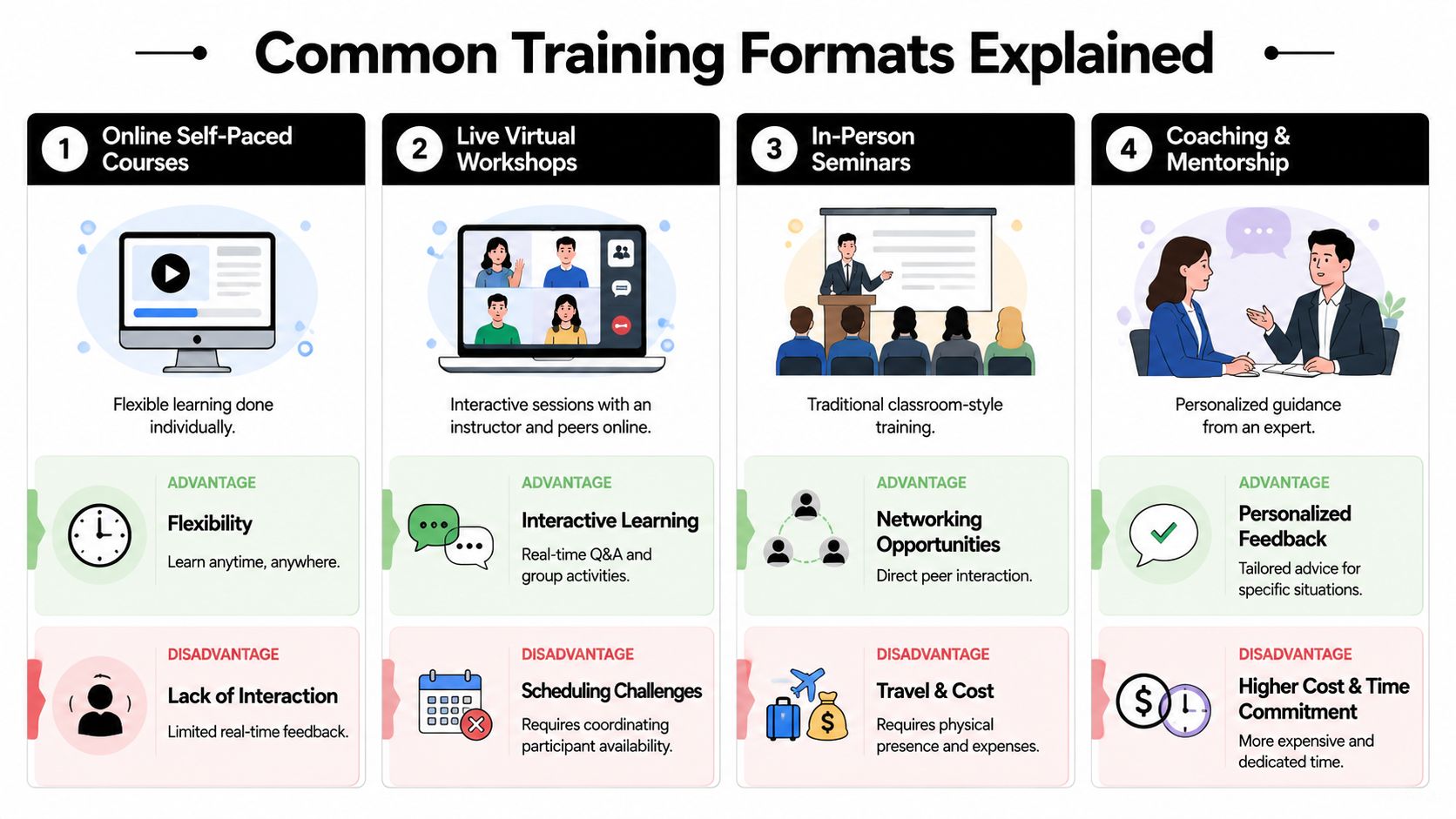
Self-paced courses
These are useful when you need flexibility and want a structured introduction.
They usually work best for professionals who are still learning the basics: stakeholder mapping, framing, trust-building, and meeting preparation. The downside is that self-paced learning can't hear your delivery, correct your phrasing in real time, or help you adapt to a specific political situation inside your company.
Live workshops and cohort programs
These formats add interaction. You can test ideas, practice conversations, and learn from peers facing similar challenges.
Their biggest strength is shared learning. You hear how others handle resistance, cross-functional conflict, and executive communication. Their main limitation is personalization. The trainer has to serve the group, so your specific communication habits may not get enough attention.
A format can be well designed and still be wrong for you if it doesn't address the situations where you actually lose influence.
In-person seminars
Some professionals learn better face to face. In-person sessions can sharpen focus and make networking easier.
They're often strongest for broad exposure and relationship-building. They're less effective when your real issue is highly specific, such as accent-related hesitation in senior meetings or difficulty sounding concise under pressure.
One-to-one coaching
This is the most targeted format. It lets you work on actual conversations, actual stakeholders, and the specific delivery patterns that weaken your authority.
A good coaching process can help you rehearse difficult conversations, tighten your message, and spot habits you can't easily hear yourself. If you're evaluating options, this resource on an influencing skills training presentation shows the kinds of capabilities many programs try to build, though the delivery format still matters.
Here's a simple comparison:
| Format | Best for | Main limitation |
|---|---|---|
| Self-paced course | Foundational learning | Minimal feedback |
| Cohort program | Peer learning and practice | Less individual focus |
| In-person seminar | Immersion and networking | Less tailored to your context |
| 1:1 coaching | High-stakes personal improvement | Higher investment of time and money |
The right choice depends on whether your challenge is knowledge, practice, or precision.
Choosing the Right Influence Program
A polished brochure doesn't tell you whether a program will help you influence your actual stakeholders.
Buyers often struggle here because the skill sounds important but the outcomes feel hard to measure. The verified data for this article includes a 2025 McKinsey finding that 62% of L&D managers cannot justify the cost of soft-skill training due to measurement ambiguity. That's the core issue. If a program promises “better collaboration” but can't connect training to visible business outcomes, decision-makers hesitate.
Start with fit, not branding
The first question isn't whether a provider is famous. It's whether the program matches your context.
If you're an international professional, generic influence training may miss the core issue. Your challenge may involve:
- Language pressure: You know the answer but need longer to phrase it
- Cultural mismatch: Your instinct for politeness may read as uncertainty
- Executive visibility: You need to sound more decisive in senior settings
- Cross-functional friction: Technical logic alone isn't moving people
A program should speak directly to the environment where you need more influence.
Ask sharper evaluation questions
Before enrolling, ask questions that expose whether the training is practical.
For example:
- What behaviors will I practice, specifically?
- How do you handle cross-cultural communication challenges?
- Will I get feedback on real meetings, presentations, or stakeholder conversations?
- How do you define progress beyond participant satisfaction?
Those questions matter more than glossy curriculum labels.
Look for signs of measurable value
Not every influence outcome can be reduced to a single neat metric, but serious programs should still connect learning to observable changes.
Reasonable indicators include:
- Decision quality: Are your recommendations getting traction faster?
- Stakeholder movement: Are more people responding, aligning, or committing?
- Visibility: Are senior leaders involving you earlier in strategic conversations?
- Career signal: Are you being trusted with broader initiatives?
What to watch for: If a program only talks about confidence, inspiration, or mindset, keep asking how those changes show up in day-to-day business decisions.
Match the teacher to the problem
Influence is situational. Academic knowledge can help, but lived experience matters too. Someone teaching this skill should understand meetings that go sideways, resistance from peers, executive impatience, and the reality of communicating under linguistic pressure.
The best program for you is rarely the one with the widest promise. It's the one that can diagnose why your influence breaks down and give you practice that maps to your real work.
Your 4-Week Action Plan to Build Influence
You don't need to wait for a formal course to start building this skill.
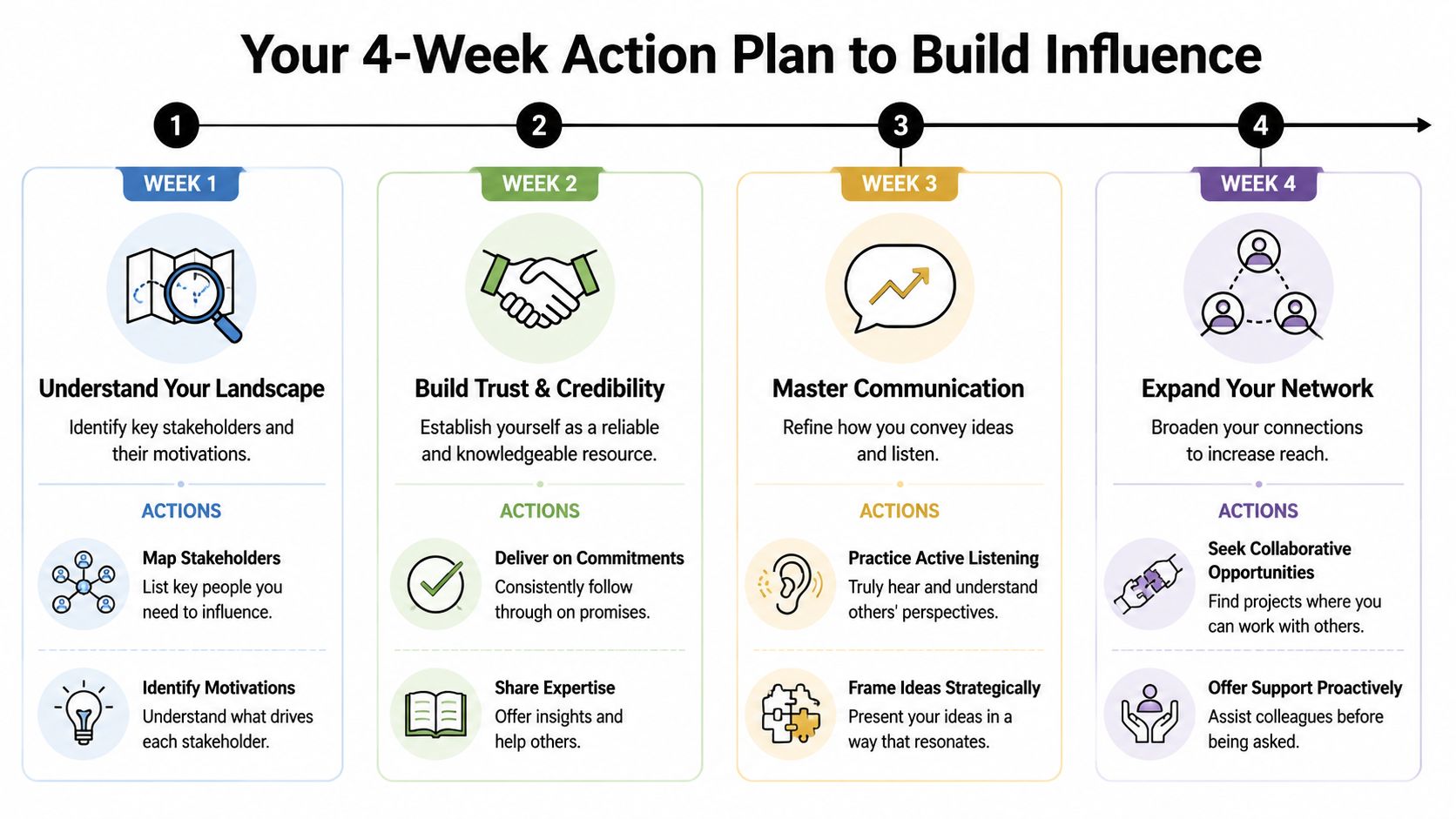
Week 1 Observe and map
Pick one recurring meeting. Don't focus on what you want to say yet. Focus on the influence dynamics.
Write down:
- Who shapes the conversation
- Who asks risk questions
- Who others defer to
- What each person seems to care about most
Then identify one stakeholder you need to understand better. Your job this week is observation, not persuasion.
A helpful companion is this guide on how to increase your influence at work, especially if you tend to enter meetings with content but not a clear stakeholder read.
Week 2 Reframe one idea three ways
Take one proposal you're likely to raise soon. Write three versions of the same message.
For example:
- For a finance stakeholder: emphasize risk, efficiency, or resource clarity
- For an operations stakeholder: emphasize execution and reduced friction
- For a senior leader: emphasize business impact and decision simplicity
This exercise trains one of the hardest executive skills. Saying the same thing in language that different audiences can hear.
If your first draft sounds like a technical explanation, keep going. Strategic framing usually appears in the second or third rewrite.
Week 3 Build one micro-alliance
Choose one colleague whose support would make your work easier. Not your best friend. Not the most intimidating executive. Pick someone realistic and relevant.
Do one useful thing for that person this week:
- Share a helpful insight
- Solve a small problem
- Offer context before a meeting
- Ask a thoughtful question about their priorities
Influence grows faster when people experience you as useful before they need to evaluate you.
Week 4 Lead a low-stakes initiative
Volunteer to coordinate something small. It might be a meeting streamlining effort, a cross-team summary, a pilot discussion, or a decision follow-up.
Your focus isn't status. It's practice.
Try this sequence:
- Clarify the goal in one sentence.
- Name the stakeholders involved.
- Frame the next step so it's easy to say yes.
- Follow up clearly after the discussion.
At the end of the week, ask yourself:
- Where did people respond well?
- Where did I lose clarity?
- Did I sound concise or overloaded?
- What would I change next time?
This four-week plan won't make you perfect. It will make you more deliberate. That's how influence starts becoming visible.
Conclusion Your Next Step to Unlocking Influence
Influence isn't a personality gift that some people are born with and others aren't. It's a professional skill built from judgment, trust, framing, and delivery.
If you've been underestimated, interrupted, or passed over, that doesn't mean you're not ready for bigger leadership. It often means your expertise isn't yet being translated into authority in a way other people can immediately recognize. That's a fixable problem.
Influence without authority training helps because it makes the hidden parts of leadership visible. You learn how to read stakeholders, shape a message for the room, build allies, and speak in a way that carries weight. For international professionals, that work can be especially powerful because it addresses a gap that standard leadership training often ignores.
You don't need to guess where your communication breaks down. Start by understanding your current baseline. Once you know whether the issue is framing, vocal authority, executive presence, or high-stakes delivery, improvement gets much faster.
If you're ready to get specific about what strengthens or weakens your authority at work, the best first step is the free Executive Communication Assessment from Intonetic. It gives you a clearer view of how you're currently coming across in senior-level interactions, and where to focus if you want more influence without relying on title alone.