How to Increase Your Influence at Work (A Guide)
You know the pattern. You do strong work. You solve difficult problems. You prepare more thoroughly than many others in the room.
Then the meeting starts, someone less informed says the same thing with more certainty, and their idea gets traction while yours lands softly and disappears.
That gap frustrates ambitious professionals for a reason. It feels irrational. If your analysis is better, your influence should be stronger. But work doesn't operate like an exam. Senior influence depends on more than correctness. It depends on how clearly you frame the issue, how confidently you deliver the point, and how deliberately you build support before the room decides.
For international professionals, this gap is even sharper. Many are already carrying the extra load of translating quickly, managing how they're perceived, and trying to sound polished under pressure. If that sounds familiar, you're not lacking capability. You're dealing with an influence problem, not a competence problem.
Introduction You're an Expert But Are You Influential
A strong performer can still be overlooked.
That happens to technical leads, senior analysts, product managers, consultants, and directors every day. They bring the right answer, but they present it too late, too cautiously, or to the wrong people. Then they watch a weaker idea move forward because it was framed better and backed by more internal support.

Influence at work isn't charisma in the vague sense people often imply. It's a system. You can study it, practice it, and improve it. That system includes your relationships, your timing, your stakeholder awareness, and your delivery under pressure.
Many professionals spend years perfecting expertise while neglecting influence mechanics. That's why useful frameworks such as Aakash Gupta's 10 core tactics of influence resonate with high performers. They turn office politics into something more concrete: trust, timing, framing, reciprocity, and decision awareness.
Why expertise alone doesn't carry senior weight
At junior and mid levels, strong execution often speaks for itself. At senior levels, it rarely does.
Leaders aren't only evaluating whether you're right. They're assessing whether you can align people, reduce friction, anticipate objections, and move decisions forward. If your message is technically sound but politically unprepared, it won't travel very far.
Influence starts before the meeting. The meeting only reveals whether you did the work.
International professionals often tell themselves a damaging story: "If I just improve the quality of my work, eventually people will notice." Sometimes they do. Often they don't. Senior visibility comes from making your value legible to other people.
What changes when you learn how to increase your influence at work
The shift is practical.
You stop walking into high-stakes conversations hoping your point will naturally win. You start identifying whose support matters, what language they respond to, and what concerns they need resolved before they can back you. You also start paying attention to delivery. That includes pacing, pauses, directness, and composure.
If accent bias or delivery anxiety has affected how you're perceived, it's worth understanding the communication layer more clearly. This breakdown on how your accent really affects your career and what you can actually do about it is useful because it addresses the issue directly rather than pretending content alone solves everything.
A lot of advice on how to increase your influence at work stays abstract. "Build relationships." "Speak up more." "Be confident." None of that helps enough on its own. What works is a combination of internal control and external strategy. First, you need to sound and act like someone whose message deserves weight. Then you need to aim that message where decisions get made.
The Foundation Vocal Authority and Executive Mindset
Most influence problems show up in delivery before they show up in content.
A 2024 LinkedIn report discussed by HBS Online found that 68% of non-native English speakers in senior roles cite communication style as their top barrier to promotion. The same source notes a Gartner 2025 study finding that 42% of hybrid teams value vocal command over content clarity for building trust. That doesn't mean substance doesn't matter. It means people often judge leadership readiness through delivery first.

If you speak too quickly, soften every statement, fill silence with extra explanation, or let your voice trail off at the end of key points, people don't experience you as senior. They experience you as uncertain, even when you're right.
Sound like someone who expects to be heard
Vocal authority isn't about sounding louder or more aggressive. It's about sounding settled.
Use these adjustments immediately:
- Slow your first sentence: Your opening pace sets the room's perception of your composure.
- Finish statements cleanly: Don't let key sentences fade upward as if you're asking for permission.
- Pause after the main point: A short pause signals control. It also gives people time to process.
- Cut verbal clutter: Words like "just," "maybe," "kind of," and "I think" weaken sentences that are already strong enough.
- Lower the rush before objections: Many professionals speed up when challenged. That speed reads as stress.
Try this in your next meeting. Replace "I was just thinking maybe we could consider another option here" with "I see a better option. Let me outline it."
Same intelligence. Different authority.
Move from participant to leader
Mindset matters because it changes your choices in real time.
Professionals who stay in participant mode wait for invitations. They wait to be asked, wait to be recognized, wait until their point is perfectly polished. Leaders don't do that. They enter the conversation prepared to shape it.
That doesn't mean dominating airtime. It means taking responsibility for clarity, decision quality, and momentum.
A useful shift is this:
| Old frame | Better frame |
|---|---|
| I hope they value my input | My role is to help the room make a better decision |
| I need to sound perfect | I need to sound clear and composed |
| I should avoid taking too much space | I should take the space the idea requires |
Practical rule: Senior presence starts when you stop treating your contribution as an interruption.
This is especially important if you've been socialized to be deferential in English-speaking workplaces. Deference can look respectful. It can also look non-leadership.
Daily drills that change how you're perceived
You don't build authority by reading about it. You build it through repetition.
Use a short practice routine:
-
Record your meeting opener
State your point in two sentences. Listen for speed, lift at the end, and filler words. -
Practice strategic pausing
Deliver one sentence, pause, then continue. Individuals often discover their natural pause is much shorter than they think. -
Trim your answer length
Take a one-minute answer and cut it to twenty seconds without losing the point. -
Pre-commit to a stronger opening line
Instead of "I have a few thoughts," say "There are two risks we need to address."
A lot of communication coaching ignores these mechanics and stays at the level of generic confidence advice. That's why more targeted work matters for international professionals. If you want a structured next step, the Executive Communication Assessment is designed to identify the specific delivery habits that weaken authority in high-stakes settings.
Later in this section, watch this short training and notice how much authority is created by timing, structure, and restraint rather than volume.
For professionals who want deeper one-on-one work, The Gravitas Method is a 12-week one-on-one executive presence coaching program for international professionals who want to communicate with more authority and influence at senior levels. The program is priced at $8,200 paid in full or $9,000 across three installments. Coached by Nikola, it covers vocal authority, strategic framing, executive body language, and high-stakes communication.
What does not work
Some habits feel safe but reduce influence:
- Over-explaining: It makes your message harder to follow.
- Apologizing before speaking: "This may be a silly point" tells people how to rate your idea.
- Memorizing every sentence: You sound rigid when the conversation moves.
- Copying native speakers blindly: You need clarity and control, not someone else's personality.
Authority isn't performance. It's stability under pressure. When people feel that stability from you, they listen differently.
Design Your Influence Blueprint With Strategic Framing
Strong delivery helps. It isn't enough.
You can sound polished and still fail if you're trying to persuade the wrong people, asking for the wrong decision, or framing your idea in language your audience doesn't care about. Influence gets easier when you make it analytical.
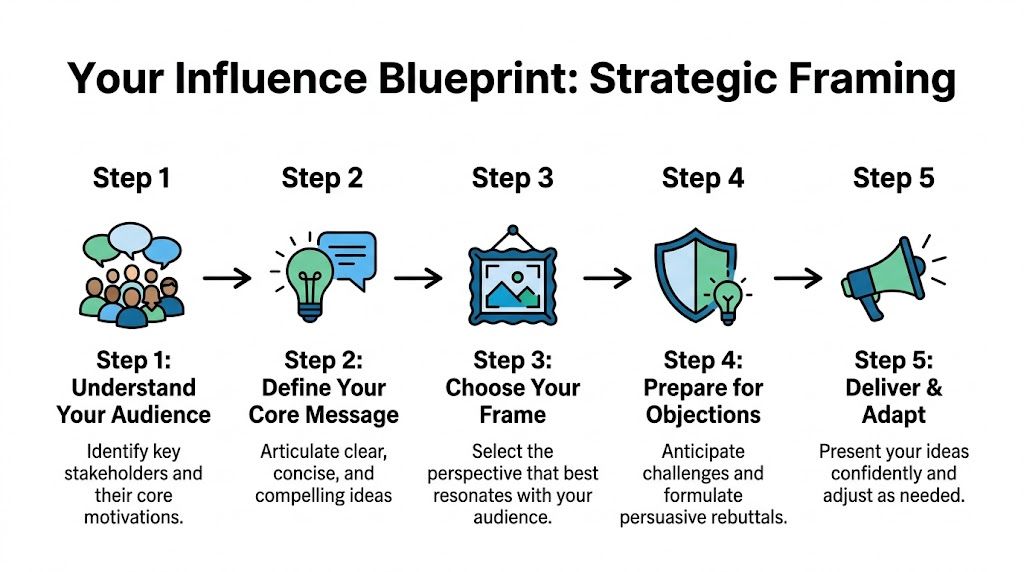
The Big Four Influence Strategy Framework from Stanford Social Innovation Review offers a useful structure: define the decision, map the decision-makers, form a hypothesis, and execute a game plan. According to that framework, following a structured plan can improve buy-in by 40-50%, while targeting the wrong stakeholders causes 60% of initiatives to stall.
Start with the real decision
Many professionals think they're advocating for "support" or "alignment." That's too vague.
Name the actual decision. Is it budget approval? A project reprioritization? Headcount? A shift in timeline? A change in ownership? Once the decision is specific, your influence work becomes more precise.
Ask yourself:
- What exactly needs to happen
- Who can approve it
- Who can block it indirectly
- What would count as a win in this conversation
If you can't answer those clearly, you're probably trying to persuade a room without a defined ask.
Build a power map, not a fantasy org chart
Formal hierarchy matters. Informal influence matters more than people admit.
For one initiative, sketch a simple power map with four groups:
| Stakeholder type | What to note |
|---|---|
| Decision-maker | Final authority, risk tolerance, priorities |
| Influencer | Trusted by the decision-maker, shapes opinion early |
| Ally | Already aligned, can reinforce your message |
| Blocker | Likely concern, preferred evidence, relationship history |
A finance leader may care about risk and predictability. A product executive may care about speed and customer impact. An engineering director may care about technical debt, staffing strain, and delivery sequencing. If you deliver the same message to all three, your framing is weak.
Frame the same idea three different ways
Many capable people lose influence when they present information as if facts are self-explanatory.
They aren't.
Suppose you want to delay a launch by two weeks. Here are three frames:
- For finance: "A short delay reduces the risk of expensive rework and protects downstream commitments."
- For product: "This gives us a stronger release with fewer avoidable support issues."
- For engineering: "This prevents the team from shipping known fragility that we'll have to repair under pressure."
Same recommendation. Different language. Better odds.
If your message doesn't connect, don't assume the audience is difficult. First check whether you framed the idea in their priorities.
Test your hypothesis before the big meeting
Don't wait for the formal discussion to discover what people think.
Use short pre-meetings, coffee chats, Slack exchanges, or one-on-ones to test assumptions. You're looking for signs: what concerns come up first, what language people use, what trade-offs they emphasize, and where resistance sits.
A simple pre-meeting question works well: "When this comes up with leadership, what do you think the main concern will be?" That question reveals more than another polished monologue from you.
Then turn what you hear into a game plan:
- Lead with the concern leadership already has
- Present your recommendation in their language
- Address the likely objection before it's raised
- Invite targeted input rather than vague discussion
This is strategic framing. It isn't manipulation. It's disciplined communication.
Most office politics become less mysterious when you stop treating influence as personality and start treating it as diagnosis, positioning, and adaptation.
Command Attention in High-Stakes Interactions
The true test comes when the room gets tense.
A senior review, a steering committee, a budget discussion, a board prep call, a negotiation with a difficult peer. That's where influence either becomes visible or collapses. Technical experts often know the material cold and still lose ground because pressure narrows their delivery.
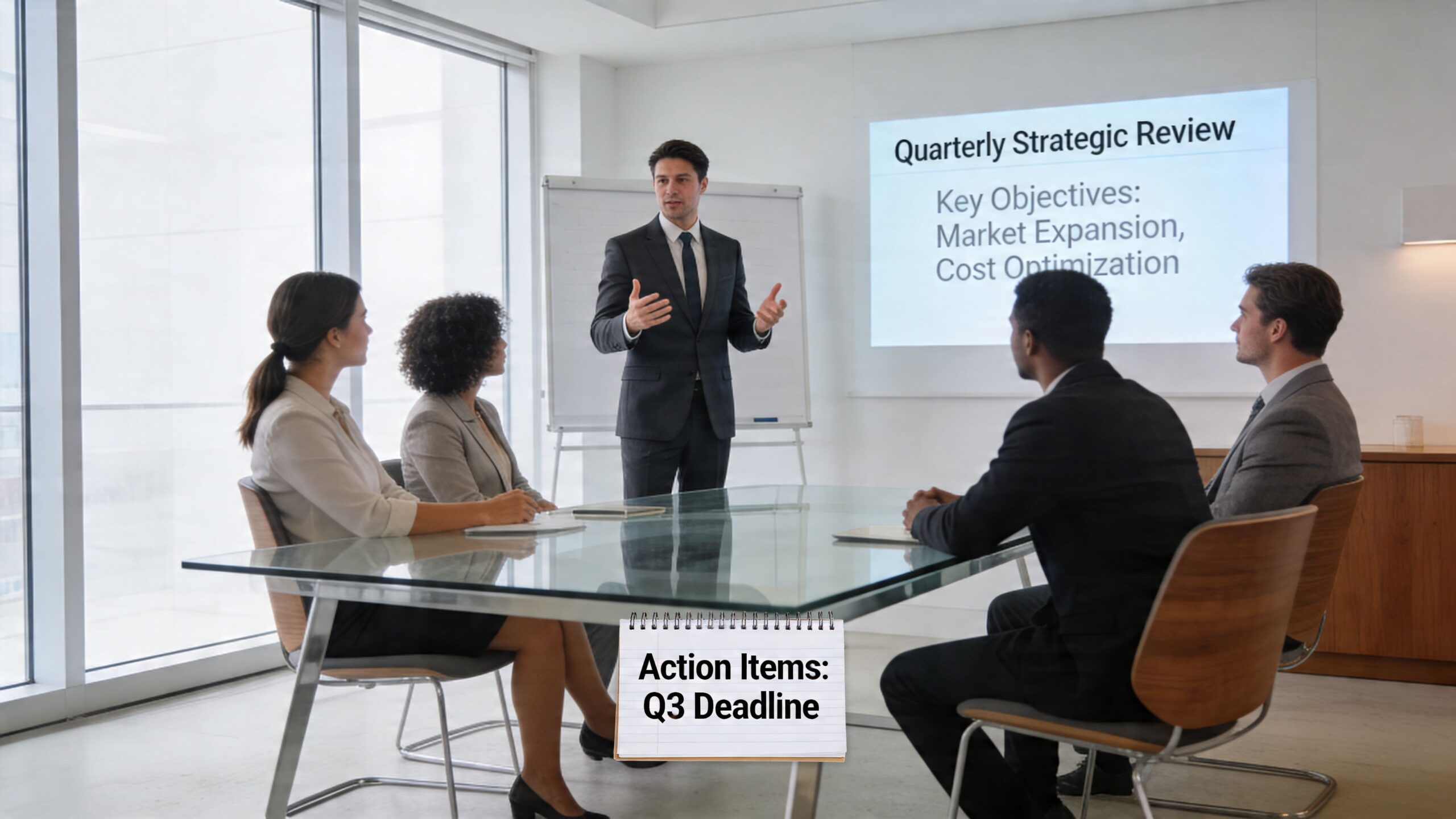
What works in these moments isn't more information. It's control. Control of your pacing, your framing, and the emotional temperature of the conversation.
According to Susan Finerty's relationship-centered approach, practicing bidirectional influence, which means seeking others' input before pushing your own agenda, can reduce resistance by 50%. The same source notes that trust deficits account for 65% of failed influence attempts in corporate environments, as described in this piece on proactive influence building.
Scenario one when your point gets ignored in a meeting
A common mistake looks like this.
Before
"Sorry, can I add something? I think maybe we should also consider the customer implications, because there might be some downstream problems."
That sounds hesitant. It also buries the point.
A stronger version:
After
"I want to pull us back to customer impact for a moment. If we make this change now, we create downstream support risk. We should address that before deciding."
The second version does three things. It names the topic, states the risk, and claims space without apology.
Scenario two when a senior leader challenges you directly
A lot of professionals become defensive too quickly.
Before
"No, I didn't mean that. What I was trying to say is that the team has worked very hard and there are a lot of complexities here."
That answer protects your feelings. It doesn't move the conversation.
After
"That's a fair challenge. My view is still the same. The current plan creates delivery risk, and the better option is to sequence it differently. Let me explain why."
You acknowledge without surrendering. That's the balance.
In the room: Treat challenge as part of the work, not as a sign you've failed.
Scenario three when you need to say no without losing trust
Influential professionals don't reject ideas bluntly or disappear into vague politeness. They redirect.
Before
"That won't work."
After
"I wouldn't recommend that path. The trade-off is too expensive for what we gain. A better option is to keep the objective and change the sequence."
That response preserves momentum. It also signals that you're solution-oriented, not obstructive.
Use questions to lower resistance
Bidirectional influence matters. If you only push, people brace.
Try these questions in high-stakes conversations:
- "What's the main concern from your side?"
- "If we pursued this, what would you need to feel comfortable supporting it?"
- "Which risk matters more here, speed or stability?"
- "What would make this easier to back with leadership?"
These aren't soft questions. They're strategic. They surface the underlying objection so you can address it.
If your team struggles with broader habits around clarity, feedback loops, and listening quality, this guide on improving communication in the workplace is a useful companion because it focuses on practical communication behavior rather than slogans.
A simple playbook for tense conversations
When stakes are high, use this sequence:
-
State the issue plainly
Name the decision, risk, or disagreement without long setup. -
Show you've heard the other side
Summarize the concern fairly. People relax when they feel understood. -
Make your recommendation cleanly
One sentence. No hedging. -
Support with selective evidence
Give enough detail to justify the point, not every detail you know. -
Invite focused discussion
Ask for reaction on the core trade-off, not on everything at once.
You can rehearse this structure before any critical meeting.
For professionals who want sharper support specifically for boardroom pressure, stakeholder challenge, and persuasive delivery in difficult conversations, this article on confident communication in high-stakes situations gives a useful lens on what to practice.
High-stakes influence isn't about sounding impressive. It's about staying composed enough to help the room think clearly when pressure rises.
Amplify Your Visibility and Position Yourself for Promotion
Single moments matter. Patterns matter more.
Promotion decisions rarely come down to one presentation or one meeting. They come from accumulated signals. People start to associate you with clarity, judgment, initiative, and reliable influence. Once that reputation forms, opportunities find you faster.
A Harvard Business Review analysis found that professionals who master informal leadership tactics such as power mapping and cultivating allies are 30-50% more likely to be promoted into formal leadership roles. The same analysis found that strategically tailoring pitches to colleagues' needs led to ideas being adopted 40% more frequently in meetings.
That should change how you think about career growth.
Do work that gets seen by the right people
A lot of talented professionals stay too loyal to invisible excellence. They become indispensable inside a narrow lane, then wonder why someone else gets tapped for the broader role.
You need visible relevance, not only reliable output.
Good visibility comes from work that sits at least partly in one of these areas:
- Cross-functional importance: Projects that require coordination across teams
- Leadership attention: Problems senior leaders already care about
- Business consequence: Work tied to revenue, risk, customer trust, or strategic execution
- Decision complexity: Situations where judgment matters as much as execution
That doesn't mean chasing every flashy project. It means choosing assignments that let other people observe your thinking.
Translate contribution into leadership signals
Many international professionals understate their role because they don't want to sound self-promotional.
The solution isn't bragging. It's precise reporting.
Compare these two updates:
| Weak update | Strong update |
|---|---|
| "We finished the migration and things went well." | "We completed the migration, reduced rollout friction across teams, and resolved the two issues leadership had flagged as adoption risks." |
The second version doesn't inflate anything. It makes the value visible.
Senior people don't just notice outcomes. They notice who frames outcomes in business terms.
This also applies to status meetings, executive summaries, and promotion conversations. If you don't explain the significance of your work, other people will simplify it for you, usually downward.
Build sponsors, not just friendly contacts
Networking advice often stays shallow. Influence grows faster when respected people can speak for your judgment when you're not in the room.
A sponsor is different from a supportive colleague. A sponsor puts your name forward for stretch work, promotion discussions, or strategic exposure. You build that kind of support by making other people's decision-making easier, not by collecting casual relationships.
Three behaviors help:
- Bring clarity: Become the person who can make messy issues easier to understand.
- Be easy to trust under pressure: Sponsors back people who stay solid when situations get political.
- Make your ambition legible: If no one knows you're aiming for director, VP, or broader scope, they can't advocate for you intelligently.
If you're wondering how long communication changes take to affect career outcomes, this article on how long before your improved accent affects your career success offers a grounded perspective on the compounding effect of better delivery and clearer perception.
Promotion doesn't only reward hard work. It rewards visible, transferable leadership. Influence is what turns your contribution into a reputation other people can endorse.
Conclusion Measure Your Impact and Take the Next Step
Influence feels intangible until you start tracking its effects.
Then it becomes easier to see what is changing. Your ideas get picked up faster. Senior leaders ask for your view earlier. Meetings feel less like a fight for airtime and more like a place where your contribution carries weight.
Gallup's workplace research, based on data from over 2.5 million employees, shows that building influence through trust and feedback increases employee engagement by 21%, directly boosts promotion rates by 18%, and contributes to teams with 21% higher profitability, according to Gallup's workplace findings. Influence isn't just personal polish. It creates operational value.
What to measure in your own work
You don't need a complicated dashboard. You need evidence that your communication is producing more traction.
Track a few indicators over the next quarter:
- Proposal adoption: How often your recommendations move forward
- Senior pull: How often leaders ask for your input without you volunteering first
- Meeting traction: Whether your points shape the direction of discussion
- Follow-up quality: Whether people act on your message after the meeting
- Advocacy from others: Whether colleagues reference your thinking when you're not leading the conversation
None of these need fake precision. You are looking for trend, not vanity.
What progress usually looks like
Progress often appears in this order:
- You feel more composed when speaking.
- Other people interrupt you less.
- Your message gets summarized back accurately.
- Stakeholders start involving you earlier.
- Your name enters higher-level conversations more often.
That's a better sequence than chasing confidence as a mood. Confidence is unreliable. Communication habits are trainable.
Keep your measurement tied to behavior
A lot of professionals judge themselves too broadly. "Was I influential?" is too vague.
Use narrower review questions after major interactions:
| After the interaction, ask | Why it matters |
|---|---|
| Did I state the decision clearly? | Influence weakens when the ask is fuzzy |
| Did I frame the issue in their priorities? | Strong ideas fail when the audience can't see relevance |
| Did I sound calm and deliberate? | Delivery shapes perceived authority |
| Did I surface objections early enough? | Resistance becomes harder to manage once people dig in |
| Did I leave with a next step? | Influence without movement is mostly performance |
Skill compounds. Better delivery helps your framing. Better framing improves your meeting outcomes. Better outcomes improve your visibility. Better visibility strengthens your promotion case.
If you're tracking communication change directly, this guide on how to measure your accent reduction progress accurately is useful because it pushes you toward observable markers instead of vague self-judgment.
Influence at work isn't reserved for the loudest person, the most politically fluent person, or the native speaker with the easiest cadence. It belongs to professionals who learn how decisions move, how trust is built, and how authority is communicated in real time.
You already have expertise. The next move is making that expertise land with senior-level force.
If you're ready to turn strong work into stronger executive influence, start with the free Executive Communication Assessment from Intonetic. It gives you a clearer view of the specific habits affecting your authority, from vocal delivery to strategic framing, so you know exactly what to fix next.