How to Speak More Concisely: Master Clear Communication
You know the feeling. You finally get the floor in a meeting, you start explaining a solid idea, and halfway through you can feel attention drifting. Someone interrupts to “help summarize.” Someone else jumps to a decision before you've landed your point. You leave knowing your thinking was strong, but your delivery made it harder for people to trust it.
If you're an international professional, this problem is more frustrating than most communication advice admits. You're often balancing clarity, nuance, diplomacy, and language precision at the same time. Cut too much, and you sound vague. Add context, and people may call you wordy.
That tension is real. And it's why learning how to speak more concisely isn't about sounding shorter. It's about sounding senior.
Why Speaking Concisely Is Your Hidden Superpower
For high-achieving professionals, conciseness is often misunderstood as a personality trait. People assume some leaders are naturally brief and others are naturally detailed. That's not what I see in practice. Concise speakers usually aren't saying less because they know less. They're selecting better.
That distinction matters even more if English isn't your first language. Data shows that non-native speakers are frequently penalized for being "too wordy" even when they are providing essential clarity, while native speakers delivering the same density of information are perceived as "detailed" and "strategic". That double standard creates a real conciseness paradox. If you oversimplify, you can strip away the framing that makes your idea credible. If you explain fully, you risk sounding less senior than a native speaker delivering the same substance with more ease.
Concise is not the same as thin
A lot of generic advice gets this wrong. “Just be brief” sounds simple, but it fails in real rooms. Executives don't reward short answers that create confusion. They reward answers that move thinking forward.
Here's the difference:
| Weak brevity | Strong conciseness |
|---|---|
| Cuts context people need | Keeps only the context needed for a decision |
| Sounds abrupt or underdeveloped | Sounds clear, deliberate, and confident |
| Forces listeners to ask follow-up questions | Anticipates the critical question and addresses it fast |
If you want to boost your communication abilities more broadly, this is one of the highest-impact places to work. Conciseness improves meetings, updates, stakeholder conversations, and even the way people interpret your leadership potential.
Conciseness doesn't mean removing your intelligence from the message. It means removing everything that competes with it.
Why this changes how people hear you
Concise speaking creates two immediate effects in senior environments.
- It signals judgment. People assume you know what matters because you lead with what matters.
- It creates confidence. A compact answer sounds more deliberate than a wandering one, even when both contain the same core idea.
- It earns airtime. When people trust that your answer will be sharp, they stop bracing for a monologue.
This is why concise communication becomes a hidden superpower. It isn't just about efficiency. It changes perceived authority.
And for international professionals, that shift is especially valuable. You don't need to become less nuanced. You need to become more selective about where the nuance belongs.
First Understand Your Audience and Your Goal
A common approach to conciseness involves editing words. That's too late. The shift happens before you speak.
Research from the Wharton Communication Program at the University of Pennsylvania establishes that the foundational step to speaking concisely is "de-centering," a cognitive shift where the speaker stops focusing on what they want to tell and instead focuses strictly on what the audience needs to know to achieve a desired outcome. That idea is simple and ruthless. Your job is not to unload everything in your head. Your job is to deliver what helps the other person decide, act, align, or respond.
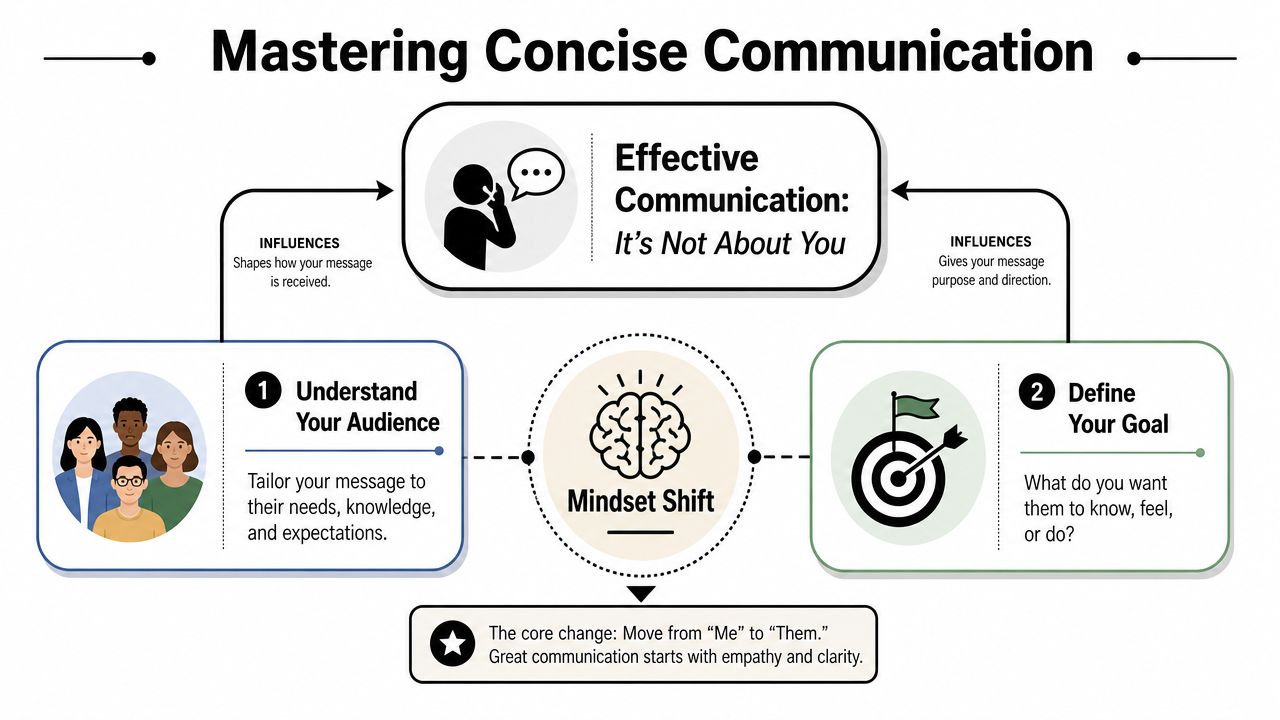
Ask two questions before you open your mouth
If you tend to over-explain, use this filter.
-
What is my purpose
Are you asking for a decision, giving an update, surfacing a risk, or making a recommendation? If you can't name the purpose cleanly, you'll ramble.
-
What does this audience need
Not what would be nice to mention. Not what proves how much work went into it. What do they need from you right now?
This is especially important in cross-cultural communication. Many international professionals add background to be respectful, complete, or careful. That instinct isn't wrong. It's often smart. But if the audience only needs the conclusion and one key reason, giving five reasons weakens your impact.
Reduce the message to one or two sentences
Wharton's guidance is strict for a reason. Compress your full purpose into one to two sentences before you build anything around it. That's the discipline that cuts throat-clearing and stops you from narrating your thought process.
Try this pattern:
- Sentence one: the main point
- Sentence two: the reason, implication, or ask
For example:
- “We should delay the launch by one week. The current risk is not demand, it's preventable instability in onboarding.”
- “I recommend we proceed. The downside is manageable, and waiting won't improve the decision.”
If you need help adapting this for live presentations, this guide on how to engage the audience pairs well with concise message design because audience focus and brevity work best together.
Practical rule: If your opening needs a runway, your thinking probably isn't ready.
A concise speaker doesn't start with history. A concise speaker starts with relevance.
Frame Your Ideas with the Headline First
When professionals ramble, they often blame nerves. Structure is usually the bigger issue. They answer chronologically instead of strategically.
Chronological speaking sounds like this: “First we looked at the data, then we noticed a pattern, then the team discussed several options, and eventually we decided…” That sequence may reflect how you arrived at the answer, but it's rarely how senior people want to receive it.

Lead with the conclusion
A better pattern is headline first. Give the answer, then support it.
That means your answer in a meeting can sound like this:
- “My recommendation is to pause the rollout.”
- “The issue is not budget. It's ownership.”
- “Yes, we can deliver this quarter, but only if we reduce scope.”
You're not being abrupt. You're making the conversation easier to follow.
Use SOAR to keep the support tight
After the headline, use SOAR to keep your explanation disciplined.
| SOAR element | What to say |
|---|---|
| Situation | What's happening now |
| Obstacle | What is blocking progress or increasing risk |
| Action | What you did or recommend doing |
| Result | What changed or what outcome you expect |
Example:
“My recommendation is to move the deadline. The situation is that the product is functional, but onboarding is still unstable. The main obstacle is avoidable user friction in setup. The action I'm recommending is a short delay focused only on onboarding fixes. The result is a cleaner release and fewer preventable escalations.”
That structure sounds calm, strategic, and easy to trust.
If your ideas tend to lose shape in longer updates, studying how to structure a presentation can sharpen the same muscle. Presentations and meeting answers rely on the same principle. Start with the point, not the path.
Start with what they need to know. Then earn the right to add detail.
Cut the Fluff and Amplify Your Voice
Once the structure is right, word choice becomes the next advantage. At this stage, seniority starts sounding audible.
A lot of verbal clutter comes from habits that feel harmless: filler words, weak qualifiers, passive constructions, and sentences that start without a clear subject. These patterns don't just make you longer. They make you sound less decided.
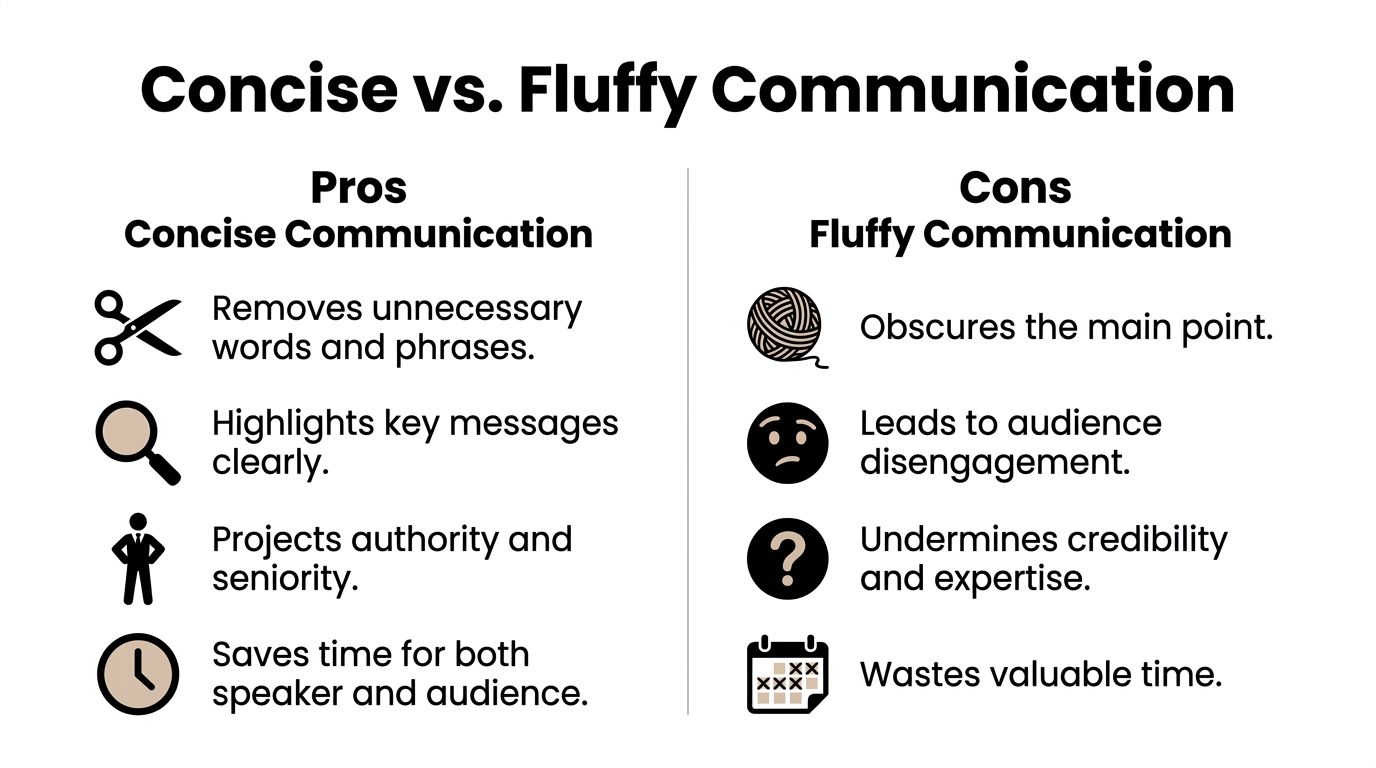
Tighten the sentence
Use this quick edit lens while you speak or rehearse:
- Swap passive for active
“A decision was made to postpone” becomes “We postponed.” - Cut unnecessary openers
“There is one issue we need to consider” becomes “One issue matters.” - Remove verbal padding
“I just wanted to quickly say that maybe we could” becomes “I recommend we.”
Here's a simple comparison:
| Fluffy version | Concise version |
|---|---|
| “I think what I would say is that we probably need more time.” | “We need more time.” |
| “There are several things that are causing the delay.” | “Three issues are causing the delay.” |
| “It was decided by the team that we should revise the proposal.” | “The team decided to revise the proposal.” |
Stop filling silence
Delivery matters as much as wording. Hewlett's research identifies that pausing for emphasis is a critical technique for projecting authority, as it prevents the "filler word" trap and ensures every spoken sentence carries intentional weight, directly supporting the mechanical shift from verbose to concise communication.
That means the pause is not dead air. It is control.
Use a pause in three places:
- Before the answer when you need one beat to think
- After the headline so the main point lands
- Before a key word when you want emphasis without sounding dramatic
For spoken language practice, especially if filler words keep slipping into your delivery, this piece on filler words in speech is useful because it helps you hear the habits you no longer notice.
This short clip is also worth studying for rhythm and delivery.
If you want a surprising way to sharpen your ear, study dialogue. Writers who improve your book's dialogue learn the same discipline good speakers need. Every line must sound natural, intentional, and free of dead weight.
The fastest way to sound more concise is to stop trying to sound continuously fluent. Silence used well sounds stronger than filler used automatically.
Build the Habit with Deliberate Practice
Most professionals understand conciseness intellectually. That's not the same as being able to do it in a tense meeting. If you want this skill under pressure, you have to train compression until it becomes familiar.
The strongest drills are measurable. They force you to choose what stays and what goes.
Use the shrinking window
This drill works because each round exposes what was optional.
Try it with topics you discuss at work:
- a project update
- a product risk
- a hiring recommendation
- a client issue
Record yourself. Don't aim to sound polished at first. Aim to hear what disappears between 60 and 15 seconds. That disappearing material is often where your unnecessary wording hides.
Add constraints to real meetings
A second drill is the Word Budget method. Give yourself 50 words for one contribution in a meeting. That limit changes how you listen. You stop planning a speech and start choosing an intervention.
Use it when:
- you're adding a decision point
- you're surfacing one risk
- you're giving a recommendation
- you're answering a direct question
The discipline is simple. Make one point. Support it briefly. Stop.
If you want your practice routine to stick, borrow a few evidence-based habit techniques and attach these drills to existing routines, such as your first meeting of the day or your end-of-day review.
What structured coaching changes
Self-practice helps. Personalized feedback accelerates the change because someone else can hear the patterns you normalize.
The Gravitas Method is a 12-week one-on-one executive presence coaching program for international professionals who want to communicate with more authority and influence at senior levels. The program is priced at $8,200 paid in full or $9,000 across three installments. Coached by Nikola, it covers vocal authority, strategic framing, executive body language, and high-stakes communication.
If you're building this skill in English, regular business English speaking practice also helps because concise speaking depends on retrieval speed, not just vocabulary knowledge.
From Concise Speaker to Influential Leader
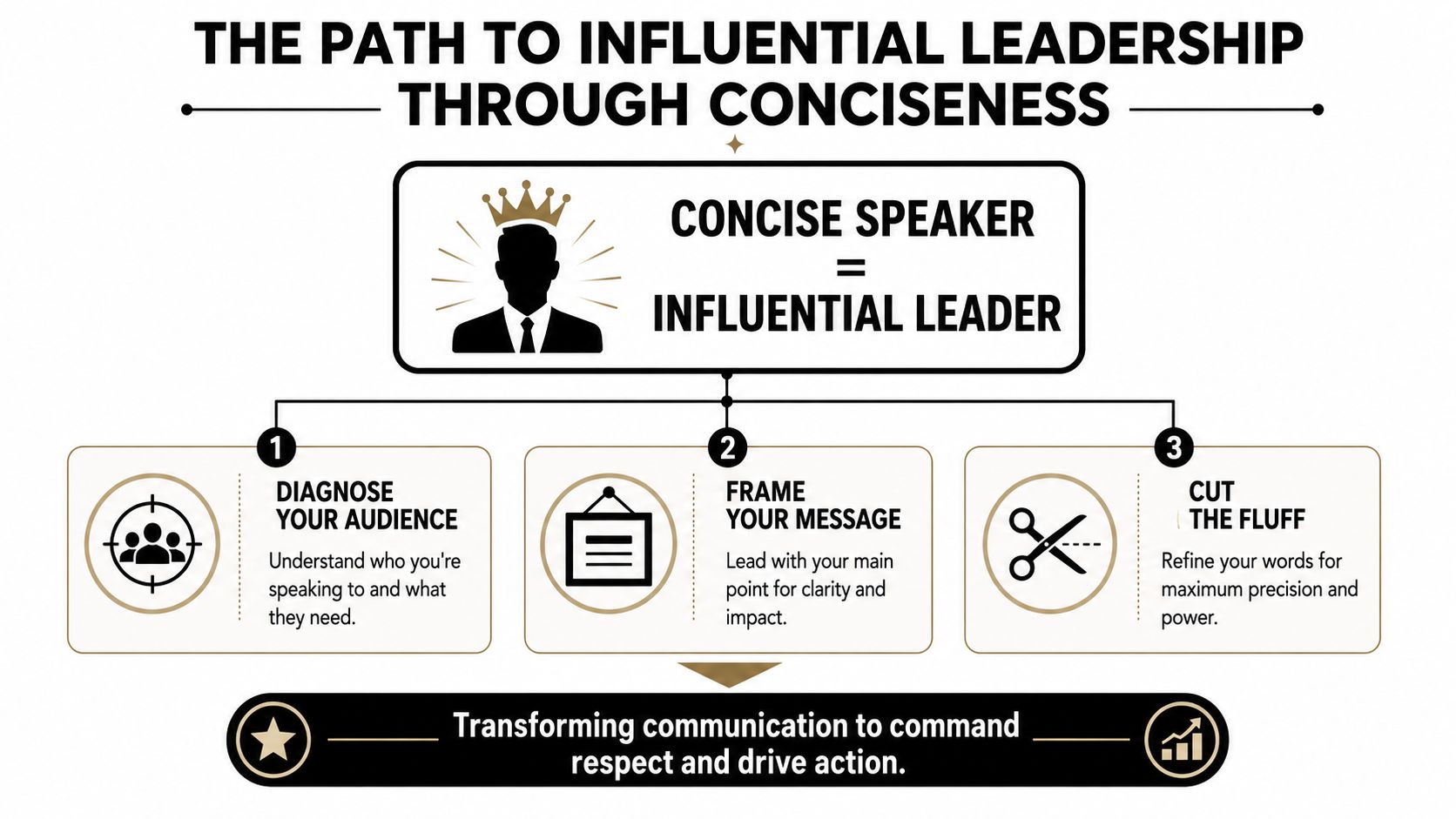
Conciseness becomes powerful when it stops being a technique and becomes your operating style. You hear the question clearly. You diagnose what matters. You lead with the point. You support it without wandering. People don't just understand you faster. They trust you faster.
This is the key shift. You're no longer trying to prove you've thought thoroughly. Your delivery already signals it.
Influence grows when friction drops
The professionals who rise in senior environments usually do four things well:
- They read the room and tailor the message to the audience.
- They frame early so listeners know what matters immediately.
- They remove clutter from both language and delivery.
- They practice enough that the skill holds under stress.
The last point matters because pressure changes everything. Research indicates that under pressure, professionals default to "throat-clearing" and rambling not due to laziness, but because the brain's executive function is compromised, making standard "plan first" advice ineffective in real-time scenarios like board questions or crisis negotiations. That's why concise speaking has to be trained beyond preparation. It must hold when you're interrupted, challenged, or put on the spot.
This is what leadership starts to sound like
A concise leader doesn't speak less for the sake of brevity. A concise leader makes it easier for other people to act.
That changes how you're perceived in every setting:
| Situation | What concise speaking signals |
|---|---|
| Executive meeting | Judgment |
| Stakeholder update | Control |
| Difficult question | Composure |
| Promotion discussion | Senior readiness |
If you want to strengthen the broader leadership side of this skill, this article on how to increase your influence at work is a useful next read because influence is what conciseness enables.
When your message is easier to follow, your leadership is easier to believe.
You don't need to become someone colder, flatter, or less thoughtful. You need a sharper filter. That's how you speak more concisely without losing substance. And that's how your communication starts matching the level you're already operating at.
If you're serious about turning this into a career advantage, start with the free Executive Communication Assessment from Intonetic. It's the best entry point if you want clear feedback on how you structure ideas, use your voice, handle pressure, and where your communication may be undermining your authority at senior levels.