
Master Public Speaking: Eliminate Filler Words in Speech
You know the moment. You're in a leadership meeting, someone asks a direct question, and your answer starts strong, then slips into “um,” “so,” “you know,” and “like” before you reach the point. Nothing catastrophic happens. No one interrupts. But you can feel the room recalibrating. Your idea may still be good, yet your delivery makes it sound less settled than it is.
That's why filler words in speech matter more than is often acknowledged, especially once you're operating at senior levels. This isn't about sounding polished for its own sake. It's about making sure your language supports your authority instead of diluting it.
For international professionals, the issue gets sharper under pressure. In presentations, negotiations, interviews, and executive updates, fillers often increase exactly when the stakes rise. The good news is that this is trainable. You don't need to become stiff, over-rehearsed, or unnaturally formal. You need a cleaner system for thinking out loud.
Why Filler Words Undermine Your Executive Presence
A senior professional can lose authority in less than a minute, not because the content is weak, but because the delivery sounds unstable. Fillers do that subtly. They pull attention away from your message and toward your processing.
A widely cited synthesis on filler words found that credibility and perceived success decline as filler use rises, with one study in the review reporting a sharp drop in success rates once speakers exceeded about 1.28 filler words per 100 words. The same review argues that occasional fillers are not the main problem. Excessive use makes speakers seem unprepared or inexperienced and shifts listener attention from content to delivery, which is especially costly in high-pressure communication (review details).
The issue isn't perfection
Many professionals aim at the wrong target. They try to eliminate every “um” and “uh,” then become tense, self-conscious, and even less persuasive. That approach usually backfires.
Linguistics research adds useful nuance. Not every filler is a failure. Some fillers buy planning time, signal genuine uncertainty, or help listeners track spontaneous speech. The problem is not the existence of fillers. The problem is when filler words in speech become frequent enough to weaken perceived authority.
Practical rule: Your audience will usually forgive the occasional filler. They won't ignore a pattern that makes you sound underprepared.
Why executives get judged more harshly
At senior levels, people don't only evaluate what you know. They evaluate whether you sound ready to lead through ambiguity, scrutiny, and pressure. That's where executive presence shows up in real time. If you want a grounded explanation of that broader standard, this guide on executive presence is a useful reference.
For some professionals, heavy filler use is tied to presentation fear, social pressure, or a deeper pattern of avoidance. If that sounds familiar, this overview of social anxiety disorder can help distinguish normal nerves from something that may need more support.
The key shift is simple. Don't treat fillers as a cosmetic speaking flaw. Treat them as a signal. They reveal overload, weak structure, rushing, or insufficient preparation. Once you see them that way, your correction becomes much more effective.
Diagnosing Your Filler Word Habits
Individuals acknowledge their use of fillers. Very few know which fillers, when they appear, and what triggers them. That's why generic advice rarely sticks. You can't change a pattern you haven't observed closely.
A 2022 review in a physiology education journal states that common fillers include “um,” “ah,” “like,” “so,” and “you know,” and identifies three main causes: nervousness or speaking too quickly, inadequate preparation time, and difficulty retrieving infrequent words. The review also notes that excessive filler use can impair audience comprehension and reduce credibility, and it recommends chunking content, slowing pace, and replacing verbal fillers with silent pauses (journal review).
Start with one recorded sample
Record yourself answering three business prompts aloud. Don't script them fully. Use natural spoken English.
Good prompts include:
- Project update: “Give a two-minute update on a priority initiative.”
- Decision recommendation: “Explain which option you recommend and why.”
- Stakeholder pushback: “Respond to a concern about timing, cost, or risk.”
Listen once for overall impression. Listen again with a notepad. Mark every filler and the moment before it. You're looking for patterns such as these:
- At sentence openings: You haven't decided on the structure yet.
- Before technical terms: You're searching for vocabulary.
- After a challenging question: Pressure is spiking your pace.
- In long answers: You're speaking beyond your prepared thought unit.
If you want a practical self-audit before deeper coaching, Intonetic's Executive Presence Assessment is designed around this kind of communication diagnosis.
Common fillers and their root causes
| Filler Word | Common Cause | Strategic Replacement |
|---|---|---|
| um | Searching for the next phrase under pressure | Silent pause, then restart with a clear clause |
| ah | Vocal stalling while retrieving language | Breath, then shorten the next sentence |
| like | Informal speech habit or softening language | Direct wording with fewer qualifiers |
| so | Habitual launch word before an idea is formed | Pause first, then begin with the main point |
| you know | Seeking listener reassurance | Finish the thought cleanly, then stop |
That table isn't a moral ranking. It's a diagnostic map. Different fillers reveal different breakdowns.
When you identify the trigger, you stop fighting your speech and start managing it.
What to track on your first review
Don't count everything. Track only what helps you act.
Use this short checklist:
-
Your top two fillers
Ignore the rest for now. Work on the most frequent patterns first. -
Your pressure moments
Note whether fillers spike in Q&A, introductions, disagreement, or technical explanation. -
Your pace
Many professionals discover they aren't thinking too slowly. They're speaking too fast for the speed of their own thinking. -
Your sentence length
Long, winding sentences create more opportunities for verbal stalling.
If you build content with AI and speak from rough written drafts, it's also worth noticing whether your language is too “written” to say naturally. This AI workflow guide for creators is useful for thinking about how raw text gets converted into more human-sounding language, which matters when preparing spoken material.
Core Corrective Techniques to Reclaim Your Authority
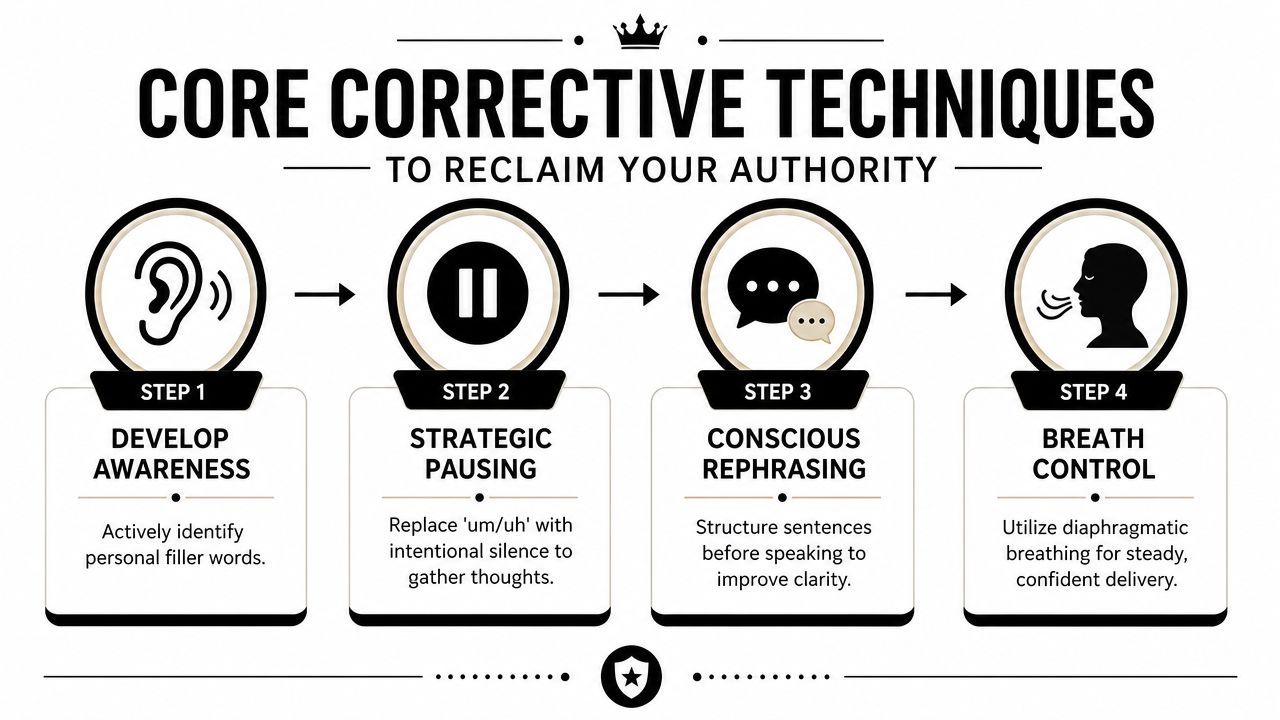
Once you know your pattern, correction becomes mechanical. That's good news. You don't need a personality transplant. You need a few repeatable behaviors that replace verbal clutter with calm control.
A practical, evidence-based reduction method is to record a baseline talk, identify the filler types and the moments they appear most often, then target only the top 2 to 3 fillers first. Coaching guidance recommends replacing verbal fillers with silent pauses, slowing pace, and chunking content so you have processing time without breaking fluency (evidence summary).
Use the power pause
The most effective replacement for filler words in speech is not a better filler. It's silence.
A short pause does three jobs at once. It gives you planning time, it lowers visible rush, and it makes you sound deliberate. Senior speakers don't fear silence. They use it to mark thought.
Try this drill:
- Speak one sentence. Stop fully.
- Take one quiet breath.
- Speak the next sentence only when the wording is ready.
At first, the pause will feel longer to you than it sounds to the listener. That's normal. Most professionals are calibrated to internal panic, not external impact.
Chunk your thinking before you speak
Many fillers appear because the speaker is trying to build the plane in the air. Chunking fixes that. Instead of launching into a long answer, divide it into small thought units.
A useful structure for workplace speech is:
- Point
- Reason
- Implication
For example:
“I recommend we delay the launch. The dependency risk is still unresolved. If we push now, we create avoidable rework.”
Short units reduce verbal scrambling. They also improve executive clarity.
Train the body, not just the mouth
Filler control isn't only verbal. It's physiological. If your breathing is shallow, your speaking pace rises. When pace rises, fillers usually follow.
Use a simple reset before meetings:
- Exhale completely
- Inhale low into the torso
- Release your first sentence at a measured pace
If your voice tightens under pressure, these vocal therapy exercises can support steadier breathing and cleaner delivery.
A pause without panic sounds confident. A pause filled with visible strain sounds like hesitation. Your breathing often determines the difference.
What doesn't work
Some strategies sound sensible but produce poor results:
-
Trying to monitor every word live
This splits your attention and often increases fillers. -
Memorizing entire answers
You may sound rigid, and the first interruption can derail you. -
Forcing artificial slowness
If the pace feels unnatural, your speech loses energy.
A better standard is controlled spontaneity. Prepare your structure, practice your pauses, and leave room for real thought.
Practice Drills for High-Stakes Scenarios
Technique becomes reliable only when you practice it inside realistic pressure. That means rehearsing the exact moments where filler words in speech tend to surge: updates, Q&A, and tense conversations.

Project update drill
It is in this context that many strong professionals lose sharpness. They know the material too well, so they speak in long loops instead of clean decisions.
Use this script pattern:
- Opening line: “Here's the current position.”
- Status line: “We're on track in one area and blocked in another.”
- Decision line: “My recommendation is to address the dependency before expanding scope.”
Now rehearse it aloud and place a full pause after each line. If you hear “so,” “um,” or “basically” between those lines, repeat until the transitions are silent.
Common trap: over-explaining context before giving the point.
Correction: lead with the conclusion, then support it.
Q and A pressure drill
Unexpected questions trigger fillers because you're processing and speaking at the same time. Don't answer on impact.
Use this sequence every time:
- Hear the full question
- Take one visible breath
- Pause briefly
- Start with a headline sentence
Example:
“Short answer, yes, but with one condition.”
That headline buys you control. It gives your mind a container for the answer instead of forcing you into verbal stalling. This is also where silence as communication becomes practical, not theoretical. A pause before answering often increases perceived composure.
Here's a useful model to practice with:
“That depends on the timeline. If the decision is this quarter, we can move. If the scope changes, we need to revisit resources.”
After you've tried it yourself, study how deliberate speakers handle timing under pressure:
Difficult negotiation drill
Negotiations create a different filler pattern. Instead of search fillers, you often get softening fillers. “Like,” “you know,” and repeated “I mean” can make your position sound less anchored.
Practice with this prompt:
“The current terms don't work for us. We're open to movement on scope, but not on delivery accountability.”
Say it three ways:
- once in a neutral tone
- once after a deliberate breath
- once after the other person interrupts you
The interruption version matters most. That's where habits show up.
Boardroom interruption roleplay
Use a partner if possible. If not, record both sides on separate passes.
Prompt from colleague: “I'm not convinced this solves the core problem.”
Your task is not to defend instantly. Your task is to hold structure under pressure.
Try this response:
“I see the concern. The core problem is adoption, not tooling. That's why I'm prioritizing rollout design over feature expansion.”
Notice what's happening. The response opens with acknowledgment, not filler. Then it moves to a diagnosis. Then it gives rationale. That sequence is what senior communication sounds like when it's under control.
Tracking Progress and Sustaining Change
Speakers improve for a week, then revert in real meetings. Not because the method failed. Because they practiced randomly instead of building a habit loop.
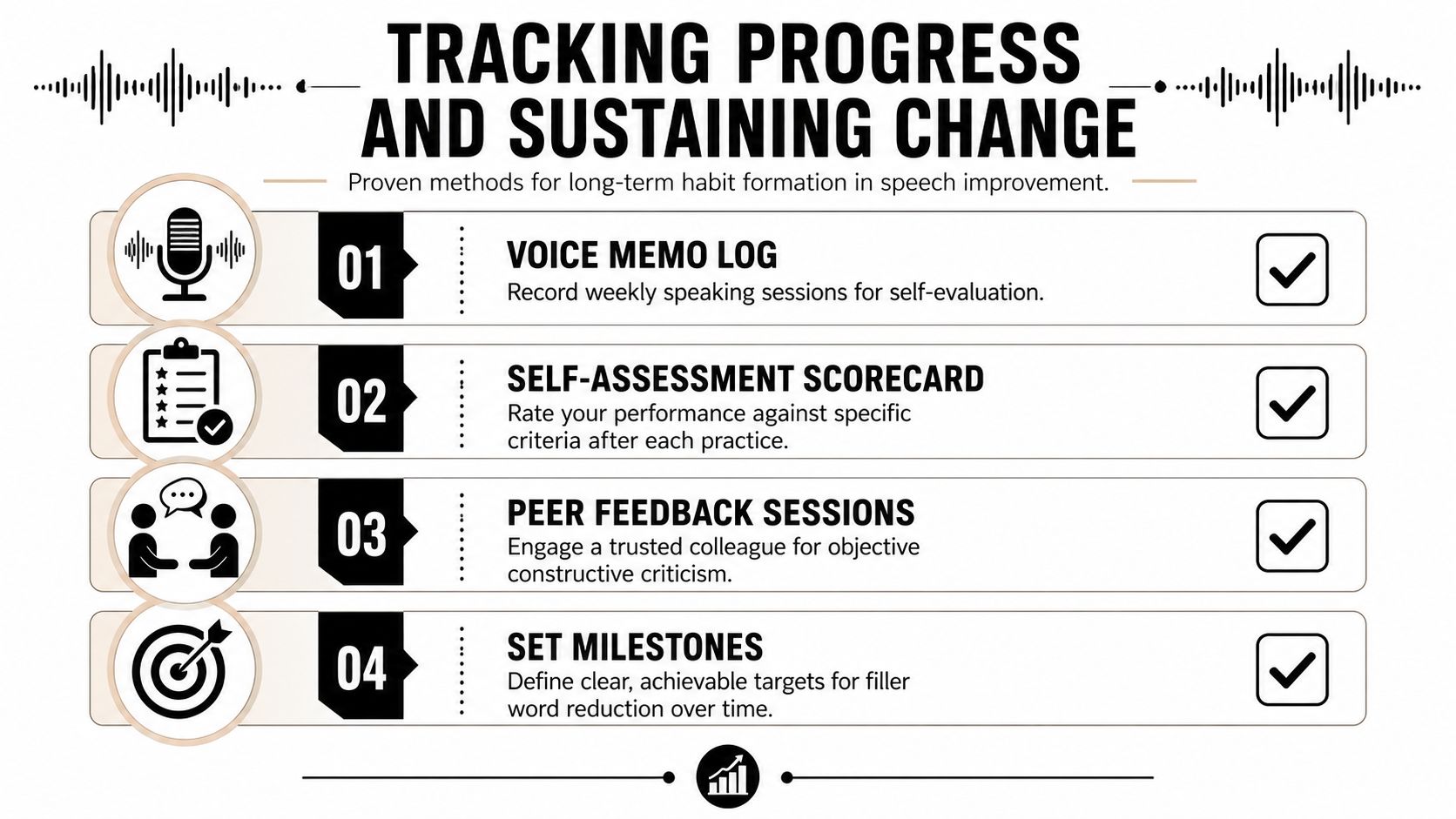
Sustained change comes from small, repeatable review cycles. You don't need to monitor every conversation. You need a consistent way to test whether your new speaking pattern holds when the stakes rise.
Build a weekly feedback loop
Use one voice memo each week. Record a short update, a question response, and a spontaneous opinion on a work topic. Keep the prompts similar enough that you can compare them over time.
Then review with four questions:
- Where did fillers appear most often
- Did I pause instead of filling
- Was my opening sentence clear
- Did my pace stay stable under complexity
Use one live meeting as your training ground
Pick one recurring meeting and assign it a single focus. Don't try to improve everything.
Examples:
- Monday team update: pause before every answer
- Client call: remove “you know”
- Stakeholder review: begin with a headline sentence
That narrow focus works better than broad self-criticism. It also protects your confidence.
Improvement sticks when the practice target is specific enough to notice in real time.
Handle setbacks without spiraling
High-stakes moments will still trigger old patterns. A board presentation, investor meeting, or executive interview can bring fillers back fast. Don't treat that as failure. Treat it as useful stress data.
When a setback happens, review it in this order:
- What triggered the spike
- Which filler returned
- What should the replacement have been
- How will I rehearse that exact moment next time
If you obsess over every “um,” you'll tighten up. If you review the pattern calmly, you'll improve faster. The standard is not robotic fluency. The standard is that your speech increasingly sounds as stable as your thinking.
From Filler Words to Focused Influence
Reducing filler words in speech isn't about becoming polished for appearance alone. It's about making your authority audible. When your pauses are deliberate, your structure is clean, and your pace stays controlled, people stop listening for hesitation and start listening for judgment.
That's the shift senior professionals need. Not perfect speech. Reliable composure under pressure.
The pattern is straightforward. First, diagnose the fillers that cost you authority. Then replace them with pauses, breath, and shorter thought units. Finally, rehearse those behaviors inside the situations that matter most: updates, questions, disagreement, and negotiation.
If you need more structured support, communication as persuasion is a useful lens for understanding why delivery changes how your ideas land. And for professionals who want direct coaching, The Gravitas Method is a 12-week one-on-one executive presence coaching program for international professionals who want to communicate with more authority and influence at senior levels. The program is priced at $8,200 paid in full or $9,000 across three installments. Coached by Nikola, it covers vocal authority, strategic framing, executive body language, and high-stakes communication.
What matters most is that you start with honest observation and focused repetition. Your fillers are not your identity. They're a trainable response to pressure, speed, and cognitive load. When you change that response, your message lands with more force.
If you want a clear picture of how your speaking patterns affect your authority, start with the free Executive Communication Assessment from Intonetic. It's the best next step if you want specific feedback on fillers, vocal presence, structure under pressure, and where your delivery may be weakening your influence in senior-level conversations.