
The Art of Silence as Communication for Executive Presence
We often think of communication as the words we use. But what if I told you that the most impactful leaders have mastered the art of what they don't say?
Silence isn't just an empty space between sentences. It's a tool. When used correctly, it's more powerful than any word in your vocabulary. For senior professionals, especially those working in a non-native language, learning to embrace silence is one of the fastest ways to project authority and unshakable confidence.
What Is Silence as Communication?
Think of a great piece of music. It’s not just a constant stream of notes, right? The rests—the moments of silence—are what give the melody its rhythm, drama, and emotional weight. Without them, it’s just noise.
Silence as communication works the same way. It's the deliberate, strategic use of a pause to make your words land with greater impact. It’s about using quiet to command a room, give your audience a moment to think, or show you’re in complete control.
For many professionals I work with, especially those from cultures where quick responses are valued, silence can feel incredibly uncomfortable. The natural impulse is to fill the void with filler words—"um," "ah," "you know"—or to rush through your points. This unfortunately has the opposite effect, often chipping away at your perceived confidence.
The real shift happens when you stop seeing silence as a void and start seeing it as an asset. This is a fundamental building block of true executive presence.
The Three Pillars of Strategic Silence
A well-timed pause isn't just about being quiet; it's about making that quiet work for you. In any professional setting, a strategic silence serves one of three critical functions.
-
Creating Anticipation: A short pause right before you deliver your key message is the conversational equivalent of a drumroll. It signals to everyone listening: "Pay attention. What I'm about to say matters." It pulls focus and builds suspense.
-
Allowing for Processing: When you're explaining a complex idea or presenting dense data, your audience needs a second to catch up. A moment of silence gives them that mental space to absorb what you've just said. Without it, you risk your most important points flying by before they can be understood.
-
Projecting Composure: In a tense negotiation or during a challenging Q&A, the person who speaks first is often the one who feels the most pressure. Taking a deliberate, calm pause before you answer signals that you’re thoughtful, unflustered, and in control of the situation. It’s a quiet power move.
This diagram shows how these three elements—anticipation, processing, and composure—work together when you master the art of silence.
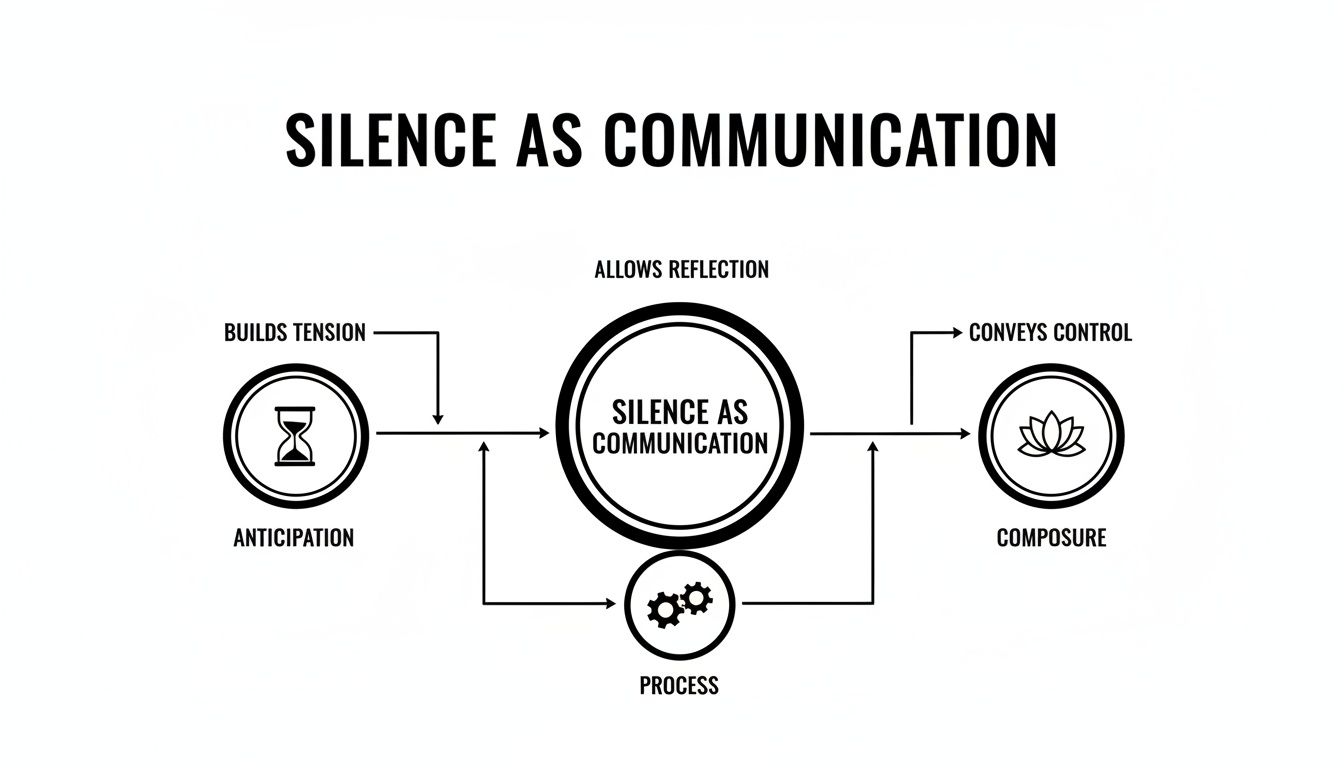
As you can see, these aren't just isolated tricks. They are interconnected skills that allow you to manage the flow of a conversation and shape how your audience perceives you. Learning to deploy these moments of quiet is a direct path to greater influence.
If you're looking to develop this specific skill as part of your leadership toolkit, our guide on building executive presence can provide a more comprehensive roadmap. Mastering silence is about turning quiet moments into your most powerful statements, and it’s a skill that anyone can learn.
A Framework for Understanding Silence
To make this more concrete, let's look at the different types of silence you can use in a professional context and what each one signals to your audience. Think of this as your practical playbook for using silence effectively.
| Type of Silence | Psychological Signal | When to Use It |
|---|---|---|
| The Emphatic Pause | "This is important." | Before or after a key statistic, a major announcement, or the punchline of a story. |
| The Processing Pause | "I want you to think about this." | After presenting a complex piece of data, a new concept, or a multi-step plan. |
| The Composure Pause | "I am in control and thoughtful." | When asked a difficult or unexpected question in a meeting, Q&A, or negotiation. |
| The Listening Pause | "I am hearing you fully." | After someone finishes speaking, before you respond, to show you've absorbed their point. |
| The Power Pause | "The floor is mine." | When interrupted, hold a brief silence to non-verbally reclaim attention before continuing. |
By recognizing these different forms of silence, you can move from accidentally being quiet to strategically using pauses to enhance your authority, clarity, and presence in any conversation.
The Hidden Link Between Silence and Power

So far, we’ve talked about silence as a personal tool you can use. But it’s also something bigger—it’s a mechanism of power. Throughout history, dominant groups have used silence to control conversations and decide what gets talked about and what doesn’t. This is a critical insight for any senior leader who wants to truly command a room.
In this context, we’re not just talking about a dramatic pause. We're talking about the deliberate choice to leave things unsaid. When certain topics, inconvenient facts, or alternative ideas are consistently ignored in meetings, they are effectively silenced.
For many international professionals, this can feel all too familiar. You might feel like your contributions are sometimes overlooked or brushed aside. Understanding this dynamic is the first step toward reclaiming your influence and making sure your voice is heard.
Power Shapes What Is Left Unsaid
The link between power and silence is deeper than you might think. People in positions of authority don’t just control what is said; they also dictate what is left unmentioned. The historian Michel-Rolph Trouillot explored this brilliantly in his book Silencing the Past.
Trouillot showed how power creates what he called ‘bundles of silences’ in history. His prime example was the Haitian Revolution. It was a world-changing event where self-liberated slaves defeated Napoleon's army, yet it was almost completely muted in Western history books. Why? Because the very idea was considered "unthinkable" and it threatened the dominant racial hierarchies of the time.
This exact dynamic plays out in corporate settings today. A 2026 analysis of 1,000 corporate reports found that 73% of them completely omitted contributions from diverse teams. This act of silencing non-Western innovations led to an 18% undervaluation of that talent in promotions. For international professionals, learning to break these silences is a vital part of telling your own authoritative story.
This lesson from history is directly applicable to the boardroom. Just as historical records were shaped to fit a certain narrative, corporate discussions can sideline ideas that challenge the status quo. When you start to see this pattern, you can strategically bring those "silenced" perspectives back to the table, demonstrating real leadership.
Disrupting Silence to Command Respect
One of the most powerful ways to assert your authority is to actively disrupt these patterns of silence. It’s a game-changer.
Imagine you're in a meeting and you notice a valuable idea from a junior colleague get completely ignored. You can use your position to bring it back.
By simply saying, "I'd like to circle back to what Priya mentioned about the data anomaly; I think it's a critical point," you do two things. You validate your colleague, and more importantly, you reshape the entire conversation. You show everyone that you’re listening on a much deeper level. You might find our guide on how to achieve confident communication in high-stakes situations useful for more strategies like this.
Just look at how some of the world's most prominent leaders operate. You'll see the quiet power of authority in action—a profound connection between their physical presence and their influence. For international professionals, learning to surface these undervalued ideas and break the silence is a true hallmark of executive presence. It turns you from a passive observer into an active, respected leader.
How Silence Leads to Flawed Group Decisions
In a high-stakes meeting, silence isn't always strategic. It can be a symptom of a much bigger, more dangerous problem: a collective decision to hold back crucial insights. When this happens, it almost always leads to flawed group decisions and missed opportunities.
This is especially true for talented professionals who happen to be non-native English speakers. Already feeling the pressure to be perfect, they often choose to stay quiet rather than voice a dissenting opinion or ask a clarifying question.
This psychological trap has a name: groupthink. It’s what happens when the desire for harmony and a quick consensus overrides a realistic, critical look at the alternatives. A few dominant voices steer the conversation, and everyone else just nods along—not because they agree, but because they’re afraid of being seen as disruptive or uncooperative. The result is a dangerous illusion of unanimous agreement.
The Spiral of Silence in the Boardroom
There’s a powerful theory that explains why this happens, called the Spiral of Silence. The core idea is that people constantly scan their environment to see which opinions are popular and which are not. If they feel their view is in the minority, they’re far more likely to keep it to themselves for fear of social isolation.
Even if the "majority" isn't real, the perception of one is enough to silence critical voices. As more people fall silent, the dominant view seems even stronger, which in turn encourages even more people to stay quiet.
This isn't just an academic concept; it has staggering financial consequences. The effect was first identified by Elisabeth Noelle-Neumann during the 1965 German federal election, but it plays out in boardrooms every single day. A 2020 study of 500 Fortune 500 executives revealed that 68% admitted to withholding their dissenting views on major strategy shifts. This silence amplified groupthink and cost their companies an average of 12% in missed revenue and growth opportunities.
For non-native English speakers, this pressure is often compounded by the fear of being misunderstood or judged because of their accent. This can make them even more hesitant to speak up. You can read more about this in our guide on understanding the hidden challenge of accent bias.
This spiral is fueled by fear. As minority opinions are silenced, the dominant view appears even stronger, encouraging more people to fall silent. It's a self-reinforcing loop that starves innovation and leads teams directly toward flawed conclusions.
Breaking the Spiral with Psychological Safety
So, what's the antidote to this costly silence? It’s a concept called psychological safety.
This means intentionally creating an environment where every member of the team feels secure enough to take risks, ask questions, and voice dissenting opinions without any fear of punishment or humiliation. As a leader, it’s your job to actively break the spiral of silence.
You can do this with simple, deliberate actions. Actively invite opposing viewpoints. Ask questions like, "I'd love to hear a counterargument to this," or, "What are the potential flaws in this plan that we're not seeing?"
When someone does offer a different perspective, thank and acknowledge them. By rewarding dissent, you reframe it from a disruption into a valuable contribution. This is how you build a culture of vigorous, healthy debate that leads to true innovation and much smarter decisions.
Using Silence in Global Business Negotiations

In high-stakes global negotiations, silence isn't just dead air—it’s a powerful tool. The meaning behind a pause can shift dramatically from one country to another, and getting it wrong can be a costly mistake. For any international professional, learning to read and use silence is absolutely critical for projecting confidence and getting the deal you want.
Many Western business cultures, especially in North America, are what we call ‘speaking cultures.’ Here, conversation moves fast. Long pauses can feel awkward, create anxiety, or even come across as a sign of disagreement. The natural instinct is to jump in and fill the quiet to keep the momentum going.
In sharp contrast, many East Asian, Middle Eastern, and even some European cultures like Finland are ‘listening cultures.’ In these environments, silence is a sign of respect, deep thought, and careful consideration. A pause doesn't mean something is wrong; it means your words are being taken seriously.
The High Cost of Misreading a Pause
This cultural gap can become a strategic minefield. I've seen it happen countless times. Picture a North American executive negotiating a major deal with a team from China. The executive tables an offer. The Chinese team says nothing, simply sitting in thoughtful, prolonged silence.
To the American, this quiet feels like a flat-out rejection. Panic sets in. Feeling the pressure to fix what they perceive as a broken deal, they immediately start talking again, offering concessions or sweetening the pot. In reality, they are negotiating against themselves. For the Chinese team, the silence was just part of their process.
This exact dynamic has been documented in cross-cultural business training for decades. Studies have found that negotiators from speaking cultures often give up as much as 20% more when their counterparts from listening cultures simply stay quiet. You can read more about the cultural implications of silence in business on rw-3.com.
How to Adapt Your Approach for Global Success
For senior leaders, mastering silence in a global setting means learning when to resist your instincts. It's about adapting to the room instead of just filling the air with words.
Here’s a simple framework to get you started:
- Do your homework. Before you even walk into the room, research your counterpart’s cultural communication style. Are they from a place that values quick verbal back-and-forth, or one that respects quiet deliberation?
- Slow your roll. During the negotiation, make a conscious effort to slow down your own pace. After you make a key point or state your terms, stop. Just stop. Let your message land and give the other side space to think.
- Don't assume the worst. When you’re met with silence, don't jump to negative conclusions. Instead of rushing to speak, hold your ground with confident, relaxed body language. Use that time to observe their non-verbal cues.
By turning what feels like a liability into a strategic move, you project authority and control. This is a crucial skill for anyone in a senior role, especially in sales, where negotiating high-value deals with an American accent is as much about reading the unspoken signals as it is about speaking clearly.
Your Action Plan For Mastering Strategic Silence

Understanding the theory behind silence as communication is one thing. Actually putting it into practice in a high-stakes meeting? That’s a completely different challenge.
For most senior professionals I work with, the biggest hurdle is a deeply ingrained anxiety—a feeling that every empty space must be filled with words. This section is your action plan to overcome that feeling. We'll build your "silence muscle" and turn those quiet moments into one of your most powerful communication tools.
The key is to start small. You don’t need to transform your communication style overnight. By weaving a few deliberate exercises into your daily interactions, you’ll gradually build comfort and skill, projecting more authority and composure.
Build Your Silence Muscle With These Exercises
The goal here is to make strategic silence feel natural, not forced. Each exercise targets a common scenario where a well-placed pause can have a huge impact. Just focus on one at a time until it feels comfortable.
-
The 3-Second Rule: This is your foundation. The next time someone asks you a question, resist that powerful urge to answer instantly. Instead, take a full, silent breath. Count to three in your head. Then speak. This tiny gap doesn't signal hesitation; it signals thoughtfulness. It also gives your brain a critical moment to frame a much stronger response.
-
Active Silent Listening: In your next team meeting, try this. Pick one person and just listen—without planning what you’ll say next. When they finish speaking, hold eye contact for a brief, quiet moment before anyone else jumps in. This simple act shows you're fully processing their point, not just waiting for your turn to talk. It's incredibly validating for the speaker.
-
The Thoughtful Presentation Pause: Think about your next presentation. Identify one key message, a powerful statistic, or a critical takeaway. After you deliver that line, stop. Pause intentionally for 3-5 seconds. Look around the room and let the weight of your statement land. This is the conversational equivalent of a highlighter, ensuring your most important point is the one they remember.
A Leader Transformed: A Case Study
I once coached a senior product director at a major tech firm. He was brilliant, but he had a reputation for being frantic in meetings. He spoke a mile a minute, peppered his speech with "um" and "uh," and constantly interrupted his team in a rush to get his ideas out. His energy, while well-intentioned, was creating chaos.
We started with just one thing: the 3-second rule.
At first, he told me it felt intensely awkward, like an eternity of dead air. But he stuck with it. Within a week, he noticed a shift. His colleagues started leaning in, listening more intently. Those tiny pauses gave his words more weight. His ideas, which were always strong, finally started landing with real impact.
Weeks later, his manager's feedback noted a "marked increase in his executive presence." He was no longer just another voice in the room; he was a voice of authority. Techniques like this, paired with controlled breathing, can be a game-changer. For more on this, you can learn how to use breathing exercises for better English speech in our detailed guide.
Your Silence Practice Plan
To make this tangible, here is a structured plan to build your comfort with silence week by week. It's all about small, incremental steps.
| Week | Focus Area | Practice Exercise | Goal |
|---|---|---|---|
| 1 | Responding | Use the 3-Second Rule in low-stakes conversations. Count to three before answering any question from a colleague or friend. | To break the habit of instant replies and feel the initial awkwardness. |
| 2 | Active Listening | Practice Active Silent Listening in one team meeting. Focus on one speaker and hold silence after they finish. | To shift from "waiting to talk" to "listening to understand." |
| 3 | Emphasis | Use the Thoughtful Presentation Pause once in a formal or informal presentation after delivering a key point. | To use silence to highlight a critical message. |
| 4 | High-Stakes Moments | Apply the 3-Second Rule in a more challenging situation, like when a senior leader or an important client asks a question. | To stay composed under pressure and deliver a more thoughtful answer. |
This simple progression will help you move from conscious, sometimes awkward, practice to a state where strategic silence becomes a natural and powerful part of your communication toolkit.
Command the Room and Advance Your Career
True executive presence isn’t about what you say. It's about how you say it, and just as importantly, when you say nothing at all. By learning to wield silence, you can shift from simply being a competent manager to becoming a truly influential senior leader.
It's those quiet moments that often hold the most power—a strategic pause before answering a tough question, the space you leave after a critical point in a presentation, or the calm you project during a high-stakes negotiation. This is what I call silence as communication. It's the unspoken skill that allows you to command attention, convey deep thought, and drive the outcomes you want. It’s a key part of your professional image, just like the one you cultivate through practical LinkedIn personal branding examples.
Moving from understanding this theory to making it a real, tangible part of your leadership style takes dedicated practice and, frankly, some expert guidance. When you hone your ability to use silence, you don’t just get better at communicating—you fundamentally change how you are perceived. You start projecting unwavering confidence, thoughtful authority, and the kind of composure that tells everyone you belong in the room.
Ready to unlock that next level of your leadership potential? The first step is always to get a clear, honest look at where you stand right now.
Take our free Executive Communication Assessment today. In return, you’ll get a personalized report that pinpoints your unique opportunities for growth and maps out a clear path to greater influence. This isn't just a quiz; it’s your first step toward mastering the unspoken rules of executive leadership.
Take the Free Executive Communication Assessment Now
Your Questions About Using Silence, Answered
Even when you intellectually grasp the power of silence, putting it into practice can feel daunting. It’s natural to have questions.
Let's walk through the most common concerns I hear from leaders as they learn to use silence not as an absence of words, but as a powerful communication tool.
How Long Should a Strategic Pause Actually Be?
This is the number one question I get. There's no single magic number, but my clients find this framework incredibly helpful to start:
-
The Thoughtful Response (2-3 seconds): When someone asks you a tough question, taking a 2-3 second pause before you answer is gold. It signals, "I'm considering your question carefully," not "I don't know the answer." It projects thoughtfulness, not hesitation.
-
The Highlighter (3-5 seconds): After you deliver a critical piece of data or a key message, stop. A 3-5 second silence acts like a verbal highlighter, forcing the point to land and giving your audience a moment to absorb its weight. Without it, your most important ideas get lost.
-
The Power Play (5-10 seconds): In a tense negotiation or a high-stakes Q&A, a longer silence of 5-10 seconds can feel like an eternity—and that’s the point. It communicates unshakable composure and often prompts the other person to fill the void, sometimes revealing information you wouldn't have gotten otherwise.
The trick is to be deliberate. Start by counting in your head. What feels awkward at first will quickly become your secret weapon.
Will I Seem Unsure of Myself If I Pause?
This is a common fear, but it’s completely backward. In my experience, it’s the unconfident speakers who rush. They’re so terrified of the quiet that they flood every second with filler words—"um," "ah," "you know"—which screams insecurity.
A calm, deliberate pause does the opposite. It projects absolute confidence and control.
It non-verbally communicates that you are so comfortable in your authority that you don't need to rush. You own the space. You are choosing your words with precision. Just be sure to back it up with the right body language: maintain steady eye contact and hold a composed, upright posture. This combination makes the pause a sign of strength, not doubt.
How Can I Use Silence Effectively in Virtual Meetings?
Silence is even more critical in virtual meetings, but you have to handle it differently. With the lack of physical cues and the dreaded "Is my internet frozen?" fear, you can't just go quiet without framing it first.
Instead of just pausing, signal your intent. Say something like, "That's an excellent point. Let me think on that for a moment." This tells everyone you're thinking, not glitching.
When you finish a key point in a presentation, don't immediately click to the next slide. Hold your gaze on the camera for an extra beat. It’s the virtual version of leaning in and letting an idea land.
To encourage others to speak, you have to create a safe space for silence. Ask a question, and then explicitly say, "I'll give everyone a moment to gather their thoughts." This transforms an awkward gap into a shared, purposeful activity.
The Gravitas Method is a 12-week one-on-one executive presence coaching program for international professionals who want to communicate with more authority and influence at senior levels. The program is priced at $8,200 paid in full or $9,000 across three installments. Coached by Nikola, it covers vocal authority, strategic framing, executive body language, and high-stakes communication.
Ready to understand your own communication patterns? Start with our free Executive Communication Assessment to get a personalized report on your strengths and areas for growth.