
Vocal Therapy Exercises for Professionals
You join a leadership call with a clear point to make. You know the numbers. You know the risks. Then you start speaking, and something goes wrong. Your voice comes out thinner than you intended. Someone interrupts. You repeat yourself. By the end of the day, your throat feels tired, and you're left wondering whether the problem was your English, your accent, or your presence.
For many international professionals, the primary issue isn't accent. It's vocal efficiency.
That distinction matters. Accent is part of identity. Vocal authority is a trainable skill. It affects whether people stay with you when you speak, whether your message sounds composed under pressure, and whether you can carry confidence through a long meeting without sounding strained.
Most advice online about vocal therapy exercises is written for hoarseness, recovery, or general vocal ease. That leaves a gap for ambitious professionals who want something more practical: a voice that feels steadier in meetings, projects credibility on calls, and holds up across demanding workdays.
Why Your Voice Is More Than Just Your Accent
A lot of professionals misdiagnose their own communication problem.
They think, “My accent is too strong,” when what their colleagues are reacting to is a different pattern entirely: low breath support, pressed throat tension, fading sentence endings, or a flat vocal line that makes strong ideas sound uncertain. I see this often with high performers who are already operating at a senior level in substance, but not yet in delivery.

What people hear versus what you think they hear
A non-native speaker might assume colleagues struggle because of pronunciation. Sometimes that's true. But often the bigger issue is that the voice itself doesn't carry enough stability or weight.
That creates practical workplace problems:
- You get interrupted more often because your sentence openings don't establish enough vocal presence.
- Your key points land weakly because your volume and pitch drop at the ends of ideas.
- You sound more fatigued than you feel because throat tension replaces proper breath support.
This is also where workplace perception gets tangled with bias. If you've experienced that, it helps to understand accent bias in the workplace separately from the parts of delivery you can train.
Most content on vocal exercises focuses on hoarseness or ease, but rarely answers if they improve outcomes that professionals care about, like projection, credibility, and consistency under pressure. A useful perspective is to track job-relevant signs such as fewer vocal interruptions, less end-of-day strain, more stable pitch and volume, or stronger perceived authority in recordings and live calls, as discussed in this voice outcomes review.
Vocal authority changes career outcomes
A stronger voice doesn't mean a louder personality. It means your delivery supports your expertise instead of undermining it.
In practice, that looks like:
| Situation | Weak vocal pattern | Stronger executive pattern |
|---|---|---|
| Team update | Starts softly, rushes, trails off | Clear opening, stable pace, controlled ending |
| Stakeholder pushback | Voice tightens under pressure | Tone stays grounded and measured |
| Video call | Sounds flat and effortful | Resonant, easy, easier to follow |
| Presentation | Tries to project by forcing volume | Uses resonance and pacing to carry authority |
The reason vocal therapy exercises matter here is simple. They train the physical habits behind professional presence. Not performance. Not imitation. Function.
When those habits improve, your communication usually feels less effortful and more believable. People stop focusing on whether you “sound different” and start focusing on what you're saying.
Mastering Breath for Confident Delivery
Most voice problems at work start below the throat.
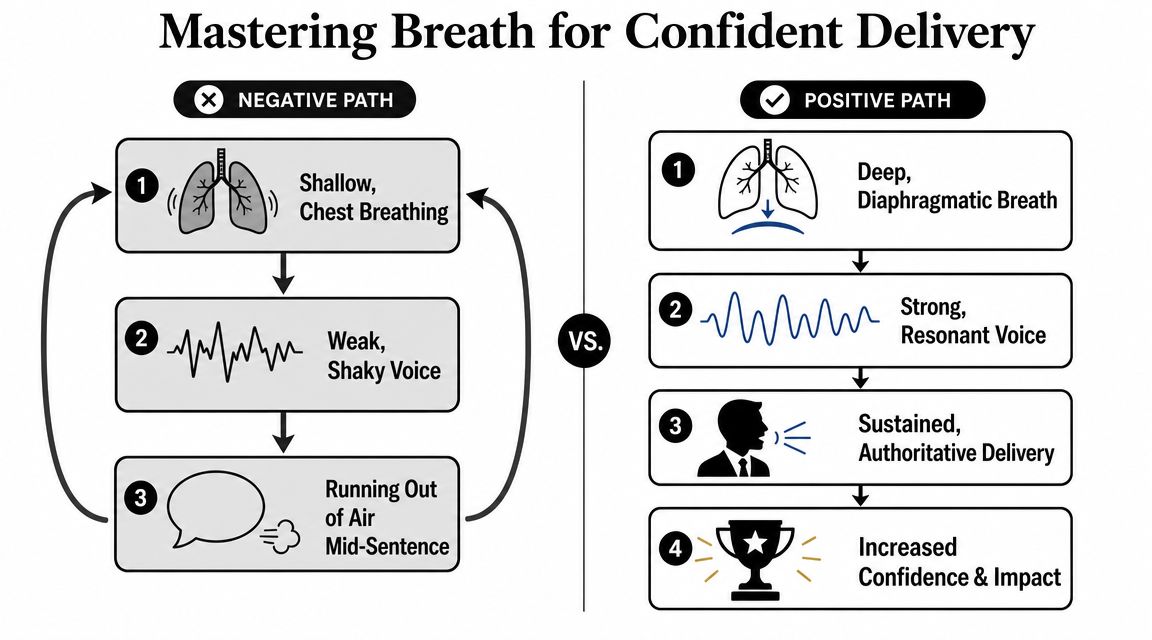
If your breathing rises into your upper chest, your voice has to work too hard. That's when you hear shaky starts, clipped phrases, breathy endings, or that drained sound that shows up halfway through a presentation.
The breathing pattern that weakens your message
Under stress, many professionals inhale quickly through the upper chest and then start speaking before the breath has settled. The result is predictable. The first words come out tight. Mid-sentence energy drops. By the final clause, the voice loses shape.
You don't fix that by “speaking louder.” You fix it by giving the voice better support.
A useful starting point is breathing exercises for better English speech, especially if you tend to rush when you're trying to sound fluent.
A simple daily diaphragmatic routine
Use this sequence standing, not slouched in a chair.
-
Set posture first
Stand upright with your ribs free and your neck relaxed. Don't lift the shoulders. -
Place one hand low on the torso
You want to feel expansion around the lower ribs and abdomen, not movement high in the chest. -
Inhale
Let the breath drop in. Don't suck air in through tension. -
Exhale on a steady sound
Use a soft “sss” or a gentle hum. Keep it even from start to finish. -
Repeat with short phrases
Say a work-relevant line such as “Let me highlight the main risk” on one calm breath.
What to feel and what to avoid
Good breath support feels grounded, not dramatic. Your torso stays organized. Your throat doesn't grab. Your voice rides the breath instead of fighting it.
Watch for these common mistakes:
- Shoulder lifting means you're still breathing high.
- Pushing the belly out aggressively usually creates stiffness instead of support.
- Dumping air at the start makes the voice sound noisy, then weak.
- Squeezing the throat at the end causes strained sentence endings.
Practical rule: If the exercise makes your neck work harder, you're not improving support. You're rehearsing strain.
A professional application
Use breath practice where it matters most. Before a board update, take a quiet low breath and speak the first sentence only after the exhale feels steady. Before answering a difficult question, inhale once, pause half a beat, then start. That tiny reset often changes your entire vocal tone.
Breath is not a warm-up detail. It's the engine behind a composed voice. If that engine is unstable, everything above it becomes harder.
Unlock Your Natural Resonance and Projection
When people say “speak up,” many professionals respond by pushing harder from the throat. That usually makes the voice sharper, thinner, and less sustainable.
Projection is not shouting. Projection is efficient resonance.

What resonance actually feels like
A resonant voice has more carrying power with less effort. You'll often notice a light vibration around the lips, nose, cheekbones, or upper face. Some speakers also feel better fullness through the chest, but the key sign is ease, not force.
That matters on video calls too. A resonant voice cuts through cheap laptop audio better than a pushed voice. If you're reviewing your speech recordings, better input also helps. A good guide to pro audio recording on mobile can make self-review more useful because you'll hear whether the tone is resonant or just loud.
A practical SOVT drill
A practical, evidence-based protocol for resonant voice work uses semi-occluded vocal tract exercises, including straw phonation and lip trills, to reduce strain while training efficient phonation, as described in this resonant voice therapy guide.
Try this sequence:
- Start upright and relaxed. Jaw loose, neck easy, breath low.
- Hum gently through a straw. Keep the sound smooth, not breathy and not pressed.
- Notice where vibration appears. Aim for a forward, buzzy sensation rather than throat effort.
- Add pitch glides. Slide gently up and down without pushing.
- Transfer to speech. Move into short phrases like “Good morning everyone” while keeping the same easy tone.
If you don't have a straw, use a lip trill or a soft humming sound.
What works and what doesn't
Here's the trade-off many professionals miss. If you chase immediate loudness, you often lose stability. If you train resonance first, volume usually becomes easier later.
A good resonant drill should feel:
- Easy enough to repeat
- Steady in airflow
- Forward in vibration
- Cleaner after the exercise than before
A poor drill usually sounds or feels:
- Pressed
- Breathy
- Throat-dominant
- Fatiguing after only a few repetitions
Don't force loudness during resonant work. If the throat tightens, back off and return to an easier hum.
A short demonstration can help you hear the difference between pushing and resonating:
Carry resonance into real speech
Many individuals frequently fail. They do the drill correctly, then return immediately to their old speaking pattern.
To fix that, bridge the exercise into live language:
| Drill | Speech carryover |
|---|---|
| Gentle hum | “Thanks everyone for joining” |
| Straw phonation | “I want to focus on two priorities” |
| Lip trill glide | “Let me answer that directly” |
Keep the phrase short. Keep the same airflow. Keep the same facial vibration if possible.
Once that transfer becomes familiar, your speaking voice starts sounding more present without feeling manufactured.
Fine-Tuning Pitch and Articulation for Clarity
A voice can be strong and still fail in a meeting.
If your pitch stays flat, listeners tune out. If your articulation is blurred, they work too hard to understand you. Senior communication needs both: vocal variation and clear consonants.
Why monotone delivery weakens authority
Many international professionals become more monotone when they're concentrating on grammar or accuracy. That's understandable. But in a high-stakes setting, monotone speech can sound uncertain, disengaged, or over-rehearsed.
Vocal Function Exercises, developed by Dr. Joseph Stemple, are one of the best-known structured protocols in modern voice rehabilitation. The protocol includes four exercises and is commonly performed twice daily, and evidence summarized in this Vocal Function Exercises review reports measurable gains including significant improvements in phonation volume across pitch levels, with the largest increases at pitch extremes, alongside improvements in maximum phonation time, jitter, strain scale, normalized mucosal wave amplitude, normalized glottal gap, and Voice Handicap Index.
For professionals, the relevant takeaway is practical. Pitch glides train the muscular control you need to avoid sounding locked on one note.
A useful pitch drill for meetings
Use a light glide, not a dramatic singing move.
- Start on an easy comfortable note.
- Glide upward smoothly.
- Glide back down.
- Keep the throat loose and airflow steady.
- Then say one sentence with intentional contrast.
Try these examples:
- “The issue isn't cost. The issue is timing.”
- “I agree with the direction. I don't agree with the sequence.”
- “We have one immediate risk, and two long-term implications.”
Mark one important word in each phrase and let the pitch move there naturally.
Articulation that sounds precise, not stiff
Articulation drills aren't about sounding theatrical. They build speed and precision in the lips, tongue, and jaw so your message survives pressure.
A practical sequence:
-
Jaw release first
Open and close gently. Massage any tension before speech work. -
Consonant contrast drills
Alternate crisp pairs such as p-b, t-d, k-g. Keep them clean, not exaggerated. -
Short tongue twisters
Use compact phrases instead of long, messy ones. Slow first, then faster. -
Business phrases
Practice “strategic shift,” “quarterly growth,” “global pricing model,” or other terms from your actual job.
If you want more targeted pronunciation work, how to enunciate better is a useful complement to articulation drills.
A smart way to self-check clarity
One of the fastest ways to test articulation is dictation software. If your device frequently mishears you, that doesn't prove your speech is poor, but it can reveal patterns in pace, consonant clarity, or microphone setup. These Mac dictation accuracy tips are useful for turning that into a practical feedback loop.
Clear articulation should sound efficient. If you feel your mouth working harder but your speech sounds less natural, you're overdoing it.
For executive communication, the target isn't polished perfection. It's reliable clarity under pressure.
Using Pacing and Pauses for Executive Impact
The most senior speakers rarely sound hurried, even when they're thinking fast.
That isn't accidental. They use pacing and pauses to signal control. The words matter, but timing changes how those words are received.
Why rushed speech sounds less authoritative
When professionals feel pressure, they often accelerate. They want to sound fluent, competent, and prepared. The irony is that speed often creates the opposite impression. Listeners hear tension. Important points blur together. The speaker sounds as if they're trying to get through the message rather than lead the room through it.
A more effective pattern is selective pace. Move briskly through setup. Slow down at the decision point. Pause before and after the line that matters most.
What a strategic pause does
A pause has at least three functions in executive communication:
- It marks importance so listeners know where to pay attention.
- It buys thinking time without filler words.
- It projects composure because you don't sound afraid of silence.
Here's the contrast.
| Delivery habit | Listener impression |
|---|---|
| Constant fast pace | Nervous, overloaded, less clear |
| Fast start then abrupt stop | Unsteady, reactive |
| Varied pace with pauses | Controlled, deliberate, credible |
A practical meeting drill
Take a short update and mark three pause points:
- Before the headline.
- After the key risk.
- Before the recommendation.
For example:
“We reviewed the rollout plan.
[pause]
The main risk is implementation timing.
[pause]
My recommendation is to phase the launch.”
That pattern feels slower to you than it sounds to others. In most cases, it lands better.
If rhythm is a weak point in your spoken English, rhythm and timing in American English gives you a useful framework for sounding more natural without rushing.
Silence used well doesn't weaken authority. It signals that you expect people to stay with you.
The practical test is simple. Record a one-minute answer to a common leadership question. Then listen for whether your pace changes with intention or whether it speeds up whenever the stakes rise.
Your Weekly Vocal Authority Practice Plan
Many individuals fail with vocal therapy exercises for one reason. They practice randomly.
They do a few humming drills one day, forget them for a week, then push their voice in a presentation and wonder why nothing changed. Consistency matters more than intensity. Short, repeatable work beats occasional effort every time.
Use a plan that fits your real workweek
A common pitfall is applying vocal exercises generically without considering the actual goal. Clinical guidance notes that exercise choice should be adapted to the person and the purpose, including the degree of vocal tract occlusion, rather than used as a one-size-fits-all routine, as explained in the Cleveland Clinic voice therapy overview.
For a professional audience, that means this. If your main problem is fatigue, you may need more resonance and breath coordination. If your problem is monotone delivery, pitch work deserves more attention. If your speech is clear but rushed, pacing practice may matter more than another set of hums.
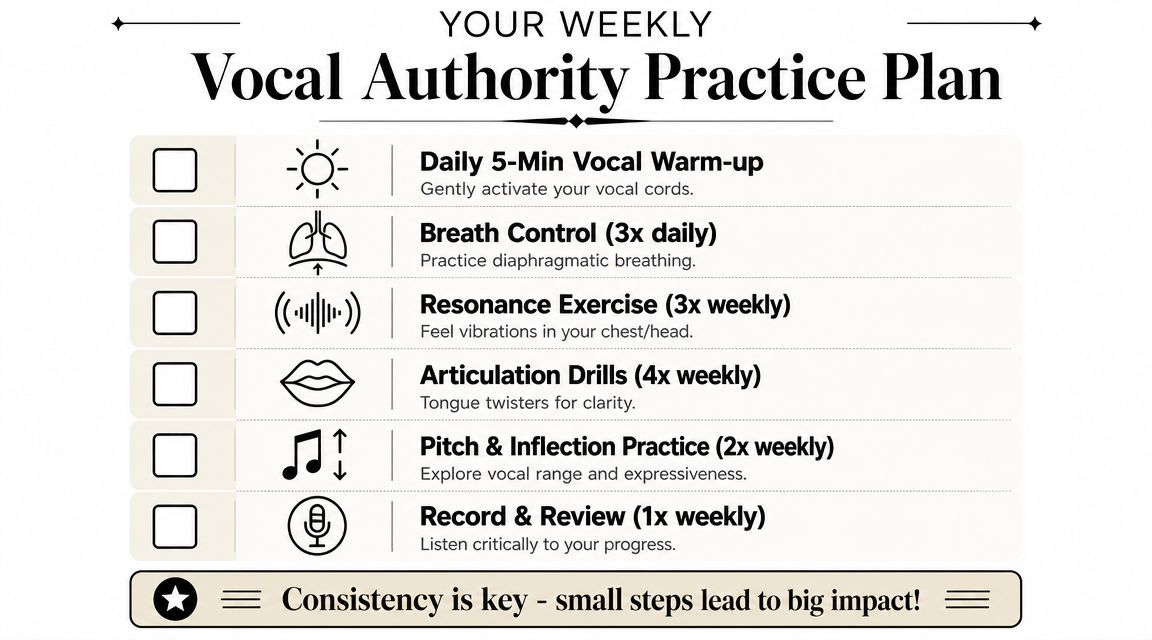
A practical weekly rhythm
Use this as a base plan, then adjust.
-
Daily warm-up
Two to five minutes of easy humming or lip trills before your first call. -
Breath resets during the day
One minute before a presentation, after lunch, and before a difficult conversation. -
Resonance work several times per week
Straw phonation or gentle humming into short business phrases. -
Pitch and articulation sessions
Alternate days. One day for pitch glides and emphasis practice, another for crisp consonants and key vocabulary. -
Recording review once a week
Listen to one meeting rehearsal or recorded answer. Don't judge everything. Pick one correction.
What should make you stop
These exercises should feel gentle and organizing. They should not create pain.
Stop self-guided practice and get evaluated by an SLP or laryngologist if you notice:
- Persistent hoarseness
- Pain when speaking
- A sudden voice change
- Ongoing strain that doesn't improve with easier technique
That decision matters. Generic drills aren't appropriate for every voice problem.
When structured coaching helps
Some professionals don't need more information. They need diagnosis, prioritization, and accountability. One option in that category is The Gravitas Method, a 12-week one-on-one executive presence coaching program for international professionals who want to communicate with more authority and influence at senior levels. It is priced at $8,200 paid in full or $9,000 across three installments. Coached by Nikola, it covers vocal authority, strategic framing, executive body language, and high-stakes communication.
If you want additional voice-specific practice outside executive communication, resources like adult voice lessons can also help with disciplined training habits, especially for breath, tone, and vocal coordination.
A strong daily system also makes pronunciation practice more sustainable. If that's part of your development, daily English pronunciation practice fits well after short vocal drills because your speech mechanism is already more awake and coordinated.
The right routine should leave your voice feeling clearer after practice than before it.
The best next step is to get specific about your own pattern. Intonetic offers a free Executive Communication Assessment that helps identify where your vocal authority, pacing, clarity, and overall executive presence are helping or hurting your message. If you're an international professional aiming for senior influence, that baseline is more useful than guessing which exercises to copy from the internet.