How to Improve Speaking Skills: Professional Guide 2026
You're fluent. You do the work. You know your material better than many others present.
Yet in senior meetings, someone with less expertise says fewer words, sounds calmer, and gets the decision. Your point lands softly. Theirs lands with weight. For many international professionals, that gap is frustrating because it doesn't come from lack of intelligence or effort. It comes from how authority is perceived in real time.
That's why learning how to improve speaking skills at a senior level isn't the same as learning how to give a decent presentation. The issue usually isn't grammar. It's presence under pressure.
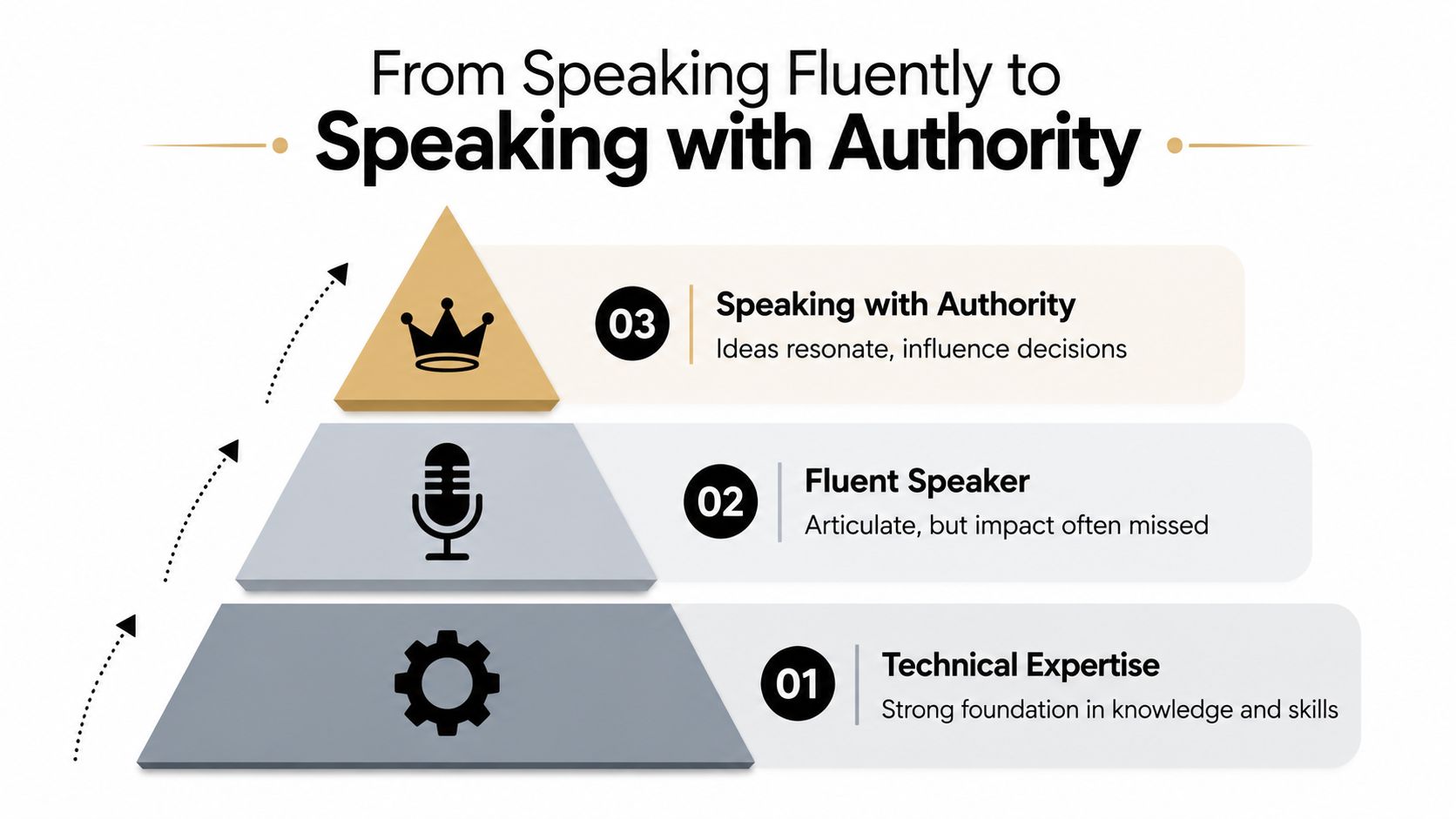
From Speaking Fluently to Speaking with Authority
A lot of capable professionals have already solved the language problem. They can explain, answer, present, and participate. But executive communication demands more than fluency. It demands gravitas, especially when the stakes are high and the room is impatient.
According to Coqual research, 67% of senior leaders identify gravitas as the most critical quality of executive presence, far ahead of communication at 28% and appearance at 5%, as summarized in this discussion of executive presence and gravitas. That matters because many professionals spend years polishing language accuracy while neglecting the quality senior leaders value most.
Why strong ideas still get overlooked
In corporate settings, authority is judged quickly. People listen for steadiness, clarity, and composure. If your delivery sounds rushed, overexplained, hesitant, or overly deferential, your expertise gets discounted before your logic gets fully heard.
That's especially common for international leaders. They often compensate by adding more detail, more background, and more proof. The intention is good. The result is usually the opposite. The message sounds heavier, but the speaker sounds less senior.
Practical rule: Fluency helps people understand you. Authority helps people follow you.
The shift that changes how you're perceived
Authority isn't a personality trait you either have or don't. It's built through choices in voice, structure, pacing, and physical presence. When those elements align, your communication starts to signal leadership rather than effort.
That's the difference between being seen as a capable contributor and being seen as someone ready for bigger scope. If you want a clearer definition, this breakdown of what executive presence means in practice is useful.
A senior audience doesn't just ask, “Was that correct?” They ask, often unconsciously, “Would I trust this person to lead through ambiguity?”
First Assess Your Communication Baseline
Many speakers attempt to improve their skills by attacking everything at once. They work on confidence, pronunciation, pacing, vocabulary, storytelling, filler words, eye contact, and posture in the same week. That approach burns energy and produces very little change.
You need a baseline first. Not a vague feeling that “I should sound better.” A specific diagnosis.
Record one real answer, not a polished speech
Don't start with a conference talk. Start with the kind of communication that affects your career most:
- A meeting update: Give a one-minute summary of a project.
- A leadership answer: Respond to, “What's your recommendation?”
- A pressure moment: Explain a risk, delay, or disagreement.
Record yourself on video. Keep it short. If the clip runs longer than two minutes, you're probably already seeing one of the problems.
Then review it with one question in mind: What makes me sound less senior than I am?
A structured communication skill assessment can help if you want a more formal starting point, but even a self-review is useful when you know what to look for.
What to listen for
The most common authority leaks are easy to hear once you stop focusing on content alone.
| Habit | What it sounds like | How it affects perception |
|---|---|---|
| Filler words | “um,” “ah,” “you know,” “like” | Dilutes precision |
| Upward inflection | Statements ending like questions | Weakens certainty |
| Rushed pacing | Few pauses, compressed phrasing | Signals anxiety |
| Low vocal energy | Flat or quiet delivery | Reduces presence |
| Overexplaining | Too much setup before the point | Lowers executive impact |
Don't try to score yourself numerically. Just notice patterns.
What to watch on video
Audio tells you one story. Video tells you the rest.
Look for behaviors that often go unnoticed in the moment:
- Head movement: Frequent nodding while making a point can soften conviction.
- Facial tension: Tight lips or a fixed smile can make you look guarded.
- Restless gestures: Hand rubbing, pen clicking, chair movement, or touching your face can drain credibility.
- Physical contraction: Shoulders pulled in, chin tucked, or torso collapsed reduces authority even before you speak.
If your words say “I'm confident” but your body says “I hope this is okay,” the room believes your body.
Choose only two priorities
After the review, write down the top two issues that most weaken your presence. Not five. Two.
Examples:
- “I rush and don't pause.”
- “My statements sound uncertain.”
- “I give too much context before the conclusion.”
- “My voice drops at the end of sentences.”
That creates a usable plan. The goal isn't to become a perfect speaker. It's to remove the habits that most clearly undermine authority.
Mastering Vocal Authority for Executive Presence
A strong voice isn't loud. Loudness can feel aggressive, strained, or compensatory. Vocal authority feels grounded. It carries weight without forcing attention.
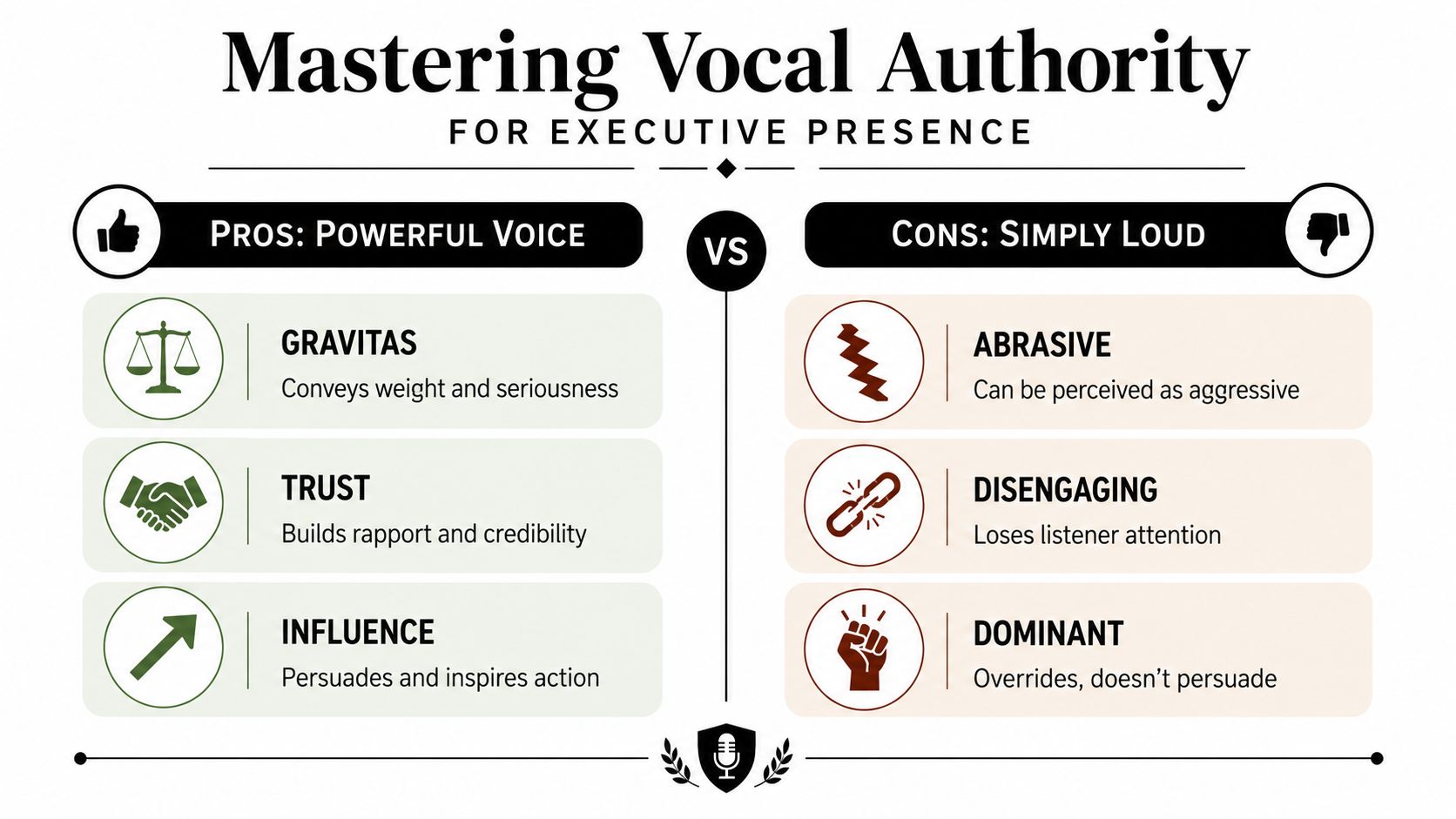
Research indicates that approximately 38% of verbal communication's effectiveness is determined by tone of voice, which is why variation in volume, pitch, and cadence matters so much for authority, as noted in this guide to improving public speaking through vocal delivery. If your tone stays flat, thin, rushed, or hesitant, the message loses force no matter how good the words are.
Projection starts below the throat
Most professionals who “speak up” under pressure push from the throat. The sound gets tighter, not stronger.
Better projection starts lower. Breathe into the torso, let the ribs expand, and release the sentence on steady airflow. You don't need a theatrical voice. You need a supported one.
Try this exercise:
- Stand upright with both feet grounded.
- Inhale gently.
- Say one sentence across the room, not louder, just more supported.
- Repeat until the sound feels less squeezed.
If you present in larger rooms or hybrid settings, even a good voice can get lost without proper setup. For in-person events, practical microphone options from London Audio Visual Hire can help you avoid straining.
Here's a useful demonstration of vocal control in action:
Tone carries status
People often misunderstand tone work. They try to sound “deeper” by artificially lowering pitch. That usually sounds unnatural.
A more resonant, settled tone is the goal. Less upward drift. Less thinness. More stable endings on key statements. If you want targeted drills, this set of deep voice exercises for professionals is a useful starting point.
Your voice should sound like it belongs to the point you're making.
Pacing creates credibility
Fast speech can signal expertise. In senior settings, it often signals urgency, defensiveness, or lack of control.
Authority comes from pace variation, not slowness alone. Move faster through familiar context. Slow down when the point matters. That contrast tells listeners what to remember.
A simple drill works well. Read a short answer aloud three times:
- First too fast.
- Then too slow.
- Then at a deliberate pace with emphasis on only the most important phrase.
You'll hear where your natural control breaks.
Pausing is not dead air
Inexperienced speakers fear silence. Senior speakers use it.
A brief pause before a key phrase increases attention. A pause after a decision statement gives it weight. This is one of the fastest ways to sound more composed.
Try the “pause and punch” pattern:
- “My recommendation is… pause …we delay the launch.”
- “The risk isn't cost. Pause. It's credibility.”
- “We have one priority. Pause. Protect the client relationship.”
That tiny pause changes how the room receives the sentence.
How to Structure Your Ideas Under Pressure
Most experts answer questions the way they think. They start with context, then nuance, then caveats, and eventually reach a conclusion. That works in technical collaboration. It fails in senior conversations.
Executives don't reward the most complete answer. They reward the clearest one.
Analysis from Stanford Graduate School of Business confirms that succinct, clear, and concise messages are more memorable, and that brevity correlates with audience retention and perceived leadership capability in this summary of the Big Data Approach to Public Speaking. In practice, that means the more pressure in the room, the more structure matters.
The expert answer versus the executive answer
Here's the trade-off.
| Style | What happens |
|---|---|
| Expert answer | Shows knowledge, but can bury the point |
| Executive answer | Frames the conclusion first, then supports it |
That doesn't mean becoming simplistic. It means ranking information.
A senior audience usually wants three things:
- Your conclusion
- Your reasoning
- Your implication
If you reverse that order, people start working too hard to follow you.
Use PREP when the question is unexpected
One of the most reliable tools for thinking on your feet is PREP:
- Point
- Reason
- Example
- Point
If a stakeholder asks, “Do we need to change direction?” a PREP answer sounds like this:
Point: “Yes, I think we should adjust direction now.”
Reason: “The current approach is creating delay without improving quality.”
Example: “We've already seen the handoff create confusion across teams.”
Point: “So my recommendation is to simplify the process this quarter.”
Clean. Decisive. Easy to follow.
If this is hard in live meetings, practice with short drills built around thinking on your feet in English.
The boardroom rewards framed judgment, not verbal endurance.
Cut what senior listeners don't need
A lot of professionals sound less authoritative because they include material that belongs in an appendix, not in a spoken answer.
Remove these first:
- Long scene-setting: “To give some background…” when the room already knows it.
- Defensive disclaimers: “I may be wrong, but…” before a reasonable recommendation.
- Overqualification: “There are many angles, and obviously this is complex…” before saying anything useful.
Use this filter instead:
- What do I want them to decide?
- What must they know to trust that decision?
- What can wait unless they ask?
That's how to improve speaking skills for leadership. Not by saying more, but by making your first sentence carry the message.
Projecting Confidence with Executive Body Language
Your body either reinforces authority or contradicts it. In high-stakes settings, people read posture, stillness, eye contact, and gesture before they fully process your words.
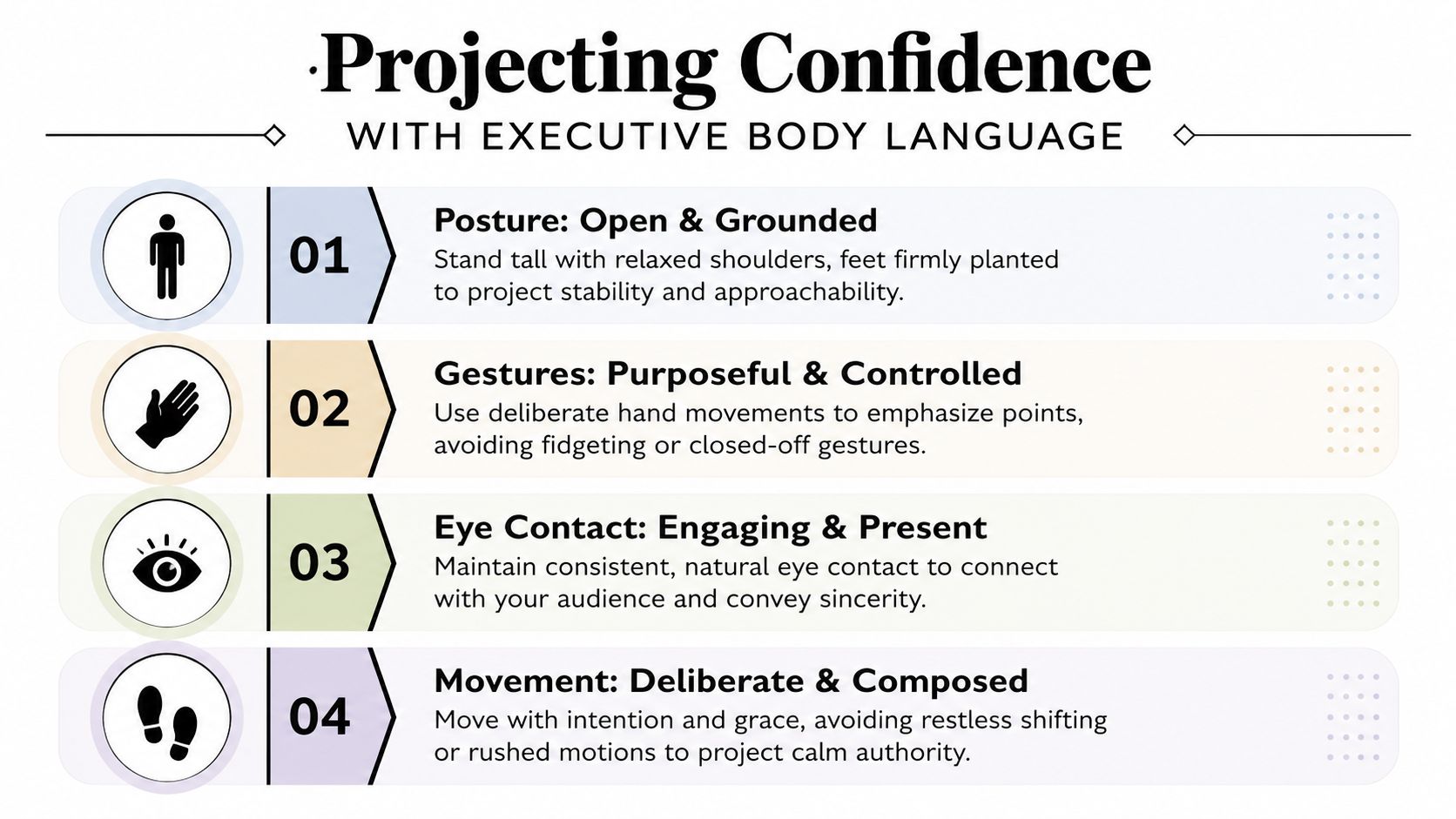
IMD's executive coaching guidance emphasizes that leaders build gravitas by speaking clearly and deliberately and by using strategic pauses to increase the perceived weight of their words, as discussed in this piece on executive presence and gravitas. Body language has to support that same sense of control.
Start with a grounded frame
Commanding presence doesn't mean taking up theatrical space. It means looking settled where you are.
Use this setup before you speak:
- Feet planted: Avoid shifting side to side.
- Shoulders released: Tension reads as stress.
- Chin level: Too high feels rigid, too low feels apologetic.
- Hands available: Not hidden, clenched, or fidgeting.
This posture gives your voice a better base and makes you easier to trust.
Eye contact without staring
Many international professionals were taught eye contact rules that don't map cleanly onto multinational corporate culture. The safest standard is simple. Be present, not intense.
When speaking to a group:
- Hold eye contact long enough to finish a thought.
- Move naturally to another person.
- Include senior stakeholders, not only the friendliest faces.
- Don't drop your gaze immediately after making a key point.
That last habit matters. If you look down the moment you finish, the sentence loses authority.
Calm eye contact tells people you can hold pressure without shrinking.
Replace nervous movement with useful movement
Fidgeting burns attention. Purposeful gesture directs it.
A good executive gesture does one of three things:
| Gesture type | Use it for |
|---|---|
| Framing gesture | Marking a key idea or decision |
| Contrast gesture | Showing two options or trade-offs |
| Containment gesture | Keeping emphasis controlled and precise |
If your hands move constantly, reduce range. If they never move, add one deliberate gesture to underline an important phrase. The goal isn't animation. It's alignment between message and movement.
Creating Your Practice Routine and Feedback Loop
Reading about communication won't change how you sound in a difficult meeting. Practice does. Not random repetition. Deliberate practice with a clear feedback loop.
A study of top public speakers found that a majority (n=6) said novices should treat public speaking as a trainable skill and specifically recommended video feedback, with speakers recording themselves, reviewing immediately, and identifying the top three areas to improve, according to this review of effective speaking themes and video feedback.
Build a routine you'll actually keep
Most professionals fail here because the routine is too ambitious. They create a complex plan and abandon it after a week.
Use a narrower cycle:
- One scenario: investor update, board answer, team presentation, client objection.
- One delivery focus: pacing, tone, pausing, structure, or body language.
- One recording per session: short and specific.
- One review pass: immediate, not someday.
If English development is part of your broader professional training, operational tools such as software designed for language academies can be useful for organizing coaching, attendance, and practice workflows across structured programs.
Review recordings the right way
Don't watch your video and think, “I hate how I look.” That's not feedback. That's avoidance.
Use this checklist instead:
- Did I state the point early?
- Did my pace stay controlled?
- Did my voice drop, rush, or flatten under pressure?
- Did my body look composed?
- What are the top three corrections for the next repetition?
That final question matters. Top three. Not top ten.
A lot of professionals also benefit from regular business English speaking practice built around real work scenarios rather than generic conversation topics.
Practice in layers, not all at once
There's a real trade-off between awareness and performance. If you try to fix every habit in one rehearsal, your delivery becomes mechanical.
Layer the work:
- Week one, focus on concise answers.
- Then add pausing.
- Then add eye contact and gesture.
- Then test all of it in a low-stakes meeting.
That progression is slower than trying to “sound executive” overnight. It works better.
Here is the kind of structured support some professionals use when they want coaching rather than self-study:
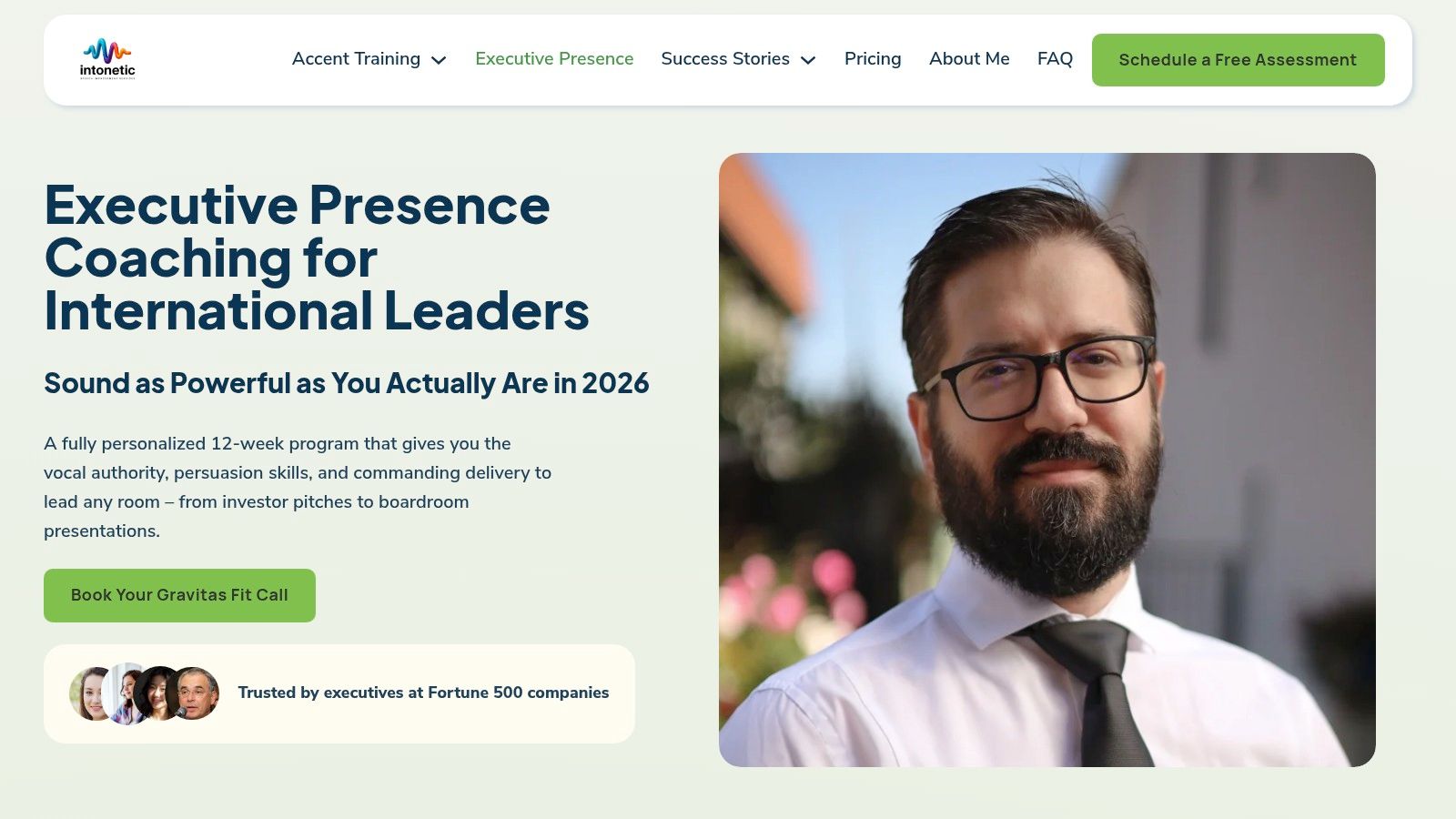
The Gravitas Method is a 12-week one-on-one executive presence coaching program for international professionals who want to communicate with more authority and influence at senior levels. The program is priced at $8,200 paid in full or $9,000 across three installments. Coached by Nikola, it covers vocal authority, strategic framing, executive body language, and high-stakes communication.
What works and what doesn't
What works is consistency, constrained focus, and honest review.
What doesn't work is waiting to “feel confident” before speaking, consuming endless tips without recording yourself, or mistaking more vocabulary for more authority.
Improvement becomes visible when practice stops being general and starts being diagnostic.
If you're serious about how to improve speaking skills for executive presence, treat communication the way you already treat leadership, strategy, or technical performance. Measure the gap. Run the drill. Review the outcome. Repeat under slightly higher pressure.
If you want a clear starting point, take the free Executive Communication Assessment from Intonetic. It's the most practical first step for identifying which speaking habits are weakening your authority and what to work on next.