
Master Deep Voice Exercises for Authority
You're probably feeling this in meetings already. You make a solid point, but someone with a steadier, richer voice says less and lands harder. Your ideas are strong. The delivery just isn't carrying the same weight.
That's why deep voice exercise matters. Not because you need a radio announcer voice, and not because leadership is a performance of masculinity or volume. It matters because vocal gravitas changes how people read your authority before they fully evaluate your content.
Most ambitious professionals don't need a lower voice. They need a more grounded one. They need a voice that sounds composed under pressure, holds up in long presentations, and gives stakeholders the feeling that this person can lead the room.
Why a Deeper Voice Commands Respect in Leadership
People respond to vocal cues fast. Often faster than they respond to your logic. In senior conversations, your first few words can shape how others rank your confidence, credibility, and influence.
A study discussed in the Journal of Experimental Psychology coverage on vocal pitch and perceived authority found that people with a deeper pitch in their first three utterances were rated as significantly more dominant, prestigious, and influential. Listeners also judged speakers whose voices decreased in pitch as more powerful and domineering. That matters if you want to be heard as the person setting direction, not just contributing input.
Depth signals control, not just tone
The mistake is to treat this as a vanity issue. It isn't. In leadership, a deeper sounding voice often reads as a sign of steadiness. It suggests you're not rushing, not tightening, and not reacting from the throat.
That's why the actual target isn't “make my voice lower.” The actual target is make my voice carry more authority.
A useful way to consider it:
| Vocal habit | How it tends to land professionally |
|---|---|
| Thin, breathy, rushed delivery | Nervous, tentative, easier to interrupt |
| Grounded, resonant, paced delivery | Composed, senior, harder to dismiss |
If you want a fuller picture of how voice fits into broader leadership perception, this explanation of executive presence in practice is worth reading.
Practical rule: Your voice doesn't need to be dramatically lower. It needs to sound less strained, less reactive, and more settled.
Why this matters in high-stakes rooms
Board meetings, investor updates, client negotiations, and cross-functional conflict all punish vocal instability. If your breath runs short or your throat tightens, people hear effort. When your tone stays supported, people hear command.
That's also why generic “deep voice” advice fails ambitious professionals. A lower sound with poor pacing still feels junior. A resonant sound with calm timing feels senior.
So yes, a deep voice exercise can help. But only when it's tied to professional outcomes:
- Holding the floor: You finish a point without your tone fading out.
- Reducing interruption risk: Your opening phrases sound decisive.
- Projecting confidence: Stakeholders hear control, even when the topic is tense.
- Creating recall: A voice with weight gives key lines more memorability.
Leadership presence starts before anyone agrees with you. Your voice often makes the introduction for you.
Master Your Breath and Posture for Vocal Power
Individuals often chase a deeper voice in the wrong place. They push from the throat, compress the neck, and end up sounding forced. That approach doesn't create gravitas. It creates fatigue.
The more useful correction is simple. The myth that deep voice exercises can physically lower your natural pitch is wrong. The better mechanism is resonance and tension control. Your vocal fold length is static, and effective training focuses on enhancing resonance rather than forcing pitch reduction, as explained in this piece on safe ways to make your voice sound deeper.

Build support before you make sound
If your breathing is shallow, your voice has no stable platform. You'll compensate by squeezing the throat, raising the chin, or speaking too quickly before the breath runs out.
Start with these cues:
- Stand tall through the spine. Don't puff your chest. Just lengthen upward.
- Let the shoulders drop. Lifted shoulders usually mean accessory breathing.
- Breathe low and wide. Feel expansion around the lower ribs, not just the upper chest.
- Exhale steadily. The goal is controlled airflow, not a dramatic inhale.
A lot of professionals benefit from simple regulation work before vocal drills. If stress is making your breath choppy, a psychiatrist's guide to calm offers a useful reset you can use before presentations or difficult calls.
Use posture to free resonance
Good posture isn't cosmetic. It changes the shape of the instrument. A collapsed chest limits breath capacity. A forward head position narrows the channel for sound. A locked jaw dulls resonance.
Use this quick comparison:
- Poor setup: chin forward, ribs collapsed, shoulders tense, jaw tight
- Better setup: head balanced, sternum easy, knees soft, jaw loose
For a more technical breakdown of breath, support, and resonance, this guide to vocal technique and voice training is a strong next step.
When clients say, “I want a deeper voice,” they usually need better breath management and less throat effort.
A short reset you can use before a meeting
Try this standing at your desk:
- Inhale through the nose
- Expand through the lower ribs
- Exhale on a soft hum
- Keep the throat passive
- Repeat until the sound feels easier, not lower
That last point matters. Ease comes first. Depth follows.
Core Exercises to Deepen Your Vocal Resonance
The safest deep voice exercise doesn't ask you to force a lower note. It teaches your body where richer sound lives. You're training resonance, placement, and release.
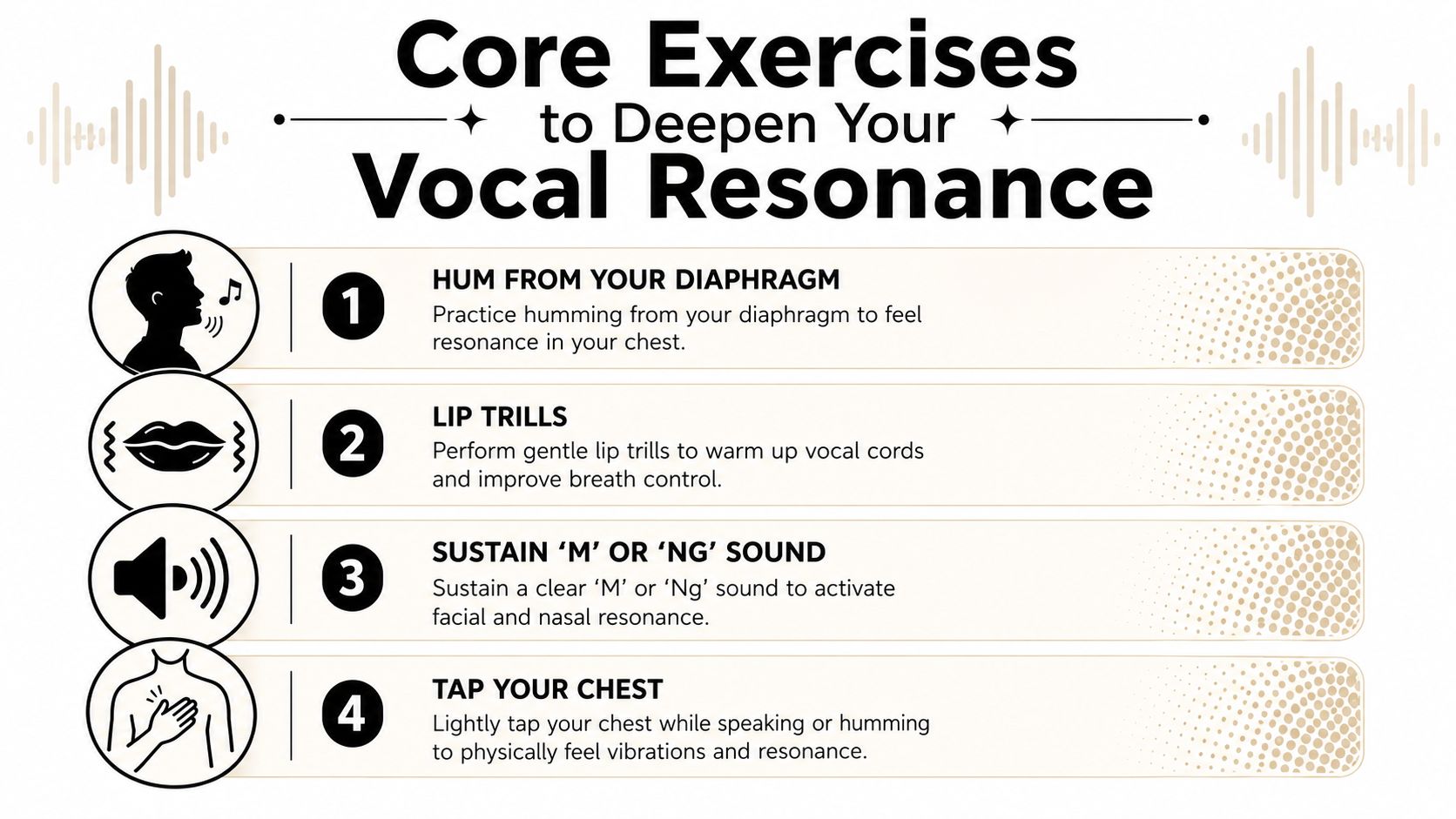
One of the most practical structures is a 9-minute daily routine made of three semi-occluded vocal tract exercises: Siren Technique for 3 minutes, Lip Trills for 3 minutes, and Soft Palate Yawns for 3 minutes. That routine is outlined in this explanation of how to make your voice sound deeper through SOVTE practice. The yawn shape widens the pharynx and lowers the larynx to create space for a richer tone without strain.
Three drills that actually help
Siren technique
Glide from your lowest comfortable pitch to your highest and back down. Use either a hum or an open vowel.
What you're looking for isn't dramatic sound. You want mobility without grabbing in the throat. The downward glide often reveals where your speaking voice can settle more naturally.
Lip trills
Blow air through relaxed lips so they vibrate. Then add pitch movement.
This is one of the best ways to reduce excess pressure. It helps you coordinate airflow and sound without pushing. If your trill stops, that usually means you're overworking.
A useful companion area is mouth and facial coordination. For readers who want that layer, this overview of orofacial myofunctional therapy gives context on how oral posture and muscle patterns can affect function.
Here's a guided visual if you want to see one of these techniques in action:
Soft palate yawn
Trigger a gentle yawn shape, then sustain an easy sound inside that space. Don't overdo it. The point is openness, not theatrical yawning.
This exercise often changes a flat voice quickly because it creates internal room. The result is usually more resonance, less nasal tone, and less throat squeeze.
Two simple add-ons for speaking voice
These aren't part of the 9-minute structure, but they help translate drills into conversation:
- Chest hums: Hum on “m” and place a hand on your chest to notice vibration.
- Ng resonance: Sustain the “ng” sound from “song” and feel buzz in the face.
If you want a broader set of speaking drills, these voice lesson exercises for daily practice are useful.
Don't judge these exercises by how low you can go. Judge them by how free, steady, and resonant your voice feels after.
Avoiding Common Pitfalls in Voice Training
Bad voice training usually sounds ambitious. People try to achieve a deeper sound by pushing harder, jumping across exaggerated ranges, or driving the larynx downward. That's how strain starts.
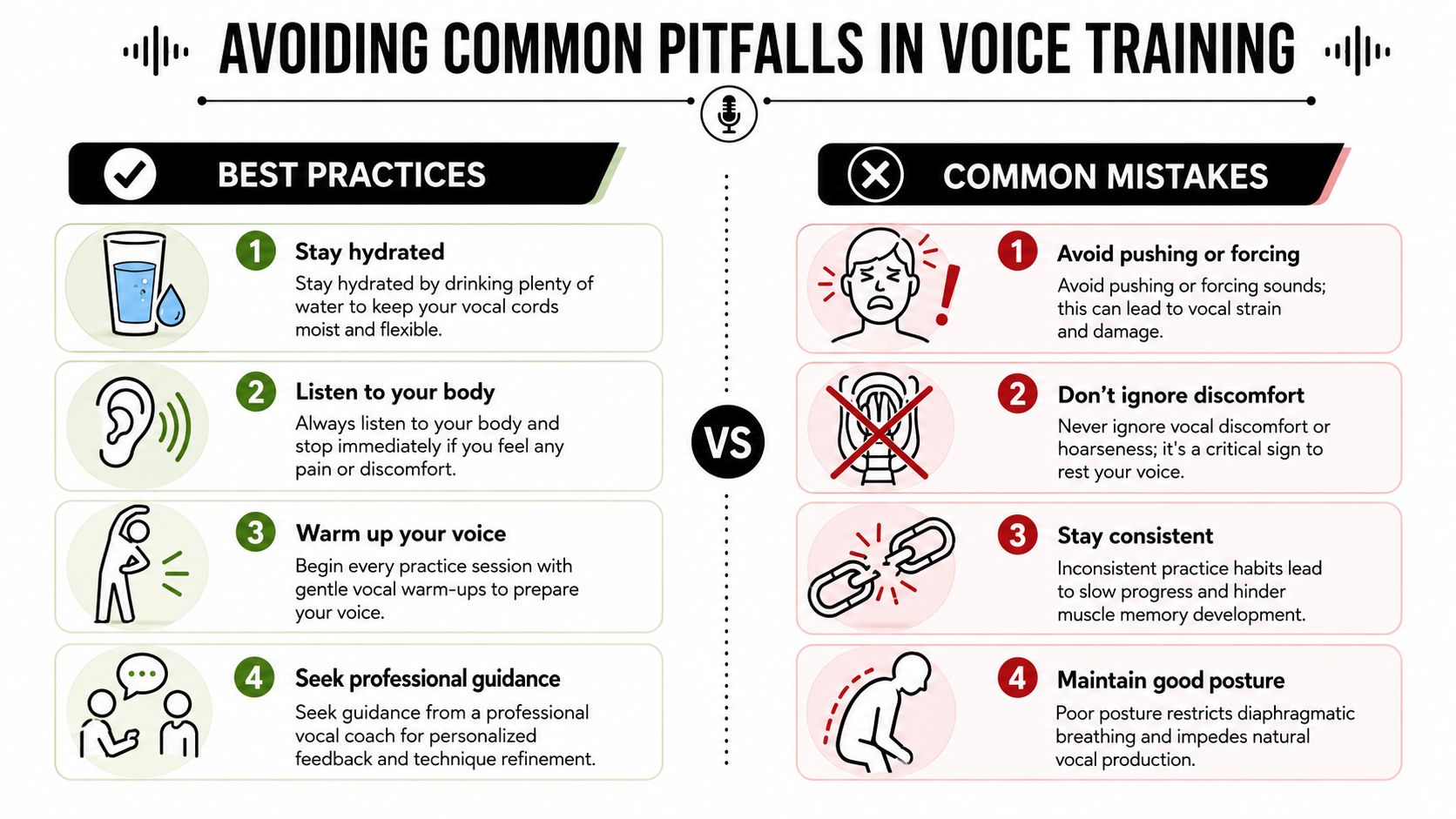
The safer view is more disciplined. A review of vocal exercise practice notes that fatiguing methods like excessive octave jumping can create tension. It also notes that trying to lower pitch below the D3 to E3 range without an open-throat technique leads to strain, and that hydration matters because dehydration causes the vocal cords to shrink, which inhibits deep tone production, as summarized in this review of vocal exercise effectiveness and common risks.
What usually goes wrong
Here are the most common mistakes I see in professionals who've been following random internet advice:
- Forcing from the throat: You hear effort immediately. The sound gets darker for a second, then unstable.
- Chasing a lower note every day: This turns training into a pitch contest instead of a communication skill.
- Ignoring fatigue: Hoarseness, scratchiness, and a “spent” voice after practice aren't signs of progress.
- Practicing dry: Low hydration and long speaking days are a bad combination.
What to do instead
Use a more conservative checklist:
| If this happens | Do this |
|---|---|
| Throat feels tight | Stop and reset with breath and gentle hums |
| Voice feels tired | Rest the voice and use warm salt water if needed |
| Low notes feel jammed | Return to easy descending sounds, one semitone at a time |
| Jaw starts pushing down | Let it release downward naturally instead of forcing space |
Pain is not a training effect. It's a stop signal.
A better standard for progress
A productive session leaves your voice clearer, not rougher. You should finish with more ease in speech, better sustain on sentences, and less effort at normal volume.
If a deep voice exercise makes you feel powerful for ten seconds and compromised for the next hour, it's the wrong exercise or the wrong dosage. Long-term gravitas comes from repeatable technique, not extreme sensation.
Design Your Daily Vocal Authority Routine
Most professionals don't need a complex plan. They need a routine they'll keep. The right daily structure is short, specific, and tied to work outcomes.
Consistency matters because the voice is physical. A clinical study on inspiratory muscle work found a 22.9% increase in Maximal Inspiratory Pressure and a 14.7% increase in Maximal Expiratory Pressure after training, with improved capacity for voice production and greater endurance for speaking tasks, as reported in this clinical study on inspiratory muscle strengthening and vocal performance. That's the part many people miss. Better vocal authority isn't only acoustic. It's also respiratory endurance.
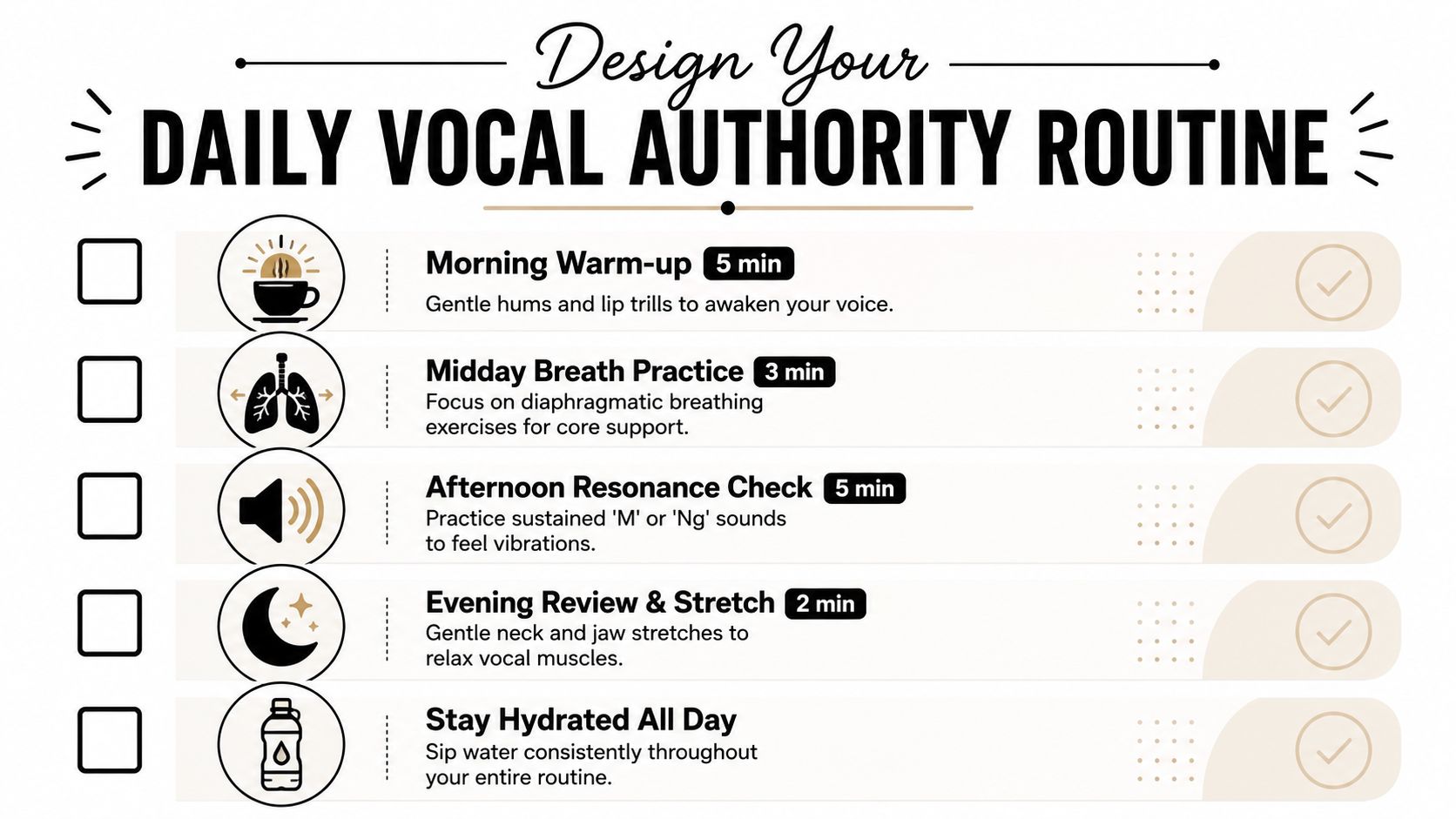
A practical workday routine
Use this template:
Morning setup
Start with 5 minutes.
- Gentle hums: Wake up resonance without volume.
- Lip trills: Get airflow moving.
- One yawn-shaped sigh: Open the back space without pushing.
Midday reset
Take 3 minutes before your first important meeting.
- Low rib breathing
- Soft sustained “m”
- One slow sentence spoken on steady breath
If you want structured spoken practice, this page on business English speaking practice is relevant for professionals who need vocal work to transfer into real meetings, not just drills.
Evening downshift
Use 2 to 4 minutes.
- Easy descending hums
- Jaw release
- Neck and shoulder relaxation
- Water before you stop for the day
How to track progress without obsessing over pitch
Don't measure success by whether your voice sounds dramatically lower on a random Tuesday. Track outcomes that matter at work:
- Stamina: Can you finish long explanations without fading?
- Clarity: Do people ask you to repeat yourself less often?
- Ease: Does your throat feel less taxed after meetings?
- Presence: Do your opening lines sound more settled?
Some people also benefit from outside feedback. If you want additional technique support in a more traditional music-training format, resources that help you find adult voice teachers can be useful, provided the teacher understands spoken voice goals and not just singing.
The best routine is the one you can repeat when your calendar is full, your energy is average, and you still need your voice to perform.
Projecting Gravitas in High-Stakes Communication
A stronger voice becomes valuable when you use it well under pressure. That's where gravitas enters. Not as a vague leadership buzzword, but as a visible communication advantage.
According to a Center for Talent Innovation summary on executive presence, senior leaders weighted gravitas at 67%, while communication accounted for 28% and appearance for 5% in how executive presence is evaluated across a study of 13,000 professionals. That should reframe how you think about voice work. You're not polishing a minor accessory. You're strengthening one of the most influential channels through which gravitas is perceived.
How vocal gravitas sounds in the room
It usually shows up in a few behaviors working together:
- Measured pacing: You don't rush the first sentence.
- Intentional pauses: Important lines get space.
- Stable tone under challenge: Your voice doesn't climb when you're interrupted.
- Clean endings: Sentences finish with conviction instead of trailing off.
That last point is where many capable international professionals lose authority. They know the material, but the ending of the sentence softens, rises, or disappears. The room reads uncertainty even when the reasoning is solid.
For presentation delivery and room control, this guide on how to engage the audience is useful because gravitas isn't only about sound. It's also about timing, focus, and command of attention.
What to use in real executive moments
A practical pattern for high-stakes speaking:
- Settle before speaking. One quiet breath is better than a rushed start.
- Land the first line low and clear. Not artificially low. Just grounded.
- Pause after the key point. Let people absorb it.
- Answer objections at the same pace. Don't speed up because tension rises.
You don't need a theatrical “leader voice.” You need a voice that stays organized when the stakes climb. That's the difference between sounding impressive and sounding promotable.
The Gravitas Method is a 12-week one-on-one executive presence coaching program for international professionals who want to communicate with more authority and influence at senior levels. The program is priced at $8,200 paid in full or $9,000 across three installments. Coached by Nikola, it covers vocal authority, strategic framing, executive body language, and high-stakes communication.
If you want a clear read on how your voice, delivery, and executive presence currently land, start with Intonetic's free Executive Communication Assessment. It's the best entry point if you're aiming for more authority in senior meetings, presentations, and stakeholder conversations.