
Vocal Technique Voice Training: Vocal Technique Voice
You know the material. You’ve done the analysis. You’ve built the deck, anticipated objections, and rehearsed the logic. Then the meeting starts, and someone with less expertise but a steadier, more grounded voice gets the room’s attention first.
That’s not just about confidence. It’s about delivery.
For many ambitious professionals, especially those working in a second language, the problem isn’t lack of intelligence or poor preparation. It’s that the voice doesn’t yet match the level of authority the role requires. A thin tone, rushed pace, clipped breath, flat intonation, or tense articulation can make strong ideas sound tentative.
Most advice on vocal technique voice training misses the professional reality. It teaches breathing, projection, or pitch as isolated mechanics. It rarely explains how those mechanics affect senior-level communication. Yet that gap matters. As noted in this overview of foundational vocal techniques, there’s a real disconnect between general vocal training and the development of executive presence, particularly for non-native English speakers navigating accent perception and credibility in cross-cultural settings.
A leader’s voice does more than carry words. It signals whether others should trust your judgment, follow your framing, and stay with you when the stakes rise.
That skill can be trained. Not by trying to sound like a broadcaster or a singer, but by building a voice that is steadier under pressure, clearer in complex conversations, and more persuasive in rooms where seniority is judged fast.
If you want a diagnostic starting point for that work, a strong first step is an executive communication assessment.
From Unheard to Unforgettable Why Your Voice Matters
You don’t need a “power voice.” You need a voice that supports the message you already know how to deliver.
In senior environments, people make quick judgments from vocal cues. They notice whether you sound composed when challenged, whether you finish a sentence without losing breath, and whether your emphasis lands on the important words instead of getting buried in speed. These signals shape perceived authority long before anyone comments on your ideas.
For international professionals, the challenge is sharper. Accent is rarely the primary issue by itself. The larger issue is what often travels with it: hesitation, overcorrection, flattened rhythm, and extra muscular tension. That combination can make a capable speaker sound less certain than they are.
Why technical competence isn’t enough
Strong performers often assume that expertise should speak for itself. In practice, it doesn’t.
A director in finance, a product leader in tech, or a founder pitching investors needs more than accuracy. They need vocal behaviors that communicate seniority: stable pace, grounded breath, clear stress patterns, and a tone that carries without force. Those are not innate traits. They’re trainable communication habits.
Practical rule: If your voice gets smaller when the stakes get higher, people often read that as uncertainty, even when your thinking is solid.
General voice training often stops at mechanics. Professional communication requires one more step. You have to convert technique into influence. That means using breath for steadiness, resonance for presence, articulation for clarity, and pacing for control.
What vocal authority actually sounds like
It usually doesn’t sound theatrical. It sounds economical.
A credible voice in a boardroom is rarely loud. It’s supported. It doesn’t rush to prove itself. It holds shape through longer phrases. It can sound calm without sounding passive, and direct without sounding aggressive.
That’s why vocal technique voice training matters for leadership. It helps your voice reflect your judgment, not your nerves.
Build Your Foundation with Breath Support and Control
Most vocal problems at work start below the throat. They begin with poor breath management.
When people say they “run out of voice,” what they often mean is that they’re speaking on shallow air. The chest lifts, the shoulders tighten, and the sentence collapses halfway through. That pattern creates strain, weak endings, and a rushed tempo that makes you sound less settled than you feel.

A better voice starts with breath support, not volume. Support means you manage airflow so the voice stays stable across the full thought. That matters in meetings, presentations, interviews, and any situation where you need to sound composed through longer answers.
A 2019 study on drama students found that vocal training improved vocal efficiency. Mean expiratory airflow dropped from 0.25 (SD 0.1) L/s to 0.17 (SD 0.1) L/s after training (P = .01), which suggests less air was wasted during phonation, and in the male subgroup vital capacity increased from 4.27 (SD 0.7) L to 4.83 (SD 0.5) L (P = .01), supporting longer phrases with less strain, according to the study on vocal efficiency and training.
What supported breathing feels like
You’re not trying to inflate the chest. You’re trying to expand lower in the torso so the breath feels anchored.
Three signs you’re doing it correctly:
- The shoulders stay relatively quiet: They don’t jump up on inhale.
- The lower ribs and upper abdomen expand: The breath moves wider and lower, not only higher.
- The exhale stays controlled: Air doesn’t spill out in the first few words.
If you want a companion resource focused on speech, these breathing exercises for better English speech are useful to pair with the drills below.
Three drills that fix weak breath support
-
Book on the belly
Lie on your back and place a light book on your abdomen. Inhale through the nose and let the book rise gently. Exhale on a soft “sss” and keep the release even. This teaches low expansion without the chest taking over. -
Hissing exhale
Stand tall. Inhale, then release on a steady hiss. Don’t force the sound. The goal is consistency. If the hiss starts strong and fades fast, you’re leaking air too early. -
Counted phrase drill
Inhale once, then speak a short business phrase such as “The priority this quarter is execution discipline.” Repeat it while aiming for the same calm tone from first word to last. This begins the transfer from exercise to real speech.
Later, use a spoken practice round with this short demonstration:
What doesn’t work
A few habits make breath support worse, not better:
- Taking huge breaths before every sentence: This adds tension and often makes the opening words sound pushed.
- Sucking in the stomach on inhale: That blocks the very expansion you need.
- Trying to “sound powerful” immediately: Forced volume usually means poor airflow management.
A supported voice doesn’t feel dramatic. It feels sustainable.
That’s the standard to aim for. If your breathing pattern is right, your voice starts to sound calmer before you’ve changed anything else.
Unlock Natural Resonance and Vocal Projection
A supported breath gives you fuel. Resonance determines whether that fuel produces a voice people want to listen to.
Projection is often misunderstood. Many professionals think they need to speak louder. Usually they need to remove the tension that keeps the sound trapped. When the jaw stiffens, the tongue retracts, or the larynx gets pulled around by surrounding muscles, the voice loses depth and carrying power.
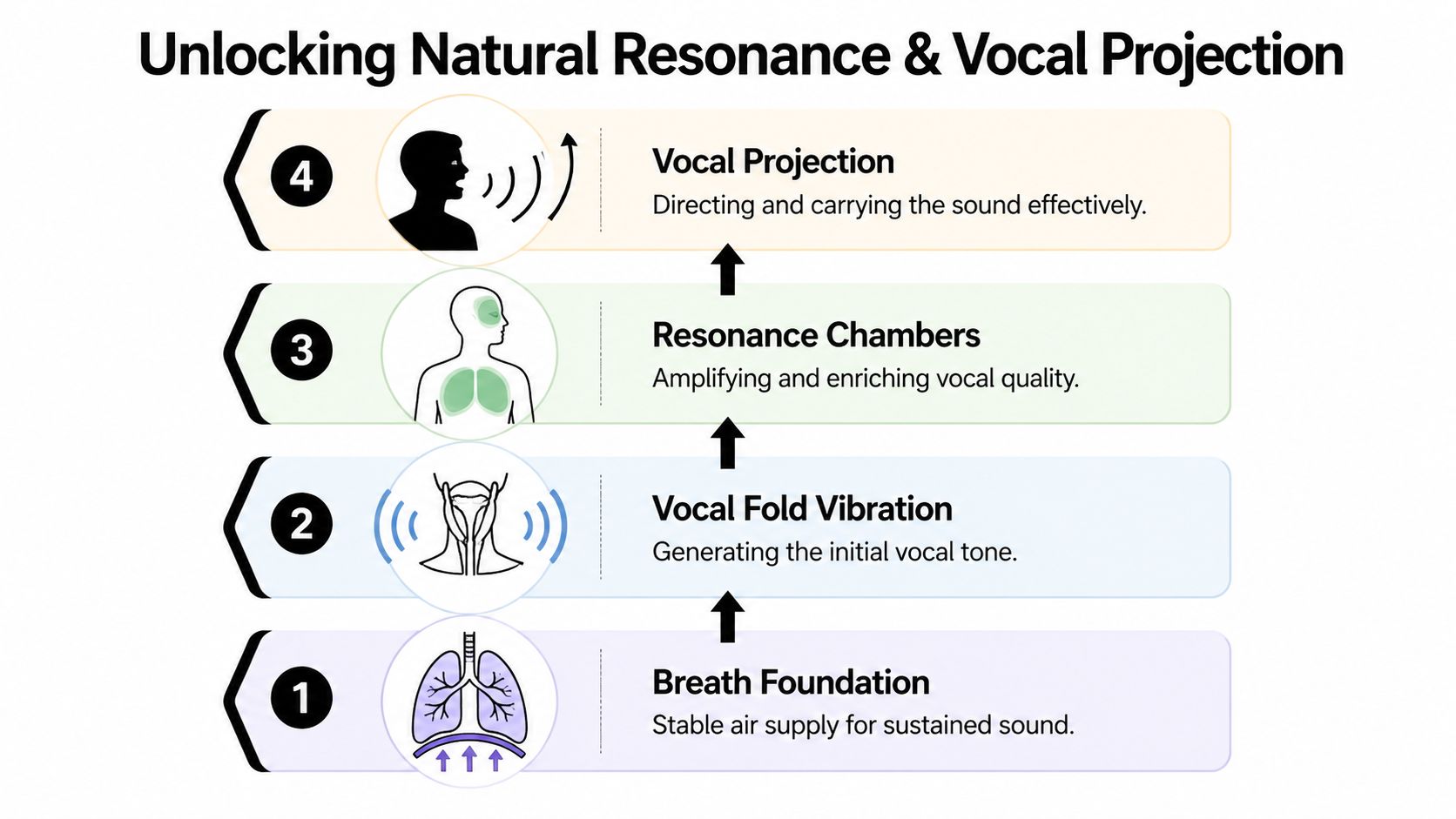
Think of resonance as the difference between tapping a muted surface and striking a well-built speaker cabinet. The same energy goes in, but the output is fuller, richer, and easier to hear.
Where thin voices usually come from
A thin or pinched tone usually isn’t a personality issue. It’s mechanical.
Advanced vocal training methods emphasize reducing tension first, then establishing positions that allow strain-free sound. They also stress separating the actions of the tongue, jaw, and larynx so one part doesn’t interfere with another. In vocal pedagogy data summarized in this step-by-step guide to vocal stability and precision, singers who skip systematic tension reduction experience 2 to 3 times higher rates of vocal fatigue.
For professionals, the lesson is direct. If your voice gets tired, flat, or sharp after a few meetings, don’t assume you just need more confidence. You may be speaking through compensation.
Exercises that build resonance without shouting
Try these in order. They work best when the neck stays easy and the face remains mobile.
-
Humming on “mm”
Start with a comfortable pitch and hum gently. Feel for vibration around the lips, cheekbones, or front of the face. That “buzz” often signals more efficient resonance. -
Lip trills
Blow air through relaxed lips so they flutter. Then add pitch. Lip trills reduce excess pressure and help the voice stay free while moving. -
Jaw release with speech
Massage the jaw hinges lightly, then say a short sentence slowly. If the jaw locks on certain consonants, exaggerate ease rather than precision for the first few repetitions. -
Forward placement phrases
Speak short lines such as “I agree” or “The key issue is timing” while keeping the sound energized near the front of the mouth instead of buried in the throat.
If you want a realistic sense of how long clarity work takes, this guide on the time required to improve voice clarity and intelligibility sets expectations well.
The trade-off professionals need to understand
Trying to project by force may help for a minute. It fails over a long day.
A better approach is to create a tone with enough ring and structure that the room does the work for you. You’re not pushing the voice outward. You’re shaping it so it carries.
When projection is working, people hear more authority, but you feel less effort.
That’s often the first noticeable shift. The voice sounds bigger, yet the body feels quieter.
Master Intonation and Articulation for Clarity
A resonant voice gets attention. Intonation and articulation make the message easy to follow.
A common problem is that many non-native professionals get misread. Their grammar may be excellent, and their ideas may be well-developed, but the delivery flattens key contrasts. Important words don’t receive stress. Sentences end with the wrong pitch pattern. Consonants get softened or compressed when the speaker speeds up. The result isn’t just reduced clarity. It’s reduced impact.

Intonation is meaning, not decoration
English uses pitch movement to signal certainty, contrast, completion, and emphasis. If every sentence lands with the same melody, listeners have to work harder to identify what matters.
Complete Vocal Technique describes four vocal modes, Neutral, Curbing, Overdrive, and Edge, each with distinct physical requirements. It also emphasizes “necessary twang” for efficient clarity and volume. In structured CVT practice, practitioners achieve 90% smoother register shifts, according to the overview of Complete Vocal Technique. For professional speakers, the useful takeaway isn’t to think like a singer. It’s to understand that vocal quality can shift intentionally without strain.
A practical place to start is this guide on mastering American English intonation with examples.
Drills for more precise spoken clarity
Use short business language, not generic warmups. That makes the training transfer faster.
Try this sequence:
- Stress contrast drill: Say “We need the proJECT, not the PROcess” and exaggerate the stressed syllables. Then create your own contrast pairs from work vocabulary.
- Pitch staircase: Take one sentence, such as “I disagree with that assumption,” and repeat it three ways: calm neutral, firm challenge, and collaborative correction.
- Consonant release practice: Slow down final consonants in words like “risk,” “cost,” “next,” and “world.” Those endings often disappear under pressure.
- Vowel length awareness: Keep the vowel fully shaped in key words such as “lead,” “team,” “scope,” and “change.” Rushed vowels make speech sound blurred.
What works and what doesn’t
What works is selective exaggeration in practice. You over-mark stress and articulation while training so that normal speech becomes clearer later.
What doesn’t work is trying to erase your accent by imitating every surface feature of another speaker. That usually adds tension and self-consciousness. The goal is not to sound native. The goal is to sound clear, deliberate, and easy to trust.
Clear articulation doesn’t mean overpronouncing every word. It means making the important words impossible to miss.
That distinction matters. Senior speakers don’t sound fussy. They sound intentional.
Control the Rhythm of Authority with Pacing and Pauses
A strong voice can still lose authority if it moves too fast.
Senior leaders often sound composed because they control time well. They don’t fill every gap. They let points land. They answer hard questions without sprinting into the first sentence that comes to mind. That rhythm shapes how others interpret confidence.
Fast speech is not always a problem. In fact, energetic pace can help in moments of momentum. But uncontrolled speed usually signals internal pressure. The listener hears urgency when you may be nervous, translating in real time, or trying too hard to sound polished.
Why pacing affects both authority and stamina
There is still a lack of research-backed guidance for professionals who speak continuously through long workdays. That gap matters for executives, consultants, sales leaders, and others in communication-heavy roles. As discussed in this article on vocal freedom and sustainable technique, proper technique, including neutral larynx positioning and controlled pacing, matters not only for authority but also for reducing fatigue, especially for international professionals managing accent and pronunciation under load.
That’s an important professional insight. Pacing isn’t only rhetorical. It’s physiological.
When you rush, you often shorten breath cycles, tighten the throat, and reduce your ability to reset between ideas. Across multiple meetings, that compounds into a voice that feels frayed by late afternoon.
Three places where pauses create seniority
-
Before the answer
In Q&A, a brief pause before speaking signals thoughtfulness. It also gives you time to organize the opening line. -
Before the key point
If you’re about to name the recommendation, the risk, or the decision, pause first. That silence works like a spotlight. -
After the important sentence
Most speakers rush past their strongest line. Hold for a beat instead. Let the room process it.
If you want to hear how this works at the sentence level, this explanation of rhythm and timing in American English is particularly useful.
A practical reset for people who speak too quickly
Use this in live situations:
- End the sentence fully: Don’t clip the last word.
- Allow the inhale to be quiet: Don’t gasp for the next line.
- Start the next sentence slightly slower than feels natural: Your internal sense of “normal” is often faster than the room needs.
This feels awkward at first. That’s normal. People who habitually rush almost always believe they are speaking more slowly than they are.
Silence used well doesn’t weaken authority. It proves you don’t need to scramble for it.
That’s one of the clearest differences between junior and senior delivery.
Your Progressive Vocal Training Plan and Troubleshooting
Individuals often improve their voice when they stop practicing everything at once.
The best vocal technique voice training for professionals is progressive. You build support first, then resonance, then speech clarity, then high-stakes application. If you reverse that order and jump straight to presentation performance, you usually hardwire the same old tension into more polished language.
A practical 12-week progression
This structure works well for busy professionals because it keeps the focus narrow enough to apply consistently.
Weeks 1 to 4
Build breath support and release obvious tension. Practice low torso expansion, controlled exhale, humming, and jaw release. Use short speaking phrases rather than long presentations.
Weeks 5 to 8
Shift attention to resonance, articulation, and intonation. Add lip trills, forward placement phrases, stress drills, and contrast work on common business vocabulary. Record short meeting summaries and listen for thin tone, swallowed endings, or monotone delivery.
Weeks 9 to 12
Apply the work to real scenarios. Practice stakeholder updates, executive summaries, interview answers, pushback in meetings, and difficult Q&A. Add deliberate pausing, cleaner openings, and stronger final words in sentences.
A useful parallel here is message design. Better voice and better structure reinforce each other. Teams working on how ideas land, not just how they sound, can learn from Podmuse's B2B storytelling expertise, especially when they need to make complex ideas clearer and more memorable.
Common Vocal Issues and How to Fix Them
| Problem | Likely Cause | Corrective Exercise |
|---|---|---|
| Voice sounds thin | Tongue, jaw, or throat tension blocks resonance | Humming on “mm” followed by forward placement phrases |
| You run out of breath mid-sentence | Air is released too quickly at the start | Hissing exhale, then counted phrase drill |
| Speech gets fast when nervous | Breath and thinking outrun pacing control | Pause before key points, then restart slightly slower |
| Accent makes certain words unclear | Stress pattern or consonant release is off | Stress contrast drill and final consonant practice |
| Voice gets tired late in the day | You’re compensating with tension instead of support | Short daily breath work plus jaw release and lower effort speech |
| You sound monotone | Pitch movement isn’t tracking meaning | Pitch staircase drill with real work sentences |
What to expect and when to get help
Improvement is rarely linear. One week your voice may sound fuller. The next week it may feel awkward because you’re no longer relying on old habits. That’s not regression. It’s recalibration.
The ultimate test is transfer. Can you keep the new voice when you’re interrupted, challenged, or speaking to senior stakeholders? If not, the issue usually isn’t knowledge. It’s application under pressure.
For professionals who want a more guided route, The Gravitas Method is a 12-week one-on-one executive presence coaching program for international professionals who want to communicate with more authority and influence at senior levels. The program is priced at $8,200 paid in full or $9,000 across three installments. Coached by Nikola, it covers vocal authority, strategic framing, executive body language, and high-stakes communication.
Start Communicating Like a Leader Today
Your voice doesn’t need to become someone else’s. It needs to become more usable, more stable, and more aligned with the level you already operate at.
That means breathing in a way that supports complete thoughts. Releasing the tension that makes the tone thin or trapped. Shaping speech with clearer stress and cleaner articulation. Using pacing and pauses to show control instead of urgency.
These aren’t cosmetic changes. They affect how people interpret your judgment, confidence, and readiness for senior responsibility.
A stronger professional voice is learned. It’s built through mechanics, repetition, and application in real conversations that matter. If your expertise is already there, vocal training helps other people hear it faster.
If you want a clear next step, start with Intonetic’s free Executive Communication Assessment. It helps you identify the specific delivery patterns that may be weakening your authority, from vocal presence and pacing to clarity under pressure, so you know exactly what to improve first.