
How to Disagree Respectfully: Workplace Guide 2026
You're in a meeting with people above your level. A senior colleague proposes a plan that sounds polished, but the numbers you've reviewed point to a risk nobody has named. You feel the moment passing. If you stay quiet, you protect the relationship in the short term. If you speak too bluntly, you risk sounding combative, especially if English isn't your first language and your tone gets judged faster than your ideas.
That's the tension behind learning how to disagree respectfully. It isn't about sounding polite for its own sake. It's about protecting your credibility while still saying what needs to be said.
For international professionals, the challenge is sharper. The same sentence can sound measured in one accent and harsh in another. A direct phrase that works in one culture can feel rude in a hierarchy-driven team. If you want senior leaders to trust your judgment, you need more than polite phrases. You need structure, vocal control, and the ability to stay composed when the room gets tense.
Why Voicing Disagreement Is a Leadership Imperative
Silence can look professional in the moment. Over time, it often reads as lack of judgment, lack of conviction, or lack of readiness for senior responsibility.

Leaders aren't valued because they agree well. They're valued because they can protect decisions from blind spots, weak reasoning, and avoidable risk. Respectful disagreement is part of that job. If you can challenge a flawed assumption without destabilizing the room, people start to see you differently.
That shift matters even more when your goal is executive presence. Senior credibility depends on how you handle pressure, not just how you perform when everyone agrees with you. If you want a stronger foundation of authority, this guide on how to build credibility as a leader connects directly to the same skill.
Practical rule: If you notice a material risk and say nothing, you haven't preserved trust. You've postponed the cost.
In practice, the strongest professionals don't confuse harmony with leadership. They know when to align, when to question, and how to do both without creating unnecessary friction.
Prepare Your Mindset Before You Speak
Most bad disagreements are lost before the first sentence. The speaker reacts emotionally, frames the issue as personal, and starts talking before deciding what the conversation is for.
The internal reset is simple. Move from reaction to contribution. Ask yourself what outcome you want the room to reach, not what irritation you want to release.
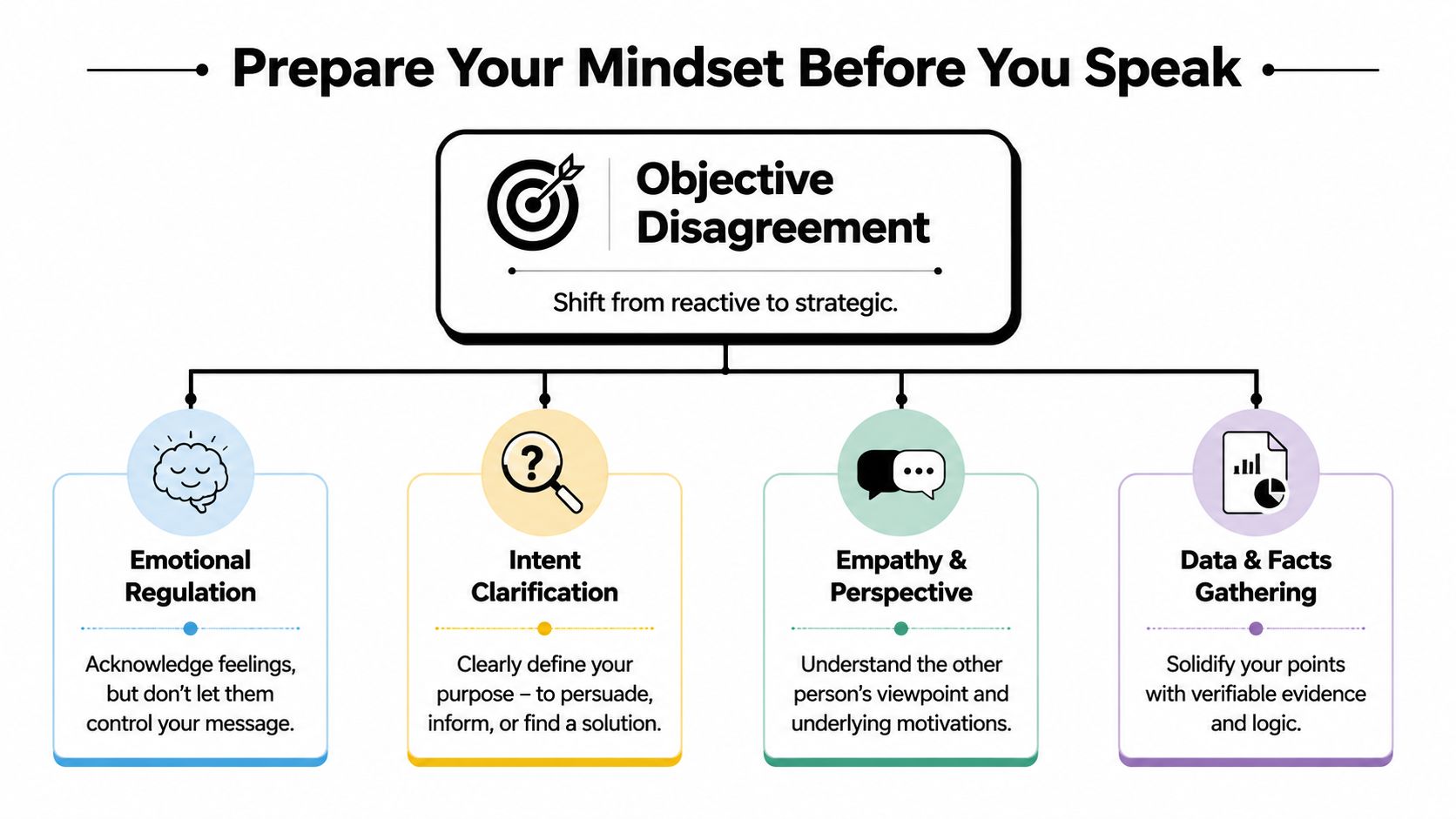
A useful starting point is shared purpose. A Forbes meta-analysis found that 67% of unresolved workplace conflicts stemmed from a failure to distinguish between opinions and facts, and that starting disagreements by restating the conversation's shared goal increased successful resolution rates by 45%. That's not a soft skill detail. It changes whether your comment lands as collaboration or resistance.
Find the shared goal first
Before you respond, identify the target everyone in the room is supposedly trying to reach.
That goal might be reducing launch risk, protecting margin, improving adoption, or avoiding client churn. If you name it first, your disagreement stops sounding like personal opposition.
Try lines like:
- For a product discussion: “We're both trying to reduce rollout risk.”
- For a finance conversation: “I think we're aligned on protecting profitability.”
- For a leadership decision: “The goal seems to be speed without creating downstream instability.”
That framing does two things. It lowers defensiveness, and it gives you a neutral platform for your next sentence.
Separate facts from interpretations
Professionals often think they're disagreeing about data when their disagreement is about meaning. One person says, “The clients aren't ready.” Another says, “Adoption is strong.” Those may both be interpretations built from partial evidence.
Run a quick mental filter:
- What do I know directly
- What am I inferring
- What am I assuming because I feel pressure
This pause matters most when the other speaker has more status than you do. Status pressure makes people either soften too much or overcompensate.
If your point rests on interpretation, say it as interpretation. If it rests on evidence, say what the evidence is.
A cleaner sentence sounds like this: “I'm looking at the implementation timeline and I'm concerned the current deadline creates execution risk.” That's stronger than “This plan won't work.” The first shows reasoning. The second invites a fight.
Regulate before you speak
For non-native English speakers, this step is often invisible but decisive. When you're mentally translating, monitoring your tone, and evaluating hierarchy all at once, your delivery can tighten. Your pace rises. Your sentence endings lift. What you intend as care gets heard as irritation.
Use a brief internal checklist:
- Lower urgency: Slow your first sentence.
- Drop the need to win: Your job is to clarify, not dominate.
- Choose one core point: Don't stack five objections at once.
- Decide your ask: Are you questioning the decision, the timing, the data, or the process?
That's how respectful disagreement starts. Not with a phrase, but with disciplined thinking.
The Strategic Framework for Expressing Disagreement
Once your mindset is steady, your wording needs structure. Without structure, many professionals swing between two bad options. They either become so cautious that nobody knows what they mean, or so direct that the room hears challenge without respect.
A practical framework is Validate, Bridge, State, and Inquire.
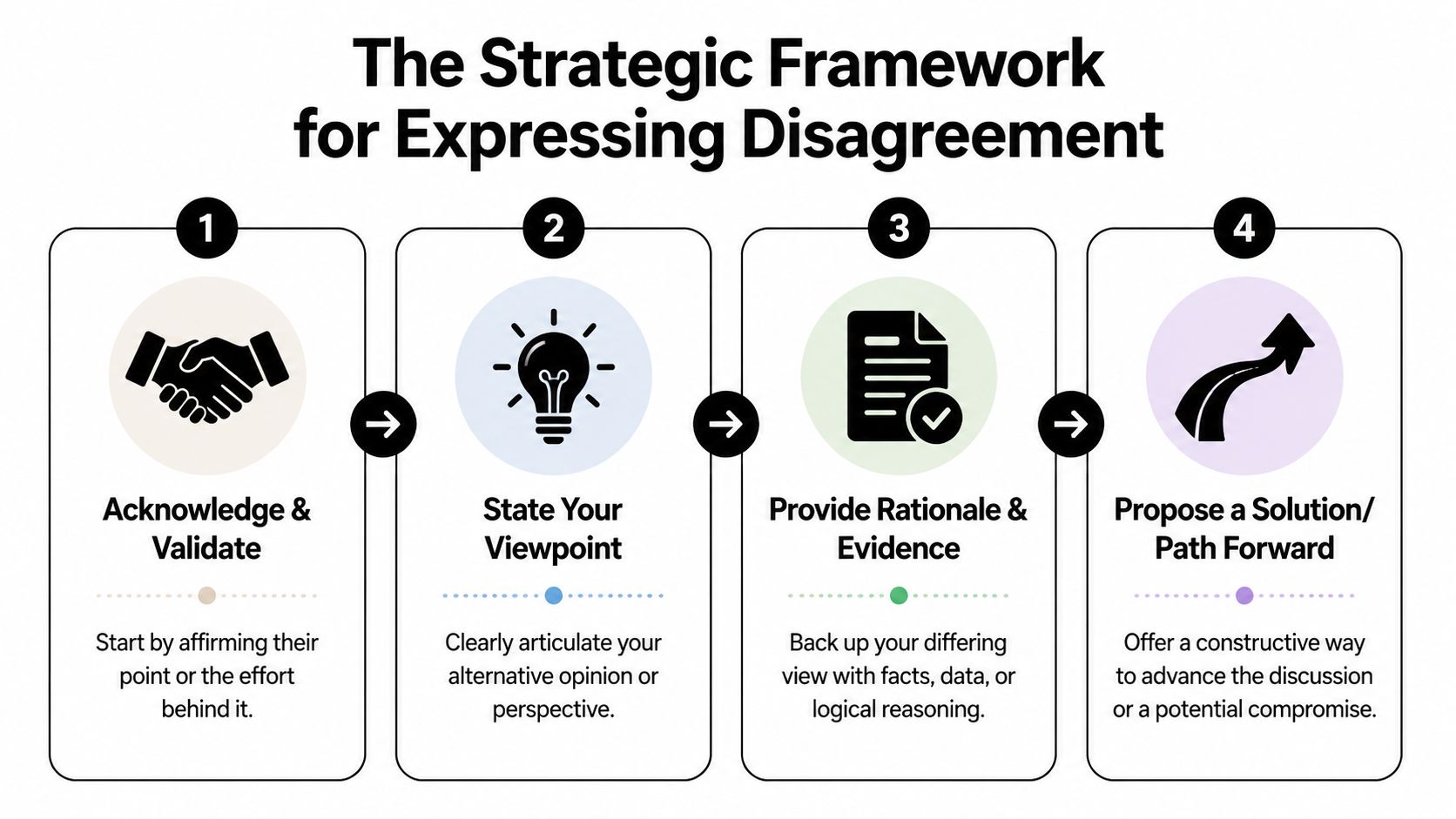
Validate the logic before you challenge it
Validation isn't agreement. It's evidence that you heard the other person well enough to respond like an adult, not a rival.
Say what makes sense in their position:
- “I can see the logic behind that timeline.”
- “That approach makes sense if speed is the main priority.”
- “I understand why that recommendation looks efficient.”
This first move matters more than many people think. Korn Ferry research shows that replacing “but” with “and” during disagreements can lower polarization effects by approximately 20%. The same research notes that 78% of employees report that feeling unheard erodes trust. If your acknowledgment gets canceled by a fast “but,” the listener often experiences the whole exchange as rejection.
Bridge without erasing your validation
The bridge is where many conversations go wrong.
If you say, “I see your point, but…,” your opening often gets deleted in the listener's mind. “But” signals contradiction so sharply that the validation doesn't fully land.
Use bridge phrases like:
- “And I'm seeing one risk we should examine.”
- “And I have a different read on the data.”
- “And there's another angle that may affect the decision.”
This isn't wordsmithing for its own sake. It changes the emotional temperature of the exchange. If you want more language models for difficult conversations, these strategic framework examples are useful practice material.
State your view with ownership
Now be direct. Respectful disagreement still needs a spine.
The cleanest way is with I-statements. They reduce blame and keep your authority intact.
Compare these:
| Less effective | Stronger |
|---|---|
| “You're looking at this the wrong way.” | “I see the risk differently.” |
| “You're ignoring the operational issues.” | “I'm concerned the operational impact is being underestimated.” |
| “That assumption is wrong.” | “I don't think that assumption holds once we factor in implementation.” |
Your sentence should do three jobs:
- Name your position clearly
- Anchor it in reasoning or evidence
- Stay brief enough to be heard
Good example: “I support the direction, and I'm concerned the current sequencing creates avoidable execution risk because onboarding isn't complete.”
Inquire so the conversation stays collaborative
End with a question that keeps the discussion open.
Useful options include:
- “How are you weighing that risk?”
- “What data would change your view?”
- “What do you see as the downside of testing this first?”
- “Can we pressure-test that assumption for a minute?”
With this approach, disagreement becomes joint analysis rather than point-scoring. It also mirrors strong negotiation habits. For readers who want a broader perspective on persuasive dialogue under pressure, the Model Diplomat negotiation advice is worth reading.
A respectful disagreement should make the other person think harder, not defend harder.
Command Respect with Body Language and Vocal Authority
The sentence matters. Delivery often matters more.
Many international professionals already know the right words. The problem is that the room judges authority through pacing, posture, breath, eye contact, and vocal finish. A careful sentence delivered with strain can sound angry. A strong point delivered with rising intonation can sound unsure.

Sylvia Hewlett's work on executive presence defines Gravitas as the “weight” of presence, expressed through confidence, decisiveness, and emotional intelligence. That definition is useful because it makes the concept practical. Gravitas isn't mystique. It's what people feel from you in high-stakes moments.
Use stillness before you use words
A rushed entry weakens your message. If you jump in too quickly, people hear interruption, not judgment.
A steadier pattern looks like this:
- Pause before speaking: Give yourself a beat to breathe and organize the first line.
- Set your posture: Keep shoulders relaxed, chest open, and chin level.
- Start lower and slower: Don't launch at the top of your range.
- Keep gestures contained: One deliberate gesture is stronger than constant motion.
For a deeper look at executive signals that support authority, this guide on body language for leaders is a strong companion resource.
Protect your tone if English isn't your first language
This is the part many generic communication guides miss. In cross-cultural settings, people don't just evaluate the content of your disagreement. They evaluate whether your voice sounds controlled.
Three adjustments help immediately:
- Lengthen the first sentence. Not with extra words, but with slower pacing.
- Land the end of the sentence downward. A falling tone sounds decided.
- Use breathing that supports volume. Thin breath creates thin authority.
If your accent becomes stronger under stress, that's normal. The answer isn't to flatten your identity. The answer is to stabilize pace and sentence endings so the message still carries authority.
Respect isn't only in phrasing. It's in how much control the listener hears in your voice.
A quick demonstration of vocal and nonverbal delivery can help make these adjustments concrete.
What strong delivery looks like in the room
You don't need a theatrical presence. You need a clean signal.
That usually means:
| Signal | Weakens authority | Strengthens authority |
|---|---|---|
| Eye contact | Looking down while disagreeing | Looking at the decision-maker steadily |
| Pace | Speeding up under pressure | Measured tempo |
| Volume | Dropping at the critical point | Consistent projection |
| Posture | Folding inward | Open, stable stance |
When body language and language align, your disagreement sounds what it should sound like. Thoughtful, firm, and useful.
Navigating Pushback and Cross-Cultural Dynamics
The first sentence of disagreement is rarely the hard part. The hard part is what happens after someone resists, deflects, or pushes back with more force than you expected.
Many professionals make the same mistake here. They repeat their position with extra intensity. That almost never improves the conversation.
Jamil Zaki's research summarized here shows that asking questions instead of making statements can lower polarization by up to 62%, and that skipping this question-first step correlates with 3.2x higher emotional escalation. That finding matches what shows up in real meetings. When pressure rises, curiosity is often more effective than explanation.
Use inquiry when the room gets tense
When someone pushes back, don't defend your dignity first. Clarify the reasoning first.
Useful responses include:
- To a dismissive reaction: “Can you walk me through what makes this approach the safer option in your view?”
- To a status-heavy objection: “What concern feels most material to you here?”
- To a fast rejection: “Which part of my reasoning do you see differently?”
- To a room that's splitting into sides: “What outcome are we each optimizing for right now?”
Those questions do two things. They buy you time, and they move the exchange from ego to evidence.
When pushback increases, your next sentence should usually get shorter and more curious.
If you lead teams or own difficult stakeholder conversations, this broader guide for business owners on conflict adds useful perspective on maintaining relationships while still addressing tension directly.
Adapt to direct and indirect cultures
Cross-cultural disagreement isn't just a language problem. It's a norms problem.
In direct cultures, clarity is often read as competence. In more harmony-oriented cultures, the same directness can be read as unnecessary threat, especially in front of a group or in the presence of hierarchy. If you were trained to preserve relational order, “I disagree” may feel too sharp. If you were trained in direct debate, indirect phrasing may feel evasive.
The answer isn't to become vague. It's to adapt your framing without losing your point.
Try these alternatives:
| More direct | More adaptive in harmony-focused contexts |
|---|---|
| “I disagree with that conclusion.” | “I see it somewhat differently.” |
| “That assumption doesn't hold.” | “I'm not sure that assumption applies in this case.” |
| “You're wrong about the risk.” | “I may be seeing an additional risk factor.” |
This is especially important for global teams. If you work across both styles, learning the difference between explicit and nuanced challenge will save you from being misread on either side. This breakdown of direct vs. indirect communication is useful if you operate across regions or multicultural leadership teams.
Read the room before choosing the phrasing
Use three quick criteria:
- Hierarchy: Is this a peer discussion or an upward challenge?
- Setting: Is this public, private, or recorded?
- Culture: Does the group reward candor, consensus, or face-saving?
A strong communicator doesn't use the same disagreement script everywhere. They adjust the frame while protecting the substance.
How to Practice Disagreeing with Confidence
Nobody gets good at this by reading one article and hoping the right phrase appears under pressure. Respectful disagreement is a performance skill. It depends on repetition, not insight alone.
That matters because executive presence gets judged in live moments. According to Sylvia Hewlett's research on 4,000 professionals, senior leaders weight the pillars of executive presence as Gravitas at 67%, Communication at 28%, and Appearance at only 5%. If you want to be seen as senior, the moments that shape perception are the ones where the stakes are real and the room isn't easy.
Start with controlled repetition
Don't begin with the most intimidating conversation on your calendar. Build the skill where the risk is lower and the feedback is faster.
Three practice rules work well:
- Rehearse one likely objection: Before a meeting, decide where you may need to dissent and draft one clean response.
- Record your delivery: Listen for speed, tension, and rising intonation at sentence endings.
- Practice with one trusted colleague: Ask them to challenge your point so you can work on staying composed.
If you struggle most when you have to respond without preparation, focused training in impromptu speaking skills helps because respectful disagreement often happens in live, unscripted moments.
Use drills instead of vague intention
A short practice system is more effective than telling yourself to “be more confident.”
| Drill | Objective | How to Practice |
|---|---|---|
| Pause and respond | Reduce reactive speaking | Ask a colleague to state a view you disagree with. Wait briefly, then answer in one sentence only. |
| Reframe with shared goals | Sound collaborative instead of oppositional | Take a past disagreement and rewrite your opening line so it begins with the common objective. |
| I-statement conversion | Remove blame from your language | Rewrite five “you” sentences into “I” statements anchored in evidence or concern. |
| Question-first pushback | Lower escalation under pressure | In a mock disagreement, respond to resistance with a clarifying question before stating your position again. |
| Vocal authority replay | Improve tone and pacing | Record yourself delivering the same disagreement three times, each time slower and with a more decisive vocal finish. |
Build a library of phrases you can actually say
Under pressure, people don't suddenly become eloquent. They default to habit. That's why phrase libraries help, especially for non-native English speakers who need language that sounds natural in their own mouth.
Useful examples:
- “I can see the logic in that, and I'm concerned about the implementation risk.”
- “I may be missing something, and I'm reading the data differently.”
- “I'm aligned with the goal. I'm not fully convinced this is the safest route.”
- “Could we examine one assumption before we commit?”
Notice what these do. They aren't weak. They're controlled.
Confidence comes after evidence, not before it
A lot of professionals wait to feel confident before they practice disagreement. That sequence is backwards. Confidence comes from having used the skill enough times that your body no longer treats disagreement as danger.
That's also why coaching can accelerate the process. The Gravitas Method is a 12-week one-on-one executive presence coaching program for international professionals who want to communicate with more authority and influence at senior levels. The program is priced at $8,200 paid in full or $9,000 across three installments. Coached by Nikola, it covers vocal authority, strategic framing, executive body language, and high-stakes communication.
The fastest way to improve isn't memorizing more polite phrases. It's diagnosing where your disagreement breaks down. For some people, it's language structure. For others, it's tone, posture, pace, or the inability to stay clear when challenged.
If you want a precise read on how your communication lands in high-stakes settings, start with Intonetic's free Executive Communication Assessment. It's the best entry point if you want to strengthen authority, disagree with more composure, and communicate like you belong at senior level.