
Best Strategic Framework Examples for 2026
You're probably in a familiar position. The strategy work is done, or close to done, but the harder part is still in front of you. You have to walk into a leadership meeting, reduce complexity fast, answer challenges without sounding defensive, and give people confidence that your plan is grounded in reality.
That's where strategic framework examples become more than planning tools. They become executive communication tools. A good framework helps you think clearly. A well-presented framework helps other people trust your judgment.
That distinction matters. Senior leaders aren't only evaluated on whether they can analyze a market, align a team, or prioritize investments. They're evaluated on whether they can frame the situation, explain trade-offs, and move a room toward a decision. Frameworks help with all three. They give you a shared language, a visible structure, and a disciplined way to show that your recommendation didn't come from instinct alone.
Some frameworks are best for growth choices. Some help diagnose internal misalignment. Others are useful because they expose uncertainty instead of hiding it. In practice, the strongest leaders don't cling to one model. They choose the one that fits the decision in front of them, then communicate it in a way that sounds composed, sharp, and credible.
Below are 10 practical strategic framework examples, with real use cases, common mistakes, and short communication scripts you can use when presenting your analysis to senior stakeholders.
1. The Gravitas Method
Not every strategic problem is analytical. Some are presentational. You know the business, your thinking is solid, and your recommendations are defensible, but your delivery weakens the message.
That's where The Gravitas Method fits. It's a 12-week one-on-one executive presence coaching program for international professionals who want to communicate with more authority and influence at senior levels. Coached by Nikola, it focuses on vocal authority, strategic framing, executive body language, and high-stakes communication. Pricing is $8,200 paid in full or $9,000 across three installments.
A strong use case is the technically excellent leader whose ideas don't land with the board. I've seen this with senior engineers, finance professionals in negotiation settings, consultants pitching enterprise clients, and founders raising capital. The issue usually isn't intelligence. It's signal. Their message arrives with too much detail, weak pacing, or hesitant framing.
Here's the program overview video:
Where it works best
The best candidates are already performing well. They don't need generic confidence advice. They need targeted correction in how they sound, structure ideas, and hold attention under pressure. If that's your situation, understanding what executive presence means in practice gives helpful context.
A useful adjacent concept is what is competitive advantage. Senior communication is often the mechanism that allows a real advantage to be seen, understood, and backed internally.
Practical rule: Treat communication coaching like strategy execution. Diagnose the gap, practice in lower-stakes meetings, then carry the improvement into boardrooms, negotiations, and executive reviews.
Communication script
Say it this way:
“My recommendation is sound, but the way I present it has to match the level of the room. I'm working on sharper framing, stronger vocal authority, and more deliberate delivery so the quality of the message is fully visible.”
2. OKRs
OKRs are useful when a business has ambition but weak alignment. Teams are busy, dashboards are full, and people still can't answer a simple question: what matters most this quarter?
The framework links an objective to measurable key results. That sounds basic, but in execution it's powerful because it forces clarity. Instead of saying “improve customer growth,” a leadership team has to define what progress would look like and how they'll know if the work is making progress.
The biggest mistake with OKRs is treating them like a motivational poster or a performance scoring trap. They work best when leaders use them to focus conversation, reveal trade-offs, and connect team activity to enterprise priorities. If people can't see how their work ladders up, the framework becomes administrative theater.

What works and what doesn't
Good OKRs are few, specific, and visible. Bad OKRs are crowded, vague, and rewritten so often that nobody trusts them.
If you're trying to sharpen goal quality at the individual or team level, these development goals for work can help translate broad ambition into concrete progress language.
- What works: Pick a small number of objectives and keep them tied to strategic priorities.
- What fails: Stuffing operational tasks into key results and calling that strategy.
- What leaders should watch: Teams often choose easy measurements instead of meaningful ones.
Communication script
Use this in an executive update:
“We're using OKRs to separate activity from progress. Our objective defines the outcome we want, and the key results tell us whether the strategy is producing evidence, not just effort.”
3. Porter's Five Forces Analysis
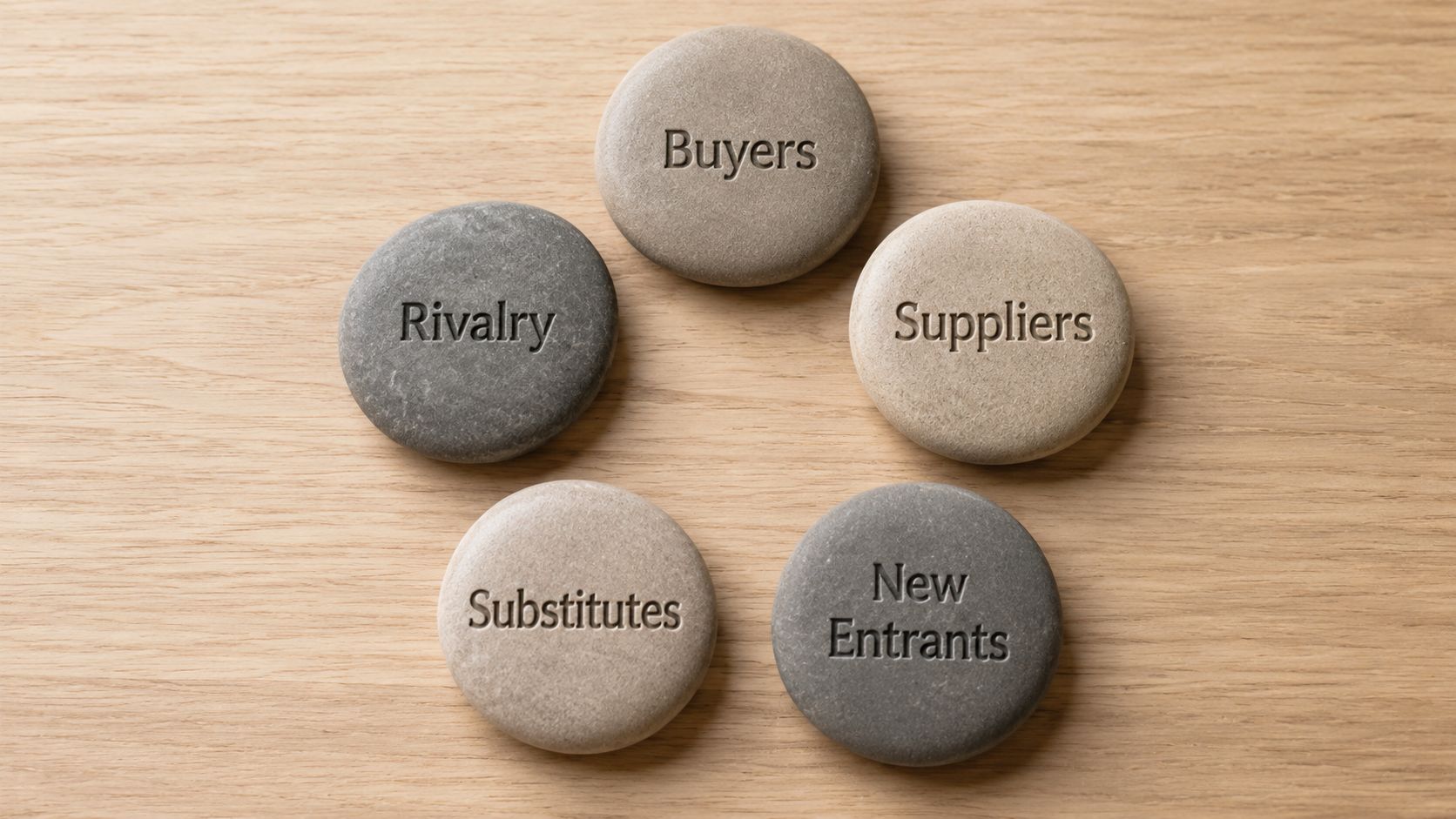
Porter's Five Forces is one of the most practical strategic framework examples for market structure. It helps you examine pressure from buyers, suppliers, substitutes, new entrants, and existing rivals. That makes it useful when pricing power is unclear, margins are under pressure, or a new market looks attractive on the surface but weak underneath.
It's especially effective before a market entry decision or a positioning reset. A healthcare technology company might use it before expanding into a regulated segment. A financial services firm might use it to understand how fintech products are changing buyer expectations. A platform business might use it to test whether switching costs are real or overstated.
The mistake is turning it into a classroom exercise. Teams list the five forces, fill a slide, and never convert the analysis into a decision. The framework only earns its place when it changes what you'll do about product design, partnership strategy, go-to-market, or pricing.
The leadership advantage
This framework also helps with executive presence because it gives you a disciplined way to talk about competitive pressure without sounding reactive. You're not saying, “the market feels hard.” You're saying which force is shaping economics and where your advantage still exists.
That kind of framing matters in senior communication, especially if you want to understand the psychology of leadership in decision-heavy environments.
The strongest Five Forces presentations end with one sentence: “Because these two forces are strongest, this is where we should change our strategy.”
Communication script
Say:
“Our analysis shows this isn't just a rivalry problem. Buyer power and substitution risk are shaping the economics of the category, so our response can't be cosmetic. We need a position that changes the terms of comparison.”
4. SWOT Analysis
SWOT remains popular because it's simple, fast, and easy to teach. It helps teams sort internal realities from external conditions by looking at strengths, weaknesses, opportunities, and threats.
Used well, it's a strong early-stage diagnostic. Used poorly, it becomes a wish list. That's the trade-off. SWOT is accessible enough for broad participation, but that same accessibility makes it vulnerable to vague thinking and political editing.
A startup preparing for a launch can use SWOT to pressure-test positioning. A company entering a new geography can use it to surface internal capability gaps against external market openings. During transformation work, it helps leaders get a baseline before they choose where to focus management attention.
How to keep it honest
The quality of a SWOT depends on the honesty of the room. If leaders list “great people” as a strength and “competition” as a threat without specifics, the exercise won't help. Teams need to distinguish between real capabilities and aspirational self-image.
Communication problems often distort this exercise too. If stakeholders can't challenge one another clearly, important weaknesses stay hidden. This is one reason barriers like unclear language, hesitation, and defensiveness matter in strategic work. This piece on barriers for effective communication is relevant if your meetings produce polite agreement instead of useful diagnosis.
For a broader strategic lens, The Business Model Analyst's guide is a helpful companion concept because external scanning often sharpens the opportunity and threat side of SWOT.
- Strengths: Capabilities you can deploy now.
- Weaknesses: Constraints that reduce execution quality or speed.
- Opportunities: External openings you can plausibly capture.
- Threats: External developments that can damage the plan.
Communication script
Use a firm, balanced tone:
“Our strength isn't everything we do well. It's what we can use immediately to win. Our weakness isn't a flaw in theory. It's what will slow execution if we leave it unaddressed.”
5. The Balanced Scorecard
The quarter closes strong on revenue, yet the executive team still leaves the meeting uneasy. Customer complaints are rising, cycle times are slipping, and high performers are burning out. The Balanced Scorecard helps leaders catch that kind of false positive before it turns into a strategy problem.
Kaplan and Norton built the framework to measure performance across four areas: financial results, customer outcomes, internal processes, and learning and growth. That structure matters because strategy rarely fails in one place. It breaks when leaders reward this quarter's numbers while ignoring the operating habits and capability gaps that shape the next four quarters.
Why executives still use it
The Balanced Scorecard is useful when the business is large enough for functions to optimize locally and miss the enterprise picture. A bank might post solid margins while trust scores weaken and compliance rework increases. A software company might hit bookings targets while implementation delays damage renewals six months later.
That is the core value of the framework. It gives senior leaders a disciplined way to say, “We are not calling this strategy successful unless performance holds across the few areas that sustain it.”
The common failure is metric overload. Teams pack the scorecard with every KPI anyone wants to protect, then spend review meetings reading dashboards instead of making decisions. A good scorecard is selective. Each measure needs an owner, a reason for being there, and a clear link to the strategy.
Communication quality matters here. If leaders cannot explain why one measure matters more than another, teams start treating the scorecard as reporting overhead instead of a management system. Strong effective leadership communication helps leaders frame the scorecard as a set of strategic priorities, not just a spreadsheet.
Executive lens: The Balanced Scorecard helps leaders prevent one-sided management and show the organization what balanced execution actually looks like.
Communication script
Use this in a board review or executive update:
“We're assessing strategy through four lenses: financial performance, customer outcomes, internal execution, and capability building. That keeps us from hitting one target at the expense of the system that produces the result. Our focus this quarter is to protect revenue while fixing the process and talent indicators that determine whether that revenue is repeatable.”
6. Blue Ocean Strategy
Blue Ocean Strategy is attractive because it promises escape from head-to-head competition. Instead of fighting over the same buyers with the same value logic, the company tries to create a different space where comparison changes.
That appeal is real, but so is the risk. Leaders often label ordinary differentiation as a blue ocean move. It isn't. A true blue ocean decision changes who the offer is for, what customers value, or how the category is defined. Without that shift, you're still in the same market, just with better branding.
Cirque du Soleil is a classic example because it redefined the circus experience rather than improving the standard formula. A digital business might use the logic when combining elements from adjacent categories into a simpler offer for overlooked buyers. A service firm might use it when clients are exhausted by feature-heavy options and want speed, clarity, and lower complexity instead.

Where leaders go wrong
The trap is falling in love with novelty. New space still has to be commercially viable, operationally deliverable, and clear enough that buyers understand why it matters.
A useful discipline is to ask what you will eliminate, reduce, raise, or create. If you can't answer those clearly, the strategy probably isn't distinct enough yet.
Communication script
Use language like this:
“We're not trying to out-feature competitors in the existing category. We're changing the basis of choice by removing complexity buyers no longer value and creating a clearer, more useful offer.”
7. The McKinsey 7S Framework
The McKinsey 7S Framework is excellent when strategy sounds right on paper but stalls in execution. It examines seven internal elements: strategy, structure, systems, style, staff, skills, and shared values.
This is one of the most useful strategic framework examples when a company is going through transformation. Leaders often assume the plan is the issue. In reality, the plan may be fine. The problem may be misalignment across reporting lines, operating routines, management behavior, or workforce capability.
A technology company preparing for AI-related change might find that strategy is clear but skills and systems lag. A firm after a merger may discover that structure and shared values are pulling in opposite directions. A manufacturer introducing lean methods may realize that style, not process design, is the barrier.
What it reveals
The value of 7S is that it forces a more honest diagnosis. It tells leaders that execution failure is rarely caused by one thing. Usually, two or three elements are conflicting at once.
That's also why this framework is difficult. It requires executives to talk about culture, leadership style, and capability with the same seriousness they bring to org charts and budgets. Some teams resist that because the softer elements feel less controllable. They aren't less important.
- Use it before change: Diagnose before announcing a major transformation.
- Use it after confusion: When teams say the strategy is clear but behavior doesn't change.
- Use it in communication: It helps explain why “we have a strategy” isn't the same as “we can execute.”
Communication script
Say:
“The issue isn't only strategy. Our structure, systems, and skills aren't fully supporting the direction we've set, and until those align, execution will continue to look weaker than intent.”
8. VRIO Framework
VRIO is one of the best frameworks for testing whether an advantage is defensible. It asks whether a resource or capability is valuable, rare, difficult to imitate, and supported by the organization.
That sequence matters. Many leadership teams confuse competence with advantage. Being good at something doesn't mean it creates durable strategic value. VRIO forces a tougher conversation.
A consulting firm may think its methodology is a differentiator, then discover rivals can replicate it quickly. A technology company may believe proprietary data is special, then realize the organization doesn't have the systems to use it well. A luxury brand may find that rarity and heritage are strengths, but internal execution weakens the value capture.
Why this framework is useful with senior stakeholders
VRIO is powerful in investment discussions because it helps you justify where to concentrate resources. It can also stop diffuse strategy. If only a small set of assets or capabilities can create meaningful advantage, leaders should stop spreading attention evenly across everything.
The trap is overestimating rarity. Internal teams tend to romanticize their own strengths. The framework works only when leaders compare themselves objectively against what competitors can also build, buy, or copy.
“If it's valuable but common, you have competence. If it's valuable, rare, hard to copy, and organizationally supported, you may have advantage.”
Communication script
Use this with confidence:
“We're evaluating our capabilities through a VRIO lens because we need to know which strengths merely help us compete and which ones can actually support a durable advantage.”
9. Scenario Planning
The board approves a strategy in March. By September, a regulatory shift, a supplier problem, or a sudden change in AI adoption has made half the assumptions shaky. Scenario planning gives leaders a way to prepare for that reality without sounding reactive.
Used well, it is less about prediction and more about decision quality. The goal is to identify a small set of plausible futures, test where the current strategy holds up, and decide in advance which signals would trigger a different move. That makes scenario planning a leadership tool as much as an analytical one. It shows the team, the board, and investors that management can handle uncertainty without drifting into vague language.
Why it belongs in serious strategy work
Scenario planning is especially useful when key variables sit outside the company's control. Regulation can change. Customer adoption can stall or accelerate. Capital costs can tighten. Competitors can reset pricing faster than expected.
In those conditions, a single forecast creates false confidence. A better process starts with one strategic decision, names the two or three uncertainties that matter most, then builds a few credible scenarios around them. From there, leaders can ask practical questions. Which investments make sense in every case? Which ones only work if the optimistic case happens? What early indicators should the executive team review each month?
The common mistake is turning scenario planning into a workshop exercise that never affects capital allocation, hiring, or sequencing. If no decisions change, the framework has not done its job.
Communication script
Say it plainly:
“We're using scenario planning to pressure-test the strategy under different future conditions, so we can commit with confidence, spot warning signs early, and respond without losing momentum.”
10. Ansoff Matrix
The Ansoff Matrix is straightforward, which is why executives like it. It looks at growth through four routes: existing products in existing markets, new products in existing markets, existing products in new markets, and new products in new markets.
That simplicity is also its strength in executive communication. When a leadership team is debating growth, the matrix gives everyone a clean way to classify the move. Are we deepening penetration, developing new offers, entering new markets, or diversifying? Once the move is named correctly, the risk discussion becomes more concrete.
A company expanding a proven offer into a new region is making a different bet from one launching a new category into an unfamiliar market. Both are growth strategies. They do not deserve the same assumptions about speed, capital, capability, or execution risk.
How to use it well
The common mistake is forcing initiatives into the wrong quadrant because leaders want them to sound safer than they are. Another problem is discussing the matrix without defining what counts as a “new product” or a “new market.” Those terms can get fuzzy fast.
This framework is strongest when paired with hard questions about readiness, resource allocation, and likely competitive response.
A practical execution companion is OGSM, which links a qualitative objective to quantitative goals, then to initiatives and KPIs so leaders can monitor whether strategic actions are producing outcomes, with examples such as market share, customer acquisition cost, and repeat purchase rate described in this strategic frameworks overview.
Communication script
Use this framing:
“We're treating this as market development, not simple expansion. That matters because the growth logic, capability requirements, and execution risk are materially different.”
Comparison of 10 Strategic Frameworks
| Framework / Program | Implementation complexity 🔄 | Resource & time requirements ⚡ | Expected outcomes ⭐📊 | Ideal use cases | Key advantages 💡 |
|---|---|---|---|---|---|
| The Gravitas Method – Executive Presence Framework | High, bespoke one‑on‑one coaching, audits and tailored plans | High, 12 weeks, significant participant time and fee | Noticeable perception shift early; sustained authority & influence with practice | Senior international professionals in high‑stakes presentations | Highly personalized, industry‑specific, measurable progress |
| OKRs (Objectives and Key Results) | Medium, requires training for good goal design | Moderate, quarterly cycles, tracking tools and cadence | Clear strategic alignment and measurable outcomes across teams | Organizations seeking cross‑functional alignment and agility | Focuses outcomes, transparent, scalable across levels |
| Porter's Five Forces Analysis | Low–Medium, structured analytical process | Moderate, market research and competitor data needed | Clear view of market attractiveness and competitive pressures | Market entry, pricing, positioning decisions | Comprehensive competitive lens; broadly applicable |
| SWOT Analysis | Low, simple four‑quadrant workshop approach | Low, quick workshops, minimal tools | High‑level strategic clarity and prioritized issues (when followed up) | Early planning, product launches, quick diagnostics | Easy to run, inclusive, fast to generate insights |
| The Balanced Scorecard | High, defines metrics across four perspectives and links to strategy | High, measurement systems, dashboards, governance | Balanced performance view and clearer strategy execution | Established organizations aligning strategy to metrics | Holistic performance measurement; ties strategy to actions |
| Blue Ocean Strategy | Medium–High, creative reconceptualization and validation | Moderate, research, prototyping and organizational buy‑in | Potential new market creation and value innovation | Firms in saturated markets seeking differentiation | Encourages breakthrough value innovation and investor narratives |
| McKinsey 7S Framework | High, diagnostic across seven interdependent elements | High, cross‑functional assessment and change management | Improved organizational alignment and implementation readiness | Transformations, post‑merger integrations, large change programs | Holistic focus on people, process and culture alignment |
| VRIO Framework | Medium, requires honest internal capability assessment | Moderate, internal data, competitor intelligence and judgment | Identification of sustainable advantages and investment priorities | Resource allocation, M&A diligence, long‑term strategy | Discerns durable vs. temporary competitive strengths |
| Scenario Planning | High, builds multiple plausible futures and implications | High, time, expert facilitation, continuous monitoring | Greater strategic robustness and contingency options | High‑uncertainty sectors (energy, finance, tech regulation) | Prepares organization for diverse futures; reduces single‑point risk |
| Ansoff Matrix | Low, simple matrix mapping products vs markets | Low–Moderate, market/product analysis per quadrant | Clarified growth options and associated risk profiles | Growth strategy sessions, portfolio prioritization | Simple visual for growth choices and risk comparison |
From Framework to Influence: Your Next Move
Frameworks help leaders think. Influence comes from how those leaders use frameworks in live communication.
That's the point many professionals miss. They study strategic models, fill decks with matrices, and assume the logic will speak for itself. It won't. In senior settings, people are listening for judgment, clarity, and command. They want to know whether you can reduce noise, identify the core decision, and speak about trade-offs without sounding either rigid or uncertain.
That's why strategic framework examples matter beyond analysis. A framework gives you structure. It gives your stakeholders a map. It shows that your recommendation sits inside a disciplined way of thinking, not a personal preference. But the framework alone isn't what builds authority. Your delivery does.
The strongest presenters do three things consistently. First, they choose the right framework for the question. They don't use SWOT for every problem or force a growth matrix onto an alignment issue. Second, they expose trade-offs instead of hiding them. That makes them sound more credible, not less. Third, they communicate conclusions in plain language. No jargon shield. No overcomplication. Just clear reasoning, clear implication, and a clear recommendation.
There's also a broader lesson here. In stable conditions, a neat framework can guide action well. In unstable conditions, the same framework can create false confidence if leaders treat it as reality instead of a tool. That's why scenario planning, data discipline, and communication quality belong in the same conversation. Good strategy isn't only about selecting the right model. It's about knowing how much certainty the moment allows.
If you're ready to close the gap between your strategic thinking and how you sound in the room, start with the free Executive Communication Assessment. It gives senior professionals a practical baseline on communication strengths and development opportunities, and it's the entry point for those considering executive presence coaching. If you're exploring support in this area, Intonetic is one relevant option for international professionals who want to communicate with more authority at senior levels.
If you want a clearer picture of how you come across in high-stakes conversations, start with Intonetic's free Executive Communication Assessment. It's a practical first step for identifying gaps in executive presence, strategic framing, vocal authority, and delivery before deciding whether one-on-one coaching is the right next move.