
Mastering Effective Leadership Communications
You prepared well for the meeting. Your analysis was solid. Your recommendation was commercially sound. Then the discussion moved on, and somehow your point landed with less weight than a shorter, less precise comment from someone else.
That experience is common among strong professionals moving into senior leadership. It’s even more common for international professionals in tech and finance, where the quality of your thinking is often high, but your authority gets judged through how fast you frame, how cleanly you structure, how confidently you sound, and whether people feel safe following your lead.
Effective leadership communications isn’t about sounding polished for its own sake. It’s about getting the room to understand what matters, trust your judgment, and act.
The High Cost of Being Misunderstood in Leadership
A leadership communication problem rarely looks dramatic at first. It looks like a strategy update that gets polite nods but no momentum. It looks like a board question that sends the presenter into too much detail. It looks like a team leaving a meeting with three different interpretations of the same decision.
Those moments feel small when they happen. They aren’t.

Communication failure is a business risk
Poor communication costs organizations $1.2 trillion annually, and 86% of employees and executives cite lack of effective collaboration and communication as the main causes for workplace failures. Organizations that prioritize effective communication strategies also experience 4.5 times higher employee retention rates, according to these workplace communication statistics.
That changes the conversation immediately. Communication isn’t a soft, secondary leadership trait. It affects retention, execution, conflict, and speed.
In practice, leaders pay this cost in predictable ways:
- Delayed decisions: Teams wait because the message was broad, cautious, or open to interpretation.
- Repeated explanations: Senior leaders spend time re-clarifying what should have been clear the first time.
- Eroded confidence: Stakeholders start trusting the person who sounds decisive, even when someone else has the better judgment.
- Unforced conflict: Friction grows when people hear different priorities in the same message.
Why international professionals feel this cost more sharply
For international professionals, the issue often isn’t competence. It’s signal distortion. Accent bias, pacing, word choice, and hesitation can all interfere with how authority is perceived. That doesn’t mean your accent is the problem in every case, but it often means the room is making faster judgments than it should. If that’s part of your reality, this piece on how your accent really affects your career and what you can actually do about it is worth reading.
There’s also a translation layer that native speakers often underestimate. In high-stakes settings, non-native English professionals may be doing several things at once: thinking strategically, monitoring accuracy, adjusting tone, and deciding whether a direct answer will sound too blunt. That extra processing load can flatten presence.
Practical rule: If people regularly say “That makes sense” but don’t move, your communication problem isn’t clarity alone. It’s authority transfer.
The same dynamic shows up in multilingual environments where precision matters. Legal, financial, and regulatory contexts make this painfully obvious, which is why resources on the high cost of communication errors are useful beyond translation itself. The lesson is simple. Small communication gaps create outsized business consequences in critical situations.
Defining True Leadership Communication
Leadership communication is often defined too narrowly, often equated with speaking clearly, sending good updates, or presenting confidently. Those matter, but they’re not the full job.
Leadership communication works more like conducting an orchestra.
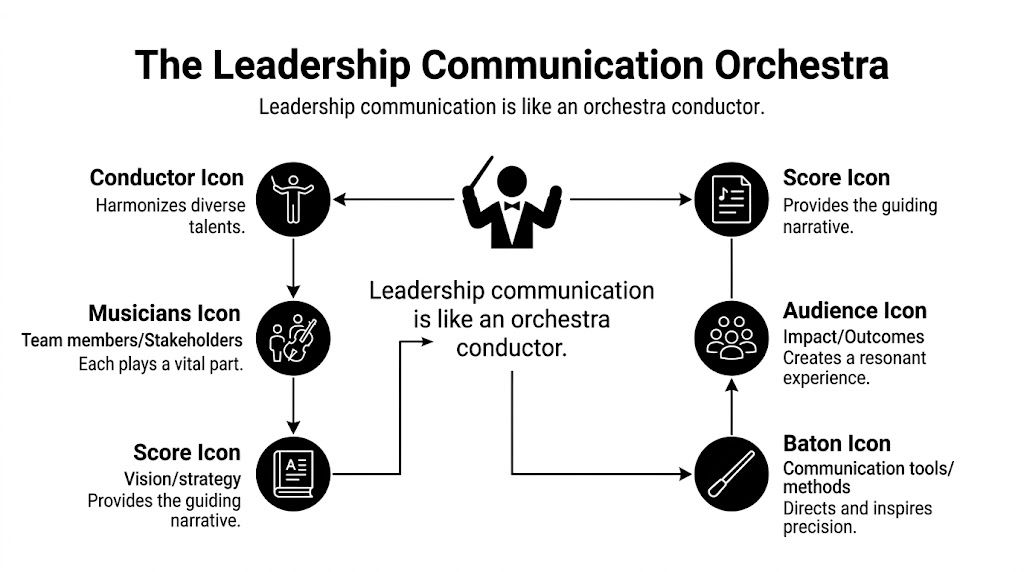
A conductor doesn’t play every instrument. The conductor creates timing, coherence, emphasis, and confidence across the whole performance. In the same way, a leader doesn’t just transmit information. A leader makes sure the message creates coordinated movement.
Clarity
Clarity answers the basic questions fast. What’s happening. Why it matters. What decision has been made. What still needs input.
This sounds obvious, but many leaders confuse detail with clarity. They give background when the room needs direction. They explain process when the room needs a point of view.
Clear communication has a hierarchy. It starts with the headline, then the reason, then the implications.
A useful test is simple: if a listener had to repeat your message in one sentence right after the meeting, could they do it accurately?
Alignment
Alignment is different from agreement. People don’t need identical opinions on every issue. They do need a shared understanding of priorities, risks, and next steps.
Many technically strong leaders underperform in this regard. They assume that because everyone heard the same words, everyone left with the same understanding. That assumption breaks strategy.
Leadership communication is working when different functions can explain the same priority in their own language without changing its meaning.
Alignment requires repetition and consistency. You often need to say the same core message in different formats: a live meeting, a follow-up note, a one-on-one conversation with a key stakeholder, and a shorter version for broader circulation.
Action
If the message doesn’t lead to action, it hasn’t done its job.
Action means people know what to do, what to stop doing, and how to judge trade-offs when conditions change. Good leaders don’t leave action implied. They make ownership visible.
Here’s the simplest model I use with clients:
- Clarity says: This is the point.
- Alignment says: This is how we’ll think about it together.
- Action says: This is what happens next.
What effective leadership communications actually sounds like
It doesn’t always sound eloquent. Often it sounds disciplined.
A strong leader might say: “We’re not discussing every option today. We’re deciding whether this risk is acceptable and who owns mitigation.” That sentence narrows the room, defines the decision, and creates movement.
By contrast, weak communication often sounds busy but directionless: too many caveats, too much context, too little point of view.
The standard isn’t charisma. The standard is whether your communication helps other people execute with confidence.
Common Failure Modes That Undermine Authority
Many leaders don’t have a knowledge problem. They have a pattern problem. Their authority weakens in consistent, observable ways, and because the habits feel normal to them, they don’t notice the damage until promotion, stakeholder trust, or team performance starts to stall.
That gap is wider than many leaders realize. 91% of employees report that their leaders lack critical communication skills, and three-quarters of employees say clear leadership communication significantly influences job satisfaction, according to these leadership communication statistics.
Four patterns that weaken perceived seniority
The first is the Data Dump. This leader knows the material and wants to be thorough, so they bring everything. Every caveat. Every dependency. Every chart. The problem is that a room full of details without a governing message doesn’t signal mastery. It signals unfiltered thinking.
The second is the Vague Vision. This leader talks in strategic language but doesn’t translate it into concrete direction. The message sounds ambitious, but the team can’t tell what changes Monday morning.
The third is the Credibility Gap. The words say confidence, but the delivery says uncertainty. That mismatch can come from weak vocal endings, rushed pace, closed body language, excessive apology, or a face that looks tense while the content asks for trust.
The fourth is the Pressure Collapse. In calm settings, this leader communicates reasonably well. Under challenge, structure disappears. Answers get longer, logic gets fuzzy, and the speaker starts chasing the question instead of leading it.
| Failure Mode | Symptom | Impact on Authority | Corrective Principle |
|---|---|---|---|
| Data Dump | Too much detail before the main point | People see expertise but not leadership judgment | Lead with the conclusion, then support it |
| Vague Vision | Big language, unclear priorities | Teams leave inspired but directionless | Translate strategy into decisions and ownership |
| Credibility Gap | Tone and body language contradict message | Stakeholders trust the content less | Align voice, posture, and language |
| Pressure Collapse | Long, defensive, unstructured responses under scrutiny | Senior presence drops in the moments that matter most | Use a repeatable response structure |
Why these patterns show up so often
The Data Dump often comes from good intentions. Technical leaders want to be accurate. Finance leaders want to protect against challenge. Product leaders want to prove they’ve done the work. But senior audiences don’t reward volume. They reward judgment.
The Vague Vision usually appears when leaders are trying to sound strategic. They use phrases like “realize synergies,” “drive transformation,” or “create alignment,” but they don’t attach those phrases to decisions, owners, or consequences. The room hears ambition without a roadmap.
If your message can’t survive outside your presence, it isn’t leadership communication yet.
The Credibility Gap matters a lot for international professionals. You may have the right answer and still lose influence if your pace is rushed, your volume drops at the end of key sentences, or your face tightens when you’re searching for a word. None of that means you lack capability. It means people are reading status signals while you’re focusing on content.
What works instead
Each failure mode has a clear correction.
- Against the Data Dump: Open with your recommendation before your evidence.
- Against the Vague Vision: Name the decision, the trade-off, and the next move.
- Against the Credibility Gap: Practice delivery separately from content. Don’t assume one fixes the other.
- Against the Pressure Collapse: Build a short answer structure for live challenge.
The strongest leaders aren’t always the most verbally gifted. They’re often the ones who know exactly how they fail under pressure and have trained a better default.
A Practical Framework for Communicating with Presence
Presence is often treated like a personality trait. It isn’t. It’s a set of communication behaviors that cause other people to read you as credible, composed, and worth following.
For leaders in tech and finance, I find four pillars matter most: vocal authority, strategic framing, executive body language, and concise structuring under pressure.

Vocal authority
People judge your certainty before they evaluate your logic. That judgment starts with sound.
Vocal authority doesn’t mean sounding deep, loud, or theatrical. It means sounding settled. The room should hear that you’re choosing your words, not scrambling for them.
Two practices help immediately:
- Use intentional sentence endings: Many professionals let their voice trail off at the end of a key point. Finish the sentence cleanly. A strong ending sounds complete, which makes the thought sound complete.
- Slow the first line: The beginning of an answer sets your status. If you start too fast, you sound reactive. Slow the first sentence, then let your natural pace return.
- Mark pause points in notes: Before an important meeting, add slashes where you’ll pause. This is especially useful if English isn’t your first language and speed becomes a coping habit.
If articulation is part of the problem, focused voice work often helps more than generic presentation tips. For professionals working on sound precision and speech clarity, this guide on how to enunciate better is a useful starting point.
Strategic framing
Senior leaders don’t just present information. They frame meaning. They help the room understand why the issue matters in business terms.
One of the strongest methods comes from active listening before you present. Expert data leaders use active listening protocols to map their narrative to business risks and costs, reducing misinterpretation risks by 30 to 50% in technical briefings, as described in this leadership communication analysis from HBS Online. The practical moves are simple: suspend technical jargon, humanize data through storytelling, and confirm assumptions with clarifying questions.
That works because executives rarely need more raw detail. They need relevance.
Try these techniques:
-
Open with stakeholder stakes
Before giving the analysis, state the business consequence. “The issue isn’t model accuracy by itself. It’s whether we can trust this forecast enough to make a hiring decision.” -
Replace feature language with decision language
Don’t say, “We built a strong framework.” Say, “This gives us a defensible way to decide where to cut risk.” -
Ask pre-briefing questions
Before a presentation, ask key stakeholders what pressure they’re under. Their answers tell you how to frame your message. If you need a planning aid, a simple communication strategy template can help organize audience, objective, message, and channel before high-stakes conversations.
The fastest way to sound more senior is to stop explaining your work only as work. Explain it as a business decision.
Executive body language
Body language doesn’t replace substance. It does shape whether people can absorb your substance without friction.
The most common mistake isn’t dramatic. It’s leakage. A leader says, “I’m confident this is the right move,” while gripping the table, avoiding eye contact, or shifting constantly. The message and the body compete.
Focus on a few visible behaviors:
- Plant before you speak: Whether sitting or standing, settle your body before your first sentence. Physical stillness reads as mental order.
- Keep gestures inside a professional frame: Wild gestures distract. No movement at all can look rigid. Aim for deliberate gestures that support emphasis.
- Hold eye contact through the key line: Not for every sentence. For the sentence that carries the decision.
Later in this section, notice how delivery changes the impact of the same message:
Concise structuring under pressure
In these situations, many capable leaders lose altitude. They know the answer, but pressure makes them answer in the order they remembered it rather than the order the room needs to hear it.
Use a short structure you can trust. For example:
- Answer first
- Give the reason
- Name the implication or next step
A board member asks, “Why are we behind?”
Weak response: long chronology, too many contributors, no ownership.
Strong response: “We’re behind because scope expanded faster than approval did. The immediate fix is to narrow the release and reset ownership today.”
That structure creates perceived seniority because it shows command.
For professionals who want deeper, personalized work on these four pillars, one option is The Gravitas Method, a 12-week one-on-one executive presence coaching program for international professionals who want to communicate with more authority and influence at senior levels. It’s priced at $8,200 paid in full or $9,000 across three installments. Coached by Nikola, it covers vocal authority, strategic framing, executive body language, and high-stakes communication.
You don’t need perfect fluency to sound senior. You need a repeatable way to sound clear, deliberate, and useful when stakes rise.
Applying Communication Skills in High-Stakes Situations
Leadership communication gets judged most harshly when the room becomes tense. Not during routine updates. During challenge, ambiguity, and conflict.
The practical question isn’t whether you know the techniques. It’s whether you can deploy them fast enough when pressure hits.

When a board member asks a hostile question
You’re presenting progress. A board member interrupts and says, “Why are we still talking about this problem? Shouldn’t this have been solved already?”
The instinctive response is defense. Many leaders over-explain, justify past decisions, or answer the tone instead of the business issue.
A better move is this:
- pause before answering
- lower your pace on the first sentence
- answer the core concern directly
- move to ownership and next action
For example: “The concern is valid. We underestimated cross-functional dependencies. The corrective move is already in place, and the decision I need today is whether we keep the current timeline or protect quality by narrowing scope.”
That response uses vocal control, structure, and framing. It doesn’t surrender authority to the question.
When you’re presenting technical work to non-technical stakeholders
Strong specialists often get misunderstood. They explain the system, the model, or the methodology in technical sequence. The audience wants the commercial meaning first.
Start with consequence. Then translate. Then ask for the decision.
A finance leader might say, “Three assumptions changed. The implication is that our current forecast is no longer reliable for staffing. I’ll show you which assumption matters most and what action that supports.”
That approach prevents the room from getting lost. It also signals that you understand the audience, which is a core part of effective leadership communications.
When you need to deliver difficult feedback
Many managers soften difficult feedback so much that the message disappears. Others become too blunt and damage trust.
The strongest version combines clarity with respect. Name the behavior, explain the effect, and define the standard.
For example: “In the last two steering meetings, your updates came with too much detail and no recommendation. That puts the room in analysis mode when we need decisions. Next time, I want your first sentence to be your recommendation and why.”
Clear feedback should reduce ambiguity, not relieve the manager’s discomfort.
When leadership teams drift out of alignment
This problem looks harmless until strategy starts slipping. Different leaders tell different stories about the same priority. Teams begin optimizing locally. Confusion spreads downward.
An April 2025 analysis found that poor intra-leadership communication costs firms 20 to 30% in strategy execution failures. It also found that teams using relentless early alignment, including weekly check-ins and pre-mortem exercises, reduce downstream confusion by 60%, according to this analysis of leadership team communication.
In real terms, that means senior teams should align early, not after mixed messages have already spread. A weekly leadership check-in with one shared message, one explicit risk, and one decision log is more useful than another broad meeting about “staying aligned.”
If your role regularly puts you into pressure-heavy conversations, practical support on confident communication in high-stakes situations can help you build more reliable defaults before the next important room tests you.
Start Your Journey Toward Leadership Communication Mastery
Strong leadership communication isn’t reserved for naturally charismatic people. It’s built through practice, feedback, and disciplined habits.
The leaders who rise fastest usually aren’t saying more. They’re making it easier for other people to trust their judgment. They speak with clearer structure. They frame issues around business consequences. They use their voice and body in ways that support, rather than weaken, their message. And when pressure rises, they don’t abandon structure.
What mastery looks like in practice
Mastery doesn’t mean sounding polished in every setting. It means you can do the following consistently:
- State your point early: You don’t bury the decision under background.
- Hold your ground under challenge: You answer pressure with structure instead of speed.
- Translate complexity: You help non-experts understand implications without oversimplifying.
- Create follow-through: People leave knowing what matters and what happens next.
That’s why communication should be treated as a strategic skill. It changes how your competence is perceived, how your leadership is trusted, and how quickly your ideas turn into action.
The next useful step
Most professionals don’t need more generic advice. They need a diagnosis. They need to know whether their biggest issue is vocal delivery, message structure, executive body language, or performance under pressure.
A practical starting point is the Executive Communication Assessment. It helps identify the specific habits that may be making you sound less senior than your actual capability. From there, you can build a targeted improvement plan instead of guessing.
The right goal isn’t to sound different from yourself. It’s to communicate in a way that lets the room see the level you’re already operating at.
Common Questions on Developing Executive Communication Skills
How long does it realistically take to notice improvement
You can notice meaningful changes quickly if you work on visible habits with consistency. Pace, sentence endings, clearer openings, and better response structure often become noticeable early because they affect how you sound right away.
The deeper shift takes longer because it involves changing default behavior under pressure. That usually requires repetition in real scenarios, not just reading about communication. The faster route is focused practice on a small number of high-impact habits rather than trying to fix everything at once.
Can I improve on my own, or is coaching necessary
You can improve a lot on your own if you’re disciplined, record yourself, and practice against real business scenarios. Self-study works well for learning frameworks, preparing better openings, and catching obvious habits like rambling or weak conclusions.
Coaching becomes valuable when your blind spots are hard for you to detect alone. That’s especially true for delivery issues such as vocal tension, credibility gaps, body language leakage, and the difference between how you think you sound and how senior stakeholders experience you. If you’re deciding which route fits your situation, the frequently asked questions page covers common concerns.
How should communication change between remote and in-person leadership
Remote communication requires more explicit structure. In video calls, nuance gets lost faster, interruptions happen more easily, and weaker audio can flatten authority. You need shorter points, stronger signposting, and cleaner turn-taking.
In person, body language carries more weight. Your posture, stillness, eye contact, and timing become part of the message. The principle in both settings is the same: reduce friction for the audience. In remote settings, that usually means verbal clarity. In person, it means verbal clarity plus visible composure.
If you want to communicate with more authority at senior levels, start with a diagnosis, not a guess. Intonetic offers a free Executive Communication Assessment that helps international professionals identify the specific patterns affecting their executive presence, from vocal authority to message structure and high-stakes delivery.