
The Psychology of Leadership: Elevate Your Strategic Impact
When we talk about the psychology of leadership, we’re really talking about what goes on inside a leader’s mind. It's the study of how your thought processes, emotions, and hidden biases directly shape your ability to motivate, influence, and guide your team. This isn’t about having a certain “leadership personality.” It’s a skill set you can build.
By mastering your internal world, you can project authority and make a real impact, especially when the pressure is on.
Why The Psychology Of Leadership Matters More Than Ever
Leadership is so much more than a title on an org chart. At its core, it’s a deeply human practice, and the most effective leaders have a sharp understanding of what makes people tick—including themselves. The idea that leaders are just “born that way” is a myth.
In fact, mastering your own psychology is probably the most critical skill for navigating the relentless pace and pressure of modern business. In a world of constant change and record-high burnout, your ability to manage your own internal state isn't a soft skill anymore. It’s a survival tool.
The best leaders I work with are the ones who get this. They understand the mental models that drive motivation and decision-making, both for themselves and for the people they lead.
The Rising Tide of Leadership Stress
Let's be honest: being a senior leader today is incredibly demanding. You're always connected, markets are shifting under your feet, and you're trying to lead teams that might be spread all over the world. That kind of sustained pressure takes a serious psychological toll.
The data backs this up. A recent study found that a staggering 71% of leaders report feeling more stress in their roles. What’s even more alarming is that 40% of those leaders are actively thinking about quitting their jobs just to protect their mental well-being.
This is creating a dangerous gap in leadership just when organizations need steady hands the most. If you want to dive deeper, you can explore more about these leadership trends and their impact on organizations.
Key Takeaway: Escalating executive stress isn't an individual failure; it's a major organizational risk. The only way to fix it is by focusing on the psychological resilience of the people in charge.
The key is to understand the core psychological domains that drive effective leadership. This is where your focus should be.
The table below breaks down these foundational pillars, explaining what they are and how they directly influence a leader's effectiveness.
Core Pillars of Leadership Psychology
| Psychological Pillar | Definition | Impact on Leadership |
|---|---|---|
| Cognition | How a leader thinks, processes information, and makes decisions under pressure. | Determines strategic clarity, problem-solving ability, and resilience to cognitive biases. |
| Motivation | The internal drives that fuel a leader's ambition and the ability to inspire that same drive in others. | Shapes team engagement, goal alignment, and the persistence needed to overcome obstacles. |
| Social Influence | The ability to persuade, build consensus, and command respect without relying on formal authority. | Underpins a leader's capacity to build alliances, manage conflict, and create a culture of trust. |
| Emotional Regulation | The skill of managing one's own emotional responses, especially in high-stakes situations. | Fosters a stable, predictable environment and allows for calm, rational decision-making. |
As you can see, mastering these pillars provides the bedrock for everything else you do as a leader. It's what allows you to turn psychological insight into tangible results.
The map below gives you a visual of how these concepts connect to create real-world impact.
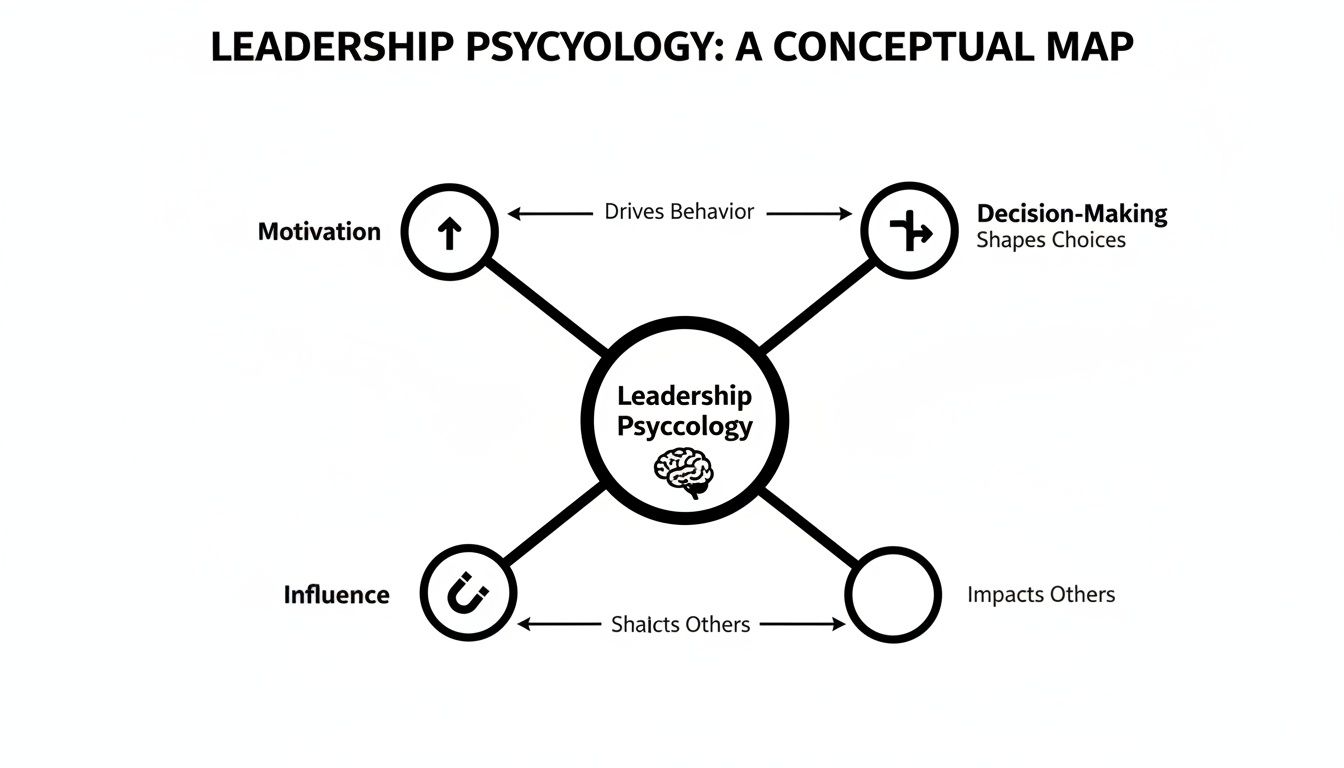
As the map illustrates, things like motivation and decision-making aren't separate skills. They are deeply interconnected, and your mastery of one will directly affect the others.
From Survival to Strategic Advantage
Once you understand these psychological principles, you can shift from just surviving the day-to-day pressures to actively using them as a strategic tool. This is a game-changer, especially for international professionals.
When you’re operating in a non-native language or navigating different cultural norms, your cognitive load is already higher. That makes psychological mastery even more critical for projecting authority and credibility. Understanding the top reasons to choose a specific development path is a key first step for business leaders and executives.
Ultimately, a deep understanding of your own psychology is the foundation on which every other leadership skill is built. It’s what separates the leaders who merely endure from those who truly thrive.
Decoding the Leader's Brain for Better Decisions
Ever walk out of a meeting where everyone nodded in agreement, only to watch the project fail for reasons that seem painfully obvious in hindsight? It’s a frustratingly common experience in leadership, and it has very little to do with how smart you or your team members are.
The real culprit is often the psychology of leadership itself. Our brains are hardwired to take mental shortcuts—instincts that served us well on the savanna but can be disastrous in the modern boardroom. For senior leaders, making great decisions isn't just about weighing pros and cons; it's about actively fighting your own brain's worst instincts.
The Hidden Traps of Cognitive Bias
These mental shortcuts, known as cognitive biases, aren't a personal failing. They're a universal feature of the human mind. The problem is, they operate silently in the background, subtly sabotaging your judgment when the stakes are highest. Two of the most dangerous for any leadership team are confirmation bias and groupthink.
-
Confirmation Bias: This is our natural tendency to hunt for information that proves us right. If a leader is personally invested in a project's success, they might unconsciously pay more attention to positive reports while dismissing data that signals trouble. It’s like building an echo chamber where your own initial optimism is the only thing you can hear.
-
Groupthink: This is what happens when a team’s desire for harmony overrides its ability to think critically. Team members, often subconsciously, hold back dissenting views to avoid creating conflict. The result is a false consensus, a fragile agreement built on what wasn't said.
These aren't just academic concepts; they've led to spectacular, billion-dollar flameouts. Just look at Kodak. Their leadership famously fumbled the future of digital photography—a technology their own engineers invented—because it clashed with their deeply held belief in the dominance of film. That was confirmation bias on an epic scale, and it cost them everything.
Building an Antivirus for Your Brain
So, how do you defend against these invisible forces? The first step is simple awareness. Just knowing these traps exist is half the battle. But awareness isn't a strategy. You need to build practical systems that force you and your team to challenge assumptions.
A key part of the psychology of leadership is accepting that your brain will try to take the easy way out. Your job as a leader is to force it to take the smart way instead, by creating processes that challenge your assumptions.
One of the most powerful tools for this is the "pre-mortem." Before you greenlight a big project, get your team in a room and ask them to imagine it’s a year from now and the project has failed spectacularly. Then, have everyone spend five minutes writing down every possible reason for that failure. This simple exercise flips the script from consensus-seeking to problem-finding and gives people the psychological safety to voice the very concerns that groupthink would otherwise bury.
Another incredibly effective tactic is to formally appoint a "devil's advocate" for any major decision. This person’s only job in the meeting is to pick apart the plan, question assumptions, and argue against the popular opinion. This makes dissent a structured, valuable part of the process instead of an unwelcome disruption. Learning how to train your brain for better communication can also sharpen your ability to articulate and defend these critical viewpoints.
When you implement structured thinking tools like these, you start building a culture where intellectual honesty is valued more than easy agreement. You’re teaching your team not just to execute your vision, but to pressure-test it and make it stronger. This is how you go from being a group of smart people to a truly intelligent organization.
Using Emotional Intelligence to Motivate and Influence

Many people mistake Emotional Intelligence (EQ) for just being "nice." But in leadership, it's the engine of real influence. EQ is the practical skill of understanding your own emotions and then using that insight to recognize and guide the emotions of others.
This isn’t a soft skill—it’s the core of the psychology of leadership. It's what separates a team that just follows orders from one that is deeply committed to a shared vision. Your technical skills and intellect might get you the leadership role, but your EQ is what will determine if you succeed in it.
The Real Cost of Low EQ
The business world is finally catching on. The World Economic Forum now lists emotional intelligence as a critical "power skill" for the future. Yet, a huge gap remains between knowing it's important and actually practicing it. Gallup’s research is pretty stark: only 21-23% of employees across the globe feel genuinely engaged at work.
This isn’t just a morale problem. That massive disengagement drains the global economy of an estimated $8.8 trillion in lost productivity every year. A huge piece of that comes from leaders with low EQ who, often unintentionally, erode trust and kill motivation. You can see a more detailed breakdown in recent studies on leadership trends and their economic impact.
The Four Pillars of Emotional Intelligence
To make EQ a practical tool, it helps to break it down into four skills you can actually build. Each one is a foundation for the next, creating a powerful framework for how you lead.
-
Self-Awareness: This is where it all starts. It's your ability to see your own emotions clearly as they happen and understand your default tendencies. A leader with high self-awareness knows what triggers them, where their blind spots are, and how they come across to others.
-
Self-Management: This is what you do with that awareness. It’s your ability to manage your emotional reactions and adapt. Instead of lashing out in a crisis, you can stay calm, think clearly, and make a deliberate choice about how to respond.
-
Social Awareness: Now we turn the focus outward. This is your ability to accurately read the emotional currents in a room or a team. It’s about picking up on unspoken anxieties, showing genuine empathy, and understanding group dynamics.
-
Relationship Management: This is where everything comes together. You use your awareness of your own emotions and others’ to build strong, trusting relationships. This pillar includes clear communication, resolving conflict constructively, and inspiring your team to move toward a goal.
Think of them as a sequence. Without self-awareness, you can’t manage your reactions. And if you can’t manage your own emotions, you’ll struggle to build the trust needed to manage relationships effectively.
EQ in Action: A Practical Scenario
Let's see how this works in the real world. Imagine a senior manager, Maria, whose project is behind schedule and over budget. The team is stressed. During a tense meeting, a key engineer gets defensive and starts blaming another department for the delays.
-
A low-EQ manager might get visibly frustrated, challenge the engineer publicly, or start assigning blame. This reaction just fuels the fire, making the engineer shut down and leaving the rest of the team feeling anxious and unsupported.
-
A high-EQ manager like Maria handles it differently. She notices her own frustration rising (Self-Awareness) and consciously takes a breath to regulate it (Self-Management). She then tunes into the engineer’s stress (Social Awareness) and validates his feeling, saying, "I get it. This is frustrating, and it feels like we're hitting one roadblock after another."
Right away, the tension in the room drops. She has shown she's on his side. Then, she steers the conversation from blame to action (Relationship Management): "Let's put the 'why' on hold for a minute and focus on the 'how.' What's one thing we can do today to get back on track?"
This approach doesn't just solve the immediate problem; it builds trust and empowers the team to focus on solutions instead of getting stuck in a cycle of blame.
An Exercise to Build Your EQ: The 3-Breath Pause
One of the most effective ways to build self-management is a simple technique called the '3-Breath Pause.' The next time you feel a strong emotion—anger in a tough meeting, anxiety before a presentation—do this before you say or do anything.
- Take one slow, deep breath. Focus only on the physical feeling of breathing.
- On the second breath, just notice the emotion you're feeling without judgment. Name it in your head: "This is frustration." or "I'm feeling anxious."
- On the third breath, ask yourself: "What is the most constructive way to respond right now?"
This tiny act creates a crucial space between the trigger and your response. It gives your rational mind a moment to catch up with your emotional impulse. It's a foundational practice for developing the composure great leaders have, and it can also help you build confidence while improving your communication.
If you’ve ever felt like your ideas aren’t landing with the impact they deserve, or that you’re not being seen as the leader you truly are, the missing piece is likely executive presence.

It’s that unspoken "gravitas" that makes people stop, lean in, and listen when you speak. It’s the visible, tangible result of your internal psychological state.
Too many leaders fall for the myth that presence is something you're born with—you either have it, or you don’t. The reality is quite different. Authority and presence are the direct results of specific, learnable skills that connect your internal mindset with your external actions.
Understanding the psychology of leadership means getting real about the fact that how you project yourself is just as important as the quality of your ideas. It's about signaling your competence before you even say a word.
The Three Pillars of Perceived Authority
Executive presence isn’t some vague, magical quality. It’s a combination of three distinct communication channels working together. When you learn to control them, you control how you’re perceived in any high-stakes room.
-
Vocal Authority: Your voice carries a huge amount of psychological weight. A steady, resonant tone signals composure, while a voice that shoots up in pitch can communicate anxiety. It’s about learning to use pace, pitch, and volume deliberately to give your message weight and project confidence.
-
Executive Body Language: Your non-verbal signals often speak much louder than your words. When you project composure through a stable posture, purposeful gestures, and steady eye contact, you create a powerful feeling of stability and control. This physical stillness tells everyone that you are unfazed by pressure.
-
Strategic Framing: This is how you package your ideas to make them stick. It’s about structuring your thoughts clearly, using powerful language, and tying your message directly to what your audience values. It’s the difference between just presenting data and actually shaping how people interpret it.
In our connected world, this extends to your online footprint. How you present yourself on platforms like LinkedIn is a key part of your executive presence. Just look at these perfect LinkedIn profile picture examples to see how powerful visual cues are in shaping professional perception.
The Hurdle for International Professionals
For international professionals, the challenge of projecting authority is often magnified. Communication styles that signal respect or deep thought in one culture can be easily misread as indecisiveness or a lack of confidence in another. This creates a frustrating perception gap where your true seniority isn't fully recognized.
For instance, pausing to formulate a thoughtful response—a sign of wisdom in many cultures—might be seen as hesitation in a fast-paced Western boardroom. Likewise, using indirect language to be polite can be misinterpreted as a lack of conviction. This isn't about a lack of skill; it's a mismatch in psychological signaling.
Key Insight: True executive presence isn't about faking confidence or playing a role. It’s about aligning your internal composure with your external communication—your voice, your body, and your words—so your authority is felt authentically.
To close this gap, you have to become a student of these unspoken rules. It means developing a sharp awareness of how your communication is being interpreted and then making intentional adjustments. This is the core work of building real presence. If you're ready to turn these insights into practice, discovering more about executive presence coaching can provide a structured path to mastering these skills.
By breaking down executive presence into these learnable parts, you can systematically build the authority you've already earned. It's about making sure your external presence finally matches your internal expertise, allowing you to command the respect you deserve in every room you enter.
Your Practical Toolkit for Leadership Psychology

It’s one thing to understand the theories behind the psychology of leadership. It’s another thing entirely to put them into practice when you’re under pressure. This is where we get practical.
Think of this section as your hands-on guide for building the mental habits of an effective leader. These aren't just abstract ideas; they're repeatable exercises I’ve seen work time and time again.
Each tool is grounded in solid psychological principles and designed to tackle a specific challenge, from managing cognitive bias to delivering feedback that actually helps. Let’s dive in.
Tool 1: The Decision Pre-Mortem
This is one of the most powerful exercises you can run with a team, especially when excitement is high. It’s a direct antidote to the over-optimism and groupthink we talked about earlier, forcing everyone to hit pause and assess risk honestly.
-
Why It Works: It gives everyone "permission" to be critical without fear of being labeled as negative or unsupportive. It creates a space for psychological safety and channels the team's brainpower toward proactive problem-solving, not just consensus.
-
How to Use It:
- Gather Your Team: Get the key players in a room before a big project officially kicks off.
- Announce the "Failure": Make this statement: "Imagine it’s six months from now, and this project has completely failed. Take the next ten minutes and write down every possible reason why."
- Share and Categorize: Go around the room and have each person share one reason at a time until all the points are on a whiteboard. Don't debate them. Just list them, then group similar concerns together.
- Strengthen the Plan: This list of potential disasters is now your roadmap. Use it to build contingencies and reinforce the weak spots in your plan before you start.
I’ve seen this one exercise uncover fatal flaws that would have gone completely unnoticed until it was far too late.
Key Takeaway: Leaders who intentionally look for what could go wrong are far better prepared to make things go right. The pre-mortem turns pessimism into a structured and incredibly productive part of planning.
If you're looking to help your team grow and learn more effectively from exercises like this, it’s worth taking the time to master instructional design principles. Structuring your team’s development thoughtfully builds both competence and confidence.
Tool 2: The Feedback Framing Template
Let’s be honest—giving constructive criticism is one of the toughest and most high-stakes parts of being a leader. If you get it wrong, you can crush someone's motivation. But when you get it right, you can spark incredible growth. This simple template helps you structure your words to minimize defensiveness and get the right message across.
-
Why It Works: It’s built on the psychological principle of relatedness. You’re showing you value the person even while you address a behavior. It cleanly separates the what (the observation) from the why (the impact) and quickly moves the conversation toward a solution.
-
How to Use It: Frame your feedback around these three simple parts.
- The Observation (Specific and Factual): "In the client presentation this morning, I noticed you moved very quickly through the Q&A section."
- The Impact (Connect to a Shared Goal): "The impact was that some of our key stakeholders seemed confused, and we missed an opportunity to address their concerns directly."
- The Question (Open and Collaborative): "What are your thoughts on how we can ensure we address all questions thoroughly next time?"
This simple framework shifts the dynamic from a personal critique to a shared problem you can solve together. Of course, how you say it matters just as much as what you say. Learning how to enunciate your words better adds clarity and authority, ensuring your feedback is heard exactly as you intend it.
These tools aren't one-off tricks. They are mental habits. The more you integrate them into your routine, the more you build the psychological muscle needed to lead with clarity, composure, and genuine authority.
Master Your Mindset to Master Your Leadership
Throughout this guide, we've unpacked how the best leaders operate. It's not about abstract theories; it’s about what goes on inside your own mind. The psychology of leadership is the invisible engine driving every sharp decision, every inspired team, and every bit of authority you command.
In high-stakes environments, the leaders who truly excel are the ones who’ve mastered their own internal world. They know how to spot and sidestep their own cognitive biases, how to keep a steady hand during a crisis, and how to communicate in a way that naturally earns respect.
These aren't personality traits you're born with. They are skills, and like any other skill, they are built through focused, intentional practice. The Gravitas Method is a 12-week one-on-one executive presence coaching program for international professionals who want to communicate with more authority and influence at senior levels. The program is priced at $8,200 paid in full or $9,000 across three installments. Coached by Nikola, it covers vocal authority, strategic framing, executive body language, and high-stakes communication.
Take Action Today
The next step isn't just about reading more. It's about doing. Real improvement always starts with an honest look at where you are right now. Getting a clear picture of your communication patterns—your natural strengths and the blind spots you don't see—is the only way to build a real foundation for growth.
Ready to turn psychological insights into tangible authority? It all starts with understanding your own communication style. Book your complimentary Executive Communication Assessment today for a personalized analysis of your strengths and a clear path toward greater influence.
This initial diagnosis gives you the clarity to put your energy where it will make the biggest difference, moving your leadership from simply effective to genuinely influential.
Frequently Asked Questions About Leadership Psychology
Let's tackle some of the most common questions that come up when leaders start digging into the psychology behind their influence. Getting clear on these points is often the key to turning theory into real-world impact.
Can Leadership Psychology Be Learned?
Yes, absolutely. While it’s tempting to think some people are just “natural-born leaders,” the reality is that the core skills are learned, not innate.
Things like emotional regulation, spotting your own cognitive biases, and communicating in a way that builds trust are all muscles. You develop them through deliberate, consistent practice. It’s less about having a gift and more about a commitment to mastering your own mind and understanding your effect on others.
Think of it this way: skills like self-awareness and emotional control are like any other form of training. The more you use them, especially under pressure, the stronger and more automatic they become.
How Does This Apply to International Professionals?
For international professionals, leadership psychology has an extra, critical layer. You're already managing the cognitive load of operating in a non-native language, which is significant. On top of that, you have to navigate cultural differences in how authority, respect, and confidence are perceived.
A thoughtful pause before answering, which might signal respect in one culture, could easily be seen as hesitation or a lack of conviction in another. A naturally collaborative style could be misinterpreted as indecisiveness in a fast-paced, direct corporate environment.
Getting this right involves a two-part process:
- Developing sharp social awareness to accurately read the room and understand the unwritten rules of your specific business context.
- Intentionally adapting your communication signals—like your vocal tone, phrasing, and body language—to project authority and confidence in a way that lands effectively.
What Is the Most Important Psychological Skill?
If you could only focus on one thing to start, make it self-awareness. It’s the foundation for everything else.
Without a clear and honest understanding of your own emotional triggers, thinking patterns, and communication habits, it's nearly impossible to manage yourself, let alone lead anyone else. You can't fix a blind spot you don't know you have.
Developing self-awareness is what allows you to catch your knee-jerk reactions before they cause damage, recognize your biases before they cloud a decision, and build authentic relationships. It’s the gateway skill that unlocks everything else, from strategic influence to genuine emotional intelligence.
At Intonetic, we believe that mastering your communication is the fastest path to unlocking your leadership potential. The principles of leadership psychology are not just theories; they are practical tools for building real-world authority and influence.
Ready to translate these insights into a powerful executive presence? Your journey starts with a clear understanding of your own communication strengths and gaps. Book your complimentary Executive Communication Assessment to receive a personalized analysis and discover your path to greater impact.