Breaking Every Barrier for Effective Communication
You know the moment. You've done the work, your analysis is sharp, and your recommendation is the right one. Then you present it in a meeting, someone interrupts early, the room drifts, and five minutes later a less prepared colleague restates a simpler version of your point and gets the nod.
That isn't just frustrating. It's a barrier for effective communication with real career consequences.
For international professionals, the problem is rarely intelligence or expertise. It's usually a stack of small frictions that distort how your message lands. A slight delay before answering. A sentence that starts too wide and gets to the point too late. A strong idea delivered in a flat tone. A listener who is already filtering you through assumptions you didn't create.
If you've felt overlooked, misunderstood, or judged as less senior than you are, you're not imagining it. But you're also not powerless. Communication barriers at senior levels can be identified, managed, and reduced with the right strategy.
The True Cost of Being Misunderstood
A senior engineer presents a proposal to reduce technical risk before a product launch. The logic is sound. The slides are clean. But his opening is too detailed, his voice speeds up under pressure, and he doesn't clearly frame the business decision. By the end, the executive team isn't debating his recommendation. They're still trying to work out what he wants.
That kind of breakdown gets dismissed as “presentation skills.” In reality, it affects decision speed, trust, alignment, and authority. It also changes how people rank your leadership potential.
For many international professionals, the emotional cost begins here. You start over-preparing because you don't trust the room to meet you halfway. You replay meetings afterward. You notice that people respond better in writing than they do when you speak live. If that sounds familiar, it's worth reading this perspective on how your accent really affects your career and what you can actually do about it, because the issue is usually broader than pronunciation alone.
Why companies pay for this problem
Poor communication isn't a soft issue. It's expensive. A Drexel summary of a Society for Human Resources Management survey notes that 400 large companies reported an average annual revenue loss of $62.4 million per company due to poor communication.
That number matters because it reframes the issue. A communication barrier isn't just an awkward moment in a meeting. It can mean:
- Delayed decisions that keep teams in analysis mode
- Rework because people heard different versions of the priority
- Lower confidence in a leader who may have the best judgment in the room
- Political losses when clear but less nuanced communicators win influence
Practical rule: If people regularly misunderstand your intent, they won't separate the message from the messenger. They'll start doubting both.
What this looks like at senior levels
At junior levels, communication errors often create confusion. At senior levels, they change perception.
A director who rambles sounds uncertain. A VP who can't land a point quickly sounds unprepared. A founder who speaks with strong insight but weak vocal authority may be heard as technical, not strategic. None of those judgments are fully fair. All of them happen.
That's why fixing communication barriers has to go beyond “speak more clearly.” You need to know which barrier is interfering, and then correct it at the source.
The Four Categories of Communication Barriers
Most communication problems feel personal when they happen. They're easier to solve when you classify them correctly.
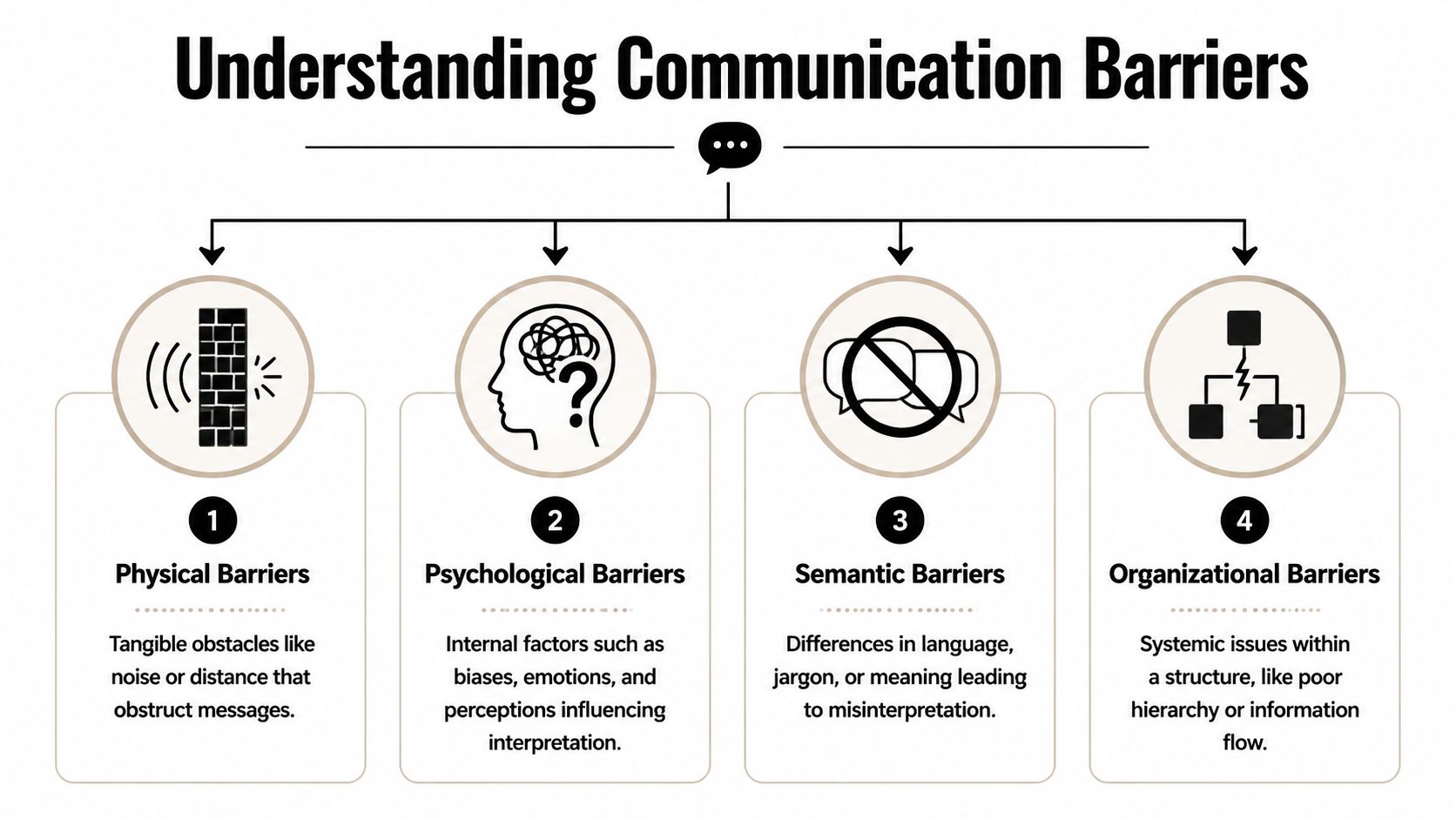
I teach leaders to think of communication barriers as four kinds of static on the line. If you misdiagnose the static, you'll use the wrong fix. You can't solve a perception problem with better slides alone, and you can't solve a channel problem with more confidence.
A 2026 Pumble workplace communication report found that 86% of employees and executives identify lack of effective collaboration and communication as the primary cause of workplace failures. That tells you this isn't a niche problem. It's a systems problem showing up in individual conversations.
Physical and technological barriers
These are the easiest to spot and the easiest to underestimate.
Noise in an open office. Bad microphone quality. Lag on Zoom. A camera angle that makes you look disengaged. A meeting room with echo that flattens your voice. In hybrid teams, these issues reduce clarity and presence.
If your team works in noisy shared environments, it helps to understand the future of office acoustic solutions because sound quality affects far more than comfort. It affects whether people can process, trust, and respond to what they hear.
Short version: if people can't hear you well, they won't judge only the audio. They'll judge your authority.
Semantic and language barriers
This category includes meaning itself. Not just vocabulary.
An executive says “let's pressure-test the assumptions” and a non-native speaker hears criticism rather than collaborative scrutiny. A product lead explains a complex issue with technically correct language, but the audience needs a decision headline, not a systems walkthrough. A consultant uses polished English but structures the answer in a way the room can't follow.
Common signs include:
- Too much jargon for the audience
- Direct translation from your first language into English rhythm or sentence logic
- Weak signposting such as failing to say what matters first
- Idioms or cultural shorthand that don't transfer cleanly
Psychological and perceptual barriers
Many talented professionals frequently get stuck. The message is fine. The listener is filtering it through emotion, bias, or assumption.
Accent bias sits here. So do status assumptions, impatience, stress, defensiveness, and prior negative experiences. If you want a deeper look at this layer, this article on accent bias and the hidden workplace challenge for non-native speakers is useful because it explains why the same words can land differently depending on who says them.
A barrier for effective communication often lives in the listener's interpretation, not the speaker's intention.
Process and organizational barriers
This is the structural layer. Even strong communicators fail inside weak systems.
Here's a quick diagnostic:
| Barrier type | What it sounds like | Best first fix |
|---|---|---|
| Physical | “Sorry, can you repeat that?” | Improve room, mic, or channel |
| Semantic | “I'm not sure what you mean” | Simplify language and sharpen structure |
| Psychological | “I'm not convinced” before content is heard | Pre-frame credibility and manage perception |
| Organizational | “I didn't know that was my decision” | Clarify ownership, timing, and channel rules |
When you start naming the type of barrier instead of calling everything a communication problem, your response gets sharper fast.
How to Navigate Invisible Psychological Barriers
The hardest communication barriers are often silent. Nobody names them in the meeting, but they still shape the outcome.
You can prepare thoroughly and still lose authority because someone reacts more strongly to a hesitation, an accent pattern, or a slightly indirect answer than to the strength of your thinking. That's not meritocratic. It's common.

A Waterloo resource on communication barriers and strategies is cited in the verified material for a finding that non-native English speakers face 27% lower perceived credibility in cross-cultural leadership interactions, and that listeners can overweight negative cues over positive ones by a 5:1 ratio. That is the working reality behind many executive communication struggles.
Why tiny cues get overinterpreted
At senior levels, people make fast judgments. They don't only evaluate content. They assess whether you sound steady, whether you seem clear under pressure, and whether your delivery matches the level of the room.
That's where negativity bias becomes dangerous. A single awkward pause or one imprecise phrase can overshadow several strong points. If a listener already has a stereotype in mind, even unconsciously, they may treat normal human imperfections as evidence that you're not ready.
This is why many international professionals report the same experience: they're respected one-on-one, but in group settings they're interrupted more, challenged faster, or remembered less clearly.
What to control before the bias kicks in
You can't eliminate other people's bias in real time. You can reduce how much room it has to operate.
Use these moves before and during high-stakes interactions:
- Lead with your conclusion: Don't warm up too long. Start with the decision, recommendation, or risk.
- Anchor credibility early: Mention the scope of your ownership, the business context, or the lens you're using.
- Shorten your first answer: Your opening response sets the room's expectation of your executive range.
- Name your structure: Say “There are two issues” or “My recommendation has three parts.” This lowers cognitive load.
If the room has to work too hard to organize your message, people will assume your thinking is disorganized even when it isn't.
The emotional side matters too
Invisible barriers don't only come from the listener. They also show up inside your own body.
Many international professionals carry anticipatory stress into meetings. You expect interruption. You brace for judgment. You rush to prove competence. That internal tension changes your breathing, pacing, and facial expression, which then affects how others read you.
If that pattern includes social tension outside work too, this THERAPSY expat anxiety guide offers useful context for understanding how anxiety can shape everyday communication habits.
A practical starting point is to work directly on how to overcome accent anxiety and speak fearlessly. Not because fear disappears overnight, but because confidence grows when you know exactly what to do with your voice, your pace, and your opening sentence.
Mastering Vocal Authority and Executive Presence
Executive presence is often described vaguely, which makes people think it's innate. It isn't. It's built from visible and audible behaviors that change how your message is received.
For international professionals, this matters even more because listeners often use delivery as a shortcut for judgment. If your ideas are strong but your tone, rhythm, or posture weakens the signal, people may rank you below your actual level.

The verified material cites a 2024 LinkedIn Global Talent Trends report stating that 68% of international tech leaders reported communication style mismatches as a top barrier to C-suite promotion, and 42% specifically cited vocal presence deficits in boardrooms. That tracks with what shows up repeatedly in senior coaching work. Many ambitious professionals don't need more language study. They need stronger delivery.
What vocal authority actually sounds like
Vocal authority isn't a deep voice or a dramatic speaking style. It's controlled delivery that makes your thinking easier to trust.
It usually involves:
- A cleaner pace: not rushed, not dragging
- Deliberate pauses: especially before and after key points
- Downward endings: finishing statements like decisions, not questions
- Stable volume: strong enough to carry without strain
- Clear stress on keywords: so the listener knows what matters
What doesn't work is trying to sound “more native” in a generic way. That often leads to self-consciousness, overcorrection, and a less natural presence. The goal is not imitation. The goal is authority.
The body supports the voice
A strong voice with weak physical presence creates a mismatch.
If your posture collapses when challenged, if your eyes drop while making a recommendation, or if your hands become restless at the exact moment you need influence, the body tells a different story than your words. Senior communicators align all three channels: verbal, vocal, and visual.
Here's a useful benchmark for your next meeting:
| Signal | Weaker impression | Stronger impression |
|---|---|---|
| Posture | Folded inward | Grounded and open |
| Eye line | Looking down while stating a point | Looking at decision-makers when landing it |
| Pacing | Filling silence quickly | Using pauses without apology |
| Gestures | Repetitive or hidden | Intentional and sparse |
One structured option for building these skills is executive presence coaching. The Gravitas Method is a 12-week one-on-one executive presence coaching program for international professionals who want to communicate with more authority and influence at senior levels. The program is priced at $8,200 paid in full or $9,000 across three installments. Coached by Nikola, it covers vocal authority, strategic framing, executive body language, and high-stakes communication.
This short clip illustrates some of the delivery mechanics that matter when authority is judged in real time.
Coach's view: Your voice trains the room how to treat your ideas. If you sound tentative, people challenge sooner. If you sound settled, people listen longer.
Tactics for High-Stakes Workplace Scenarios
Communication training only matters if it changes what happens in the room.
The following tactics are the ones I see work best when the stakes are real: executive presentations, decision meetings, and negotiations. They're practical because they don't depend on the room being fair. They help you hold ground even when the environment is rushed, political, or biased.

The verified material cites a Weavix article on workplace communication barriers for the claim that technological and channel mismatch barriers in remote executive communication cause 52% message distortion in multinational teams, with leaders on high-latency calls losing 30% perceived authority. In other words, your message can degrade before your audience even processes your thinking.
In presentations
When you present to senior stakeholders, detail is not your opening move. Direction is.
Use this sequence:
-
Start with the decision headline
Say what you recommend first. Example: “I recommend delaying the rollout by two weeks to reduce operational risk.” -
Give the business reason second
Tie the recommendation to revenue, risk, customer impact, or execution speed. -
Limit the supporting points
Most executive audiences can track a small number of core reasons better than a full technical explanation.
A useful self-check is simple: if someone interrupted you after your first minute, would they already know your recommendation?
In meetings
Meetings reward speed, but not frantic speed. The leaders who sound most senior usually do three things well.
-
They answer the question that was asked. Don't start with backstory unless it's necessary.
-
They take verbal space early.
If you wait too long, the room assigns authority elsewhere. -
They reset drift.
Say, “The core issue is…” or “We're discussing two different questions.”
“You don't need to talk more to sound senior. You need to make each turn of speech easier to follow.”
If video calls are a recurring weak point, this guide on speaking English more clearly on video calls and presentations is worth reviewing. Remote settings punish muddy pacing and reward tighter structure.
In negotiations
Negotiation pressure exposes every weak communication habit. People start over-explaining. They defend too early. They answer the surface objection instead of the underlying concern.
A stronger approach looks like this:
| Scenario | Common mistake | Better move |
|---|---|---|
| Pushback on price or scope | Immediate justification | Ask what concern sits underneath the objection |
| Stakeholder disagreement | Matching the other person's emotion | Slow the tempo and reframe the decision criteria |
| Pressure question | Long, defensive answer | Give a short answer first, then expand only if needed |
For hybrid and remote negotiations, test your setup before the call. Use a stable microphone, proper lighting, and the right platform for the stakes. If the conversation is sensitive, don’t default to the noisiest or most fragmented channel. The tool is part of the message.
Build Your Leadership Communication Toolkit
A barrier for effective communication rarely disappears because you “become more confident.” Confidence helps, but only when it’s attached to repeatable behaviors.
The stronger path is to build a leadership communication toolkit you can use under pressure. Not just when you’re calm, but when you’re interrupted, challenged, or speaking to people with more formal power than you.
What belongs in the toolkit
Keep these five elements visible in your practice:
- Diagnosis: Know whether the barrier is physical, semantic, psychological, or organizational.
- Message structure: Lead with the point, then support it.
- Vocal control: Pace, pause, and land your statements with conviction.
- Perception management: Frame credibility before others fill in the blanks for you.
- Scenario practice: Rehearse real meetings, not generic speaking exercises.
Many professionals also benefit from formal team learning when they’re trying to improve broader collaboration habits. If you’re responsible for a group as well as your own delivery, this resource on refining team communication skills can help you think beyond individual performance.
What works and what usually doesn’t
What works is specific feedback tied to real situations. Recordings. Pattern recognition. Tight repetition. Practicing the opening thirty seconds of your recommendation until it sounds calm and senior.
What usually doesn’t work is broad advice like “be more confident,” “speak up more,” or “just simplify.” Those phrases aren’t wrong. They’re incomplete. You need to know what exactly to change in your rhythm, structure, and presence.
Communication at senior levels is not a personality contest. It’s a discipline of clarity, authority, and control under pressure.
If you’ve been carrying the sense that you’re better than the way you come across, trust that instinct. Many international professionals are operating far above how they’re currently being perceived. Closing that gap can change meetings, promotions, and the level of influence you’re trusted with.
If you’re ready to move from generic advice to a concrete next step, start with the free Executive Communication Assessment from Intonetic. It’s the most useful entry point if you want to identify the specific habits that are weakening your authority, clarity, or executive presence, and understand what to work on next.