
Executive Presence: Elements of Communication Mastery
You join a leadership meeting with the right analysis, a clear recommendation, and answers to the obvious objections. Then someone else speaks with less substance and somehow gets the room.
That experience is common for senior international professionals. The problem usually isn't competence. It's that one or more elements of communication are working against you at the exact moment your expertise needs to carry authority.
In executive settings, people don't evaluate your idea in isolation. They evaluate the sender, the structure of the message, the channel, the timing, the room, the friction, and how confidently you handle response. If any of those pieces break, your idea can sound less mature than it is.
I've seen this especially often with non-native English speakers who are already performing at a high level. They overprepare content, underprepare delivery, and assume the room will reward accuracy alone. It rarely does. Senior leadership also rewards clarity, composure, sequencing, and the ability to move people toward a decision. If that part feels uneven, your credibility can stall even when your thinking is strong.
If this is familiar, the fix isn't more jargon or more slides. It's learning to diagnose communication the way an operator diagnoses a system. That's also why building authority often starts with understanding how others read your presence, not just your content. A useful next step is this piece on how to build credibility as a leader, because credibility is often the visible result of hidden communication choices.
Why Your Expertise Is Not Enough
A senior engineer presents a risk update. The analysis is sharp. The recommendation is sensible. But the delivery starts with too much background, the key point arrives late, and the voice tightens when challenged. By the end of the meeting, executives don't say the analysis was wrong. They say they need more confidence before acting.
That gap matters.
In senior rooms, people aren't just listening for information. They're deciding whether the speaker can lead under pressure. That's why a technically strong professional can still be perceived as tentative, scattered, or too detailed.
What leaders actually hear
When your communication isn't landing, decision-makers usually experience one of these failures:
- The point is buried: They can't tell what matters most.
- The delivery feels uncertain: Your pace, pauses, or vocal energy suggest hesitation.
- The medium is wrong: A sensitive issue arrives by email when it needed live discussion.
- The room is noisy: Competing agendas, weak audio, or cultural mismatch distort meaning.
- The close is missing: The conversation ends without alignment, ownership, or next steps.
None of that means you lack expertise. It means the communication system around your expertise isn't supporting it.
Strong expertise without strong communication often gets interpreted as lower seniority.
Here, the classic elements of communication become useful. Not as academic vocabulary, but as a practical diagnostic tool. If a board update falls flat, you can ask: Was the sender credible? Was the message structured? Was the channel appropriate? Was the feedback loop active? What noise entered the exchange? What context did I ignore?
Once you look at communication that way, the problem becomes workable. You stop personalizing every awkward meeting and start identifying what to fix.
Deconstructing Communication The Core Elements
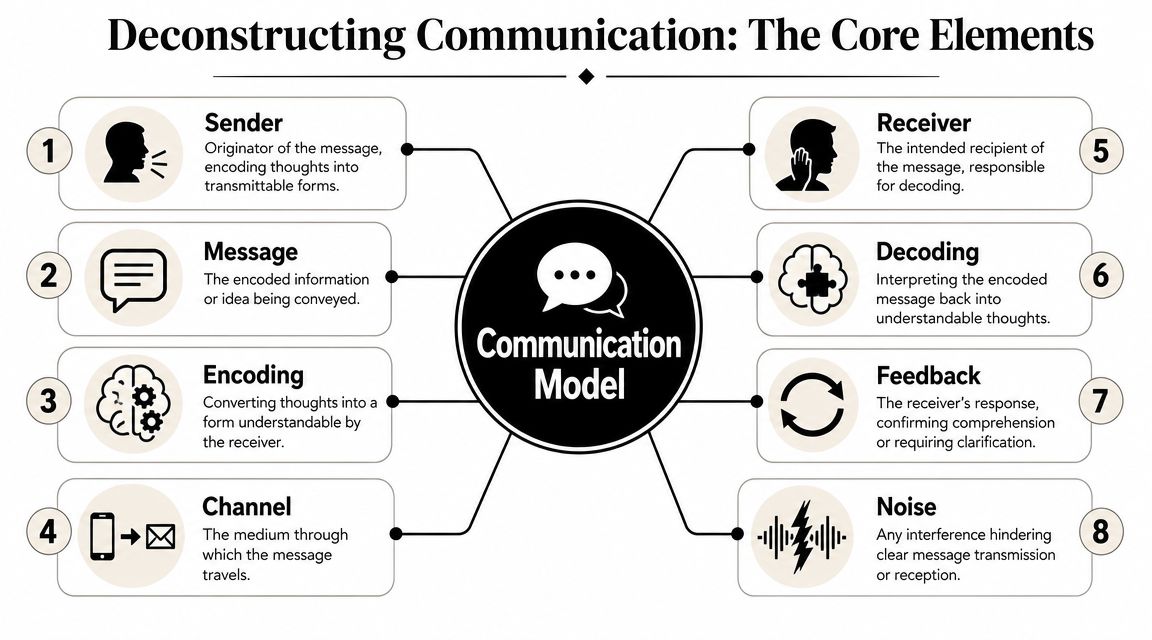
Modern communication theory was formalized in 1948, when Claude Shannon published the mathematical model of communication, later expanded with Warren Weaver in 1949. Their framework organized communication into sender, message, channel, receiver, and noise, and it became one of the most influential ways to understand how information is transmitted and interpreted across systems, as outlined in this overview of the historical communication model.
That matters because it gave professionals a way to analyze communication as a process, not a personality trait. In business, that's powerful. It means unclear communication isn't just "bad speaking." It's often a failure in design.
The seven elements that matter in practice
Most executive communication problems can be traced to seven parts:
Sender
Receiver
Message
Channel
Feedback
Noise
Context
You'll also see related terms such as encoding and decoding. Those are useful because they describe what happens between intention and interpretation. You think one thing, encode it into language and delivery, and the other person decodes it through their own assumptions, attention, and experience.
Why this framework still works
The classic model sounds simple. Real business communication isn't.
A leadership update isn't just sender to receiver. It's sender to several receivers with different incentives, through a channel that may weaken nuance, while noise competes for attention and feedback arrives indirectly. That's why a plain explanation of what business communication is isn't enough on its own. Senior professionals need a model they can use under pressure.
A few examples make the point:
| Element | What works | What fails |
|---|---|---|
| Sender | Calm, direct delivery | Overexplaining to prove expertise |
| Message | One clear recommendation | Dense detail without hierarchy |
| Channel | Live discussion for sensitive issues | Hiding behind email |
| Receiver | Tailoring to audience priorities | Speaking as if everyone thinks like you |
| Feedback | Checking alignment early | Waiting until the end to discover confusion |
| Noise | Managing distractions and ambiguity | Ignoring accent, audio, or jargon issues |
| Context | Reading power dynamics and timing | Treating every room the same |
Communication breaks down less often because people are unintelligent, and more often because they are misaligned.
For international professionals, this model is especially useful because it separates language skill from communication design. Your accent may not be the core issue. Instead, the issue may be message structure, weak signaling, rushed pacing, or poor channel choice.
The Sender and Receiver Mastering Your Role
You present a solid recommendation in a leadership meeting. The analysis is right. The room still hesitates.
In senior settings, that usually means the problem is not expertise. It is how the audience reads you while you deliver it, and how well you read them back. Sender and receiver are not classroom labels. They are the two roles that determine whether your message sounds executive or uncertain.
The sender role carries more than information. It carries judgment under pressure. Colleagues decide quickly whether you sound clear enough to lead, steady enough to handle pushback, and aware enough to adapt to the room.
Sender behavior that raises or lowers authority
Authority comes from control that other people can hear and see.
A steady voice suggests conviction. Brief pauses give your audience time to absorb a point and signal that you are not rushing to defend yourself. Direct openings help senior listeners orient quickly. Composed body language reduces the small cues that make a speaker seem unsure, such as fidgeting, nervous smiling, or apologetic posture.
Non-native English professionals often run into a specific trade-off here. To avoid sounding incomplete, they add too much context, speak faster, or soften every recommendation. The intention is sensible. The result is weaker executive presence, because listeners hear effort instead of judgment.
I see this often with technically strong leaders. They know the material better than anyone else in the room, but they try to prove that expertise sentence by sentence. Senior audiences rarely reward that. They respond better to selective detail, clear emphasis, and visible composure.
Perception also forms before the meeting starts. Your written updates, profile, and public professional presence shape the assumptions people bring into the room. A thoughtful personal branding tool can help keep those signals consistent, especially if you want colleagues to associate you with clarity and leadership rather than just technical competence.
Receiver skill builds trust in real time
Strong communicators receive with as much discipline as they send.
That means listening for priorities, constraints, and unstated concerns. It means checking whether a question is really about timing, risk, ownership, or politics. Senior people rarely say all of that directly. If you answer only the surface question, you can sound polished and still miss the decision.
This matters even more in a second language. Silence can be hard to read. Indirect disagreement can pass unnoticed. A polite comment can carry real resistance. Professionals who build authority learn to test their interpretation instead of assuming they understood the signal correctly.
A practical approach:
- Name the stake: "Your concern seems to be implementation risk more than budget."
- Check meaning early: "Do you want a smaller pilot, or more evidence before rollout?"
- Use prior context: Refer back to an earlier concern to show attention and continuity.
- Push for specificity: Vague hesitation becomes manageable once the other person defines the obstacle.
Empathy helps here, but senior-level empathy is not about sounding warm for its own sake. It is about reading accurately and responding without defensiveness. This guide on what an empathic listener is is useful if you want to strengthen that skill with more intention.
One habit changes the quality of both roles fast. Stop asking, "Did I explain it well?" Start asking, "What is this person trying to solve, protect, or avoid?" That question sharpens your delivery and improves your listening at the same time.
The professionals who sound most senior are often the ones who make other people feel understood quickly, then respond with precision.
The Message and Channel Crafting With Intent
You are in a leadership meeting. You know the work cold. Then you spend three minutes on background, add every caveat to sound careful, and send the follow-up in a long email because it feels safer in writing. By then, the room has already decided you are thorough, but not decisive.
That is the real test of message and channel. In senior settings, they shape how your judgment is perceived.

Build the message for decision-makers
Executives usually listen for four points:
- What is happening
- Why it matters
- What you recommend
- What decision or support you need
Order matters. If you begin with history, context, and exceptions, the audience has to work too hard to find your position. In high-stakes business discussions, that weakens authority fast, especially for non-native English professionals who are already being judged on clarity, speed, and control.
A stronger structure is simple:
- Lead with the recommendation: State your position early.
- Add selective evidence: Use the facts that help the audience decide.
- Name the trade-off: Show that you see the cost, risk, or constraint.
- End with a decision ask: Be explicit about the next move.
This is not about sounding blunt. It is about reducing cognitive load for senior listeners. If you want a stronger framework for that, this piece on communication as persuasion adds useful context.
Pace changes how authority sounds
Delivery changes the message people think they heard.
Under pressure, many international professionals speed up. I see this often with highly capable leaders who want to avoid mistakes, fill silence, or prove command of the material. The result is usually the opposite. Key points blur together, emphasis disappears, and the speaker sounds tense rather than credible.
A better rule is practical.
Slow enough to be understood. Fast enough to keep momentum.
Short pauses help. Clear sentence stress helps more. If a point carries risk, cost, or a recommendation, give it space. Senior audiences do not reward speed by itself. They reward control.
This short video is useful if you want to study delivery more consciously before important meetings.
Choose the channel with intent
The same message can sound decisive in one channel and weak in another.
Use a live meeting when you need alignment, trust, or room to handle objections in real time. Use email when precision, documentation, or decision traceability matters. Use chat for quick coordination. Do not use it for sensitive disagreement, strategic repositioning, or anything that depends on tone.
This is a trade-off, not a rulebook. A written note gives non-native English professionals more control over wording, but it can also hide uncertainty until it becomes resistance. A live conversation gives you immediate reaction, but it also demands faster processing and stronger listening discipline. Strong communicators choose the channel that serves the decision, not the one that feels most comfortable.
That choice gets harder as teams produce more communication with AI tools, templates, and automated updates. Volume goes up. Clarity often does not. If that problem is showing up in your organization, this guide to internal comms and artificial intelligence offers a useful broader lens on channel choices.
Overcoming Noise and Using Feedback
Most communication advice treats noise as background sound. In executive settings, noise is much broader and more dangerous because it often goes unnoticed until the meeting is already off course.
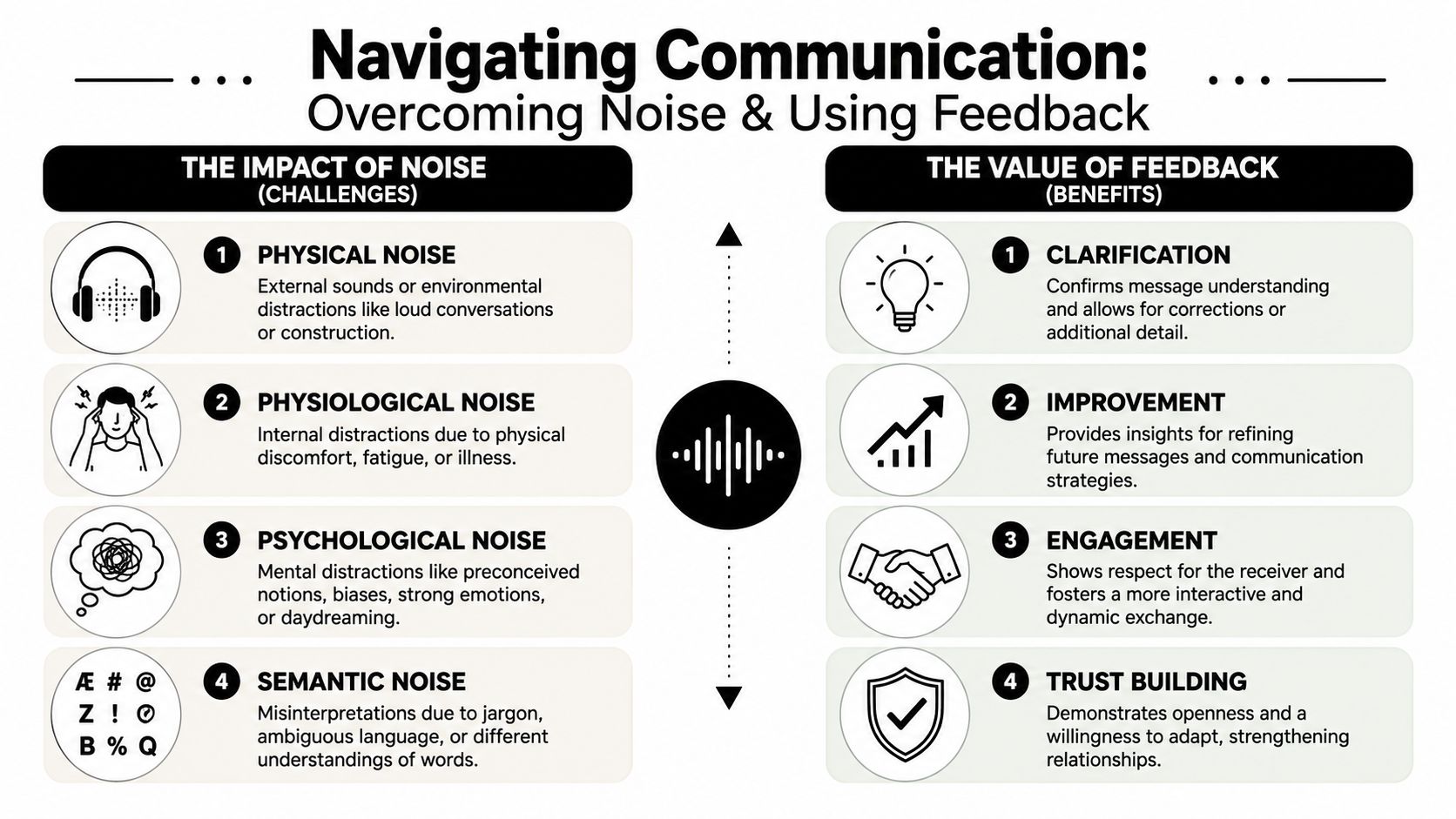
Noise includes poor audio, weak lighting, jargon, emotional tension, split attention, cultural assumptions, and platform friction. Academic and applied sources also note that communication is shaped by audience analysis, channel choice, plain language, visual aids, physical and psychological environment, and interference such as poor audio, poor lighting, attention drift, and digital constraints. In hybrid work, that makes noise less visible but more consequential, as described in this overview of communication elements in context.
The kinds of noise leaders underestimate
A few forms show up repeatedly:
- Semantic noise: You use terms the audience interprets differently.
- Psychological noise: Someone hears your proposal through fear, bias, or defensiveness.
- Digital noise: Lag, camera fatigue, multitasking, or weak visuals reduce engagement.
- Cross-cultural noise: Directness, silence, and disagreement mean different things to different people.
For non-native English speakers, semantic noise often gets blamed on accent when the deeper issue is message density or unfamiliar phrasing. Accent can affect ease of processing, yes. But so can overloaded slides, vague verbs, and unexplained shorthand.
Feedback is how you repair the signal
Senior communicators don't wait passively to see whether others understood. They create feedback loops.
Try these moves in real time:
| Situation | Better feedback move |
|---|---|
| Room goes quiet after your recommendation | Ask, "What's the main concern holding this back?" |
| Stakeholder nods but doesn't commit | Confirm ownership and next step out loud |
| Video call feels flat | Name the ambiguity and invite reaction directly |
| Question sounds broad or political | Narrow it: "Are you asking about timing, budget, or adoption risk?" |
These moves matter because feedback isn't only verbal. It also appears as delay, evasiveness, side questions, or unusually cautious agreement.
If you don't actively seek feedback, you'll often mistake politeness for alignment.
The point isn't to control every variable. You can't. The point is to notice friction early enough to adapt before the exchange collapses.
The Elements in Action High-Stakes Scenarios
A high-stakes conversation is where all the elements of communication collide. Consider a director presenting a risky expansion plan to senior leadership. The data is solid, but the audience is divided. Finance worries about cost. Operations worries about execution. The executive sponsor wants a clean recommendation, not a lecture.
That conversation won't succeed because the slides are polished. It succeeds when the speaker manages the full system.
What effective communicators do differently
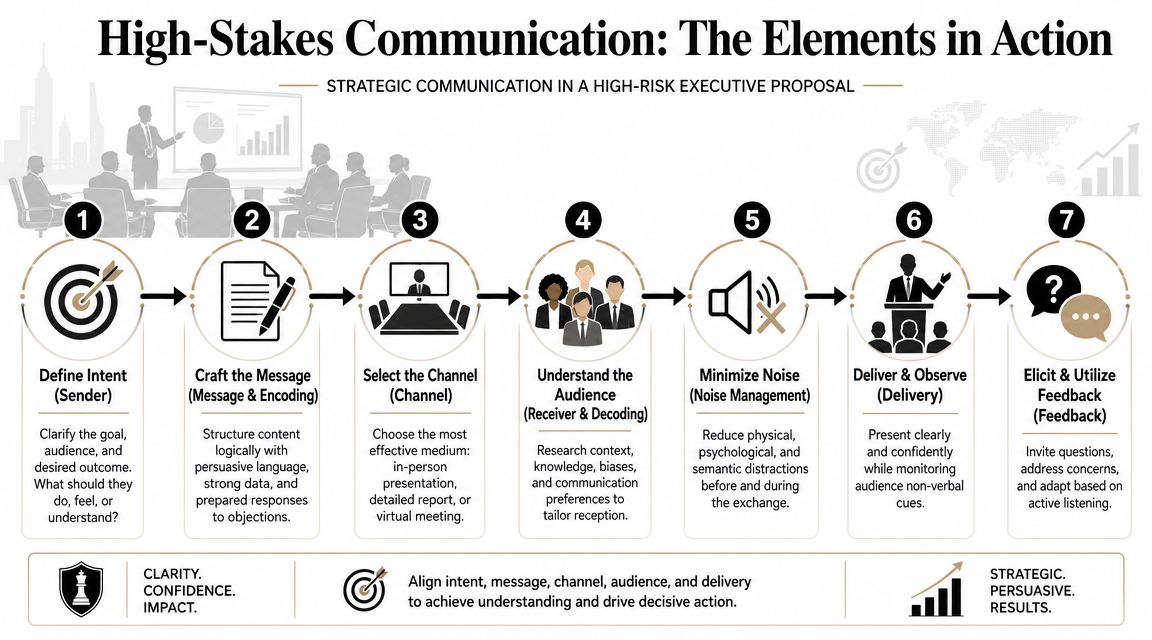
A practical sequence looks like this:
- The sender enters with a clear point of view and stable delivery.
- The message is framed around decision, not information volume.
- The channel matches the stakes. A live discussion comes before a summary email.
- The receiver is analyzed in advance. Each stakeholder hears what matters to them.
- Noise is reduced early. Slides are simplified, jargon is translated, side concerns are anticipated.
- Feedback is invited before resistance hardens.
- Context shapes tone, timing, and level of directness.
This is also where many simplistic explanations fall short. Real high-stakes communication is not just a sender-message-receiver pipeline. Effective communication also requires task-specific moves like building rapport, opening the discussion, understanding the other person's perspective, reaching agreement, and closing the conversation. A PubMed review identified seven essential communication tasks in real encounters, which makes it a useful reminder that practical communication depends on sequence and action, not only theory, as discussed in this PubMed review of communication tasks.
A boardroom example
Say you're asking for approval on a high-risk initiative.
A weak version sounds like this: too much history, no early recommendation, defensive answers, and a vague close such as "happy to discuss further."
A stronger version sounds different:
- You open with the recommendation and business rationale.
- You acknowledge the main risk before someone else uses it against you.
- You test the room's concerns early.
- You adapt your explanation for finance, product, and operations instead of repeating the same wording.
- You close with a specific decision request.
That's the difference between sharing information and leading a decision.
For professionals who want a structured way to build that capability, how to talk to senior leadership is one useful starting point. Another option is The Gravitas Method, a 12-week one-on-one executive presence coaching program for international professionals who want to communicate with more authority and influence at senior levels. The program is priced at $8,200 paid in full or $9,000 across three installments. Coached by Nikola, it covers vocal authority, strategic framing, executive body language, and high-stakes communication.
In high-stakes moments, authority comes from sequence. Say the right thing, in the right order, with enough control that others can follow you.
Your Executive Communication Checklist
Most communication improvement doesn't require a personality transplant. It requires better defaults.
Use this checklist before your next high-stakes meeting:
Before the meeting
- Sender: Rehearse your first two sentences out loud until they sound settled.
- Receiver: Identify what each stakeholder is most likely to protect, question, or need.
- Message: Write your recommendation in one sentence before you open PowerPoint.
- Channel: Decide whether this conversation needs influence, documentation, or both.
During the meeting
- Pace: Stay within a controlled rhythm so people can follow your thinking.
- Noise: Fix what you can. Better audio, simpler slides, clearer wording, fewer distractions.
- Feedback: Test understanding before the end. Don't assume nodding means agreement.
- Context: Adjust your tone to the room. Boardroom, client call, and cross-functional update are not the same event.
After the meeting
- Close the loop: Send a concise summary with decision, owner, and next step.
- Review the breakdown: If it didn't land, identify which element failed.
- Practice in another format: Executive skill improves faster when you work across meetings, writing, and spoken delivery.
If you want another outside format to study how leaders communicate clearly under public pressure, this guide for B2B podcast communication offers a useful angle on clarity, audience awareness, and spoken authority.
The important thing is to stop treating communication as one vague soft skill. It isn't. It's a set of observable elements you can improve deliberately.
If you want expert eyes on how these elements are helping or hurting your executive presence, start with the free Executive Communication Assessment from Intonetic. It gives you a practical way to diagnose where your authority breaks down, especially in high-stakes English communication, and what to fix first.