
What Is an Empathic Listener: Your Leadership Edge
You explain a solid idea in a leadership meeting. The analysis is strong. The recommendation is practical. People nod, then move on.
Later, someone else makes a similar point and the room suddenly engages.
That gap often has less to do with intelligence than people think. In senior environments, influence depends on whether others feel understood before they’re willing to be persuaded. If they don’t, your expertise can sound technically correct but strategically disconnected.
That problem hits international professionals especially hard. You may already be translating language, tone, hierarchy, and culture at the same time. Add subtle workplace dynamics like accent bias in professional settings, and it becomes even easier for strong ideas to land flat for reasons that have nothing to do with quality.
An empathic listener changes that dynamic. Not by becoming softer, and not by turning every conversation into therapy. By making other people feel accurately heard, you lower resistance, surface better information, and earn the right to lead the discussion.
The Unseen Barrier to Your Influence
A senior engineer presents a migration plan. The CFO pushes back on risk. The engineer answers with more detail, more logic, more evidence. The room gets colder.
A product leader hears a stakeholder say, “I’m not comfortable with this timeline.” She responds with a defense of the roadmap. The stakeholder's underlying message was, “I don’t trust that my team’s constraints were considered.”
That’s the unseen barrier. People rarely react only to your words. They react to whether you’ve registered their pressure, their priorities, and the emotional context underneath their objection.

When expertise isn’t enough
In high-stakes conversations, many capable professionals make the same mistake. They assume influence comes from explaining better. Sometimes it does. Often it doesn’t.
If the other person feels dismissed, rushed, or misread, they stop processing your argument fairly. They start protecting their position. That’s why technically skilled leaders can still struggle in executive rooms.
You can lose authority by sounding too eager to solve a problem you haven’t fully understood.
For international professionals, this gets more complicated. You might already be speaking more carefully than everyone else in the room. If you focus only on precision, you can sound distant when you intend to sound respectful.
The strategic shift
Empathic listening helps you catch what people are really telling you. The surface message might be about budget, timing, or deliverables. The deeper message is often about status, fear, trust, workload, or uncertainty.
Once you hear that, your response changes. Instead of pushing harder, you get traction.
An empathic listener doesn’t surrender leadership. They make leadership easier to accept.
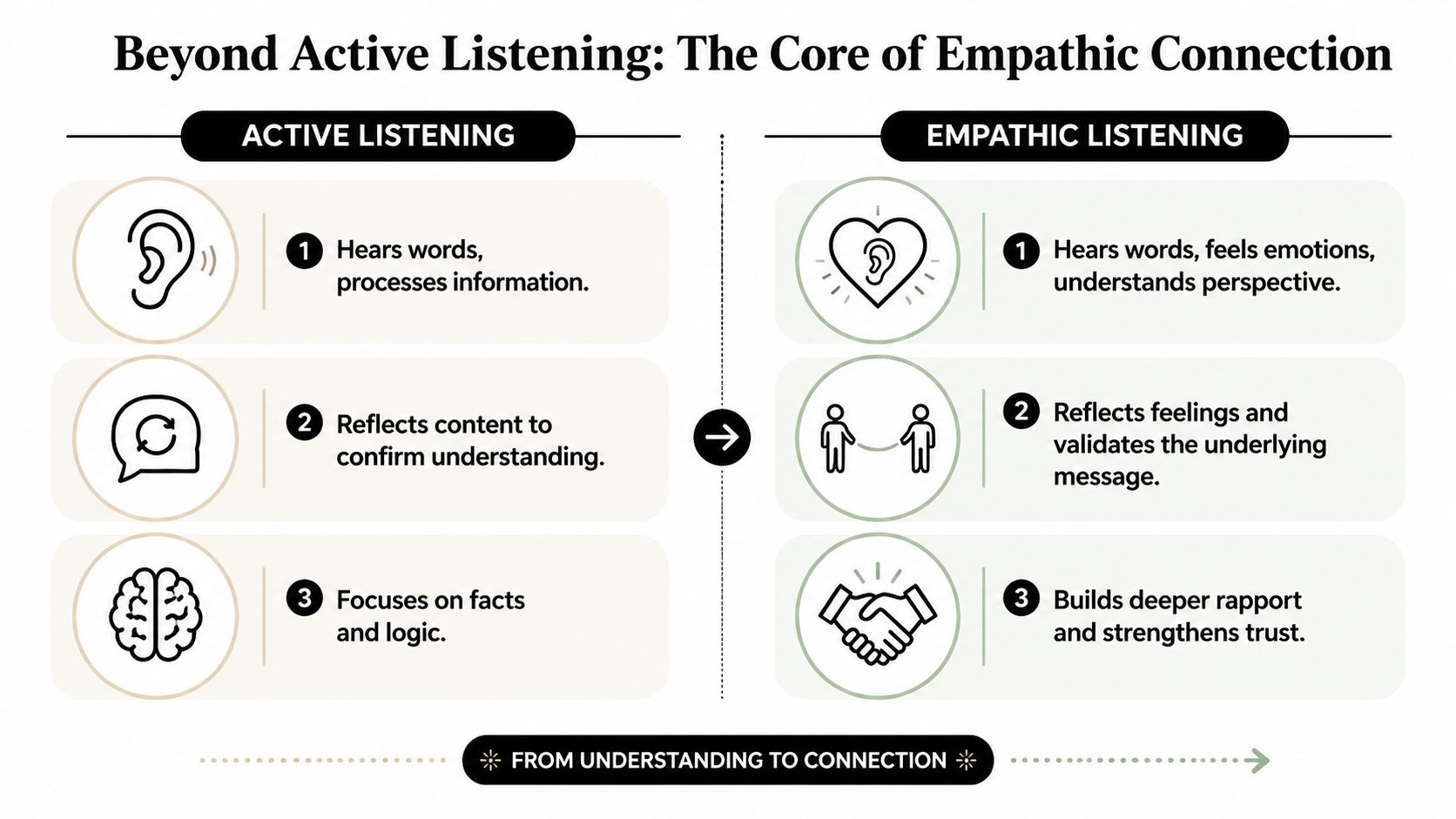
Beyond Active Listening The Core of Empathic Connection
If you’re asking what is an empathic listener, start with this distinction. Active listening proves you heard the words. Empathic listening shows you understood the human experience behind them.
Active listening is useful. It keeps conversations accurate. But many senior professionals stop there. They summarize, repeat, and clarify, yet the other person still leaves feeling unseen.
Empathic listening goes further. It hears the notes and the music.
What the research-based definition adds
The communication model that best clarifies this is Active-Empathic Listening, or AEL. It defines empathic listening through three parts: Sensing emotion, Processing it accurately, and Responding in a way that verbally validates the speaker. A study discussed in the Active-Empathic Listening research from Old Dominion University found middle-aged leaders scored significantly higher on the Responding subscale than younger adults, which suggests empathic responsiveness is observable and measurable, not just a personality trait.
That matters in leadership. The part many people skip is Responding. They notice the emotion internally but never communicate that they noticed it.
Sympathy, active listening, and empathic listening
Here’s the practical difference.
| Style | Focus | Goal | Example Phrase |
|---|---|---|---|
| Sympathy | Your reaction to their pain | Offer comfort | “I’m sorry you’re dealing with that.” |
| Active listening | Their words and facts | Confirm understanding | “So your concern is the delivery timeline.” |
| Empathic listening | Their words, feelings, and perspective | Help them feel understood | “It sounds like the timeline isn’t the only issue. You’re concerned your team will absorb the risk.” |
Sympathy can be kind, but it often creates distance. Active listening is cleaner and more useful in business, but it can still feel procedural. Empathic listening is what builds trust without becoming sentimental.
What this sounds like in real life
An active listener might say, “Let me confirm what I heard.”
An empathic listener might say, “I hear the concern about scope, and I also hear frustration that your team was brought in late.”
That second response does more than verify content. It validates context.
Practical rule: If your response only reflects facts, you’re listening actively. If it reflects facts plus emotional meaning, you’re listening empathically.
This is especially important for professionals working in a second language. Many are taught to focus on correctness first. That’s understandable. But if your delivery becomes too literal, people may miss your warmth, flexibility, or social awareness. Work on clarity, yes, but also on tone, pacing, and natural signaling. That’s part of why improving spoken English clarity and confidence in leadership settings changes more than pronunciation.
For people trying to deepen connection outside purely corporate settings, resources on trauma-informed attachment healing can also be useful because they show how emotional safety depends on feeling accurately understood, not merely answered.
The Verbal and Non-Verbal Signals of an Empathic Listener
You can usually recognize an empathic listener within a minute. Not because they perform empathy, but because their attention changes the other person’s nervous system.

According to Participedia’s overview of empathetic listening, accurately reflecting feelings is linked to mirror neuron activation, and fMRI evidence shows 35% deactivation in the amygdala for speakers when listeners reflect feelings accurately. In plain terms, people feel safer, less threatened, and more open when they sense that you actually get them.
Verbal signals people trust
Empathic listeners use language that opens rather than corners.
- They ask for perspective, not just data. “What’s your biggest concern here?” works better than “What exactly is the issue?”
- They reflect emotion without overdramatizing it. “You sound disappointed by how that decision was handled.”
- They validate without surrendering judgment. “I can see why that would be frustrating” is not the same as “You’re right.”
- They check meaning. “Am I hearing correctly that the timeline matters less than the resourcing risk?”
One of the strongest habits is naming the pressure beneath the statement. When someone says, “This approach feels aggressive,” the hidden message may be about exposure, reputation, or loss of control.
Non-verbal signals that carry more weight than words
A lot of professionals undermine empathic listening with their body language. Their words sound patient, but their posture says, “Please finish quickly.”
Watch for these cues:
- Stillness at key moments. Don’t shuffle papers while someone explains a difficult point.
- Open posture. Uncrossed arms, visible hands, body turned toward the speaker.
- Non-interruptive attention. No glancing at your laptop, no phone checks.
- Useful silence. A pause after someone finishes often gets you the full answer.
Here’s a simple benchmark I use with clients. If your face, shoulders, and pace look tense, the other person won’t experience you as receptive no matter how polished your wording is.
A short training example helps make this visible:
Where international professionals often get misread
Some non-native English speakers default to a serious expression to avoid mistakes. Others speak too quickly because they want to show fluency. Both habits can reduce the felt warmth of your listening.
On video calls, this matters even more because tone and facial responsiveness carry more of the message. If that’s an area you’re working on, targeted practice for speaking more clearly on video calls and presentations often improves not just intelligibility, but also perceived presence.
Silence is part of empathic listening. Fast reassurance often sounds like self-protection, not support.
Why Empathic Listening Is a Superpower in Tech and Global Leadership
In technical environments, people often treat empathy like a cultural extra. It isn’t. It’s an operating advantage.
Tech leaders make decisions through incomplete information, cross-functional friction, and shifting priorities. In that setting, the person who can surface the actual concern early is more effective. The person who only responds to the literal statement usually cleans up conflict later.

The business case is strong. The AMA resource on empathic listening and leadership notes that empathetic leaders retain talent 40% better, trained empathic listeners can produce a 30% gain in employee satisfaction, and 55% of leaders overestimate their empathy. That last point matters most in senior careers. The perception gap is often the problem.
Why it matters in tech
Engineers, product managers, data leaders, and founders work across different decision languages. One person speaks in architecture risk. Another speaks in revenue exposure. Another speaks in user trust.
Empathic listening helps you translate between them.
- In product discussions, it reveals whether resistance is really about roadmap logic or about ownership.
- In engineering management, it helps direct reports tell you what they won’t say to a leader who feels rushed.
- In executive meetings, it lets you address the emotional subtext of risk without sounding vague.
A leader who listens empathically hears when “we need more time” actually means “we don’t feel protected if this fails.”
Why it matters even more globally
International professionals often operate across high-context and low-context communication norms. In one culture, direct emotional acknowledgment feels respectful. In another, it can feel intrusive or theatrical.
That’s why empathic listening is more powerful than empathy-as-performance. You’re not trying to sound emotional. You’re trying to make your understanding unmistakable.
The goal isn’t to become more expressive than your culture allows. The goal is to become more legible to the people you lead.
This is also where executive presence enters the picture. Presence isn’t only how you speak. It’s whether people feel steadier in your presence. A leader who can absorb pressure, reflect it accurately, and respond with clarity looks senior.
For international tech teams, communication coaching sometimes includes work on delivery patterns that affect how empathy is received, including pacing, stress, intonation, and directness. Teams exploring accent-focused communication development for tech employees usually find that clearer delivery and better listening habits reinforce each other.
What doesn’t work
Three things weaken authority fast:
- Listening only to rebut. People sense it immediately.
- Over-empathizing. If every response sounds therapeutic, you can lose precision.
- Using empathy as a script. Stock phrases without real attunement come off as corporate theater.
The strongest leaders combine empathy with decisiveness. They acknowledge reality, then move the conversation forward.
Empathic Listening in Action Workplace Scenarios and Scripts
The easiest way to understand empathic listening is to hear the contrast. Most weak responses fail for a simple reason. They answer the problem before they’ve answered the person.
Microsoft’s overview of empathic listening notes that open-ended questions and reflective paraphrasing can increase mutual trust by 40% to 60% in high-stakes deliberations, and a Mindtools survey found 70% of managers rank empathy among the top five skills for executive effectiveness, as summarized in Microsoft’s practical guide to empathic listening. In negotiation-heavy roles, that difference changes outcomes.
Scenario one with a defensive direct report
Typical response
“You need to be more open to feedback. Nobody is attacking you.”
It sounds corrective. It also escalates the threat.
Empathic response
“I can see this feedback feels frustrating. You put serious work into this, and it probably feels like that effort isn’t being recognized. Let’s slow down and separate the quality of your effort from the impact the team experienced.”
Why it works: it lowers defensiveness without diluting standards.
Scenario two with a resistant stakeholder
Typical response
“We already explained why this timeline is necessary.”
That response may be true. It still misses the concern.
Empathic response
“It sounds like the timeline itself isn’t your only issue. You may be worried your team is carrying implementation risk without enough input. What would you need to see to feel this plan is workable?”
Why it works: it names the likely pressure, then invites specifics.
A good empathic response often starts with a hypothesis, not a certainty.
Scenario three with a burned-out team member
Typical response
“Take a day off if you need one.”
Sometimes that helps. Often it’s too small for the actual problem.
Empathic response
“You seem stretched thin, and not just busy. I’m hearing that the volume is one part of it, but the bigger issue may be that priorities keep shifting and you can’t get traction. What feels most draining right now?”
Why it works: it distinguishes workload from helplessness.
Scenario four in cross-cultural communication
International professionals often tell me they understand the words but miss the intent. That’s common when teams use indirect disagreement.
Typical response
“So you agree with the proposal?”
The other person said, “That could be challenging,” which might mean strong opposition.
Empathic response
“I may be missing some of the nuance here. When you say this could be challenging, do you mean the plan needs refinement, or that it creates serious concern for your side?”
That wording is especially useful in practice sessions that involve role-playing communication scenarios for clearer English and stronger leadership responses. It trains you to test meaning instead of assuming it.
A script formula you can borrow
Use this sequence in difficult conversations:
- Name the observable issue.
- Reflect the likely feeling or pressure.
- Check your interpretation.
- Ask an open question.
Example:
“I hear the concern about the launch date. It sounds like there’s also some concern about accountability if things slip. Am I reading that right? What would make this feel manageable from your side?”
That’s empathic listening in business form. Not soft. Not vague. Not passive.
How to Develop Your Empathic Listening Skills
Individuals often don’t need more advice about listening. They need practice that exposes where their habits break down under pressure.
A useful self-check starts with a few uncomfortable questions.
A quick self-audit
Ask yourself:
- Do I interrupt when I think I already understand the point?
- Do I jump to solutions before naming the other person’s concern?
- Do people repeat themselves around me?
- When someone is emotional, do I become more mechanical?
- Do I confuse empathy with agreement, or avoid empathy because I think it sounds weak?
If you answered yes to several of these, that’s not a character flaw. It’s usually a speed problem, a control problem, or a cross-cultural interpretation problem.
Three ways to practice
Try these in real conversations this week:
- The five-minute listen. For five minutes, your only job is to understand. No advice. No stories about yourself. No fixing.
- Emotion labeling. After someone speaks, reflect one likely emotion carefully: “You sound disappointed,” or “It seems this created a lot of pressure.”
- Perspective-getting questions. Instead of assuming, ask. A 2024 HBR study summarized in Indeed’s discussion of empathic listening found that perspective-getting through questioning boosts understanding by 35% in diverse teams.
Common mistakes to stop making
- Empathy hijacking. “That happened to me too.” Now the conversation is about you.
- Premature reassurance. “It’ll be fine.” Maybe. But that doesn’t help someone feel understood.
- Overdoing warmth. Especially in senior settings, too much emotional language can dilute authority.
- Misreading cultural cues. A pause may signal thoughtfulness, not disengagement. Indirect phrasing may signal disagreement, not confusion.
The target is precise empathy. Enough to make the other person feel understood. Not so much that you lose structure, standards, or leadership.
Accelerating Your Path to Influential Communication
Empathic listening isn’t passive. It’s one of the most practical ways to increase influence without becoming louder, more aggressive, or more polished than necessary.
When you listen this way, people stop bracing and start telling you what matters. That improves decision-making, trust, and executive presence at the same time. It’s especially valuable for international professionals who need their authority to come through clearly across language and cultural differences.
Self-practice helps. Feedback speeds things up. Many find it challenging to hear their own patterns in real time, especially under pressure.
One structured option is The Gravitas Method, a 12-week one-on-one executive presence coaching program for international professionals who want to communicate with more authority and influence at senior levels. It’s priced at $8,200 paid in full or $9,000 across three installments. Coached by Nikola, it covers vocal authority, strategic framing, executive body language, and high-stakes communication.
The important first step isn’t guessing what to fix. It’s identifying the pattern that’s costing you influence now.
If you want a clearer read on how your communication is landing, start with the free Executive Communication Assessment from Intonetic. It’s the most practical entry point if you want to understand where your listening, delivery, and executive presence may be helping you, or holding you back.