Changing the Topic with Authority: A Guide for Leaders
A meeting starts well. Then one director gets stuck on a side issue, someone else defends a past decision, and suddenly the room is spending expensive time on the wrong problem. If you're a non-native English speaker, this moment can feel worse. You know the conversation needs redirecting, but you also know the social risk. Interrupt too hard and you sound rude. Wait too long and you look passive.
Senior leaders are judged in those moments.
Changing the topic isn't small talk. In boardrooms, executive reviews, investor meetings, and tense cross-functional discussions, it is a strategic move. Done well, it shows that you can protect focus, manage energy in the room, and move people toward a decision. Done badly, it makes you sound evasive, defensive, or unprepared.
For international professionals, the challenge is sharper. You aren't only choosing the right idea. You're managing timing, tone, wording, and cultural expectations at once. That is exactly why this skill matters so much for promotion. The leader who can redirect a conversation without losing trust often becomes the person others follow.
Why Changing the Topic Is a Leadership Power Move
The quarterly review is ten minutes from ending. One board member is still pushing on a minor implementation detail. The CFO needs a decision on risk exposure. If you redirect that discussion with clarity and calm, people read more than language skill. They read judgment.
That is why topic shifting matters at senior levels. It is a way to show authority under pressure. In high-stakes meetings, the leader who decides what deserves attention is often the leader the room trusts.
Authority shows up in redirection
Executives are not judged only on the quality of their answers. They are judged on whether they can protect relevance. In practice, changing the topic often means saying, "we have heard that concern, and the priority now is the decision in front of us." That move sets the hierarchy of issues. It shows command of time, risk, and agenda.
Research discussed by the Center for Talent Innovation on executive presence has long reinforced a point I see in coaching. Gravitas carries the most weight, and communication supports it, rather than replacing it (breakdown of executive presence pillars). For non-native English executives, this matters. Perfect phrasing is not the standard. Clear control is.
I have seen talented international leaders lose ground because they answered every side question as if every question had equal priority. That sounds cooperative, but in a boardroom it can make you look junior.
Practical rule: If you cannot redirect a conversation when stakes are high, people may doubt your ability to redirect the business when conditions change.
The fear is understandable, but the cost of hesitation is higher
Many non-native speakers worry that changing the topic will sound abrupt or disrespectful. Sometimes that risk is real. A hard pivot, delivered too early or with the wrong tone, can trigger resistance. But letting the room stay stuck has a cost as well. You lose decision time. You blur priorities. You give louder voices control over the narrative.
The stronger move is purposeful redirection. Shift the topic because the group needs a decision, a clearer frame, or a better definition of risk. That is different from avoiding a hard question. Senior people notice the difference quickly.
Here is the trade-off leaders face:
| Situation | What weak leaders do | What strong leaders do |
|---|---|---|
| Discussion goes off-track | Add more detail to the wrong topic | Redirect to the decision or objective |
| Stakeholder fixates on one issue | Defend themselves point by point | Acknowledge, then widen the frame |
| Team gets overloaded | Keep feeding information | Simplify and reset focus |
A crowded discussion weakens everyone's judgment. Leaders who reset the frame usually make the next decision easier because they reduce mental clutter first. If your team is already overloaded, these practical steps to reduce overwhelm can help you structure conversations so redirection feels disciplined rather than abrupt.
For leaders who want to improve this deliberately, strategic communication skills for senior-level conversations matter more than generic advice about sounding confident. The goal is not to sound polished. The goal is to sound in charge of what matters now.
The ABRC Framework Acknowledge Bridge Reframe Close
A CFO raises a valid concern in a board meeting, then keeps talking past the decision at hand. If you interrupt too sharply, you look defensive. If you let the point run, you hand over the agenda. ABRC gives you a disciplined way to redirect without sounding evasive, which is exactly what senior leaders need in high-stakes English conversations.
Use ABRC when authority depends on steering the room
ABRC stands for Acknowledge, Bridge, Reframe, Close. It is a repeatable sequence for changing the topic with control and respect.
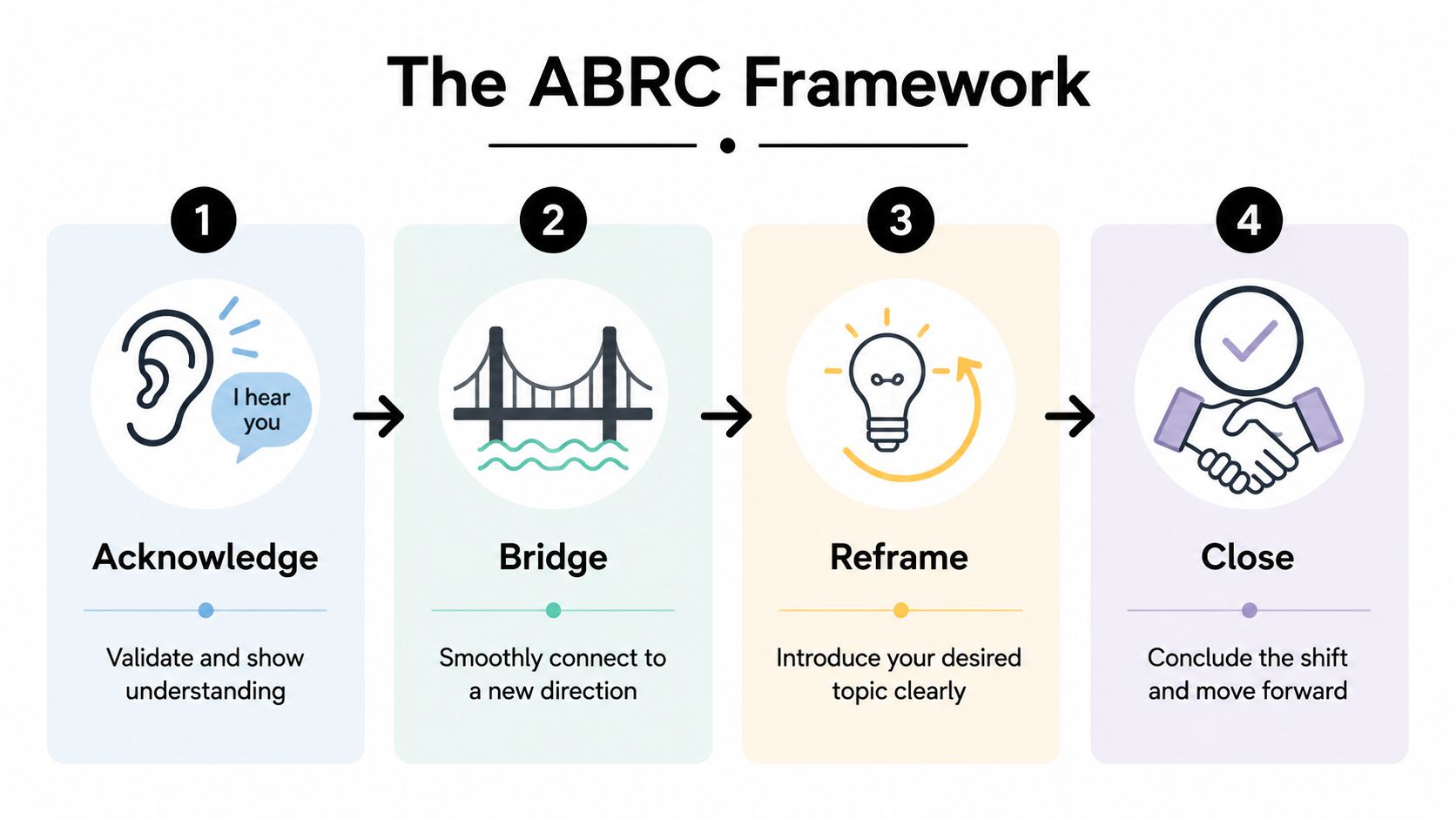
Used well, it does more than keep a conversation tidy. It signals judgment. Senior executives are assessed on whether they can hear input, sort what matters, and move a group toward the key decision. For non-native speakers, that signal matters even more because listeners often judge authority through structure before they judge it through accent or fluency.
The sequence is straightforward. You show that you heard the point. You create a verbal turn. You set a better frame. Then you hold the room there long enough to make progress.
ABRC works best when you know your destination before you speak. The new topic needs a clear purpose. It might be the decision this group owns, the risk that has not been named yet, or the priority that should outrank the current detail. In executive communication, redirection works when people can hear the logic of the move, not just the language of it. That is the same principle behind communication as persuasion in executive settings.
What each step sounds like
-
Acknowledge
Show that you heard the contribution and that you understand why it was raised. Keep this brief. Long acknowledgments weaken your pivot.
Examples: "That's a fair concern." "I see why that matters." "You're right to raise that." -
Bridge
Use a transition phrase that prepares the room for a shift. This step is small, but it carries a lot of weight because it makes the change sound chosen rather than reactive.
Examples: "What matters for this decision is…" "The question we need to answer now is…" "Let me connect that to the bigger issue…" -
Reframe
Name the topic that deserves attention now. Good reframing is specific. Vague pivots sound political. Clear pivots sound executive.
Examples: "The issue is implementation risk, not only cost." "The core question is whether this supports the quarterly priority." "For this group, the concern is governance, not process detail." -
Close
Direct the next few minutes. This is the step many capable leaders skip, and the conversation slips back.
Examples: "Let's stay with that." "I want us to decide that first." "Let's spend the next five minutes on that question."
Acknowledge the point, then retake control of the frame.
Why ABRC holds up under pressure
In real meetings, people do not resist a topic shift only because they disagree. They resist because they fear being ignored, exposed, or overruled. ABRC handles that social reality without giving away leadership ground.
For non-native English executives, the bridge step is often the difference between sounding hesitant and sounding deliberate. A practiced phrase buys thinking time. It also reduces the risk of overexplaining, which is a common trap when you are working in a second language and trying to prove competence at the same time.
I often tell clients to memorize three bridge phrases and use them until they become automatic. In high-pressure settings, authority rarely comes from originality. It comes from clean structure, calm delivery, and knowing how to redirect a room toward what matters.
Topic-Shifting Scripts for High-Stakes Scenarios
Theory helps. Scripts make the skill usable on Tuesday at 2 p.m. when someone in a budget review decides to revisit a decision from last quarter.
Board meeting drift
A common boardroom failure is descent into operational weeds. The discussion becomes detailed, animated, and completely misaligned with the board's role.
Use this:
"That's useful context, and the team can take that offline. For this group, the decision is whether the current approach still supports the revenue and risk assumptions. Let's stay at that level first."
Why it works:
- Acknowledge: "That's useful context"
- Bridge: "For this group"
- Reframe: "the decision is whether…"
- Close: "Let's stay at that level first"
This script protects hierarchy without sounding dismissive. You are not saying operations don't matter. You are saying this room has a different job.
Aggressive question in an all-hands
A public Q&A can get hijacked by one emotionally loaded question. Leaders often make it worse by defending every detail. That rewards the hijack.
Try this instead:
"I understand why people are paying attention to that. What I want to address first is the principle behind the decision and what it means for the team going forward. Then we can come back to specifics where helpful."
The key move here is sequencing. You don't reject the question. You place it after the frame you want everyone to hear.
One-to-one conversation stuck in complaint mode
Managers often tolerate endless venting because they want to show empathy. But after a point, empathy without direction becomes permission to stay stuck.
Use this language:
"I hear your frustration. Let's shift from what has been difficult to what would make this workable. What's the first change you want from the other team?"
That pivot is powerful because it changes the speaker's role. They stop being a reporter of problems and become a contributor to solutions.
When you need a firmer pivot
Some moments require less softness. If a colleague keeps re-opening settled ground, you need a cleaner boundary.
A few direct options:
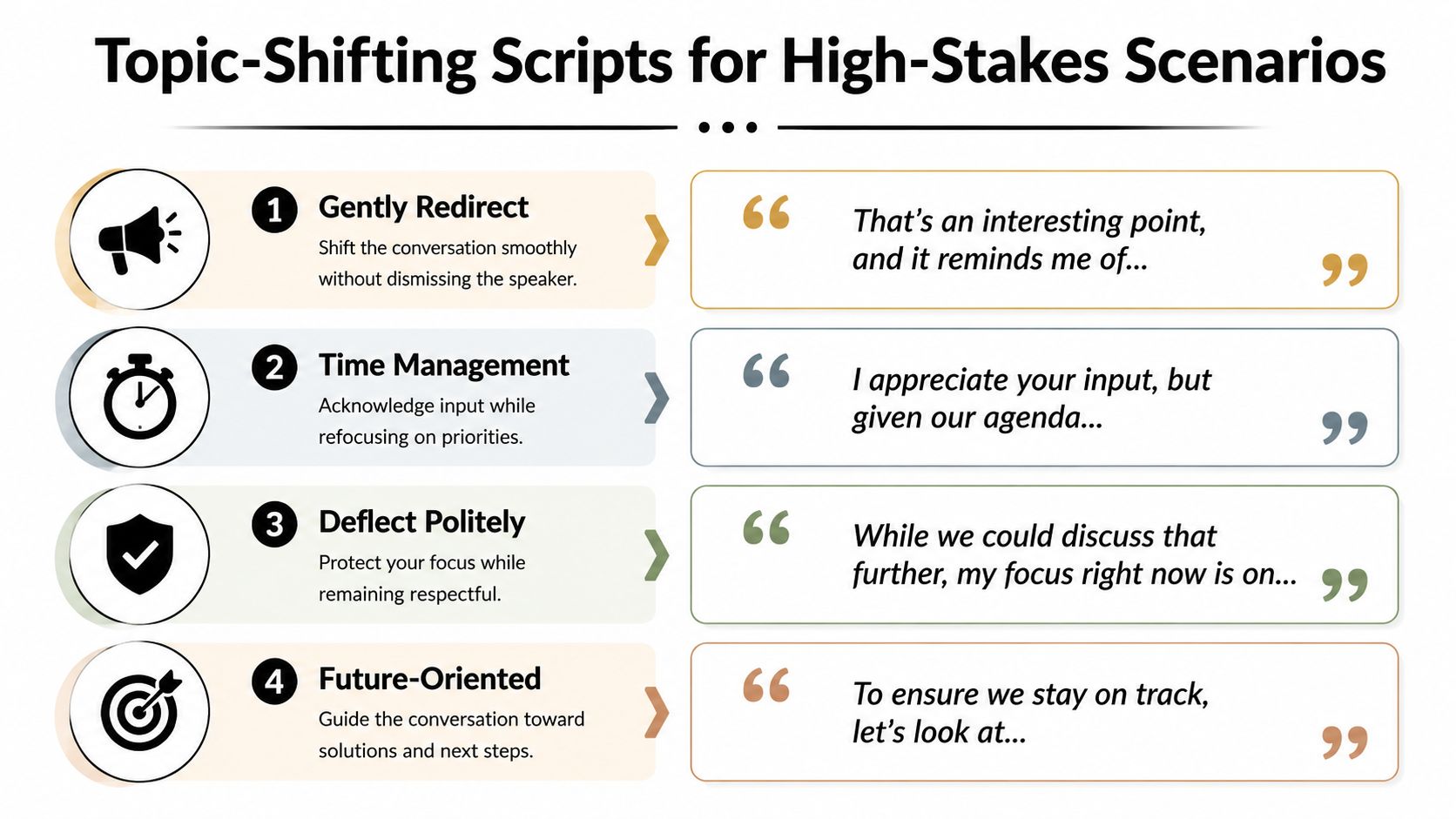
- Agenda control: "I want to pause that and return to the decision on the table."
- Time control: "We're short on time, so I'm going to move us to the next issue."
- Decision control: "We've heard the concern. What we need now is a recommendation."
- Priority control: "That matters, but it isn't the critical path today."
Notice what these scripts have in common. They don't apologize for leading. They use neutral, business-focused language.
Practice until the wording is yours
Do not memorize these word for word and recite them mechanically. Steal the structure, then adapt the phrasing to your own voice. Senior people sound authoritative when the language fits them.
A useful drill is to take one recurring meeting from your week and write three ABRC pivots in advance. Then say them out loud. If you can't say them naturally in one breath, they're too long.
For moments when you don't get preparation time, strong impromptu speaking skills in executive conversations make a major difference. The goal isn't perfect spontaneity. It's controlled spontaneity.
Navigating Cultural Nuances as a Non-Native Speaker
The hardest part of changing the topic for many international professionals isn't logic. It's fear. They worry that a direct pivot in English will sound cold, arrogant, or abrupt.
That fear has a basis in real cultural differences. Some business cultures reward directness. Others reward patience, deference, or careful context-setting. In global organizations, you often have to signal both clarity and respect in the same sentence.

Soft language, firm direction
You do not need aggressive language to sound senior. You need clean framing and stable delivery.
These softening phrases work well in many Western business settings:
- "Let me zoom out for a moment."
- "I want to make sure we're solving the right problem."
- "Can I redirect us to the decision we need?"
- "Before we go deeper there, I'd like to clarify the priority."
These phrases lower social friction. But the authority doesn't come from the words alone. It comes from how you deliver them.
Use a short pause before the pivot. Lower your pace slightly. Finish the sentence instead of letting your voice trail upward. If you need a second to find the exact word, don't fill the space with nervous explanation. Pause, then continue. A calm pause sounds senior. Rushing sounds uncertain.
Gravitas is built, not borrowed
Many professionals hope they can solve this with a quick workshop and a few better phrases. That isn't how gravitas develops. Research confirms that gravitas cannot be developed in a two-day workshop. It requires systematic, months-long development of strategic thinking, decision-making under pressure, and business acumen, often with gravitas built before communication refinement (why gravitas takes sustained development).
That matters because topic-shifting isn't a language trick. It reflects judgment. People accept your redirect when they trust your priorities.
Your accent is rarely the real problem. Weak framing, hesitant timing, and apologetic delivery usually do more damage.
If you work across cultures, it also helps to study practical advice for business professionals who need to adjust tone without losing clarity. That kind of awareness reduces friction before it starts.
Professionals who want structured support often need more than feedback on pronunciation. They need coaching on posture, pacing, narrative control, and pressure handling. The Gravitas Method is a 12-week one-on-one executive presence coaching program for international professionals who want to communicate with more authority and influence at senior levels. The program is priced at $8,200 paid in full or $9,000 across three installments. Coached by Nikola, it covers vocal authority, strategic framing, executive body language, and high-stakes communication.
For broader development in this area, cross-cultural communication training for global professionals is often more useful than generic public speaking advice, because the challenge is more than fluency. It's authority across different norms.
Common Pitfalls That Undermine Your Authority
Most failed pivots do not fail because the idea was wrong. They fail because the delivery creates distrust, confusion, or resistance.
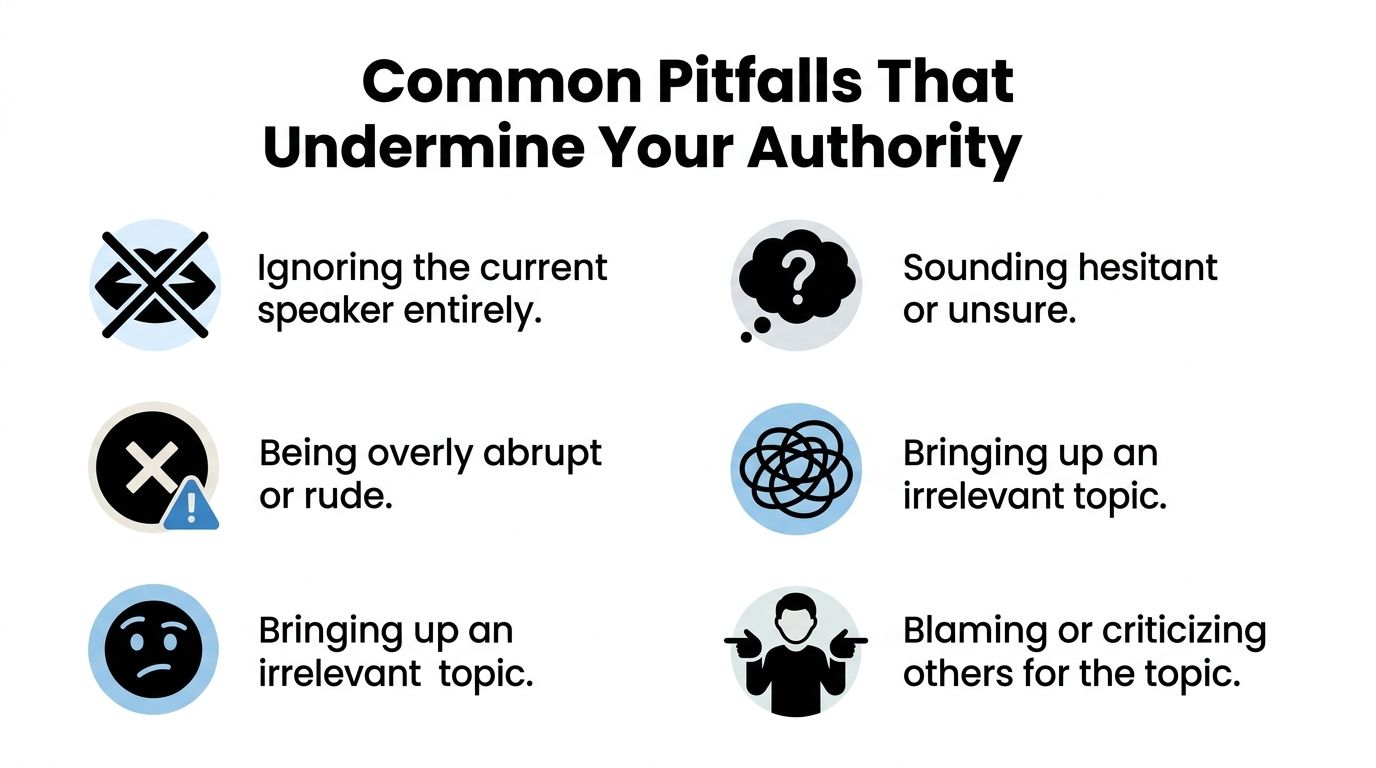
The mistakes that weaken your move
Here are the patterns I see most often:
- Over-acknowledging: You spend so long validating the original point that you never redirect. The room hears empathy, but not leadership.
- Bridging too abruptly: You jump from one topic to another with no connective tissue. People then assume you are avoiding the issue.
- Reframing weakly: You introduce a new topic, but it is vague, secondary, or not clearly more important than the first one.
- Closing without engagement: You state the new direction, then keep talking at people instead of bringing them into it.
- Using body language that contradicts your words: You say, "Let's focus on the main issue," while your voice rises, your eyes dart, or your posture collapses.
Why one-sided pivots often backfire
In organizational settings, changing direction works better when people experience some repetition and bidirectional engagement. One-sided broadcasting tends to create resistance and lower adoption (what improves success when changing topics in organizations).
The lesson for meetings is practical. A strong pivot is not a speech. It is a reset plus a new invitation to engage.
Compare these two versions:
| Weak pivot | Strong pivot |
|---|---|
| "Anyway, let's move on." | "That concern is noted. The decision we need now is X. What's the strongest argument for or against it?" |
| "We're not discussing that." | "That deserves a separate discussion. For this meeting, let's focus on the client risk and next step." |
| "No, that's not the issue." | "Part of the issue, yes. The larger issue is timing and ownership." |
Watch for this signal: If people keep dragging the conversation back, your close wasn't strong enough or your reframe didn't feel valuable enough.
One more problem deserves attention. Some professionals try to compensate for linguistic insecurity by becoming physically smaller. They smile too quickly, nod too often, or look down while redirecting. That turns a clear message into a tentative one. Your body has to support the pivot.
If you need to strengthen the nonverbal side, body language for leaders in high-stakes settings matters because people decide whether to follow your redirect before they consciously evaluate your wording.
Conclusion Put Your Skills into Practice
Changing the topic is not avoidance when it protects relevance, sharpens decision-making, and keeps a room aligned with the primary objective. In senior environments, that is part of the job. People with authority do not let every conversation go wherever it wants. They guide it.
The skill improves faster when you stop treating it as something you will "just do naturally someday." Practice it on purpose. Use low-stakes repetition until the move feels normal in higher-stakes rooms.
Three exercises for this week
-
Meeting reset drill
In one team meeting, notice the first moment the discussion drifts. Use a simple pivot such as, "That's useful, and I want to bring us back to the decision." Keep it short. -
Script rehearsal
Write three ABRC responses for recurring situations in your work: a rambling update, an off-topic question, and a complaint-heavy one-to-one. Say each aloud until it sounds like your language. -
Pause before redirecting
In your next live conversation, take one deliberate pause before you change the topic. That single beat often makes you sound more considered and less reactive.
The deeper lesson is this. You don't build executive presence only when you present slides or give formal speeches. You build it in the small moments when a room wobbles and you steady it.
If you want precise feedback on how you sound in those moments, start with Intonetic's free Executive Communication Assessment. It is the clearest entry point for identifying where your delivery, framing, and presence may be weakening your authority in senior-level conversations. From there, if deeper support makes sense, you can explore Intonetic and decide on the right next step.