
Cross Cultural Communication Training: A Practical Guide
Your regional leaders all attended the workshop. The slides were polished. People nodded along. A week later, the same problems returned.
The Singapore team still says the UK lead is too blunt. The German stakeholder still thinks the US product manager is vague. A senior engineer with strong expertise stays quiet in global meetings because speaking up in a second language under pressure feels risky. You didn't have a training problem. You had a transfer problem.
That's the core issue with most cross cultural communication training. It raises awareness, but it doesn't change behavior in the moments that matter most: executive meetings, project escalations, negotiation calls, board updates, and cross-border feedback conversations.
If you're an L&D manager, you don't need another generic program on etiquette. You need a design that helps senior international professionals adapt in real time, stay credible under pressure, and show observable improvement in how they lead, influence, and make decisions across cultures.
Beyond Cultural Checklists Why Most Training Fails
Most cross cultural communication training still fails for one simple reason. It treats culture like a set of facts to memorize.
People learn that one country values directness, another values harmony, and a third expects more deference to hierarchy. That information isn't useless. It's just incomplete. In a real meeting, nobody announces which rule applies. Your leaders still have to read the room, decide how direct to be, and respond without sounding artificial.
One of the more useful summaries of this problem comes from Learnit's perspective on cross-cultural training, which argues that training should build behavioral agility and self-awareness rather than stopping at etiquette tips. That distinction matters most at senior levels, where communication failures rarely look like obvious cultural mistakes. They look like lost influence.
What checklist training gets wrong
A cultural checklist can help someone avoid a basic social error. It won't help them do any of the following:
- Reframe disagreement diplomatically: A leader may know a team prefers indirect feedback, but still struggle to challenge a weak proposal without sounding evasive.
- Read ambiguous silence: Silence might reflect respect, hesitation, disagreement, or language processing time. The response has to fit the moment.
- Adjust authority signals: Some executives overcorrect in multicultural settings and become so cautious that they sound less decisive.
That's why I push clients away from country stereotypes and toward communication choices. What did you say? How did you structure it? What assumption did the other side hear? What would a better adaptation sound like?
Practical rule: If training leaves people with trivia about cultures but no repeatable method for adapting their own behavior, it won't survive the first tense meeting.
What works better for senior professionals
Senior leaders need pattern recognition, not scripts. They need to understand how directness, feedback style, turn-taking, status, and nonverbal signals interact under pressure.
That doesn't mean country-specific resources are useless. They're useful when you place them in the right role. For example, a guide on German business and study etiquette can help a manager prepare for a specific context. But it should support training, not define it.
A stronger model starts with self-awareness. Many communication barriers are cultural, but many are also personal habits amplified by culture. Fast speech, overexplaining, hedging, interrupting, weak signposting, and unclear ownership create friction everywhere. This is why broader work on barriers of culture in communication matters. The obstacle usually isn't ignorance alone. It's the gap between intention and delivery.
The best cross cultural communication training teaches people to pause, diagnose, and adapt. Not perfectly. Reliably.
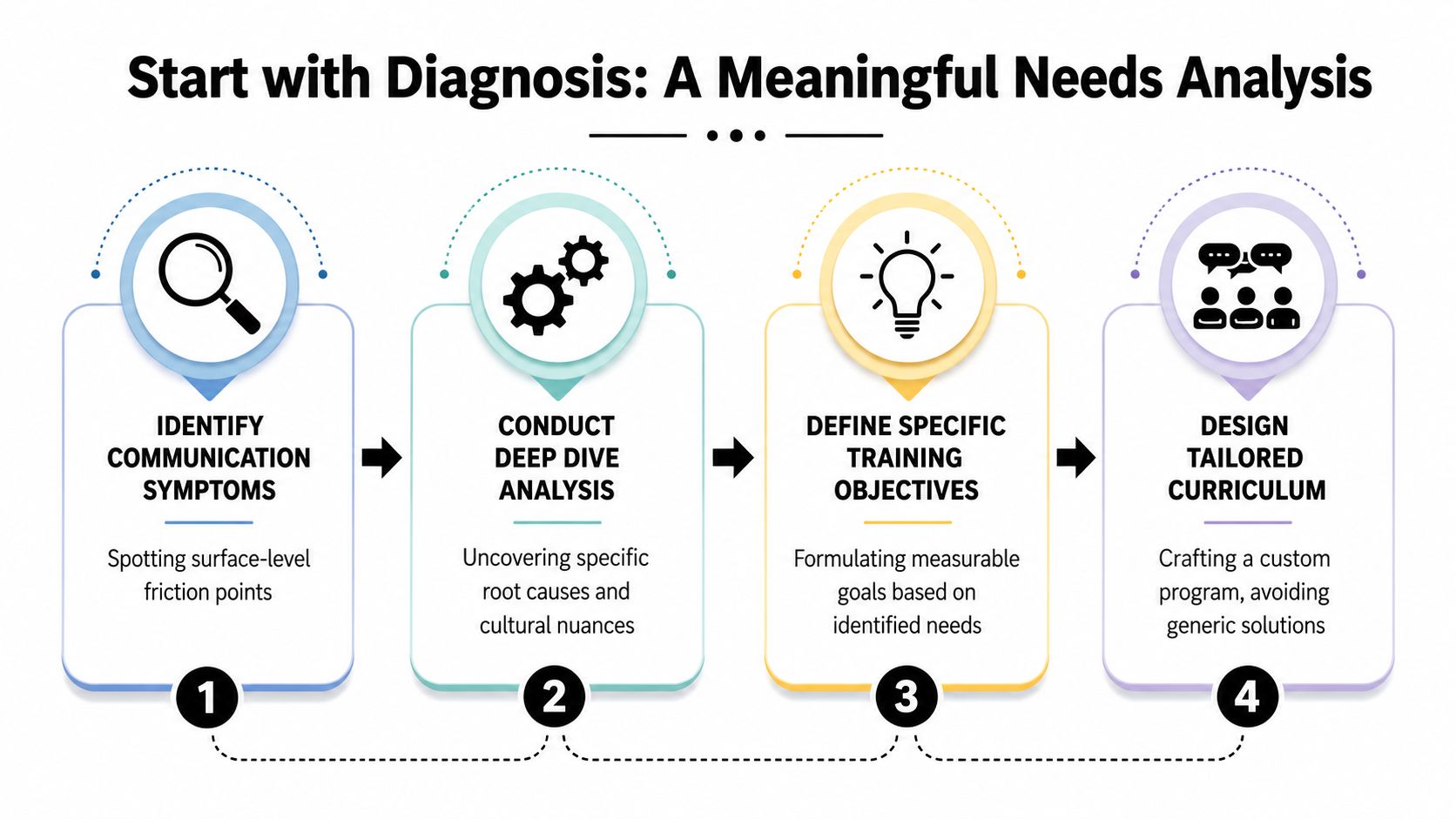
Start with Diagnosis A Meaningful Needs Analysis
Most training programs are built backwards. Someone spots friction in global teams, buys a workshop, and hopes the content fits. That approach almost guarantees generic outcomes.
A useful needs analysis starts with business moments, not broad sentiment. Where exactly is communication breaking down? In deal reviews? In remote project handoffs? In performance feedback? In technical presentations to non-technical executives? If you can't answer that, you're not ready to design a curriculum.
Look for evidence in live work
Start with communication artifacts your organization already has. The strongest clues often sit in plain sight.
-
Project post-mortems
Read them for language around misalignment, unclear ownership, delayed decisions, or stakeholder tension. Those phrases often point to communication failure disguised as process failure. -
Meeting recordings and transcripts
Watch who speaks, who hesitates, who gets interrupted, and where decisions drift. In multinational teams, the issue is often less about content and more about how ideas are framed and received. -
Escalation emails and comment threads
Review points where tone changed, assumptions multiplied, or accountability became muddy. These are rich training inputs because they contain real language your people already use. -
Manager interviews
Don't ask, “Do your teams need cultural training?” Ask, “Where does communication slow execution?” Managers usually answer that question with examples.
Separate symptoms from causes
A complaint like “the team isn't collaborating well” is too vague to train against. You need to translate it into observable behaviors.
Here's a simple way to do that:
| Symptom | Likely communication issue | Better training target |
|---|---|---|
| Meetings feel unproductive | Unclear turn-taking and weak summarizing | Structured contribution and recap habits |
| Feedback is seen as harsh | Direct language without context | Diplomatic framing for corrective feedback |
| Senior experts stay quiet | Low confidence in high-stakes English | Concise speaking and authority under pressure |
| Decisions stall across regions | Different expectations on alignment | Explicit decision protocols and ownership language |
Many teams benefit from specialist support in coaching for communication skills. Not because coaching replaces training, but because it sharpens the diagnosis. An experienced coach can hear the difference between a language issue, an executive presence issue, and a cross-cultural issue. Those problems overlap, but they aren't the same.
When the diagnosis is vague, the curriculum becomes inspirational instead of useful.
Ask better questions in focus groups
Group sessions can uncover patterns surveys miss, especially when people compare interpretations of the same scenario. But the questions have to be concrete.
Use prompts like these:
- “Tell me about a meeting where you left with a different understanding than your counterparts.”
- “What kind of feedback feels clear and respectful to you?”
- “When do you hold back in global meetings?”
- “Which stakeholder groups are hardest for you to influence, and why?”
Notice that none of these ask for opinions about culture in the abstract. They ask for situations, reactions, and consequences.
The output of a strong needs analysis is not a long report. It's a short list of communication behaviors that matter to business performance. Once you have that, the rest of the design becomes much easier.
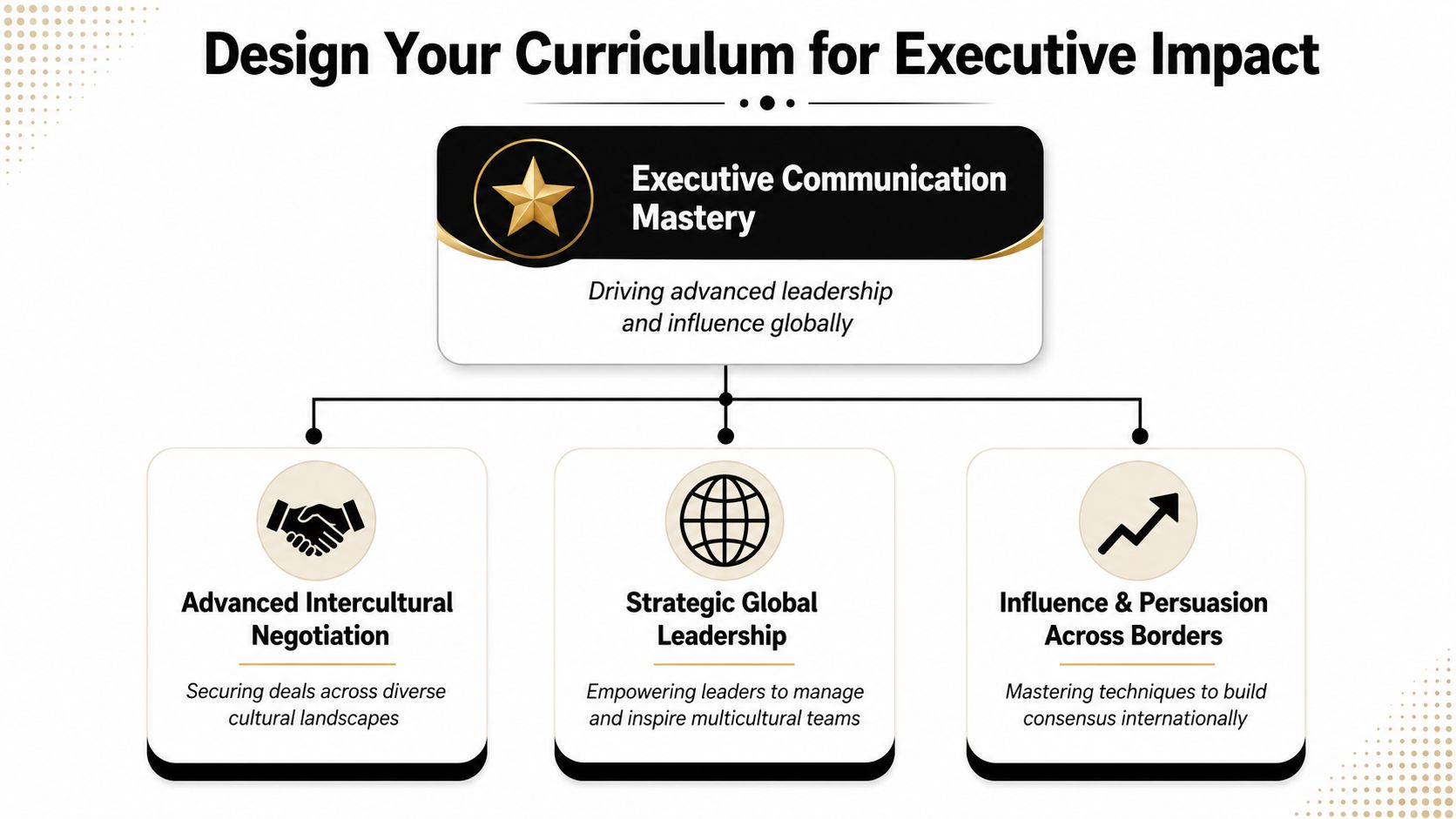
Design Your Curriculum for Executive Impact
Senior professionals don't need a broad lecture on cultural awareness. They need a curriculum that helps them sound clear, credible, and adaptable when stakes are high.
That means your program should sit at the intersection of intercultural competence and executive communication. If you teach only culture, people become cautious. If you teach only executive presence, people may become polished but culturally clumsy.
Build around business-critical communication tasks
A solid curriculum starts with the interactions your leaders face. For most global organizations, that includes:
- Executive updates: speaking with brevity, clear structure, and appropriate confidence to senior stakeholders across regions
- Cross-border feedback: adjusting directness without diluting the message
- Decision meetings: clarifying ownership, surfacing disagreement, and closing with shared understanding
- Negotiation and influence: framing recommendations so different audiences can trust them
Many L&D teams can make a helpful shift: stop organizing modules around cultural topics alone. Instead, organize them around communication tasks, then teach the cultural variables inside those tasks.
Use frameworks only when they improve action
Frameworks like high-context versus low-context communication are valuable if they help people make better choices in conversation. They become dead weight when they stay theoretical.
Aperian's guidance on ROI and design supports a practical blend of communication frameworks, role-play simulations, peer discussion, microlearning, and manager enablement in its evidence-based approach to cross-cultural training. That's the right direction because leaders don't need more abstraction. They need rehearsal.
A curriculum for executive impact usually needs these ingredients:
Communication frameworks
Teach a small number well. High-context and low-context communication, direct versus indirect feedback, and nonverbal decoding are especially useful because they show up repeatedly in leadership situations.
Pressure-tested simulations
Use scenarios from your business, not generic HR examples. A product roadmap conflict, a delayed regional launch, a tense client review, or a board-level recommendation will produce much better practice.
Peer discussion
Senior leaders often learn fastest when they compare interpretations. One person thinks they were concise. Another heard them as abrupt. That gap is where the learning sits.
Manager reinforcement
Without manager follow-through, participants return to the same environment that shaped the original habit.
Include executive presence, not just cultural literacy
This is the part many programs miss. International professionals can understand cultural differences and still struggle to project seniority. Their language may be accurate, but their delivery can sound tentative, over-detailed, or deferential.
That's why a stronger curriculum often includes elements usually found in executive communication skills training, such as strategic framing, vocal control, concise message structure, and confident nonverbal delivery. These aren't separate from cross cultural communication training. In high-stakes global settings, they're part of it.
A leader who adapts well but sounds uncertain still loses influence.
Design for moments of pressure, not moments of theory. That's where executive impact is built.
Choose the Right Delivery Modality for Your Team
Delivery shape changes outcomes. The same content can land as impactful or forgettable depending on format, timing, and participant mix.
This matters even more in cross cultural communication training because the skill itself is relational. People need time to reflect, practice, hear how others interpreted them, and try again. A single modality rarely does all of that well.
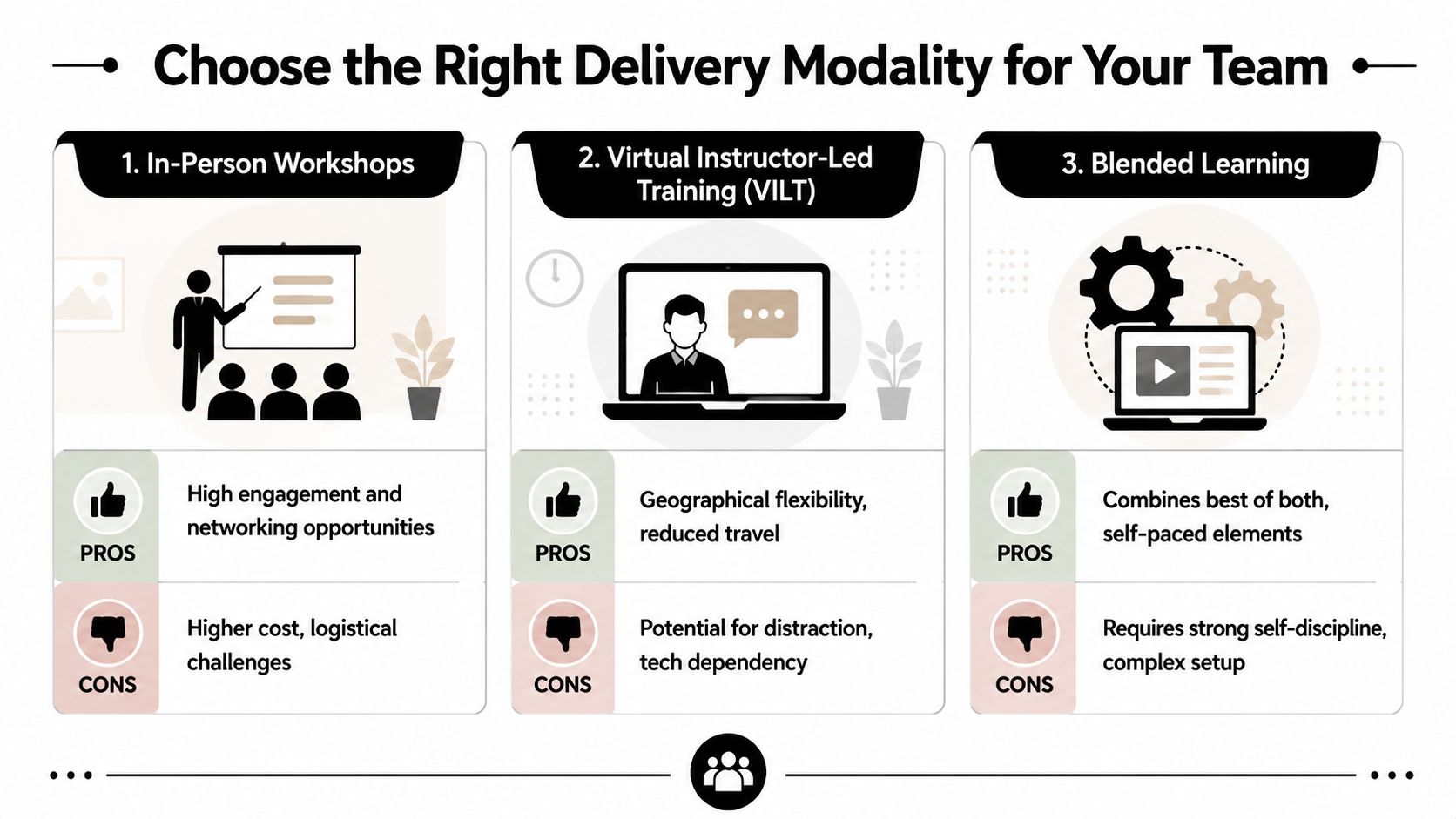
Why blended formats usually outperform standalone workshops
The market has already moved toward scale-friendly formats. Mordor Intelligence projects the cross-cultural training market at USD 2.26 billion in 2026, rising to USD 3.16 billion by 2031 at a 6.97% CAGR, and reports that e-learning and online platforms held 39.80% of the market in 2025 in its cross-cultural training market analysis. That tells you how buyers want to deliver training. It doesn't mean self-paced learning is enough.
For senior teams, each modality solves a different problem:
| Modality | Best use | Main limitation |
|---|---|---|
| Self-paced e-learning | Shared vocabulary and baseline concepts | Weak behavior transfer on its own |
| Live virtual workshops | Distributed practice across regions | Easier to hide, multitask, or disengage |
| In-person sessions | Rich feedback and stronger trust | Harder to scale across geographies |
| One-to-one coaching | Personalized habit change | Higher cost and narrower reach |
Match the format to the objective
If the issue is inconsistent understanding across a large global population, start with digital learning. If the issue is leadership behavior in complex conversations, add live practice. If a small group of senior leaders needs visible change fast, coaching becomes hard to avoid.
I usually recommend a sequence like this:
- Foundation first: self-paced modules for key concepts and shared language
- Group practice next: live facilitated sessions built around realistic scenarios
- Individual reinforcement: targeted coaching for leaders whose communication patterns are highly visible or politically important
That sequence respects both scale and depth.
When personalized coaching makes sense
Some communication problems are too individual for group training alone. A senior finance leader may need to reduce over-explaining. A technical VP may need more executive-level framing. A country manager may need to sound firmer without sounding aggressive.
For those cases, online executive presence training can sit alongside a broader L&D initiative. One example is The Gravitas Method, a 12-week one-on-one executive presence coaching program for international professionals who want to communicate with more authority and influence at senior levels. The program is priced at $8,200 paid in full or $9,000 across three installments. Coached by Nikola, it covers vocal authority, strategic framing, executive body language, and high-stakes communication.
Use coaching selectively. It's most valuable where the business cost of weak senior communication is highest.
What doesn't work well is pretending all learners need the same depth. They don't. Build a delivery model with tiers, and your budget will work much harder.
Deliver Training That Actually Changes Behavior
A curriculum can be excellent on paper and still fail in the room. Delivery is where credibility is won or lost.
The biggest mistakes usually show up fast. The facilitator asks for a role-play that feels artificial. Participants retreat into safe, polished answers. Nobody practices the awkward moment they need help with. Then everyone leaves with agreeable feedback and unchanged habits.
Make practice realistic enough to trigger real behavior
Effective sessions use pressure without humiliation. The scenario should be specific, familiar, and slightly uncomfortable.
A good example is a regional leadership meeting where one executive must challenge an unrealistic timeline proposed by headquarters. In that moment, several communication tensions collide at once: language speed, hierarchy, directness, diplomacy, and status. If you want behavior change, that's the sort of scene participants should rehearse.
A review of global team communication problems in the WJARR study on language barriers, nonverbal cues, and communication protocols highlights recurring failure points: language-barrier effects, misread nonverbal cues, and weak protocols. It also recommends simple language, avoiding technical terms, structured four-step updates, and explicit communication standards. That guidance is highly practical for training delivery.
Use the training room to model the standard
Don't just teach structured communication. Run the session with it.
For example, ask participants to give updates in a fixed sequence:
- the issue,
- the impact,
- the recommendation,
- the owner and next step.
That format helps multilingual teams reduce ambiguity. It also exposes where someone's message collapses under pressure. You can coach the issue in real time.
If your training environment is vague, participants will default to the same vague habits at work.
Give feedback people can act on immediately
General feedback doesn't change much. “Be more confident” is useless. “Cut your opening from two minutes to twenty seconds, then state your recommendation before your background” is coachable.
I also recommend borrowing from broader active learning strategies rather than relying on lecture-heavy facilitation. Adults learn faster when they have to interpret, respond, test, and reflect instead of just listen.
A practical debrief might sound like this:
-
What did your counterpart likely hear?
This shifts attention from intention to impact. -
Where did your language become harder to process?
Jargon, speed, and nested explanations often create the core problem. -
What nonverbal signal changed the meaning?
Eye contact, facial tension, long pauses, or flat tone can all distort the message.
This is also why leaders working on broader leadership communication skills often improve faster in cross-cultural settings too. Better structure and delivery make adaptation easier. They give people something to adjust.
The session should feel like a lab, not a lecture.
Measure What Matters The True ROI of Your Training
If your only metric is whether participants liked the session, you don't know whether the training worked. You only know whether it was pleasant.
That standard is too low for cross cultural communication training, especially when the target audience is senior international talent. The key question is whether communication changed in ways that improved execution, trust, and influence.

Use three levels of measurement
A sensible measurement model tracks change at three levels.
Participant capability
This includes pre- and post-training assessments of specific communication behaviors. Focus on observed skills, not self-esteem. Can the participant summarize clearly, adapt directness, check understanding, and lead a tense discussion without losing authority?
Manager and peer observation
Ask a small group of stakeholders to rate visible changes after training. Keep it behavior-based. Did the leader become easier to follow in meetings? Do cross-regional calls end with clearer decisions? Has feedback become more respectful and more actionable?
Business-linked indicators
To establish L&D's credibility, look for movement in the business situations identified during diagnosis: fewer misunderstandings in global handoffs, cleaner decision-making in distributed meetings, stronger stakeholder trust, and less rework caused by unclear communication.
Why mixed-method measurement is the right standard
The business case for training is stronger than many teams realize. One industry estimate says poor cross-cultural communication costs U.S. businesses $37 billion annually, and a 2025 NIH literature review covering 19 quantitative studies found that cross-cultural training generally improved cultural intelligence and cultural competence. The same summary reports that 9 of 10 programs using mixed delivery methods improved cultural intelligence or its dimensions in this cross-cultural communication statistics review.
That doesn't mean every program will produce meaningful ROI. It means you have good reason to expect improvement if the design is specific, blended, and measured properly.
The wrong question is “Did people enjoy it?” The right question is “What changed in the interactions that matter?”
Establish a baseline before you scale
Many L&D teams skip the baseline because they're in a hurry to launch. That makes later evaluation weak and political. If there's no starting point, every discussion about impact turns into opinion.
A practical first step is a structured diagnostic for your target leaders. A professional baseline through an executive presence assessment gives you something far more useful than a generic satisfaction survey. It tells you where authority, clarity, delivery, and influence are currently breaking down.
If you want a practical starting point, begin with the free Executive Communication Assessment from Intonetic. It's the best entry point if you need a clearer baseline on how your senior international professionals are coming across in high-stakes communication, and where focused development will have the most visible impact.