
Improve Leadership Communication Skills: A Leader’s Guide
You know the situation. You’ve done the analysis, shaped the recommendation, and walked into the meeting prepared. Then you speak, and the response is thinner than it should be. Your point is reasonable, but it doesn’t move the room. A louder colleague repeats a simpler version five minutes later, and suddenly everyone engages.
That gap is rarely about intelligence. It’s usually about leadership communication: how you sound, how you frame, how you hold the room, and how you respond when the conversation gets messy.
For senior international professionals, the challenge is sharper. You may be operating in a second language, navigating accent bias, and leading people across functions and cultures. That can make weak feedback especially frustrating. “Be more executive.” “Be more confident.” “Be more concise.” None of that tells you what to practice on Monday morning.
Communication improves when you treat it as a skill system, not a personality trait. If you want to improve leadership communication skills, you need a clear diagnosis and a repeatable training approach.
Why Your Leadership Communication Is Not Landing
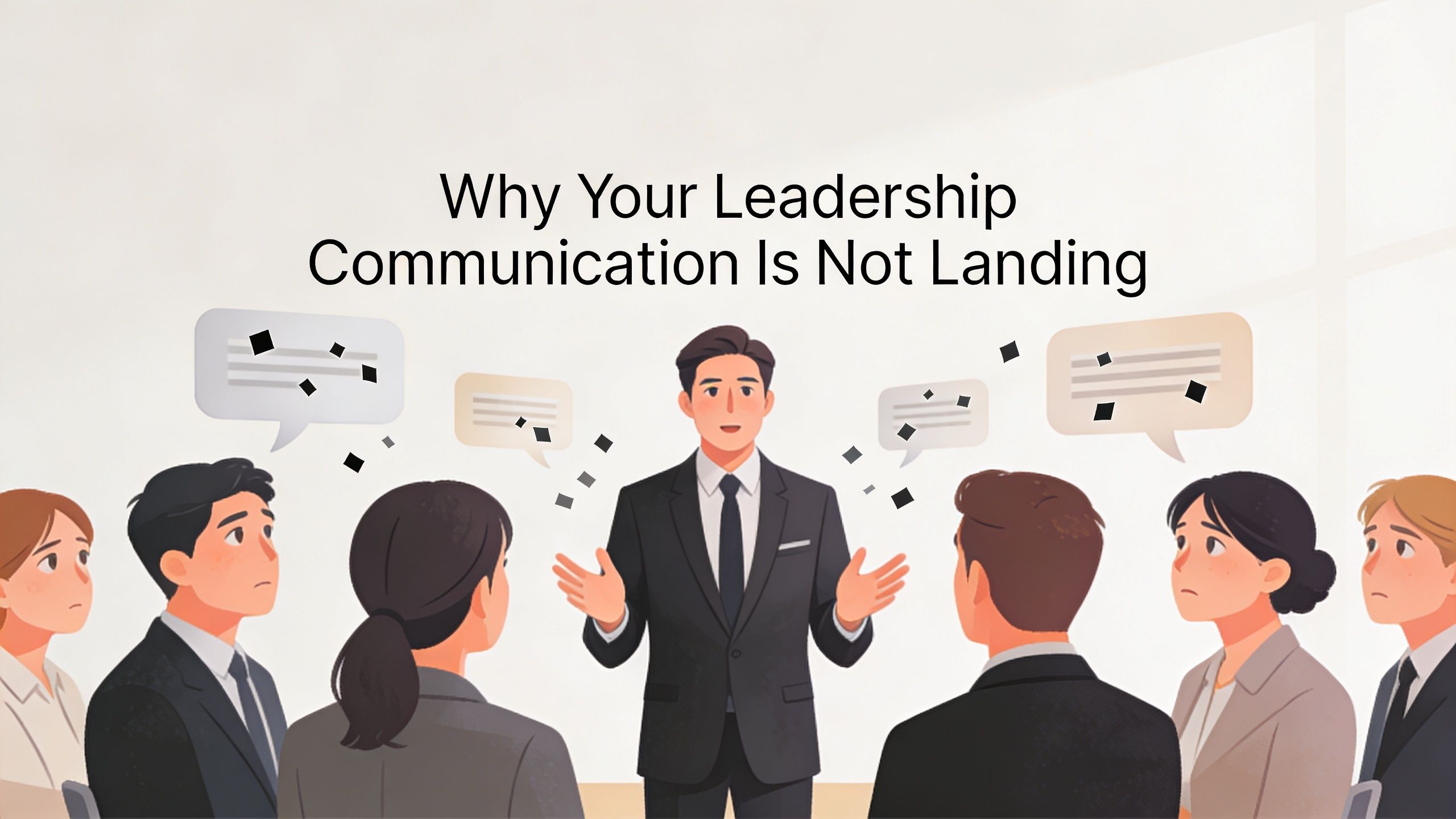
A weak leadership message usually fails in one of four places. The voice lacks authority. The message isn’t framed for the audience. The body language undercuts the words. Or pressure narrows your thinking and you start speaking reactively.
That’s why strong ideas often get underestimated. Senior audiences don’t just evaluate content. They evaluate whether you sound like someone they can trust with risk, ambiguity, and decision-making.
The business cost is real
The cost of poor communication isn’t abstract. 86% of employees and executives cite ineffective communication as a primary cause of workplace failures, and the Holmes Report identified an average annual loss of $62.4 million per company. The same dataset also notes that leaders with strong communication skills are 47% more effective, and that 85% of career success is attributed to communication skills rather than technical expertise (communication research summary).
If your communication doesn’t land, people don’t just miss a point. They delay decisions, question alignment, repeat work, and lose confidence in your leadership range.
Practical rule: Seniority is often judged through communication before it is rewarded through title.
For many leaders, the mistake is assuming the problem is “confidence” in a vague sense. It’s usually more specific than that. You may be speaking too quickly when challenged. You may bury the recommendation under context. You may be over-explaining to prove expertise. You may be using polite language that softens your authority.
Why ambitious leaders misdiagnose the problem
High performers often overinvest in correctness and underinvest in delivery. That works for specialist roles. It doesn’t work as well when your job is to align people, influence stakeholders, and make priorities clear.
A few common patterns show up repeatedly:
- Content overload. You include every caveat, and the audience loses the main point.
- Flat vocal delivery. Your message has no emphasis hierarchy, so everything sounds equally important.
- Defensive body language. Tight shoulders, still hands, or downward gaze weaken perceived authority.
- Reactive answers. In Q&A, you answer the exact wording of the question instead of the concern behind it.
If you’re leading across cultures, there’s another layer. Some professionals compensate for being underestimated by becoming hyper-formal or excessively detailed. That can make them sound careful, but not decisive. Others shrink verbally to avoid being judged for accent, word choice, or fluency. If that resonates, it’s worth understanding accent bias in the workplace for non-native speakers, because many communication issues are shaped as much by perception as by language itself.
Leadership communication is also a team issue
Your communication style doesn’t operate in isolation. It sets norms for the people around you. If your team leaves meetings unclear on decisions, ownership, or challenge rules, the problem spreads. A useful companion resource is this guide to Match My Assistant on team communication norms, especially if you need cleaner expectations across a hybrid or cross-functional team.
The important shift is this: stop asking, “Am I a good communicator?” Start asking, “Which part of my communication breaks under pressure?”
That question leads to practice that works.
Mastering the Core Skills of Influential Leaders
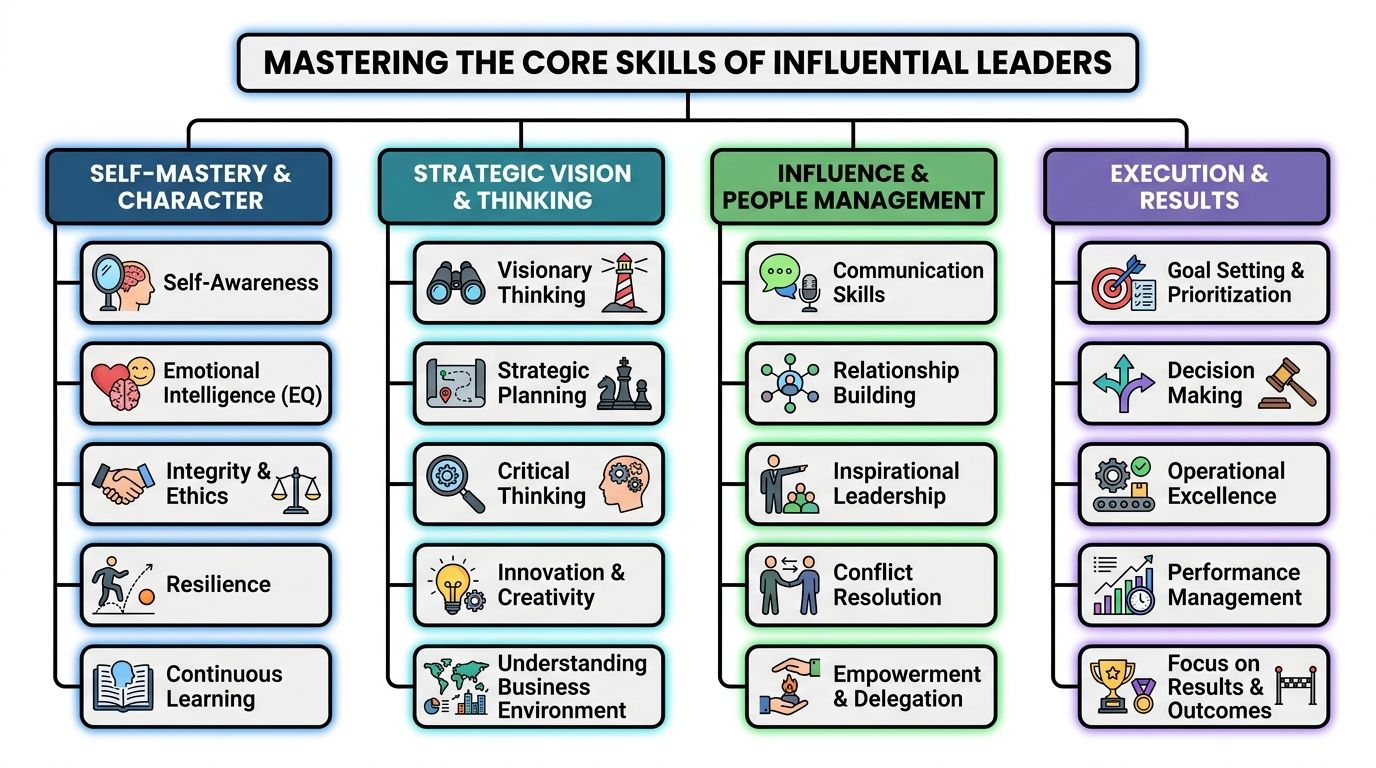
Senior leaders are judged on a small set of communication behaviors that people notice fast and remember longer than the content itself. In practice, three skills do most of the work: vocal authority, strategic framing, and executive body language. These are trainable. They also break in predictable ways under pressure, which is why vague advice rarely helps.
Vocal authority
A strong leadership voice is controlled, not loud. Colleagues listen for steadiness, sentence shape, and whether your words finish with conviction.
Pace is usually the first issue. Many capable professionals speed up when the stakes rise, especially when they want to sound prepared or prove expertise. The trade-off is clear. More detail delivered faster does not sound more credible. It sounds less filtered. A measured pace gives senior listeners time to track your reasoning and trust your judgment.
Work on four adjustments first:
- Open more slowly than feels natural. That buys breath control and settles your delivery.
- Emphasize key words, not full sentences. Stress the decision, the risk, the deadline, the owner.
- Pause before the recommendation. Let the audience hear that a decision point is coming.
- End statements cleanly. Downward sentence endings sound more assured than upward drift.
Record a 60-second update on your phone and listen for one thing only. Do your important sentences end with authority or with hesitation?
Strategic framing
Influential leaders do not speak in discovery order. They speak in decision order.
That means leading with the point, then giving the reason, then the evidence needed to support action. Senior audiences usually do not need every step of your analysis. They need confidence that you have done the analysis and can guide them to a sound choice.
A practical structure looks like this:
-
Start with the recommendation
“My recommendation is to delay the rollout.” -
Name the business rationale
“The current version creates operational risk we do not need to carry this quarter.” -
Add selective evidence
Include only what supports the decision. Save the full background for follow-up. -
Close with a specific ask
“I need approval to move the launch by two weeks and reassign the dependencies.”
Many internationally experienced professionals gain influence quickly. They already have the substance. The gap is often packaging. If your message arrives buried under context, caveats, or chronology, people may read you as thoughtful but not directional.
The same discipline applies on the page. Leaders who want to enhance business communication skills often find that unclear speaking and unclear writing come from the same habit: explaining too much before stating the point.
Executive body language
Executive body language should support your message, not compete with it. Presence comes from alignment between what you say and what your body signals while saying it.
Small visible choices have outsized effects. A still start before you speak suggests control. Gestures that stay contained around torso height help your points feel deliberate. Eye contact that is steady, without staring, makes you easier to trust. None of this is theatrical. It is disciplined.
| Situation | What helps | What hurts |
|---|---|---|
| Presenting | Grounded stance, open chest, still start | Swaying, fidgeting, shifting weight constantly |
| Listening | Steady eye contact, small nods, note-taking | Looking away too quickly, frozen face |
| Making a point | Deliberate gestures near torso height | Random hand movements, pointing aggressively |
I often tell clients to stop trying to “look confident” and start trying to look clear. Clear posture, clear eye line, clear movement. That standard is easier to practice and far more credible.
If you want structured feedback on these three areas together, executive presence coaching for vocal authority, message framing, and nonverbal communication can help you diagnose the specific habits that weaken authority, then train them in a repeatable way.
Building Your Communication Muscle With a Weekly Plan
Most leaders don’t improve because they rely on occasional high-stakes reps. They wait for the board update, the stakeholder review, or the difficult conversation, then hope to perform well under pressure. That’s too late.
Communication skills improve faster when you train them in short, repeatable sessions during the week. Not long. Not dramatic. Just focused.
A workable five-day rhythm
This schedule fits a busy senior professional because each drill can be done in a short block before work, between meetings, or after a call.
Monday: vocal control
Read one page aloud. Record it. Focus only on pace and sentence endings.
Your target is simple: fewer rushed phrases, cleaner pauses, stronger finishes. Don’t judge accent or wording. Judge control.
Tuesday: message framing
Take one current business issue and explain it in three versions:
- Thirty seconds for an executive
- Ninety seconds for a peer
- Three minutes for your team
This forces you to separate signal from detail. If the short version is weak, the long version usually isn’t helping.
Wednesday: listening practice
Choose one real conversation and make it a listening rep. Ask more clarifying questions than usual. Reflect back what you heard before offering your view.
Use phrases like:
- “What I’m hearing is…”
- “Let me check that I’ve understood you correctly.”
- “Is the main concern timing, risk, or ownership?”
Thursday: body language review
Record a short practice update standing up. Watch once with the sound off.
You’re checking for posture, eye line, gesture discipline, and facial tension. Sound-off review is useful because it shows whether your body supports your authority even before anyone processes your words.
Friday: pressure simulation
Answer five hard questions about one current project. Don’t script them fully. Write prompts and respond live.
Examples:
- “Why should we prioritize this now?”
- “What’s the downside if you’re wrong?”
- “Why didn’t you flag this earlier?”
A simple weekly scorecard
You don’t need a complicated dashboard. A one-page tracker is enough.
| Skill | What to review | Self-check question |
|---|---|---|
| Voice | Pace, pausing, sentence endings | Do I sound settled or hurried? |
| Framing | Clarity of recommendation | Is my point obvious in the first few lines? |
| Listening | Quality of questions | Did I respond to the real issue? |
| Body language | Posture, gestures, eye contact | Do I look as composed as I want to sound? |
| Pressure handling | Brevity under challenge | Can I answer without rambling? |
Weekly standard: Practice should feel slightly uncomfortable but still repeatable. If your plan is too ambitious, you won’t keep it.
If you want more practical prompts to support daily reps, this article on how to improve your communication skills can complement your routine.
What good practice looks like
Good practice is narrow. You train one communication variable at a time.
Bad practice is vague. You tell yourself to “be more confident” and then repeat the same habits in the next meeting.
A better approach is to decide, before the meeting, what one thing you’re testing. Maybe it’s pausing before the recommendation. Maybe it’s answering challenges in two sentences before expanding. Maybe it’s keeping your shoulders relaxed when speaking to senior stakeholders.
That’s how communication becomes trainable.
Navigating High-Stakes Conversations With Composure

High-stakes communication exposes every weak habit at once. Your breathing shortens. Your pace increases. Your framing gets less disciplined. You either over-talk or become too brief to be persuasive.
The answer isn’t to become robotic. It’s to use a few reliable patterns when the pressure rises.
The executive presentation
A presentation to senior leaders is not a data dump. It’s a decision conversation with slides attached.
A weak version usually starts with background. A strong version starts with orientation. Tell people what decision sits in front of them, why it matters, and what you recommend.
A clean opening sounds like this:
“We have a delivery risk in the current plan. My recommendation is to re-sequence the rollout, protect the client-facing deadline, and absorb the operational change internally.”
That works because it creates instant structure. Your audience knows what problem they’re hearing about, what action you want, and what lens to apply.
For presentations, focus on these contrasts:
- Open with the decision, not the history
- Use fewer points, but land them clearly
- Stand still at the beginning instead of pacing immediately
- Pause after key conclusions instead of rushing to the next slide
If your breath tightens before you speak, prepare physically, not just mentally. Short pre-meeting breath work can help regulate pace and voice. This guide on breathing exercises for better English speech is particularly relevant for professionals who lose vocal stability under pressure.
The difficult stakeholder meeting
Stakeholder tension usually escalates when leaders argue positions before clarifying interests. If someone says, “This plan won’t work,” the worst move is to defend every line item immediately.
Start by slowing the interaction down. Confirm the concern. Then identify the underlying category of resistance. Is it timing, control, credibility, budget, workload, or risk?
A useful sequence is:
- Acknowledge the concern without surrendering your position
- Clarify what’s driving the concern
- Reframe the conversation around a shared objective
- Present options, not just your preferred answer
A grounded response sounds like this:
“I can hear that the current proposal feels risky from your side. Let’s isolate which risk matters most so we can solve the right problem.”
That kind of response reduces friction because it shows control without aggression. It also prevents the meeting from turning into a contest of certainty.
The challenging Q and A
Q&A is where many strong presenters lose authority. They either answer too fast and sound defensive, or they over-explain and bury the answer.
Use a three-part response pattern:
| Stage | What to do | Example |
|---|---|---|
| Receive | Pause, then restate the issue | “The key question is whether this is the right priority right now.” |
| Respond | Give the direct answer first | “Yes, because the cost of delay is operational, not just strategic.” |
| Bridge | Move to the broader message | “The larger point is that we’re choosing sequencing, not adding scope.” |
This protects you from being dragged into the least useful version of the question.
A few habits matter here:
- Don’t interrupt the questioner
- Don’t start with five disclaimers
- Don’t treat every challenge as an attack
- Do buy a beat of time before answering
- Do return to your central message
Composure doesn’t mean sounding calm while hiding panic. It means staying organized while the room becomes less predictable.
How to Measure Your Impact and Avoid Common Pitfalls
Improvement feels slow when you don’t measure the right things. Most leaders judge themselves by internal effort. They think, “I prepared more,” or “I felt less nervous.” That matters, but it’s not enough. What counts is whether other people experience you differently.
What to track
Look for evidence in three places: self-review, audience response, and trusted external feedback.
Self-review is easiest with recordings. Watch short clips of your own updates, meeting comments, or presentation rehearsal. Don’t ask, “Do I like how I sound?” Ask narrower questions.
- Was my recommendation clear early?
- Did I rush under pressure?
- Did my body language support or weaken the message?
Audience response shows up in behavior. Are people engaging with your point faster? Do they ask sharper follow-up questions instead of basic clarification? Do meetings end with cleaner ownership and fewer unresolved misunderstandings?
Trusted feedback is most useful when it is specific. Don’t ask, “How was I?” Ask, “Where did I lose clarity?” or “At what point did I sound less decisive?”
Why feedback loops matter
Systematic practice with feedback loops is associated with a 15 to 20% sustained improvement in collaboration after 6 to 12 weeks of coached practice. The same leadership guidance warns that over-relying on an authoritative style can alienate teams, and that ignoring non-verbal cues can reduce message impact by 30% (leadership communication guidance).
That matters because communication often improves unevenly. A leader may become more concise but also less warm. Or more authoritative but less adaptive. Feedback catches those trade-offs before they become habits.
Pitfalls that quietly stall progress
The most common mistakes aren’t dramatic. They’re subtle, and that’s why they persist.
- Overcorrecting into stiffness. You stop rambling, but you also sound scripted.
- Confusing authority with hardness. Your tone gets firmer, but people stop being candid with you.
- Ignoring visual signals. Your words improve while your face and posture still broadcast tension.
- Practicing only in private. Rehearsal matters, but live reps reveal what breaks.
A useful discipline is to review one communication moment each week the way an athlete reviews game film. If pronunciation, clarity, and perceived credibility are part of your leadership goals, this resource on how to measure your accent reduction progress accurately gives a practical model for tracking changes that are easy to miss in day-to-day conversation.
Improvement is easier to sustain when you measure behavior, not just confidence.
Your Next Step Toward Elite Communication
You leave an executive meeting knowing your analysis was right, yet the decision still goes to the person who framed the issue faster, sounded steadier under pressure, and looked fully in command while speaking. For many senior international professionals, that gap is not expertise. It is communication under scrutiny.
Progress at this level comes from precise diagnosis, deliberate weekly practice, and repeated use in real conversations. The goal is not generic polish. It is stronger command in the specific moments that shape reputation: presenting to the board, handling pushback, setting direction, and speaking with authority across cultures.
The pattern is usually clear once you examine it closely. Your pace rises when challenged. Your message starts with context instead of the decision. Your posture tightens when the stakes go up. Small habits like these change how senior you sound, even when your thinking is strong.
That is the work The Gravitas Method is built to address. It is a 12-week one-on-one executive presence coaching program for international professionals who want to communicate with more authority and influence at senior levels. The program is priced at $8,200 paid in full or $9,000 across three installments. Coached by Nikola, it focuses on vocal authority, strategic framing, executive body language, and high-stakes communication. For additional context, review why business leaders and executives choose Intonetic.
A strong next step is a direct assessment of what is helping your presence and what is weakening it. Guesswork wastes months. Specific feedback shortens the path.
You do not need another list of speaking tips. You need a disciplined program that helps you sound credible, frame ideas clearly, and stay composed when the room gets difficult.